

5 issues that should top the city of Ann Arbor's priority list in 2012
Ann Arbor is poised for a significant transformation that might not be readily apparent to the casual observer, and 2012 could be the year that a few major initiatives get going.
Thousands of new beds are being added in and around the downtown with a wave of new housing developments, many of them catering to University of Michigan students.
That presents unique challenges and opportunities for the city, which owns several prime pieces of real estate in the downtown that are ripe for development of some kind.
And there are big talks happening around transit as the Ann Arbor Transportation Authority pushes ahead with an ambitious countywide expansion.
Meanwhile, with visions of high-speed rail in their heads, city officials continue to make preparations for a new transit center in front of the U-M Hospital along Fuller Road.
The Ann Arbor City Council found itself distracted with issues like public art and crosswalks toward the end of 2011. But with the beginning of a new year, it's time to refocus. Here's a look at five issues that should top of the city of Ann Arbor's priority list in 2012.
1. AATA countywide expansion
The AATA released a new Transit Master Plan this past year that identifies literally hundreds of millions of dollars in planned service improvements over the next 30 years.
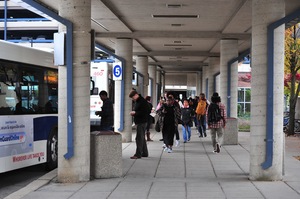
AATA officials plan to demolish and rebuild the Blake Transit Center in 2012.
Ryan J. Stanton | AnnArbor.com
For transit enthusiasts, it's an exciting time. AATA officials are talking about more frequent bus service on most routes, including nights and weekends, more connections to areas currently underserved, and the addition of bus rapid transit, light rail and possibly even streetcars.
If proponents of the expansion are feeling ambitious, a five-year countywide transit millage proposal could appear on the ballot as early as November 2012.
The most-talked-about scenario involves layering a new 1-mill countywide transit levy on top of the 2 mills Ann Arbor residents currently pay for AATA service. That equates to a little more than $100 in additional taxes for the average Ann Arbor homeowner.
The Ann Arbor City Council has a big role to play in any countywide expansion, and AATA officials already are asking the city to enter into a four-party agreement that will lay the framework for creation of a new countywide authority in 2012.
City officials should give careful consideration to that request and play an active role in making sure the final plan works for Ann Arbor residents who will pay a larger share of the costs.
2. Fuller Road Station
Movement also is expected in 2012 on the city's $121 million vision for a new train and bus station in front of the U-M Hospital on Fuller Road.
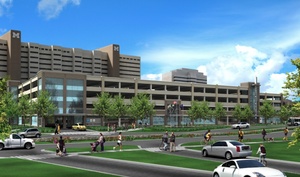
A look at the plans for the first phase of Fuller Road Station.
Behind the scenes, many of the details are being worked out. Officials now say they'd be surprised if the first phase of Fuller Road Station — a 977-space parking garage with accommodations for buses and bicycles — doesn't break ground in 2012.
The university's original goal was to have a parking garage built in the area before the new Mott Children's Hospital opened, so there's pressure to move ahead.
The first phase has been waiting for council approval since the Planning Commission approved it in September 2010.
But the city has to come up with about $10 million for the first phase of the project, and some still have questions about that.
Mayor John Hieftje says the university will pay almost all of the upfront costs for construction. Under the plan still being worked out, the city's portion of the costs would be made up over time from funds generated by parking spaces.
As for future phases — including a new Amtrak station — Hieftje and other city officials remain confident the federal government's investment of $2.8 million in seed money for planning Fuller Road Station is indicative of more federal funding to come for the project.
In the meantime, the feds have pumped hundreds of millions of dollars into rail improvements along the Detroit-to-Chicago corridor, which passes through Ann Arbor. The same improvements that will make high-speed rail possible (increasing speeds from 60 mph to 110 mph) will help make commuter rail between Detroit and Ann Arbor possible.
It's now looking likely the first phase of Fuller Road Station will come back to council in a matter of months, and it appears it has the votes it needs. A thorough discussion with public input about the project's merits, shortcomings and the city's long-term obligations — along with a clearly spelled-out plan for future operations and maintenance — would go a long way toward alleviating some of the concerns some still have about the project.
3. The housing boom
Counting the already-built 411 Lofts and Zaragon Place, Ann Arbor will have welcomed more than 2,300 new beds in the downtown when six other housing projects come online.
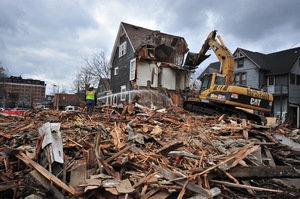
The last of seven houses on Fifth Avenue comes down to make way for the controversial City Place apartments.
Ryan J. Stanton | AnnArbor.com
The City Council recently approved another 13-story student high-rise called The Varsity, which promises 415 beds on Washington Street.
Another 14-story student housing project called Zaragon West is well under way and will bring nearly 200 more beds to William Street.
Landmark, a 14-story student high-rise formerly known as 601 Forest in the South University area, is halfway complete and will bring more than 600 beds.
The Village Green project — officially known as Ann Arbor City Apartments — will bring another 194 beds at the corner of First and Washington. And a six-story project called 618 South Main is in the planning stages and could bring close to 200 more beds.
Meanwhile, the 144-bed City Place apartments project is moving forward on Fifth Avenue, and that means the student housing boom is now spilling into a near-downtown neighborhood.
Seven houses in the Germantown neighborhood were demolished recently to make way for the project, which both city officials and residents opposed. But the developer had the city's zoning on his side, and so city officials said there was little they could do to stop the project.
That now raises the question: How safe are other near-downtown neighborhoods? Could other areas be impacted by the current development rush?
The council appointed a committee in August 2009 to study the issue. But it's been nearly two and a half years now and recommendations for changes to the R2A and R4C residential zoning districts, established in the 1960s, haven't come back to council yet.
Many are waiting for the council to take up the issue and close loopholes in the zoning laws that allow for out-of-character projects in certain residential neighborhoods.
4. City-owned properties
Under direction from the City Council, the Downtown Development Authority is undertaking a master planning process that's being called Midtown Discovery.
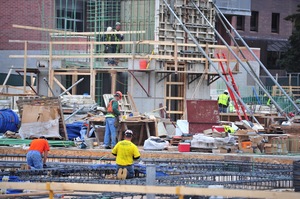
The underground parking garage on the Library Lot is nearing completion and what goes on top remains to be decided.
Ryan J. Stanton | AnnArbor.com
The five properties include the Library Lot, Y Lot, Palio Lot, Kline's Lot, and the first floor of the Fourth and William parking structure.
Most of those are concentrated around an area that's poised for a significant transformation but is currently dominated by surface parking lots and inactive sidewalks.
The Library Lot is where the city and DDA are building a 700-space underground parking structure that's expected to open later this spring. What goes on top still hasn't been decided, but those talks are likely to pick back up in 2012.
The council already rejected a proposal from a private developer that wanted to build a hotel and conference center on the site.
Next door to the Library Lot is the Ann Arbor District Library, which could see renovations or even a complete redevelopment sometime in the future. And directly across the street, the AATA is getting ready to demolish and rebuild the Blake Transit Center.
Working with the DDA and residents, city officials would do well to think holistically about the future of the downtown and ask the question: What's missing?
Some might say a large commercial office space that can bring new jobs. Others might say more green space. Or maybe a mix of both.
5. Public safety
Last but not least, public safety should be a top priority in 2012. The police and fire departments have seen deep cuts over a period of many years, and they were downsized again in 2011 — causing fears in the community that the city might have cut too far.
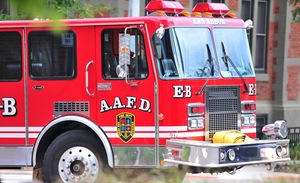
A new report from a consultant hired by the city says Ann Arbor has a significant residential fire problem.
Ryan J. Stanton | AnnArbor.com
Investigations by AnnArbor.com in the past year showed the fire department struggling to meet national standards for response times, and on most days at least one of two active firetrucks at the downtown station is listed as "out of service" due to low staffing levels.
A total of 13 positions in police and seven in fire were eliminated last July, and the plan since then has been to cut 12 more in police and five more in fire in the spring.
Hieftje now says the city likely will avoid more cuts in police, partly thanks to recent union concessions. In fact, he wants to go a step further and bring back more police patrols in the downtown where there's a perception among some that it's becoming less safe.
But the fire side of the equation remains unsolved, and comments by some city officials suggest it might not end well if the firefighters don't make concessions.
There wasn’t a very thorough discussion — at least not publicly — about the cuts made in the police and fire departments last year. And even Roger Fraser, before he resigned as city administrator, said: “The fact is that every bit of this is an experiment."
A new report from the International City/County Management Association, a consultant hired by the city to study the fire department, has given city officials a lot to chew on. An open conversation about whether the experiment is working out would be welcomed by many.
Ryan J. Stanton covers government and politics for AnnArbor.com. Reach him at ryanstanton@annarbor.com or 734-623-2529. You also can follow him on Twitter or subscribe to AnnArbor.com's email newsletters.
Comments
15crown00
Wed, Feb 15, 2012 : 4:21 p.m.
take care of public safety first then all else.
Tru2Blu76
Fri, Jan 6, 2012 : 1:14 a.m.
Do corporations consult the public when deciding to build or vacate a property (Pfizer, borders, etc.)? Equally important: do real estate investment companies consult the public before abandoning properties (Georgetown Mall, etc)? Hopefully, the City of Ann Arbor will be held to a higher standard than "private enterprise" entities. Don't we have public access cable TV in this town? These proposed projects, together, amount to a huge project involving a huge sum of money. Shouldn't there be a highly publicized tv production made to show us what this will cost and what benefits will accrue? Run that presentation for a couple of months - to give as many as possible a chance to look and decide. Our daughter & her husband were visiting for the holidays. She's had to find work in California since graduating from U of M (in 1998!). So I took them up to the top of the William and Fourth parking structure and showed them the transformation of our skyline - so far. Both of them have come visiting a couple times a year for the past 4 years. Yet - both found the sight almost baffling because of the number and scope of new buildings visible from the one vantage point. At one point a few years ago, 13 construction cranes were visible from there. As of last week: there were none because the last 2 were removed. The mass transit project sounds wonderful: but it seems to be designed for a city of a million or more people. We have: about 120,000 people in this city. U of M says it doesn't want the 27,000 + students it has: WHAT IS THAT ABOUT? Most major universities have that many or more. U of M is ranked 18th in the world among major universities. Is the BoR saying they aren't up to the task of handling that many students? Very confusing - and a bit troubling. a
townandcountry
Mon, Jan 2, 2012 : 2:39 p.m.
PUHLEEZE MOVE PUBLIC SAFETY TO THE TOP!!!
YpsiVeteran
Mon, Jan 2, 2012 : 7:58 p.m.
No one wants to talk much about it, but this "perception that the downtown is not safe" is the single biggest threat to long-term financial stability that the city faces. It's an insidious mindset that's almost impossible to fight once it's spread. City residents start changing their habits to avoid uncomfortable encounters with aggressive beggars, and downtown employees stop going out at lunch for the same reason. The downtown area stops being an attractive destination for visitors out for an evening or weekend adventure. Parking structures are avoided like the plague, to avoid drug dealings and random violence. The short- and long-term consequences can't be overstated.
Rita Mitchell
Mon, Jan 2, 2012 : 5:15 a.m.
Whoops: The proposal is a complicated project, that has not been fully vetted or discussed with the public. By discussion, I mean a dialogue, not a presentation of a diagrams followed by the opportunity to indicate preference for options for building materials. I mean that city officials should listen to the public's comments and concerns about the project and use those comments to determine whether to proceed or not, as well as to determine whether this particular project is a priority.
Goober
Mon, Jan 2, 2012 : 10:58 a.m.
Public comments by a few are not a good indication of the desire of the majority of voters. I suggest this be placed in front of the voters to decide. Then, all we can do is hope for a strong turnout to determine what the majority desires.
Rita Mitchell
Mon, Jan 2, 2012 : 5:11 a.m.
Larry, I agree with you on the use of transportation alternatives to the automobile as the sustainable way for our future. Rail and bus transportation make much more sense, as do pooling our resources to reduce use of single occupancy vehicles. A parking structure is a car-magnet, and does not make sense for a city or for the University, which have both stated goals for use of sustainable practices. A parking structure will draw more cars, 24/7 for hospital shift changes, into the center of Ann Arbor, along the Huron River. Why would we do that? If commuting by train is the goal, why would we need a parking structure? In addition, the city has not provided a rationale for building and owning a new train station. We have not been provided with the professional information to show that a new train station is needed, or a review of options to improve the current site. The proposal is for the city to own the parking structure, paid for largely by the University. We know nothing about the financial risk to the city, except for the expectation of paying $10 million, and access to (perhaps) 200 parking spaces...that are currently available. City funds have already exceeded $1.5 million, and that is in addition to the $10 million. The proposal is a complicated project, that has not been fully vetted or dis
StopSpending
Mon, Jan 2, 2012 : 5 a.m.
NoTaxForTracks.com, a PAC formed last year in Hillsborough County, FL helped to overwhelmingly defeat a countywide proposed sales tax increase to fund a light rail boondoggle. You can fight these initiatives that are being pushed by a collusion of politicians, taxpayer funded agencies and special interests. The rail and streetcar projects are wasteful, inefficient and cost-ineffective. Congress needs to zero out funds for these boondoggles and reform the Highway Trust Fund - empower states to collect and keep all the fed gas tax dollars and use those funds to FIX OUR ROADS that 90% of Americans use everyday. And then Primary those politicians pushing these financially irresponsible projects...
Larry Krieg
Mon, Jan 2, 2012 : 3:24 a.m.
Ryan, thank you for recognizing the importance of reducing our dependence on private vehicles. I have one, I use it, and I enjoy it, but I hate to depend on it. It's costly (even though it's small and 10 years old) and I could save a bundle by paying $100 a year for better transit and not using it. I fill up only every couple of weeks, but at about $30 a pop it would only take 7 weeks to recoup what I paid in taxes. Look at Ypsi - in 2010 they voted to tax themselves rather than lose bus service, and they're already more heavily taxed than any other part of Washtenaw County. They may be smarter, though - they must have done the math! As for the Fuller Road station, whether we like it of not U of M Hospital is growing at about 700 new employees each year. Even if you don't like growth in Ann Arbor, are you willing to give up top-notch health care in your city for it? If it's good, it will grow. If it grows, it needs to get employees in and out of the buildings. If they neither have a place to park, not improved bus transit, nor a commuter rail option, what then? I didn't like the idea of the Fuller Road station/deck when I first heard of it either, but I've reluctantly come to agree that it's the best option. If you want a park, nobody's stopping you from using the large city parks across the street or the huge university Arboretum. And there's park land near the VA that was designated in trade for the Fuller Road surface parking lot, in order to preserve the ancient oaks there. So nobody's really losing anything real. On the other hand, loss of police and fire protection is a *real* loss. Let's appreciate the value of all these things in their true context.
Kai Petainen
Mon, Jan 2, 2012 : 3:18 a.m.
Ryan, Great article. It's a good summary of 5 big issues that will impact Ann Arbor. Nicely done. Plus... it gets people talking and passionate about their views on these matters.... and I think that is a good thing.
John Q
Mon, Jan 2, 2012 : 2:59 a.m.
Ann Arbor is going through the same downsizing that every other community in SE Michigan has faced. Police and Fire are the most expensive part of any municipal budget. Police officers and firefighters have some of the highest salary and benefit costs of local government employees. You can't reduce a local government budget without touching police and fire. Whatever one thinks of spending on roads, public art, greenbelt, etc., those have no impact on spending for police and fire. If people wanted more spending on police and fire, it's going to require more in taxes. Otherwise, people need to accept that spending on police and fire has to go down just as it has in every other Michigan community.
villageman
Sun, Jan 1, 2012 : 8:46 p.m.
Thank you, Ryan, for a well-researched and well-written article. I apparently will be the lone commentator on here who is hugely in favor of the Fuller Road Station. As evidenced by the current commentary, there obviously are a number of Ann Arbor residents who don't like mass transit, will never take it and don't think it is necessary. Fine, you can continue to get in your cars and drive to Wal-Mart, but there are many Ann Arbor and other Michigan residents who see a strong mass transit system as something that can strengthen our community and Michigan, in general. Have any of you actually taken the train to Chicago? Have you seen how crowded and inadequate the current Ann Arbor train station is? Are you a student who depends on the train to go to Chicago or to get from the airport to Ann Arbor? Have you taken the bus to Detroit Metro Airport and discovered how infrequent and inadequate that connection is? Don't be so certain that putting this train station to a citizen's vote would ensure it would go down to defeat. I suspect just the opposite. Many in the professional and business community in Troy are embarrassed their long-planned train station was voted down by some newly-elected tea party city council members. That city deserves much better and so does Ann Arbor. I would prefer that the first phase of Fuller Road Station include something more energizing than a parking ramp, but if this is what it takes to get it off the ground and to get future funding, then ok, it's a start. Getting things done isn't always pretty or perfect, but the funding for the first phase, as proposed, offers little risk for Ann Arbor and offers huge potential. As we enter a new year, let's start thinking about how to create a vibrant future for Ann Arbor and stop always seeing the negative in everything. And, yes, the roads need to be fixed, I completely agree, but I want my City to also be forward thinking and creative. That's why I live here.
Vivienne Armentrout
Tue, Jan 3, 2012 : 2:05 a.m.
Thanks, John Q, and I have always respected your contributions as well. But this is not an Amtrak project. It is not being funded through Amtrak. I heard today that Fuller Road Station as currently planned would not come near to supplyiing even the current parking available to Amtrak at their present station. Remember most of the Fuller Road parking structure is dedicated to the UM.
Goober
Mon, Jan 2, 2012 : 9:28 a.m.
Did Magna consider the presence of a mass transit system when they decided to locate in Troy from Canada years ago?
Goober
Mon, Jan 2, 2012 : 9:23 a.m.
To Larry Krieg: First, I am awake. Many employers do not consider transit systems when choosing a place of employment or company location. In all of my site selection years, this was never on the list of criteria. Second, if Mr. Ervin worked for me, he would be fired for making a public comment such as this. Knowing this company well, their Troy based employees come from many communities. A mass transit system covering this area would look like a spider web; almost like roads leading in all directions. Not probable for a mass transit system.
Mick52
Mon, Jan 2, 2012 : 4:39 a.m.
The success of this program likely depends on one important factor: that the President gets re-elected and the democrats take over both houses of Congress by a filibuster proof majority. Otherwise I can't see the funding coming out of D.C. Like Vivienne points out, no funding is expected for next year. In addition to Florida, Wisconsin and Ohio also returned federal funding. The reason is potential cost overruns which are very likely and very costly: <a href="http://articles.latimes.com/2011/nov/06/opinion/la-oe-white-railroaded-20111106" rel='nofollow'>http://articles.latimes.com/2011/nov/06/opinion/la-oe-white-railroaded-20111106</a> I doubt these trains will draw business either. Larry has given us one example of a ticked off potential star in Michigan's economic recovery. One that has headquarters in Troy, but its operations are based in ......Canada! Yes, lets build high speed trains to Canada so its easier for executives to get to the plants in another country/state where most of their jobs are. Thanks for a rock solid example of how the choo choo will bring jobs to Michigan. Gonna need a lot more than one example and preferably related to jobs in Michigan.
Larry Krieg
Mon, Jan 2, 2012 : 3:05 a.m.
@Goober: wake up! Many employers consider transit before coming to a city - it lowers their employees' costs, which means the company benefits too. NY Times (<a href="http://www.nytimes.com/2011/12/23/us/michigan-city-of-troy-led-by-tea-party-mayor-rejects-federal-dollars.html?_r=1)" rel='nofollow'>http://www.nytimes.com/2011/12/23/us/michigan-city-of-troy-led-by-tea-party-mayor-rejects-federal-dollars.html?_r=1)</a> had fun at Michigan's expense when Troy City Council last week voted down their new train station. NYT quoted this large firm's manager, "On Tuesday, an official of Magna International, a global automotive supplier based in Canada whose American headquarters are in Troy, expressed frustration with the City Council vote ..."'..."Frank W. Ervin III, the company's manager of government affairs [wrote] "I have also recommended that where ever and when ever possible we reduce our footprint and employment level in Troy"'. What a great way to keep Michigan shrinking in population, personal income, and national standing.
John Q
Mon, Jan 2, 2012 : 3:05 a.m.
I respect Vivienne's take on these issues but I think she overstates the concerns about funding for a new station. Amtrak's budget includes ongoing capital improvement projects. New stations have been built throughout the Amtrak system long before the stimulus funding came through for the latest round of funding. With the initial work done on the planning for the station, the Ann Arbor station would be in line for future funding from the feds.
John Q
Mon, Jan 2, 2012 : 2:44 a.m.
There's no connection between the light rail system in Detroit and the decision not to pursue it and the rail improvements on the Detroit to Chicago line.
mtlaurel
Sun, Jan 1, 2012 : 10:34 p.m.
students aren't preoccupied with the Amtrak station adequacy. In fact, if they were, they would say leaveit where it is: it can be reached by foot. I used it myself a few times while in college: no complaints. But in truth, look at Madison Wi-they have run Megabus and VanGelder bus to and from campus to Chicago for years-perfectly adequate and quite economical and didn't involve the headaches being discussed here. Doesn't the lack of a Detroit rail plan now not raise concerns about doing this? It's for the Univ-plain enuf to figure out.
Vivienne Armentrout
Sun, Jan 1, 2012 : 10:26 p.m.
As I tried to explain in detail in my post <a href="http://localannarbor.wordpress.com/2011/12/09/say-what-the-mayor-speaks-about-fuller-road-station/" rel='nofollow'>http://localannarbor.wordpress.com/2011/12/09/say-what-the-mayor-speaks-about-fuller-road-station/</a> there is no reason to suppose that an actual train station will ever be built. The program that awarded Ann Arbor $2.8 million is not an ongoing program and this should not be seen as "seed money". The program was the high-speed rail program (HSPIR) and the only reason Michigan got any of the money was that Florida refused it. Further, the Congress has zeroed out this program for next year. I'd have put that in caps if it were allowed. To emphasize: $0.0 dollars were allocated for the program in this coming year. There is also no money available to operate a commuter train (the Ann Arbor-Detroit commuter train would not be operated by Amtrak and did not qualify for a New Starts grant). Fuller Road Station is not the first phase of a train station by any reasoned estimation.
Goober
Sun, Jan 1, 2012 : 9:09 p.m.
A mass transit system will do nothing to bring jobs and other businesses to Michigan. I do not believe i have ever heard any company say that this is the reason they selected another state vs. over Michigan due to a lack of a mass transit system. Normally, these selections are done based on the labor climate, customer base proximity, tax base, etc. Without this business growth and jobs, we cannot afford this luxury. It would have to be much more than student travel to justify the large expense.
MjC
Sun, Jan 1, 2012 : 8:23 p.m.
"In fact, he (Hieftje) wants to go a step further and bring back more police patrols in the downtown where there's a perception among some that it's becoming less safe." There is no perception if you open your eyes and pay attention to your surroundings. The drug dealing going on is at a 'in your face, we don't care' level. Inside city parking buildings, on the corners of State/William, all along Liberty Street... the drug dealers don't care if you see them or not. And anyone who thinks the panhandlers are kind and down on their luck individuals are kidding themselves. Ann Arbor deserves increased police visibility and cleaner streets.
Dagrmc McEwen
Sun, Jan 1, 2012 : 7:37 p.m.
Yes, the city continues to waste money on pet projects instead of fixing the streets that are in bad condition and getting worse.I agree, there needs to total transparency of city council meetings and departmental meetings. How can one city waste so much money and still have the nerve to ask for tax increases. Or, increase fines and fees to help finance the waste.
Goober
Sun, Jan 1, 2012 : 7:50 p.m.
Because the majority of Ann Arbor voters like this team and the direction they are taking the city.
Steve
Sun, Jan 1, 2012 : 6:25 p.m.
How about #1...... a new city council and mayor.
Attempted Voice of Reason
Sun, Jan 1, 2012 : 6:11 p.m.
Mr. Stanton: Do you know if there is any local mechanism for the citizens to block the UM Parking Garage in Fuller Park short of recalling the mayor and supporting council members, or filing an expensive lawsuit regarding the intent of the parkland sale ordinance? Is there a petition process that would be legally binding on the council? Unfortunately most of the supporting council members were not up for election in 2011.
Mick52
Mon, Jan 2, 2012 : 4:14 a.m.
You know, you don't have to recall a mayor or council member to impact a decision. You can call or write them. Either way, it only matters if the numbers are there. If a council member hears from constituents on an issue, that will make a difference, but only if the numbers are there. I have been perplexed for years at what A2CC does, but I agree with Goober. Since the mayor and most council members get re-elected over and over, that indicates that the majority support what they are doing. Then again, with politicians who are of the social agenda ilk; they are willing to give up their seat in exchange for imposing a project they think is good no matter if it is or not. The President is a big promoter of high speed trains and I think the Mayor is being a good democrat. These systems are controversial, and very expensive, thus at least three governors have rejected approved federal funding. California's voter approved train from SF to LA is turning out to be far more expensive than expected: <a href="http://www.mercurynews.com/news/ci_19233576" rel='nofollow'>http://www.mercurynews.com/news/ci_19233576</a> <a href="http://articles.latimes.com/2011/nov/06/opinion/la-oe-white-railroaded-20111106" rel='nofollow'>http://articles.latimes.com/2011/nov/06/opinion/la-oe-white-railroaded-20111106</a> The price tag on the Ca project keeps going up and it will not be done until 2033. There seems to be no real way to estimate how much this costs.
A2James
Sun, Jan 1, 2012 : 4:36 p.m.
City Council's big project in 2012: Researching the latest in pedestrian safety/traffic technology and further implementing it on a disagreeing populace. Followed by periods of inactivity and ignorance!
Tex Treeder
Sun, Jan 1, 2012 : 3:41 p.m.
"Grow or die" is a false dichotomy foisted onto us by real estate agents and politicians who think that an increased tax base is a desirable end in itself. There is nothing wrong with keeping a city about the same size with about the same services. We don't need projects like the Fuller Road station or more high-rises or more building for the sake of building.
Mick52
Mon, Jan 2, 2012 : 3:36 a.m.
Sort of. You have to plan for increasing costs. Costs rise based on inflation, personnel raises and increased costs of benefits, cuts in state/federal funding. Your example of high rise buildings is worthy of note. In the past A2 had a policy of keeping buildings low rise, six stories or so after some distaste from buildings like U Towers and Tower Plaza. But with urban flight to the outer areas causing lowered populations and a need for increased city business activity to increase spending, a change to higher residential density helps to solve those problems. Thus with a lack of horizontal space you look at vertical space. If you can't go sideways, you go up.
Hot Sam
Sun, Jan 1, 2012 : 2:54 p.m.
The biggest mistake we make as a society is to succumb to the notion that government always has to be "doing something".
Mark Wilson
Sun, Jan 1, 2012 : 5:03 p.m.
There used to be a middle ground where people made their own decisions and took responsibility for them. Now if government doesn't subsidize an activity, it bans it.
Craig Lounsbury
Sun, Jan 1, 2012 : 4:15 p.m.
at the federal level they have been making laws for 235 years. Seems like they could take a break. I propose that for the next 100 years no branch of Government can pass a new law unless they repeal an existing law at the same time as part of the process.
Carole
Sun, Jan 1, 2012 : 2:33 p.m.
Question: Are taxes collected on student housing? Is there any tax base for all of these apartments or is the city losing funds? This isn't a housing boon, it is apartmentville. DDA should be disbanded, and the citizens should be asked what should go in vacant lots. Frankly, not sure would wish to build on top of underground parking lot. AAFD and AAPD need to be brought up to required staff to keep the city safe.
Mick52
Mon, Jan 2, 2012 : 3:27 a.m.
Taxes are collected on all privately owned buildings such as apartment buildings unless they are tax exempt like University owned buildings. And they are not actually "student housing." They may be built in an area that may attract students, but I would imagine anyone could rent there.
Stephen Lange Ranzini
Sun, Jan 1, 2012 : 2:10 p.m.
I suggest we ought to have a list of priorities that is very different: 1) Ann Arbor is not meeting national standards for fire safety. This will raise our fire insurance rates & cause more unnecessary loss of life. The current budget for 2012 anticipates even further cuts to the fire department personnel. This must be stopped & adequate staffing provided once again to keep the citizens & their properties safe! 2) The current budget for 2012 anticipates even further cuts to the police department. Ann Arbor already has an inadequate number of cars on patrol at any one time (if I recall correctly only 5 at any one time city wide) & we need to reinstate daily downtown foot patrol beat cops. While the new city manager, Steve Powers, promises to revise the budget and solve this problem, we must insure that this happens, because with inaction, a further round of CUTS is already baked in! 3) Ann Arbor's roads are a mess & are rated among the worst in the state. The funds are available from the street millage to repair them. Get on with it already! @Halter is correct, we should have replaced the Stadium Bridges with a flat road and I explained how to do that very inexpensively but our current leadership wasn't listening. 4) The Fuller Road project ought to go to a vote of the citizens because no one can assert with a straight face that they will spend $121 million building in it & that it will ever be parkland again! Personally I support the project in concept but NOT if the voters don't approve it first. If it's a project with merit, sell the citizens on that & if you can't convince the citizens, respect the democratic process and move on to other topics. 5) Repeal the current pedestrian crosswalk ordinance & replace it with one that conforms exactly to what the signs say, "stop for pedestrian in crosswalk.". We are putting people at risk of serious injury by having an ordnance different than the model state law.
Stephen Lange Ranzini
Mon, Jan 2, 2012 : 5:12 a.m.
@John Q: According to the Michigan Infrastructure and Transportation Association, based on an analysis of data submitted by municipalities to the Michigan Asset Management Council, Ann Arbor for the past three years has had the third highest number of miles of roads in "poor" or worse condition of any city in Michigan. See: <a href="http://www.mi-ita.com/default.aspx?tabid=95&mid=473&newsid473=13" rel='nofollow'>http://www.mi-ita.com/default.aspx?tabid=95&mid=473&newsid473=13</a> Here is a sample of articles in local media on the topic: <a href="http://www.a2politico.com/?p=8032" rel='nofollow'>http://www.a2politico.com/?p=8032</a> <a href="http://www.michigandaily.com/content/ann-arbors-roads-rank-third-worse-state" rel='nofollow'>http://www.michigandaily.com/content/ann-arbors-roads-rank-third-worse-state</a> @Attempted Voice of Reason @Cynic A2: thanks for your kind words and compliments. Running for Mayor is a major undertaking and unless you and a lot of people who vote up these comments that I should run for Mayor round up a many people to email me to commit that they would work on a campaign or contribute to a campaign, I can't see how it would even be realistic to consider it. In case you do want to email me, if only to wish me a Happy New Year and encourage me to stick to being a community bank CEO and AnnArbor.com frequent poster, or to refinance your mortgage at the current record low interest rates, it's ranzini@university-bank.com
John Q
Mon, Jan 2, 2012 : 2:40 a.m.
"Ann Arbor's roads are a mess & are rated among the worst in the state. The funds are available from the street millage to repair them. Get on with it already!" On what basis do you make that claim? I've never seen any statewide ranking of roads on which someone could run around making such claims.
CynicA2
Sun, Jan 1, 2012 : 10:56 p.m.
Much better list! Mayor idea kind of resonates, too - although Jane Lumm may be a couple steps ahead of you.
Attempted Voice of Reason
Sun, Jan 1, 2012 : 6:15 p.m.
Hear, Hear!! Ranzini for mayor 2012??
motorcycleminer
Sun, Jan 1, 2012 : 12:24 p.m.
Halter's comment nailed it on the head..get rid of all this wizard of oz and pie in the sky crapola projects and get back to basics including a city council that doesn't need both hands to finds it butt....
Goober
Sun, Jan 1, 2012 : 8:51 a.m.
Yes, let's plan on more taxes.
grimmk
Sun, Jan 1, 2012 : 3:41 a.m.
What downtown really needs is a good grocery store. A place to buy not only essentials but a real market. Someplace in walking distance of the diag? Someplace easily accessible to students. Not Whole Foods price.
Mick52
Mon, Jan 2, 2012 : 3:20 a.m.
Also, White Market at 609 E. William <a href="http://www.whitemarketa2.com/" rel='nofollow'>http://www.whitemarketa2.com/</a>
Ryan J. Stanton
Sun, Jan 1, 2012 : 7:19 p.m.
I live downtown and I agree with Stephen. I think we're pretty well covered from a grocery standpoint. Most of my grocery shopping needs are met by People's Food Co-Op, and we now have babo, Sava's new market, which has a good selection of products. And there's CVS and Sparrow Market, etc. Adding something like a Whole Foods downtown sounds nice, but that might just hurt the already existing local groceries.
Stephen Lange Ranzini
Sun, Jan 1, 2012 : 2:18 p.m.
I thought the same ways for years. Then I discovered Door-To-Door Organics.com, which delivers high quality organic fruits and vegetables to your door with higher quality and lower cost than Whole Foods, and that between the People's Food Co-op, the Kerrytown market and Farmers' Market there is nearly everything we need as long as you are willing to clear your mind of the need to buy national brands. What's not there there is always CVS or really if you must jump in the car to visit your favorite Big Box retailer. We hardly go to Kroger any more.
Bill
Sun, Jan 1, 2012 : 3:38 a.m.
The #1 issue for Ann Arbor in 2012 should be to bring in a new city council and mayor where the members understand they work for the people and not for themselves. Ann Arbor is not meeting national standards for fire safety. That is a problem and needs correction which can be accomplished by replacing the current admininstration with one focused on the needs of the people. Public art is nice but not necessary. Police, fire and working roads are necessary and should come first. Let 2012 be the year when Ann Arbor can free itself from the downward spiral.
Goober
Sun, Jan 1, 2012 : 8:53 a.m.
A nice dream, but this will never happen in Ann Arbor. The majority loves this team.
tommy_t
Sun, Jan 1, 2012 : 3:23 a.m.
All these grand expansion projects and monies and you can't manage to keep fire and police personnel or even pick up the leaves. The priorities are skewed and screwed up. City services shrink in favor of bigger and better => WHAT? More taxes and comfortable students? Wonderful.
Bob Carlin
Sun, Jan 1, 2012 : 12:27 a.m.
Ryan J. Stanton at 1:43 PM on December 31, 2011 It's been my understanding, and I've confirmed it with city officials, that a super majority is not required for anything on Fuller Road Station. It just needs six votes. If you have other information contrary to that, please share. Ryan, The city charter requires a super majority vote on transfers of city owned property.
Ryan J. Stanton
Sun, Jan 1, 2012 : 7:09 p.m.
Actually, since this is technically parkland (a surface parking lot right now, but parkland nonetheless), it would require voter approval if the city was selling the land, but it's not. The city will continue to be the owner.
Silly Sally
Sun, Jan 1, 2012 : 1:23 p.m.
I'll bet this crooked mayor will not transfer the land, it will still be owned by the city with a 1,000 year lease for a dollar, so, no vote needed.
Bill
Sun, Jan 1, 2012 : 3:34 a.m.
I'm sure the mayor can find his way around something as trivial as the city charter if it stands in his way of one of his bet projects.
Halter
Sun, Jan 1, 2012 : 12:20 a.m.
Hmm....my Top 5 list is quite different... 1) Get that Stadium Bridge project done as quickly as is safely possible - its disrupted the entire city's traffic flow - they would have done better to flatten the entire thing and just build a flat-road across the train tracks. But I digress.... 2) Fix the roads all over town and stop all this "transportation" nonsense. The Fuller Street depot boondogle needs to be aborted asap 3) Get rid of the entire Greenbelt project -- return the funds to other city services -- stop taxing us for a greenbelt we don't need....disagree? Great, get it back on the ballot -- you will see it go down in flames now that people actually know what it is and how much money is being wasted there 4) Work toward getting to know your City Council, and take all necessary action necessary to assure that 95% of them do not get elected again, ever, in any capacity in Ann Arbor and environs 5) Public safety, public safety, public safety.
bruceae
Sun, Jan 1, 2012 : 12:03 a.m.
Wow, only another $100 a year per houshold going to waste at the AATA? You're losing money big time with what you have but you want to expand and lose even more? No way
Mick52
Mon, Jan 2, 2012 : 3:13 a.m.
I think that is going to be a tough one. I hardly think the majority of voters will support a county wide system they do not use. Especially when you have to pay to board the bus too.
Rita Mitchell
Sat, Dec 31, 2011 : 11:42 p.m.
"Behind the scenes, many of the details are being worked out." Big changes such as the Fuller Road proposal require more dialogue with the community that will provide the funding...well before the meeting at which a vote will be taken. Why is it that so much time and attention have been applied to a project that is yet to be voted on by Council? What is the financial plan for this project that will avoid additional city debt? We lose on park land, and the process to date has excluded the charter-required public vote on sale of park land, by instead re-purposing of park land, by attempting to structure a long term lease. Is that the approach that we can now expect for all of our parks? Why should the city own and operate a train station? Is it fiscally responsible to own and operate a parking garage, when 78% of it will be used primarily by the University? How is the cost of the park land addressed in the project funding plan? How does the city benefit from yet another parking structure? How does a parking structure support sustainability?
Attempted Voice of Reason
Sun, Jan 1, 2012 : 6:20 p.m.
It's obvious. The city gives the land to the university for free. The city rebuilds the roads and pipes in the area for free. The city pays for some of the giant structure. Then city residents pay to park in a structure that used to be free parking - so the university gets their money back, meaning: 1) City taxpayers lose lots of money and parkland. 2) University gets a nice subsidized, income-earning structure next to the hospital. 3) Hieftje gets a nice bonus from his day job at the university, thanks to his great negotiating skills. (OK I have no proof on this one, but it's the only thing that makes any sense.)
xmo
Sat, Dec 31, 2011 : 10:30 p.m.
Thank Goodness you voted for a bunch of "little People" to run the city. They will vote on important issues like side walk signs, texting while driving or couches on porches.
Mick52
Mon, Jan 2, 2012 : 3:04 a.m.
I agree Goob. They re-elect them over and over so that in an indicator they approve of these decisions. What irks me is how long it takes to get anything done: "The university's original goal was to have a parking garage built in the area before the new Mott Children's Hospital opened, so there's pressure to move ahead." "The council appointed a committee in August 2009 to study the issue. But it's been nearly two and a half years now and recommendations for changes to the R2A and R4C residential zoning districts, established in the 1960s, haven't come back to council yet." "Many are waiting for the council to take up the issue and close loopholes in the zoning laws that allow for out-of-character projects in certain residential neighborhoods." "The first phase has been waiting for council approval since the Planning Commission approved it in September 2010." The longer decisions take the more expensive a project can become with increasing costs of construction materials, fuel, labor, etc. That City Place project was on the table and debated for years too beginning with the first design plan.
Goober
Sun, Jan 1, 2012 : 11:58 a.m.
What's the problem? The majority of Ann Arbor voters love this team. I have decided that opposition is the minority. In this town, the majority rules. Poor leadership, spending on wasteful projects and art is all the majority of Ann Arbor voters care about. Thus the mayor and most city council members can enjoy job security.
Wolf's Bane
Sat, Dec 31, 2011 : 9:11 p.m.
Public safety and quality of life issues for all ages should be the top priority for Ann Arbor.
InsideTheHall
Sat, Dec 31, 2011 : 9:08 p.m.
AATA Expansion and Fuller Station MUST be stopped. Both are public sector boondogles that are a total and complete waste of taxpayer money. Both are subsidized projects for the "public good' (hint: hold your wallet). FIX THE DAMN STREETS!
Les Gov
Sun, Jan 1, 2012 : 12:15 p.m.
"Both are public sector boondogles" You are so right!!!!....but if projects like these are stopped how are elected government employees going to justify taking our money and putting it in their wallets?....
CynicA2
Sat, Dec 31, 2011 : 8:58 p.m.
One boondoggle after another... Hieftje fiddles while A2 swoons. Unlikely that any of these financial disasters will get funding before the 2012 elections, and even less likely thereafter. Let 2012 be the year Ann Arborites free themselves from the wicked tyrant Hieftje and his minions. We got off to a good start this year - let's finish the job and give the Hieftje the heave-ho!
wowAA
Sat, Dec 31, 2011 : 8:56 p.m.
The mayor and police chief keep forgetting the 18 POLICE civilian employees that will be laid off between March and July 1 from dispatch. The police department is continuing to shrink.
thinker
Sat, Dec 31, 2011 : 8:34 p.m.
Please explain to me where rapid transit and rail can go. Detroit has decided not to go rail, but to stick with rapid express bus service. Are we going to have rapid rail service within Washtenaw County only? What a waste of taxpayer money, no matter whose pork barrel it comes out of (sorry for the preposition there, at the end.)
John Q
Mon, Jan 2, 2012 : 2:35 a.m.
The high-speed rail coming to that line has nothing to do with the recent decision about BRT in the Detroit area.
David Cahill
Sun, Jan 1, 2012 : 10:13 p.m.
As Winston Churchill said, "Ending a sentence with a preposition is something up with which I will not put."
Townie
Sat, Dec 31, 2011 : 8:04 p.m.
'That presents unique challenges and opportunities for the city, which owns several prime pieces of real estate in the downtown that are ripe for development of some kind.' and 'The Ann Arbor City Council found itself distracted with issues like public art and crosswalks toward the end of 2011. But with the beginning of a new year, it's time to refocus. Here's a look at five issues that should top of the city of Ann Arbor's priority list in 2012.' Ryan - run for Mayor then. Looks like you've already made up your mind (and written your article in advance) according to your pro development mentality. Add: 'But the fire side of the equation remains unsolved, and comments by some city officials suggest it might not end well if the firefighters don't make concessions.' Now you've told us what needs to 'give' in order to realize your pro-development (read Republican) agenda. Sorry, I'm not buying this one from you. How about reporting instead of editorializing for a change?
Vivienne Armentrout
Sat, Dec 31, 2011 : 11:21 p.m.
I've found Ryan's reporting on city issues to be insightful and useful. In rereading this one, I believe that he is presenting analysis, not opinion.
YpsiVeteran
Sat, Dec 31, 2011 : 8:25 p.m.
Now that you mention it, why isn't this article labeled "opinion" or "editorial"?
YpsiVeteran
Sat, Dec 31, 2011 : 7:12 p.m.
Spend, spend, spend spend. Can't afford what we already have, but let's spend some more. Lay off firefighters and cops, expand and conquer the transit world. Cut student numbers, but build more housing, off campus, where city resources will be further stretched to provide services. The city council isn't even competent enough to manage zoning sufficiently to keep from having a development no one wants or believes is desirable (City Place) shoved down their throats. What hope is there they will educate themselves sufficiently to undertake anything else without ultimately becoming an even greater liability to the taxpayers than they already are? Never mind...I'm sure spending more money will fix it.
LDR
Sat, Dec 31, 2011 : 6:25 p.m.
ummm..how can this article be posted tomorrow?
Ryan J. Stanton
Sat, Dec 31, 2011 : 6:43 p.m.
The timestamp has been corrected.
Bob Carlin
Sat, Dec 31, 2011 : 6:10 p.m.
This article suggests that council has the votes to go ahead with the UofM parking structure at Fuller Road. I wonder about that. It needs 8 votes. Anglin, and Kunselman, will vote against it, so most likely will Lumm. It's possible that Briere will also vote against it. Right now, council approval is not certain. Much of the city's major spending does not go to voters for a choice. The Library Lot parking, Fuller Road, AATA expansion. It would be better if we had more representative government and less behind the scenes maneuvering. If the mayor's huge transit plans are such a great idea, why not ask the voters first? In fact, the major puts a great deal of energy into keeping the decisions away from voters.
John Q
Mon, Jan 2, 2012 : 2:32 a.m.
Troy voters weren't given a vote on the transit center in Troy.
Silly Sally
Sun, Jan 1, 2012 : 1:24 p.m.
I'll bet this crooked mayor will not transfer the land, it will still be owned by the city with a 1,000 year lease for a dollar, so, no vote needed. so 6 votes is enough
Halter
Sun, Jan 1, 2012 : 12:27 a.m.
The transportation hub has always been kept away from the public -- otherwise it would go down exactly the same way Troy's was just defeated on the ballot...big waste of money and not needed
Vivienne Armentrout
Sat, Dec 31, 2011 : 11:18 p.m.
Another issue that the city's voters need a voice in is the upcoming vote to sign the 4-party agreement for the proposed countywide authority. According to my analysis, by signing that now, Council will have lost any opportunity to pull back from transferring all of AATA's assets and the 2-mill charter millage to the new authority. As I said in my blog post <a href="http://localannarbor.wordpress.com/2011/12/17/aata-moving-us-where-the-big-picture-ii/," rel='nofollow'>http://localannarbor.wordpress.com/2011/12/17/aata-moving-us-where-the-big-picture-ii/,</a> it is critical that Council take this slowly and they should make the countywide referendum mandatory as a contingency on their opting in.
Ryan J. Stanton
Sat, Dec 31, 2011 : 6:43 p.m.
It's been my understanding, and I've confirmed it with city officials, that a super majority is not required for anything on Fuller Road Station. It just needs six votes. If you have other information contrary to that, please share.
BornNRaised
Sat, Dec 31, 2011 : 3:20 p.m.
"But the fire side of the equation remains unsolved, and comments by some city officials suggest it might not end well if the firefighters don't make concessions." Yes, because when the FD was the only department to make concessions the last time around it ended so well. They layoff of 4 firefighter positions while the other department that gave no concessions were impacted. Let's also remember that's when the Mayor and council REFUSED to give a 3% concession. One was even quoted as saying, "I can't afford it." But they did offer to make a ONE time donation to any charity of their choice. A donation that was also tax deductible. City of Ann Arbor. The great city of "do as I say, not as I do".
BornNRaised
Mon, Jan 2, 2012 : 2:27 a.m.
@Snapshot. 1) It was a total of 4%. 2) When we asked why the 4% wasn't being included in our budget numbers, we were told, "That's your own fault for agreeing to that." This came from the city. The same people the keep demanding more. 3) "Hero Tx" is a term only you use. No one else. Since you always seem to comment no matter what we try to do in this city, please answer the following honestly: What do you feel a firefighter or police officer should make in this city for a salary? What number would allow you to show a little respect for those that are trying to help you? Don't give a % reduction. Please provide a salary number for a first year firefighter and a 20 year officer that you think would be a fair number. I'm genuinely interested. The benefits thing is a non-issue as that's now going to mandated by the state.
snapshot
Sun, Jan 1, 2012 : 10:53 p.m.
Like a broken record.....that 3% concession keeps getting the "hero" treatment. Make it 15% and save some other firefighter's job you'll have something to brag about and be fully staffed. Or would you prefer to tax my property more?
Huron74
Sat, Dec 31, 2011 : 3:30 p.m.
If you were born and raised in AA this behavior should not come as a surprise.