

New report: Ann Arbor has 'a significant fire problem' and fails to meet response time standards
The Ann Arbor Fire Department should make it a top priority to respond more quickly to fires and other emergencies, according to a new report.
The department fails to meet national standards and there's "a significant fire problem within the city," according to the International City/County Management Association.
The city released a final draft copy of the long-awaited report on Tuesday. AnnArbor.com has analyzed all 63 pages of the study, which cost the city $54,000.
ICMA's report echoes previous analyses by AnnArbor.com that showed the fire department, after years of cutbacks, is struggling to meet national standards for response times.
The ICMA report touches on staffing levels, ways to increase public education about fire prevention, new deployment methods and technologies to be more effective in fighting fires, and what ICMA is calling "lucrative benefits" provided to firefighters.
It also suggests the fire department would be well served by undergoing a strategic planning process with input from the community to figure out appropriate levels of service.
Failing to meet national standards
ICMA looked at whether the fire department is meeting National Fire Protection Association standards for turnout and response times on both emergency medical calls and fires.
Turnout time is defined as the period beginning when units acknowledge notification of the emergency to the initial point of response. Response time is the period that follows, beginning when units are en route and ending when units arrive on the scene.
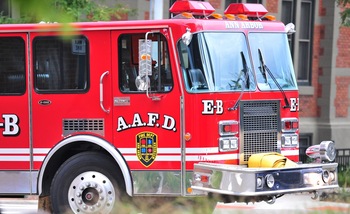
The fire department responded to 278 fires last year, 116 of which were reported as structure fires. Of those, 101 happened inside homes or apartments.
Ryan J. Stanton | AnnArbor.com
ICMA found the actual turnout time was 120 seconds for fires and 121 seconds for medical calls. Both of those times fail to meet the national standards.
"This is where ICMA data analysis reveals the greatest opportunities for improvements," reads a draft copy of the report obtained by AnnArbor.com.
The report goes on to indicate the average turnout time ranged from 1.8 to 3.1 minutes in different cases. ICMA called special attention to the average turnout time between 1 a.m. and 6 a.m., which was longer than 2.9 minutes and "significantly outside the recommendation."
As for response times, the ICMA report offers actual times only for emergency medical calls, pointing out the department is again failing to meet national standards there.
"Currently AAFD has a response time of 10.4 minutes for EMS calls 90 percent of the time," the report states, noting that exceeds the NFPA-recommended 6.5 minutes.
The report doesn't provide any actual response times for fires, but an AnnArbor.com analysis earlier this year showed the department was struggling to meet national standards there, too, and that was before the city made more cuts to fire services.
According to ICMA, the most effective way to improve outcomes for both fires and medical emergencies is to reduce response times. ICMA recommends the city develop its own response time standards based on the community's desired level of service.
ICMA also recommends the city consider upgrading station notification systems and monitor crew turnout performance to help get to fires and emergencies quicker.
According to ICMA, the method of communication between the dispatch center and the fire station might be causing a delay in getting the units out of the station faster.
"Improvements in this area may include equipping response vehicles with mobile data units, upgrading station notification systems to automatically turn on lights and open fire apparatus bay doors, or again, monitoring crew turnout to ensure a timely exit from the fire station," the report states.
ICMA's analysis indicates the turnout times are generally longer during the 24-hour shift period when crews are sleeping.
"In review of the current average response time for AAFD, there appears to be opportunities to decrease response time without adding additional stations or resources," the report states.
According to ICMA, there are five parts in determining the total "reflex time" after receiving an initial call: dispatch time, turnout time, response time, access time and setup time.
But the city does not track the last two parts, and ICMA recommends the city start tracking those to improve performance.
Access time is the time required for a crew to move from where a vehicle stops to the emergency, and setup time is the time required to connect hoses, position ladders and otherwise prepare to extinguish a fire.
'Such lucrative benefits'
ICMA recommends the city make serious efforts to seek concessions from the firefighters union, including on health care, food allowances and tuition reimbursement.
According to figures cited in the report, the city has been spending about $90,000 a year on food allowances for firefighters. That's one of multiple benefits provided to firefighters that ICMA argues is "hard to justify given the difficult economic times."
"Given the city's current financial situation, it is difficult to justify to community stakeholders why such an agreement exists," the report states. "ICMA staff is not aware of any collective bargaining agreements within recent history offering such lucrative benefits."
The report also draws attention to a part of the collective bargaining agreement that provides for full reimbursement for registration, tuition and books for firefighters, up to $2,500 per year.
According to ICMA, a more equitable education incentive would be to reimburse firefighters for 50 percent of tuition costs and make them pay for their textbooks.
"A plan offering 100 percent reimbursement far exceeds that offered by the majority of municipalities," the report states.
Another collective bargaining issue that ICMA suggests reviewing is the level of health insurance provided to firefighters, an issue AnnArbor.com analyzed earlier this year.
"This benefit represents a substantial allocation of city funds that is out of line with what is usually provided to employees elsewhere in the country," the ICMA report states.
The city could save hundreds of thousands of dollars if those contract changes were made. Negotiations between the city and the firefighters union have been at a standstill, though, and they're now going through a binding arbitration process.
'A significant fire problem'
The report identifies one area where ICMA believes the Ann Arbor Fire Department is "minimally staffed," and that's in public education about fire prevention.
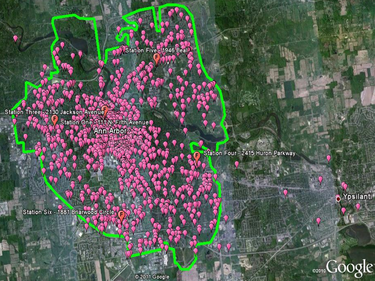
Using GIS technology, ICMA put together a map showing fire calls handled by the city from March 1, 2010 to Feb. 28, 2011. The locations of fire stations are shown in red. To view a larger version of this map, download the full ICMA report.
The fire department responded to 278 fires last year, 116 of which were reported as structure fires. Of those, 101 happened inside homes or apartments.
Those fires killed two people and caused an estimated $1.3 million in property damages last year, records show. Most of the damages — $1.24 million worth — happened to homes and apartments, while businesses and other buildings were less affected.
ICMA recommends the city address "the residential fire problem" through implementation of planned public education and fire prevention programs. It suggests the city consider hiring civilian employees for fire inspector and public education specialist positions.
"Smoke detectors have long proven effective in reducing deaths and property loss in residential structures," the report states. "An active campaign providing free smoke detectors, including installation by firefighters, will go a long way toward bringing the issue under control."
Though money can be a limiting factor, the report states, it shouldn't keep the city from investigating opportunities to secure grant funding, including donations from businesses.
Training is another area where ICMA believes the city could improve.
"The AAFD undertakes the responsibility for providing continual staff training with somewhat less efficiency and effectiveness than would be considered appropriate for a public safety agency," the report states, arguing an "inordinate amount of time" — 1 p.m. to 5 p.m. each day — is blocked out as “health and fitness" time for firefighters.
"The fact that so much time is given personnel in this area may be due to a lack of additional resources within the administrative staff to serve as training instructors," the report states, recommending the fire department use all of its existing resources to improve and increase the amount of training provided to firefighters.
A look at staffing levels
The number of full-time employees in the Ann Arbor Fire Department has dropped from 131 to 82 over the last decade.
Seven positions were cut under the budget that took effect July 1, and the plan for next year is to trim another five firefighter positions in the spring.
Right now, Ann Arbor has 0.72 firefighters per 1,000 residents — a figure that drops to 0.67 with the cuts proposed to take effect next July.
ICMA compared Ann Arbor's firefighter staffing levels to those in five other cities of similar size and density in the region.
But the ICMA report uses fiscal year 2009-10 staffing levels to do the comparison. The city had 94 full-time firefighters then, but has gone through two rounds of cuts since.
Based on the two-year-old staffing numbers, Ann Arbor had 0.83 firefighters per 1,000 residents, compared to 0.74 in Warren, 0.76 in Sterling Heights, 0.88 in Livonia, 0.98 in Flint, and 2.06 in Lansing, according to the ICMA report.
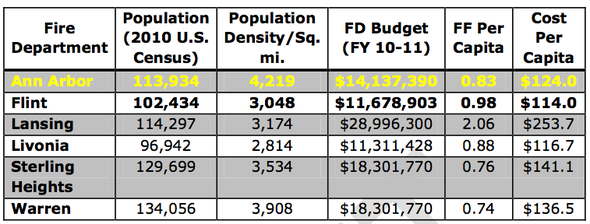
According to figures provided by ICMA, that's in line with most of the other fire departments. Lansing, however, spent twice as much.
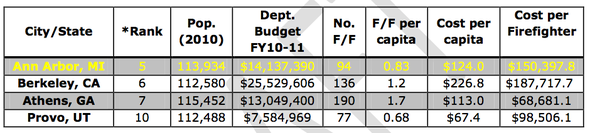
ICMA also compared Ann Arbor to three similar-sized cities with a major university: Berkeley, Calif., Athens, Ga., and Provo, Utah.
Again using 2009-10 staffing levels, Ann Arbor's 94 full-time firefighters compared to 190 in Athens, 136 in Berkeley and 77 in Provo, according to the report.
In terms of the number of firefighters per 1,000 residents, Ann Arbor's 0.83 figure compared with 1.7 in Athens, 1.2 in Berkeley and 0.68 in Provo.
The report acknowledges the questions of how many firefighters and fire stations a community needs have vexed local decision makers for many years. But ICMA believes the debate that rages has, at times, become more emotional than analytical.
"Pressure from some politically involved professional organizations would have fire stations within a drive time radius of every one and one-half miles, with four to five personnel staffing every response vehicle," the report states.
In Ann Arbor, a fire company is composed of a minimum of three firefighters using an engine, ladder, tower or rescue vehicle. Of the five fire stations in the city, only the downtown station — with two active trucks — has multiple companies.
The report doesn't mention that on most days at least one of the two active fire trucks at Ann Arbor's downtown fire station is listed as "out of service" due to low staffing levels.
Options for reducing staffing
The study looked at the locations of Ann Arbor's five fire stations relative to fire calls and found they're well placed.
The report doesn't recommend adding or decreasing stations, but it does identify an option for reducing staffing at two of them.
For each of the three busiest fire units, emergency medical calls consumed more than 60 percent of engine company workload, according to ICMA.
The report identifies an alternative deployment option that would have light suppression vehicles — manned by two firefighters instead of three —responding to calls.
ICMA recommends the city consider that to reduce staffing by one firefighter at Station 3, 2130 Jackson Ave., and also at Station 4, 2415 Huron Parkway.
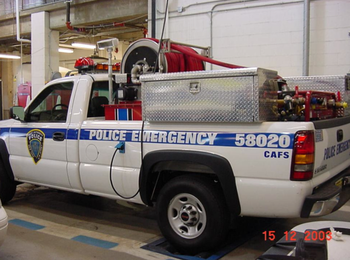
The ICMA report shows this example of a so-called "quick response vehicle" that the Ann Arbor Fire Department could purchase and use in place of more traditional vehicles.
According to ICMA, technological advances in fire suppression make it possible to increase the overall effectiveness of a reduced workforce. One particular technology is a compressed air foam system, or CAFS, a pumping and delivery system that mixes water, foam and air.
"It reduces the amount of water needed to suppress a vast majority of fires, so primary water tanks and fire engines can be downsized, possibly fewer firefighters are needed, and attacks on a fire can be made from a safer distance," the report states.
ICMA suggests the use of a mid-sized pumper truck or quick response vehicle equipped with fire suppression tools such as CAFS could work in certain parts of the city.
The report also raises questions about whether it makes sense for Ann Arbor to have consistent 24-hour staffing that doesn't take into account demand levels.
"What is the purpose of maintaining a constant staffing level over a 24-hour period when statistics show that off-peak hours require fewer staffed units?" the report states, pointing out calls for service in Ann Arbor are lowest between 2 a.m. and 8 a.m.
The department is the busiest from 10 a.m. to 10 p.m., according to ICMA.
The report also suggests the city should work to cut back on the number of runs for false fire alarms.
According to records reviewed by AnnArbor.com, there were 750 false fire alarms in the city last year. That was about 12.4 percent of all incidents reported by the fire department, and most were deemed unintentional or the result of a system malfunction.
The City Council already approved raising the penalty fee for first-time false alarms in October 2010, going from zero to $250.
"If cause is due to improperly maintained systems, then stiffer penalties should be implemented as a means to bring property owners in compliance," the ICMA report states.
Long-term planning
According to ICMA, every fire department should conduct and periodically update a community fire risk analysis.
"This process enables the department to determine what assets within the community are at risk and what resources are available or needed to effectively deal with them," the report states. "The AAFD has not conducted such an analysis within its jurisdiction."
ICMA suggests the city adopt a strategic goal of achieving fire department accreditation within a specific time period.
The report notes an accreditation process managed by the Commission on Fire Accreditation International provides an analytical self-assessment tool to evaluate 10 categories and causes managers to examine more than 240 separate performance indicators.
"Integrated within these categories is an expectation for the community to analyze itself by planning zones and for each planning zone to identify the hazards posed," the report states. "The community then ranks the hazards by potential severity to ensure that the appropriate resources are available to manage the hazards."
ICMA also suggests the city undergo a strategic planning process and develop a fire protection master plan that helps identify priorities and levels of service.
The Ann Arbor Fire Department published a five-year strategic plan in July 2008, but there is no evidence that an "environmental scan" took place, according to ICMA.
"This is a critical step in understanding fully the external factors that will influence the direction and goals of the organization," the report states, noting it could indicate the number of students attending the University of Michigan may increase or decrease significantly. "This would undoubtedly have an effect on the appropriate level of service needed."
The report suggests Ann Arbor officials shouldn't worry too much about meeting the NFPA's national standards for staffing, though.
"While the NFPA is a highly respected and creditable organization, bringing many life safety standards into use today, there is little scientific evidence to support its minimum staffing standard," the report states, going on to suggest Ann Arbor should conduct its own analysis to determine the appropriate staffing levels for the fire department.
"There is no evidence that AAFD has conducted any performance standards test to determine appropriate crew size for its department based on level of risk assessment and acceptability," the report states. "It would serve both firefighters and the public if such tests were conducted."
The report also touches on the city's relationship with Huron Valley Ambulance. Under new protocols put in place in April, Ann Arbor firefighters now respond only to the most serious emergency medical calls, leaving routine medical calls up to HVA paramedics.
ICMA compared response times from the fire department and HVA and found "insignificant differences in arrival times among the various call types," the report states.
Ryan J. Stanton covers government and politics for AnnArbor.com. Reach him at ryanstanton@annarbor.com or 734-623-2529. You also can follow him on Twitter or subscribe to AnnArbor.com's email newsletters.
Comments
Stephen Lange Ranzini
Fri, Dec 23, 2011 : 9:17 p.m.
@Chase Ingersoll: Among the many cuts, the fire prevention staff has been decimated. It is my understanding that the number of fire inspectors has dropped to just one individual. I can't recall the last time our headquarters has been inspected by the fire department. Too many buildings in our town for one individual to get around to them all in any reasonable period of time. FYI, "SLR" will do.
Goober
Sat, Dec 24, 2011 : 11:06 a.m.
Stephen: Many of us in the private sector inspect our own facilities with another audit by our insurance carriers. The cost is ours, not falling on the general public.
Chase Ingersoll
Fri, Dec 23, 2011 : 7:48 p.m.
SMOKE DETECTORS vs. FIRETRUCKS/MEN Stephen L.R.: I read the report in full and it concludes that the first actions to take place is community education/outreach that would increase the use of smoke detectors. I have argued for this in previous comments on AnnArbor.com posted in response to articles about fatal fires in Ann Arbor. Those articles also note that in the cases of fire fatalities, the cause of the fatality is not due to the response time of the fire department, but rather a lack of working smoke detectors. Here is a cursory search of AnnArbor.com listing the last 3 sets of fire fatalities. I can't find in the articles, that response time was raised as a cause of the fatalities. But lack of smoke detectors - you betcha. <a href="http://www.annarbor.com/news/autopsies-underway-on-fire-victims-officials-say/">http://www.annarbor.com/news/autopsies-underway-on-fire-victims-officials-say/</a> The house was not equipped with a sprinkler system, and investigators have found no evidence of smoke detectors, Dziubinski said. "Please, please, please check your smoke detectors," he said. <a href="http://annarbor.com/news/ann-arbor-woman-injured-in-saturday-house-fire-has-died-hospital-officials-say/">http://annarbor.com/news/ann-arbor-woman-injured-in-saturday-house-fire-has-died-hospital-officials-say/</a> This is where two young people sleeping in a basement died. I raised the issue of smoke detectors in this case. <a href="http://www.annarbor.com/news/lawsuit-filed-in-fatal-fire-on-south-state-street-in-ann-arbor/?cmpid=RSS_link_news">http://www.annarbor.com/news/lawsuit-filed-in-fatal-fire-on-south-state-street-in-ann-arbor/?cmpid=RSS_link_news</a> The lawsuit, filed Nov. 23 in Washtenaw County Circuit Court, alleges that Vessels LLC was negligent in one or more of the following ways, including failing to install and maintain operational smoke detectors, failing to have a proper fire escape plan or failing to have a working fire extinguisher. The suit seeks an unspecified amount of money.
Pam Bethune
Fri, Dec 23, 2011 : 2:50 p.m.
Very interesting reading. But I wonder how the national standards were set. What was the process to understand what a difference in turnout time of 40 seconds truly makes in an emergency? Does it truly make a difference in the outcome? I liked seeing the emphasis in false alarms and fire alarms. Preventing the stupid use of fire fighters and the fuel for the vehicles is good.
kirkers
Fri, Dec 23, 2011 : 2:24 p.m.
How quickly does a fire double in size, damage and property loss? The articles title focused on response time, but there was heavy discussion on how to cut costs and personel more. Priorities out of order? My understanding is that two ladder trucks are needed for fires in high rise buildings. One or both for the fire and one for rescue. Is Ann Arbor keeping prepared to handle a significant fire in a tall building. We seem to be building more of them. Unfortunately, unexpected catastrophic events occur with severe long term consequences. My guess is that it will cost us less to pay and prevent a disaster than the cost after one. Unfortunately, it seems our nature is to underestimate the long term value of prevention and timely intervention. I sadly forsee a horrible headline some day. I believe I may have already read one last year involving a death. Was response time a factor?
440RC
Fri, Dec 23, 2011 : 2:08 p.m.
The sad thing here is that the ICMA, like so many other"expert" organizations, associations, and especially Government Commitees, are only experts in their own minds. This report, like others previously submitted by ICMA to other jurisdictions, contains just enough opinion to make the entire report lack true integrity. All major media, nationally too, covered the unfortunate death of Ivory Ivey, a 3 yo girl in Detroit, as the result of a fire in her home. The first arriving truck to that fire was exactly what ICMA wants A2 to consider. Although some reports are that the "quick response vehicle" was not operating properly, the fact is that it is not capable of flowing adequate water (GPM) to extinguish fires other than cars and brush piles. The lack of compartment space limits equipment storage (remeber ICMA thinks A2 needs MORE "fire reduction tools") and eliminates ground ladders- which was another issue in the death of Ivory. CAFS, another recommendation, adds $35k-$50k to the price of a new engine and sometimes more when retro'd to an existing pump. The addition of class A foam (not Class B) to the water used to extinguish a fire reduces the surface tension of the water (so does dish soap) and allows for better absorbtion, which can reduce the amount of water needed- BUT is water usage a problem which was identified as an issue in the AAFD? Worse yet, another recommendation is fighting a fire from the exterior, which is way less efficient, less accurate, and wastes water. Fire science 101; heat is measured in BTU's, BTU's are decreased by water volume or GPM, Class A Foam, when applied via CAFS or in-line eductor does NOT increase GPM and therefore has NO effect on reducing heat created by combustion. It WILL however provide better protection to a bail of straw than plain water in reducing potential ignition. If only I had more room. ICMA disputes NFPA who disputes ICMA who are both disputed by OSHA. Waste of money and time at YOUR
Stuart Brown
Fri, Dec 23, 2011 : 7:34 a.m.
The fact that someone like Hieftje can be elected time and time again is testament to how broken the political process is in Ann Arbor. Citizens exist to be milked by the political machine.
Goober
Fri, Dec 23, 2011 : 6:57 a.m.
We need to quit complaining. The majority of Ann Arbor voters love our city council and mayor. They love their leadership, their spending on wasteful projects and how they manage our finances. We need to find something else to complain about that we can actually influence.
Sallyxyz
Fri, Dec 23, 2011 : 4:44 a.m.
Not to worry. There's $1.5 million floating around for public art......that'll help the firefighters!
Stephen Lange Ranzini
Fri, Dec 23, 2011 : 2:59 a.m.
For those of us who have been "raising the alarm" about the fire department cuts being unsafe and warning about the increased fire deaths, seeing the facts in the report is certainly vindication, however we can't get back the people who have died.
Mike
Fri, Dec 23, 2011 : 1:07 a.m.
Ann Arbor definitely needs to spend more money on parks and green space.
SMC
Fri, Dec 23, 2011 : 12:54 a.m.
Congratulations, Mayor Hieftje: you'll soon see your name in the history books, right next to Emperor Nero. Hope you can play the fiddle...
Fat Bill
Fri, Dec 23, 2011 : 12:46 a.m.
For all those who want to get your own measure of the "out the door" time, just find yourself an old school programmable scanner and set it to 154.175 Mhz, the old city fire channel. They use the new radios but dispatch on the old channel as well. Having been a 9-1-1 dispatcher before, I was shocked at how slow the AAFD firefighters are out the door especially at night (been a firefighter as well, hold your flame replies...). For a department the size of Ann Arbor, they don't necessarily need to have individual station tones; why not use the same tone and simply identify the station(s) requested? Other stations (not to mention the Battalion Chief) would then have an idea of what's going on should they be toned out later. Sorry if your sleep is disturbed, but you are on the clock after all. This is not L.A. County with 166 stations, anything of any large nature is an all-call anyway at the current staffing levels...
Fat Bill
Sat, Dec 24, 2011 : 1:38 p.m.
Nice, so you push a button before you are even rolling. I am all for MDT's, etc, but I have been in front of Ann Arbor fire stations, heard the tones, and watched the responses. Afternoons are pretty good, but late at night not so much. Observation is widely considered a fine method of gathering data. I talk to firefighters, police dispatchers and HVA dispatchers all the time.
BornNRaised
Fri, Dec 23, 2011 : 1:08 a.m.
Fat Bill... the new systems that were implemented have a box in each station next to where the dispatch runs print out. We push a button stating 'enroute'. Which is supposed to free radio traffic (not that it's all that congested). So when you're listening to your scanner, you're not hearing them talk just as they pull out the door. The "Ack" button was pushed long before that. Just an FYI. Not everything is learned about the FD listening to a scanner. Talk to a firefighter sometime and you'll learn that our dispatching system is a little different than most.
Alfie
Thu, Dec 22, 2011 : 11:01 p.m.
BENEFITS: There you have it. If the firefighters are so concerned with staffing levels they could make concessions similiar to EVERY other union(including Police) in the City. Yes, they made some token gestures, but the bottom line is that the benefits packages are still way out of line for this group of employees. Agree to bring in line with others and a big problem is solved. Health Benefits: "This benefit represents a substantial allocation of city funds that is out of line with what is usually provided to employees elsewhere in the country," the ICMA report states. $90,000 in FOOD allowances!?!? Extreme benefits, there you have one of the biggest reasons for Fire cuts. Conclusion: Bring the benefits in line with reality and you can hire more firefighters, which we really need. So many posters seem to ignore the benefits part of the report. Why? The answer to our need is right there. Its interesting how some only mention only the staffing shortage while completely ignoring that section or blamiing some grand conspiracy for teh parts they don't like.
BornNRaised
Fri, Dec 23, 2011 : 12:23 a.m.
OK, I have to ask you then. When FD takes the healthcare plan the city is asking for, are you going to be satisfied? What would it take for you to get over the 'extreme benefits' argument? I ask because it seems no matter what we do, people are going to complain. So I'm seriously asking you... in a perfect world, how much would you like to see firefighters get paid? Low and high salary please taking into consideration a first year firefighter and a 20 year officer. What would you like to see the benefits package look like?
CityFF
Thu, Dec 22, 2011 : 8:31 p.m.
I assure you that turning on lights and opening doors automatically is not going to fix 10 minute response times. The only way to do that is to increase staff. Have more then 1 truck responding in the busiest district. When the station 1 truck is out on a run and another run comes in (happens all the time) another station has to respond. They arent close and it takes a while. Thats why there has always been multiple trucks at that station. There were 3 trucks there up until about 5 years ago. How about opening station 2 up (Packard & Stadium). its been closed for 5 years. That will help. Where are these recommendations? Opening a garage door automatically will only decrease times by about 10 seconds. And the dispatch at HVA is so screwed up that they constantly set the wrong tones off for the wrong stations. So then we have doors opening up all the time and the heat bills will triple.
BornNRaised
Thu, Dec 22, 2011 : 10:31 p.m.
@Craig... A major problem that we've tried to bring to the city is what Roger Fraser did before he left. He decided to tell HVA that we were not going to be dispatched to certain calls. Most actually. The problem with that is that when a call first comes into HVA dispatch they just send it to the ambulance. When the ambulance arrives on scene, or after they were dispatched and they realize the call is more severe than the call taker coded it as, they THEN dispatch FD. Many times the call came in anywhere from 5-20 minutes before FD was even alerted. The city stated that they would 'closely monitor' the new dispatch when we moved to it. Just like they are going to 'closely monitor' PD dispatch after county took over. A major fix would be one of two parts (both being ideal). 1) reinstate the calls the FD gets dispatched to instead of sending a PD unit of HVA unit to 'size it up' first. 2) Let FD dispatch their own calls. This system was working great. Trucks were sent on the road as soon as the call came in, with updates being sent while in route. The new system is to get all the info FIRST, then decide who goes. I don't know about you, but if I call 911 because I'm having a heart attack, all I should have to say is I'm having a medical and seconds after that get a truck on the way. You don't need my entire history before deciding who to send. BTW, the 'savings' of going to HVA dispatch and increasing our response times along with decreasing the calls we go on was a PROJECTED savings of $17k. No one will investigate to see just how much is truly saved now. Kind of raises a red flag that they won't follow up. Then again, they haven't been 'closely monitoring' the progress either.
Craig Lounsbury
Thu, Dec 22, 2011 : 9:35 p.m.
what needs to be done to decrease turnout time?
jeff4179
Thu, Dec 22, 2011 : 7:46 p.m.
Maybe it takes so long for our emergency workers to respond because they are stopping at crosswalks for pedestrians.
ranger007
Thu, Dec 22, 2011 : 7:21 p.m.
I guess the only people the city council is worried about protecting is the pedestrians that need their hand held while crossing
Basic Bob
Thu, Dec 22, 2011 : 7:18 p.m.
So this is what you get for paying Ann Arbor taxes. Substandard service. I'm glad to be in Pittsfield, even without the silly fountain and big hole.
ranger007
Thu, Dec 22, 2011 : 7:24 p.m.
There is more than one "big hole" in ann arbor and its seems each one has hot air coming out of it
Bcar
Thu, Dec 22, 2011 : 6:34 p.m.
To all those who are bashing the FD, union etc. about their "too high" pay and benefits packages. etc Why don't you tell them that when they are the first ones to get to your house when it is on fire and kick down the front door, brave the heat, smoke and flames to search for YOU to pull YOU out to safety while RISKING THEIR LIVES. These people put THEIR LIVES and the wellbeing of their families on the line for US. So don't you dare forget that. They risk their LIVES for US. Do you want them to show up and say "f'this, im not getting paid enough to go into that burning house, its not worth it..." yeah, didn't think so... When seconds count, the FD is only, what, ~10 min away?? I don't want the bottom of the barrel fire fighters in my city, I don't want the cheapest or minimalist trained FD. I want them to have the best equipment and training possible, and enough of them to handle 2 fires at the same time (S happens...), I like it when most of them are EMTs if not full Paramedics, even though the "minimum standards" don't require it... Would anyone walk into the parachute store and ask for the cheapest one??? Well, then again we are talking about some of the citizens of our fare city, so yes, some of you would ask for the cheapest one, LOL.
Romie
Wed, Aug 29, 2012 : 3:21 a.m.
BCAR, you were a prophet. Here it is, August 2012, and the AA FD has agreed to go after the cheapest, bottom of the barrel FFs. 6 are being hired right now, for $14 an hour, no retirement pension, tuition decimated, pension reduced and not vested for 10 years, subpar medical benefits with huge copays and premiums that consume your whole check if you have a wife and kids. Food allowance halved, bonuses decimated.....basically the lowest paid kids in Southeast Michigan...$38,000 minus medical cost deductions. No future either. The ICMA and Union Bashers can declare victory as people die and houses burn down. High quality Public Safety talent does NOT work for Taco Bell Money you arrogant cheap greedy Ann Arborites.Congrats
Bcar
Thu, Dec 22, 2011 : 8:49 p.m.
HA HA HA HA!!!
A2Medic
Thu, Dec 22, 2011 : 8:30 p.m.
Yawn..
A2Dave
Thu, Dec 22, 2011 : 5:01 p.m.
's Okay. We have neato public art.
Simon Green
Thu, Dec 22, 2011 : 4:45 p.m.
Please don't tell my homeowner's insurance company about this report.
L'chaim
Thu, Dec 22, 2011 : 4:22 p.m.
So, according to the corporate-minded ICMA, the AAFD needs to react faster and communicate more effectively; and the best way to do that is to (of course!) pay fire-fighters less, reduce their benefits (especially the $60 to $90 per month 'food allowance') and buy some new technology (communication devices and trucks and foam). They (the ICMA) no doubt has a passel of providers in the ranks of their corporate 'members'. A sucker born every minute and two to take him.
walker101
Thu, Dec 22, 2011 : 3:58 p.m.
Give them another 10% raise and I'll bet they'll improve on response time, money talks and. Kind of looks like the same tactics applied with the Bus transit in Detroit, unions rule.
CityFF
Fri, Dec 23, 2011 : 2:37 p.m.
So you get proven wrong and your only response is that you'll laugh when a few families are devastated with a layoff. It's clear the type of person you are. I have to assume that you work for st joes since the UM nurses just threatened to strike to get a contract.
A2Medic
Fri, Dec 23, 2011 : 5:43 a.m.
that should say when A2 lays off, no news there..
A2Medic
Fri, Dec 23, 2011 : 5:42 a.m.
Sorry to disappoint but I do not work for/never have worked for HVA. I am a paramedic as well as a nurse and work in cardiology services at a local hospital.. With that said, I'm going to MickeyD's and buyin me some fries.. BTW, I will chuckle when the A2 news lays off a few more of you this spring.. Your sense of entitlement is truly disturbing to me..
CityFF
Thu, Dec 22, 2011 : 8:35 p.m.
Actually in the case of this report they include HVAs time. The clock starts at the time of initial call. Maybe while you are sitting post you should have read the article. "According to ICMA, there are five parts in determining the total "reflex time" after receiving an initial call: dispatch time, turnout time, response time, access time and setup time."
A2Medic
Thu, Dec 22, 2011 : 8:29 p.m.
CityFF- gettin up out of your lay-z-boy and into your truck faster than 120secs and to the scene quickly has nothing to do with HVA dispatching you as the clock starts when you are toned..
CityFF
Thu, Dec 22, 2011 : 8:22 p.m.
Is that the best you got? The Response time issue falls in the hands of HVA dispatch. Come do a ride along sometime, a Friday or saturday evening when the students are in town would be ideal. Then you can really see our response time. I assure you the firefighters are doing their part. And thats with a 4% paycut.
walker101
Thu, Dec 22, 2011 : 7:14 p.m.
This is the type of action a union will take in order to get what they want, give them more money and maybe they'll consider doing the job they were hired to do. Same as the bus system in Detroit, they'll take their time and hold the citizens hostage intill the city allows them to go back on OT as much as they want, just before the city went broke. I didn't say they got a 10% raise, I said give them 10% and then they comply.
gofigure
Thu, Dec 22, 2011 : 6:08 p.m.
Where does it say the FF's got a 10% raise? Unless you have something to back that up, you shouldn't be making those kind of statements. Besides, didn't they make concessions last year? Correct me if I'm wrong......I believe they gave back 3 or 4%.
irritated
Thu, Dec 22, 2011 : 3:54 p.m.
Born and raised makes a point that some of the data used to come up with these conclusions may be inaccurate. Perhaps its time to hear from some of the fire officials on the findings. My sources tell me that the 10 min response time figures are way off and need to be looked at more closely. I caution all of you to be sure the facts are in line before making any assumptions.....
Goober
Thu, Dec 22, 2011 : 6:32 p.m.
You mean that the city paid $54,000 to a consultant for this study and the data or facts as reported are not correct?
bunnyabbot
Thu, Dec 22, 2011 : 3:46 p.m.
I am really grateful (not) that the mayor and city council have been making a big push to have us on the same playing field with those great beacons of "international" cities like New York, Boston, Chicago and San Francisco. The public art, the big dig (and hopefully a conference center too, oh my) will make us all as great as they hope. Nevermind they are completely out of touch with reality and have a city dysmorphic disorder.
Sparty
Fri, Dec 23, 2011 : 4:18 p.m.
Wow, I'm shocked, but I'm in complete agreement with you. Let's not forget Boulder though. If that was missing from a city council decision, I think I'd pass out in shock.
javajolt1
Thu, Dec 22, 2011 : 3:42 p.m.
Here is the inside story from a great piece of journalism. <a href="http://annarborchronicle.com/2011/12/21/column-foia-hazards-christmas-gifts/" rel='nofollow'>http://annarborchronicle.com/2011/12/21/column-foia-hazards-christmas-gifts/</a> If dispatchers are delaying the call to the station, wouldn't that delay the arrival of firefighters to the scene? Why would dispatchers delay a call to the station? Hmmm... Let's think about this. This smells really, really bad.
javajolt1
Thu, Dec 22, 2011 : 3:48 p.m.
An exerpt from the report: First, the method of communication between the dispatch center and the fire station may be causing a delay in getting the units out of the station faster. Improvements in this area may include equipping response vehicles with mobile data units, upgrading station notification systems to automatically turn on lights and open fire apparatus bay doors, or again, monitoring crew turnout to ensure a timely exit from the fire station. As might be expected, ICMA's analysis indicates increased turnout times during the twenty-four hour shift schedule when crews are sleeping. In review of the current average response time for AAFD there appears to be opportunities to decrease response time without adding additional stations or resources.
Major
Thu, Dec 22, 2011 : 3:10 p.m.
Maybe it would help if the U of M had it's own fire department for all their properties...which must be a pretty good percentage of the town...or, seeing they have millions to throw around, have them help fund the AA fire department. It's become quite obvious we have no one at the helm on city council! Did they really spend $54,000 to be told they made a huge mistake??? Is there ANY good that comes from this unsuccessful, unproductive, group??
nowayjose
Thu, Dec 22, 2011 : 6:34 p.m.
Unless things have changed recently, East Lansing FD had one station on Campus across from the FB stadium. I went to State, and last time I checked they don't have their own FD.
Vivienne Armentrout
Thu, Dec 22, 2011 : 3:35 p.m.
The City is obligated to provide the UM fire protection and in theory the State of Michigan is supposed to reimburse us. But as I recall the fraction of the actual cost of the service that has been reimbursed continues to fall.
Carole
Thu, Dec 22, 2011 : 2:52 p.m.
Regardless of what the report states, when the department is cut so drastically response times will be longer. I say again, drop the art fund and DDA and bring the staffing of AAFD and AAPD back to what is safe for the citizens of AA.
Ron Granger
Thu, Dec 22, 2011 : 2:36 p.m.
Does the University pay anything for fire support? They sure were eager to build their own gun-wielding police force, and ticketing people all over the city for traffic offenses. They should be so eager with their own fire department.
gofigure
Thu, Dec 22, 2011 : 6:05 p.m.
I seem to recall awhile back an article mentioning UM is paying for Fire Protection during home games but I never saw anything about paying for year round fire protection. Ryan, perhaps you could look into that.
grye
Thu, Dec 22, 2011 : 4:03 p.m.
How about charge the University for Fire Dept responses. Non-taxpaying entities within the city will be charged for services rendered. The charge can also be extremely high since there is enough money in the University's budget to provide $100K salary increases.
a2roots
Thu, Dec 22, 2011 : 2:33 p.m.
Here we go with another dog and pony show. Bottom line is the City of Ann Arbor taxpayer pays far to much for fire services. This has been an ongoing issue of contention which again is verified. The fd union has held steadfast regardless of any so called concessions they have made. The fd players will again blame the city but it is pretty obvious their pay and benefit packages are out of line. Remember their brethren that worked the system over for a few days to get huge retirement payoffs. This attitude appears to still permeate the air.
BornNRaised
Thu, Dec 22, 2011 : 11:02 p.m.
You live in the past. Jump up to the present day and do your research. Even the Administrator has come out and stated the average pension is $31k. You know, back in the day, the Germans and Japanese did some pretty bad stuff too. Do you hold on to the past, or realize that mistakes have been corrected and don't occur anymore? The multiple stories you talk of are all from the past. When it's a slow news day, they keep resurfacing. City admin created that system. FD wasn't the only ones that were part of it, but the city uses FD as the scape goats instead of admitting they let this guy walk all over the city unchecked. Yep, that old system was wrong. And as a FF, I'll have to pay for it for the rest of my career by listening to residents constantly throw it in MY face. Again, that system hasn't existed for quite sometime. You can either accept that and move on, or continue to believe what you want. Just takes about 5 minutes of research to find the truth.
a2roots
Thu, Dec 22, 2011 : 10:56 p.m.
@BnR...Again blame others...you know very well what your brethren did to rip off the system. @jcj... I have no relatives working for the city but do many current and past employees that work very hard and earn every dime they are paid. I have never said FD does not work hard. What I maintain is the benefit and retirement plans are out of wack. Many reports verify this. The FD dating back to at least the 70's that I am aware has been a sacred cow and always held the city hostage in negotiations. When the economy is bursting it is easier to brush things aside. Plenty of blame for this to go around. Now is the time to correct it.
jcj
Thu, Dec 22, 2011 : 5:19 p.m.
"the City of Ann Arbor taxpayer pays far to much for fire services." Name a city worker (that is not a relative) that gives us what we pay for.
BornNRaised
Thu, Dec 22, 2011 : 2:52 p.m.
Oh.... were you aware that we've been giving concessions? Or do you just refuse to accept that? Are you also aware that the FD had N-O-T-H-I-N-G to do with the creation of the retirement system you speak of? That was the city administrator. But instead of the city admitting they hired a thief, it's easier to blame the firefighters that had nothing to do with it. They do this because they know people like you will run with it.
pbehjatnia
Thu, Dec 22, 2011 : 2:30 p.m.
The cuts in public safety in Ann Arbor have been and are unacceptable. This report only shines a spotlight on what has been obvious from the beginning of the staffing cuts at the AAFD and AAPD - that Mayor Hiefjte is interested only in his pet projects and his buddies on council always follow his lead. I guess it seems silly to give food allowances or tuition reimbursements to firefighters, and they are holdovers from days of good economy gone by, however, now that we giving less and expecting more from a FD decimated in numbers maybe these things are minimum benefits that should be shrunk but not cut completely. Morale also plays a big part in output. The sad part of this is that come spring when campaigning should start no one will step up to challenge Hieftje for the democratic ticket and come November Ann Arborites will dutifully line up and cast their straight party tickets and vote Hieftje and his posse right back into office again. For myself I can't wait for the first lawsuit using this data to sue the pants off our already broke city.
BornNRaised
Thu, Dec 22, 2011 : 2:23 p.m.
Does anyone else find it odd that ICMA stated that the FD is having difficulty meeting response times due to recent slashing of staff by the city. But then the recommend making further staff reductions??? Is that supposed to be a solution, or a way to make the problem worse? $54k for that? FD only has 79 people total. That includes 9 in Administration. 70 to respond to emergencies. Does it raise any red flags with people that this 'final version' has DRAFT stamped on every page? How about the fact they didn't include the busiest truck in the city in their statistics? The engine that services downtown. Instead, they included Tower 1 which is indefinitely out of service due to mechanical issues. AA.com also did an article on how often that truck has been out of service due to staffing cuts prior to the recent mechanical problems. These 'experts' were actually paid for this?!?! If you would like an even bigger laugh, look up the people that wrote this report. See how much FD experience they have. They were probably good cops in their careers... should probably stick to what they know.
A2WS1
Thu, Dec 22, 2011 : 2:15 p.m.
Recommend letting the ambulance services handle the purely medical calls. Seems like we don't need a fire engine going to every medical call...
A2WS1
Thu, Dec 22, 2011 : 2:14 p.m.
Bring benefits in-line with national averages and maybe save 2 or 3 positions.
racerx
Thu, Dec 22, 2011 : 2:12 p.m.
Maybe this can put an end to all city departments responding to a guy who has already fallen from a construction site, or, having all departments respond to a house fire that was already put out by the time those various other departments responded from various other parts of the city. Not meeting standards maybe the mayor and council should really be hugging and congratulating each other for allowing this to occur.
Kai Petainen
Thu, Dec 22, 2011 : 1:57 p.m.
a big thanks / congrats to Ann Arbor.com for having the guts/courage/journalistic integrity to do this sort of story. thank you.
Alan Goldsmith
Thu, Dec 22, 2011 : 3:23 p.m.
Huh? Lol.
Vivienne Armentrout
Thu, Dec 22, 2011 : 1:56 p.m.
Thank you for this excellent reporting and summarization of the ICMA report. Readers should also see <a href="http://annarborchronicle.com/2011/12/21/column-foia-hazards-christmas-gifts/," rel='nofollow'>http://annarborchronicle.com/2011/12/21/column-foia-hazards-christmas-gifts/,</a> which reveals much about how long the fire protection report was held up and some of the effort to have it released.
Roy Munson
Thu, Dec 22, 2011 : 1:52 p.m.
Fire is down. Actually, fire is way down!
hut hut
Thu, Dec 22, 2011 : 2:46 p.m.
And a good portion of that good fortune is because of building and rental housing inspections, but those people aren't overpaid "heroes" and whose departments were decimated by Frasers reorg and lack of council understanding about what they do.
Wolf's Bane
Thu, Dec 22, 2011 : 1:45 p.m.
Check out Summit and Main street for burnt out ruins.
WonderWoman
Thu, Dec 22, 2011 : 1:45 p.m.
Who was the former city administrator who years ago voted himself and his cronies golden parachute retirement / severance packages, then "retired" and moved to Colorado, ...maybe Boulder? Now the residents are left to "pay his Piper".....
javajolt1
Thu, Dec 22, 2011 : 3:36 p.m.
That would be....Neil Berlin. We should all go visit him at our ranch in Colorado!
Carole
Thu, Dec 22, 2011 : 2:51 p.m.
I'm glad someone else remembers this administrator -- It was some time back, but the package was totally sweet and we have been paying ever since.
Bcar
Thu, Dec 22, 2011 : 1:44 p.m.
Wow, sweet, a 10.4 minute response time. That's good to know, with ~17 minutes being the average time from start of fire to structural collapse of a house... Gives the fire fighters a WHOLE 6 minutes to get setup and get everyone out! Now, what happens if there were ever TWO fires at the same time??? Oh wait, that can't happen, the mayor doesn't like that. Moral of the story, be the first to call 911...
A2Medic
Fri, Dec 23, 2011 : 5:29 a.m.
I stand corrected.. It's sad that there were multiple fatals over the previous few years.. I was referencing the State/Hoover fire..
Bcar
Thu, Dec 22, 2011 : 8:33 p.m.
@A2Medic, nope, he was unconscious and was pulled out. This was the fire in late Jan of this year. Super sad. 2 people were in the basement and both died, the girl lived for a day or two I think.
A2Medic
Thu, Dec 22, 2011 : 8:12 p.m.
Bcar, they didn't pull him out of the fire.. He came out on his own.. Sadly, his wounds were non survivable regardless..
Bcar
Thu, Dec 22, 2011 : 6:18 p.m.
Well, if you read the article you'd have noticed "...The report doesn't provide any actual response times for fires..." So I interpolated based on EMS calls/turn out times, but then again, I guess that whole 120 seconds vs. 121 seconds makes a HUGE difference... But hey, the mayor gets his cuts so he can waste OUR money on art and other BS him and his lib-lackies want. Just don't tell that to my neighbor two doors down who's son was one of the people killed this year in an A2 house fire... He lived a short while after they pulled him out of the house before he died, so why dont you and the mayor talk to his parents about how important that extra minute or five is....
drewk
Thu, Dec 22, 2011 : 4:40 p.m.
Of course this would be totally different if you actually read the article properly. It states over ten minutes to respond to a medical call, not a fire.
AACity12
Thu, Dec 22, 2011 : 1:41 p.m.
So the city paid $60,000 for a report that says the way to run the fire department cheaper by paying firefighters less money. What a revelation! Then they base all their findings on completely inaccurate info. The fact that there are 15% less firefighters then what the base their findings on is kind of a big deal. Then they don't include the fact that the cities ladder truck is closed almost everyday. I would want a refund. $90,000 for food for firefighters is better money spent then the $60,000 paid for this study.
Craig Lounsbury
Thu, Dec 22, 2011 : 3:19 p.m.
I don't we the tax payers should pay for either one.
DOT
Thu, Dec 22, 2011 : 1:05 p.m.
The city caved to the Fire Department again this year in negotiations because citizens cried foul. Now the city is validated. The AAFD has been getting too much and giving too little. This is not a silly situation, this is public safety.
BornNRaised
Fri, Dec 23, 2011 : 1:57 p.m.
Fair enough.
jcj
Fri, Dec 23, 2011 : 1:36 p.m.
My point was not to rip on the FD. My point was actually directed at city hall. I should have made that clear.
jcj
Thu, Dec 22, 2011 : 5:15 p.m.
"The AAFD has been getting too much and giving too little." Not arguing the point, but give me an instance of a public tax paid job where we get what we pay for.
AACity12
Thu, Dec 22, 2011 : 1:43 p.m.
How did they cave to firefighters? That contract is still open and being negotiated. The last contract the city got major concessions from the FD.
townie54
Thu, Dec 22, 2011 : 12:59 p.m.
oh but this cant be true.Our former city attorney said the fire department has more than enough men to get the job done and you know he didnt have any conflicts of interest.
motorcycleminer
Thu, Dec 22, 2011 : 12:32 p.m.
Gee at almost $ 1000 a page I need to change jobs and become an advisor to Ann Arbor ..gotta love how they piss away money on studies instead of the problems ...Let the council fiddle while the city burns..I fear OZ is losing some of its glitter..but take heart you can still enjoy the new state st. skylight while out for a drive..and while your at it you can place odds in Las Vegas on it's being done by on time and win a bundle....
justcurious
Thu, Dec 22, 2011 : 4:43 p.m.
So you see no value in this study or the fact that now the public is informed?
McGiver
Thu, Dec 22, 2011 : 12:20 p.m.
Odd that the report doesn't give response times for fires , just EMS calls. This is, after all a fire dept. Additionally, the report doesn't give us any stats or facts that shows us what ham is done by these average response times. Perhaps the fire dept responds differently to true emergencies. The report just doesn't answer enough questions for me.
zigziggityzoo
Thu, Dec 22, 2011 : 12:18 p.m.
The $$ Per resident figure is off. The university has an agreement with the Fire Department, and pays them annually. That should not be figured into that dollar amount.
justcurious
Thu, Dec 22, 2011 : 4:42 p.m.
If you read the report it also includes comparisons of Ann Arbor with other university towns.
Eep
Thu, Dec 22, 2011 : 3:32 p.m.
Craig, The state is supposed to compensate local fire departments for covering state-owned properties, including Universities. They also compensate local fire departments that cover state prisons, state office buildings, etc. The formula used to determine how much compensation is provided was developed in the 1970's, and has never been updated. I believe that it's based entirely on the square footage of the state-owned buildings, and doesn't take the population or use of the buildings into account. Anyway, I believe the formula would provide for about 1.5 million dollars per year, but it has never been fully funded, from the 1970's up to the present. In recent years, the state has funded between 50% and 75% of the formula - I think they provided about 1 million dollars two years ago - I haven't looked up the figures for the most recent year, but it's probably similar. Here is a quote from an older article in the Ann Arbor Chronicle regarding the budget: "Fire protection was also the one bright spot in GCSI's report to council. The $1.1 million grant from the state to the city to cover the cost of fire protection for public institutions like the University of Michigan would not be cut." The article was published in May of 2009, but it was talking about the upcoming FY2010 budget year. Another quote from the same article is also enlightening: "In the ensuing discussion, Sandi Smith (Ward 1) asked Fraser to explain where the $1.1 million could be found in the fire department's revenue statement. Fraser said that the $1.1 fire protection grant was listed as revenue in the general fund, not the fire department specifically, because the city didn't tie the provision of fire protection to having the grant." So... basically the city takes the money from the state and spends it on other things. You can read the whole article here: <a href="http://annarborchronicle.com/2009/05/12/city-budget-some-cuts-sooner-than-2011/" rel='nofollow'>http://annarborchronicle.com/2009/05/12/city-budget-some-cuts-sooner-than-2011/</a>
Craig Lounsbury
Thu, Dec 22, 2011 : 3:18 p.m.
I thought I read once upon a time that the State of Michigan was supposed to compensate local fire departments for covering State owned university's but the state was way behind and/ or not even bothering to cut the checks anymore. Does that sound familiar to anyone else?
Carole
Thu, Dec 22, 2011 : 2:48 p.m.
The U of M do not pay for fire service. They at one time, I believe, helped with purchasing a new truck.
AACity12
Thu, Dec 22, 2011 : 1:44 p.m.
They do? Im pretty sure U of M doesn't give a penny for fire protection.
justbob
Thu, Dec 22, 2011 : 12:17 p.m.
Thank you for this detailed and informative article. Refreshing for AA.com. The report is clear that there is blame on both sides of the equation for less than adequate fire services in AA. Now I would like to see the in-depth response from City Council and AAFD about how they will address these issues.
yohan
Thu, Dec 22, 2011 : 12:15 p.m.
It will be great to see Heiftje try to "greenwash" his way out of this one! I wonder if he is still "comfortable" with staffing levels. But to be fair, much of the blame belongs to the people within the fire department. I have always been dismayed by their casual response to emergency situations.
63Townie
Thu, Dec 22, 2011 : 5:15 p.m.
"I have always been dismayed by their casual response to emergency situations." Where on earth did you get the information to come up with this opinion?
townie54
Thu, Dec 22, 2011 : 1:03 p.m.
well I have had need for the fire department in a couple emergency situations and they were very helpful,concerned,and professional
golfer
Thu, Dec 22, 2011 : 12:14 p.m.
hey keep give money to the art commission. they will get 300,000 this year. how many more fireman and equiptment can we get for that money. we put up crosswalks etc. time to take care of the people. oops that means fireman and policemen. nice job council.
Simon Green
Thu, Dec 22, 2011 : 12:09 p.m.
More public art would solve this problem.
Kai Petainen
Thu, Dec 22, 2011 : 9:56 p.m.
you can thank the HRWC for the artwork. the political club is responsible for the $750,000 piece of artwork. with respect to the artwork, this statement came from Laura Rubin at the HRWC: "This is the culmination of four years of my work and that of former HRWC staff member Joan Martin, as well as the efforts of Janis Bobrin, the Washtenaw County Water Resources Commissioner, Margaret Parker, Jan Onder, and present and past members of the Ann Arbor Public Arts Commission" "In the Fall of 2008, we hosted the State of the Huron Conference around Dreiseitl's visit and coordinated meetings with academics,local government officials, planners, and artists."
Craig Lounsbury
Thu, Dec 22, 2011 : 1:15 p.m.
all public art should be made from fire suppressing foam. This is would be a win win on two levels. The art would not catch on fire, and should a fire break out near the art the citizens could throw the art on the fire and perhaps negate the need for a response from the fire department. If the city could please send me a check for $125 for this report I assure you it is a final draft.
A2James
Thu, Dec 22, 2011 : 11:46 a.m.
"Strategic input from the community"? Great idea! In fact, it should be used in ALL Ann Arbor City Council decision-making.
Alan Goldsmith
Thu, Dec 22, 2011 : 11:43 a.m.
So now we can see why this report was buried until after the November Council election. Congrats Mayor for your part in making the delay happen. Apparently it didn't help in getting your guy reelected, did it? You have time to get involved when it's a delaying a tree cutting by City workers but were 'too busy' to review the draft for this report apparently, when public safety and lives are at risk? Ok, sorry to bother you--know you are busy picking out strobe lights for Plymouth Road.
yohan
Thu, Dec 22, 2011 : 12:54 p.m.
As worth noting is the timing of the release of this report. A few days before Christmas. When most people are too busy with holiday activities to get involved with politics. Another politician trick.
A2Medic
Thu, Dec 22, 2011 : 11:34 a.m.
Oh let the drama begin...
omniskeptic
Thu, Dec 22, 2011 : 1:57 p.m.
Yeah, the flames are going to be largely virtual for a while on this one. I think I'll go read comments on Detroit stories -- they're funnier, by and large.
JPLewis
Thu, Dec 22, 2011 : 11:33 a.m.
Come on Annarbor.com, you continually put pictures and graphics in stories that are too small to read, with no clickable larger image.
JPLewis
Fri, Dec 23, 2011 : 12:07 a.m.
@yohan I know about the zoom function....it only makes the small map big and blurry. ;-)
Ryan J. Stanton
Thu, Dec 22, 2011 : 1:13 p.m.
The image is straight from the report, which you can download here: <a href="http://www.annarbor.com/Ann%20Arbor%20MI%20Fire%20Operations%20Final%20Draft%20Report.pdf">http://www.annarbor.com/Ann%20Arbor%20MI%20Fire%20Operations%20Final%20Draft%20Report.pdf</a>
yohan
Thu, Dec 22, 2011 : 12:18 p.m.
Every browser has a built in magnify function Learn it. Use it.
xmo
Thu, Dec 22, 2011 : 11:24 a.m.
A lot of reading but it sounds like we are over spending on the Fire Department and not getting the most bang for our buck. Being a College town, you would figure that between the City Council and the Fire Department staff, they could come up with a Fire Department that fits Ann Arbor's elite status, maybe our decision makers are not that smart?
BornNRaised
Thu, Dec 22, 2011 : 10:41 p.m.
You're comparing apples to oranges. Volley departments send one, maybe two guys on a fire truck to a scene. We could get a pickup truck to a fire in a matter of seconds with one guy on it. So what? The response time looks great. But they he's going to sit around waiting for people to show up. All the high tech equipment in the world doesn't do a bit of good. It's the people using that equipment that counts. Not just how fast I pulled up. Ask Detroit about that when they sent their 'medium pumper' (aka pickup truck) to a house fire where a 3 yo died because they couldn't get everything done fast enough. You have to look at the big picture. Our time might be a little longer, but when we arrive it's at full force. Not just a one guy that drove fast enough to be the lucky one to drive the engine out of the station and to the scene. This isn't a knock on volley departments. It's just the facts of response times. Yes, they get to scenes much faster. But then what? As a volley, if you're neighbor's house catches on fire, you can say you 'responded' in full gear in 15 seconds. So what? What were you able TO DO? That's the key. I came from a combination department, so I'm well aware of how it works. One full time guy at the station to get the truck on the road. He then depends on volleys to show up to do the work. You never know if you're getting 1 guy, or 10. Worse yet, you never know how long it's going to take. When houses burned, we were real good at saving basements. But hey, we got there fast.
jcj
Thu, Dec 22, 2011 : 5:13 p.m.
Arbuckle Clarification please. Are you saying it seldom takes more than min to arrive at fire or station? I assume you mean station.
Arbuckle
Thu, Dec 22, 2011 : 3:23 p.m.
I totally agree, no bang for the buck. I was shocked when I saw the average response times. I am a paid-on-call firefighter for another Washtenaw County fire department. We have NO full time employees (firefighters must respond to the station in their own vehicle, board the fire truck, and continue to the scene) and we seldom take more than 6 minutes to arrive. I can't believe a fully paid department like Ann Arbor is so dysfunctional.
Goober
Thu, Dec 22, 2011 : 11:22 a.m.
Yes, another indication that Ann Arbor is not the stellar city that they think they are. Our city lacks true visionary leadership, spends time on wasteful projects/programs and refuses to adopt best practices from others.