

Q&A with Steve Powers: Ann Arbor's city administrator talks about first year on the job

Steve Powers on his first year as Ann Arbor's city administrator: "I'm very thankful to City Council and the city employees and the residents for their support and assistance during this first year. Everyone has been very gracious and generous with their time, with their advice, with their ideas, and that has helped me with my knowledge and understanding of Ann Arbor."
Ryan J. Stanton | AnnArbor.com
Now that he has a full year under his belt, Powers, an Illinois native, sat down with AnnArbor.com on Thursday to talk about his first year's experience.
"In some ways, I felt like a college freshman, wandering the campus, not knowing where to go, having a map but not really knowing where the buildings were," he admits of his early days in Ann Arbor last fall. "I'm beyond that. I don't get lost on campus any longer."
When he first moved here, he came without his family, except for his mother who now lives at the Glacier Hills retirement community. But his wife, an elementary school teacher, stayed behind in Marquette for nine months to finish the school year. She finally moved here in June.
"Our youngest daughter came down as well when my wife moved down," Powers said. "Now she's going to school back up in Marquette, ironically, at Northern Michigan University. Then our oldest daughter is at Central Michigan and our son is at the University of Minnesota Duluth."
Without some of the usual day-to-day family responsibilities to worry about, Powers said he was able to heavily immerse himself in the community and quickly get up to speed.
"It really allowed me to spend what time I needed to get to know the community, spend evenings at neighborhood meetings, spend time here in the office," he said.
AnnArbor.com: What's a typical day like for you now?
Powers: I'm living close enough to city hall that I can bicycle to work, so I hop on my bike and I'm usually here by about 7:30 a.m. I have coffee-making duty, so I make coffee and then start going through emails and checking out what happened the previous night in Ann Arbor. And then starting at 9 a.m., most days are pretty full with meetings. Meetings with staff, meetings with council members, meetings with organizations in the community. Evenings have been more community meetings, meeting with neighborhood associations. Certainly the council meetings on Monday night.
AnnArbor.com: What have you learned about Ann Arbor that you didn't already know before you came here a year ago? What has surprised you?
Powers: What surprised me, and it's a pleasant surprise, is the intensity of people's interest in the community in what's happening in the city. I had been told that Ann Arbor values process, that there is an active citizenry, but I guess what surprised me was the level and intensity of that interest.
AnnArbor.com: What are the biggest challenges you've had to confront since becoming city administrator and how did you handle those challenges?
Powers: I'm very fortunate to be here in Ann Arbor at this time. My predecessor, City Council, the managers, the employees have done a considerable amount of work to help sustain Ann Arbor through the very difficult economic times that Michigan has gone through. In comparison to so many communities in the country — really Ann Arbor does have challenges — but the challenges are good challenges. There are challenges around growth and development. There are challenges about adding to our service levels and how to do that in an intelligent and sustainable way.
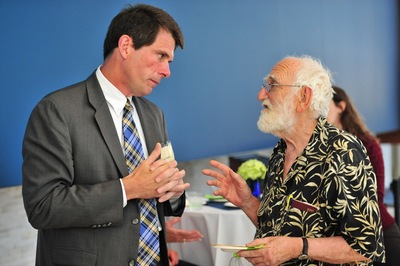
Powers speaks with a resident during a meet and greet event last summer when he was being interviewed for the city administrator position.
Ryan J. Stanton | AnnArbor.com
AnnArbor.com: The city has a lot on its plate right now. Several initiatives related to transportation are under way, including a train station project and efforts to morph the city's transit authority into a countywide system. In your opinion, what are the biggest issues facing the city?
Powers: The biggest issue that I see is that balance between continuing to deliver the services that the community expects and looking ahead and making sure the long-term and communitywide needs and opportunities of the city are being considered. The immediate, every-council-meeting type of issues and then the longer-term issues such as a train station that will take years to develop.
So I think that's Ann Arbor's challenge. Certainly we have day-to-day immediate challenges. Crime is always going to be an area that always needs attention.
AnnArbor.com: You passed on holding what traditionally had been an annual city budget retreat shortly after you started last year. I know the budget process for fiscal year 2013-14 and beyond starts soon. Can you offer a look ahead at what to expect?
Powers: Council has indicated an interest in having a retreat. The council's budget committee is developing the framework for that. So sometime later this fall there will be a planning session. I expect the council members will want to talk about the priorities for the next two years. And I expect there will be discussion regarding safety services, discussion regarding capital improvements, discussion about what is important. And as part of that, we'll have some updated financial projections.
AnnArbor.com: Is the city in good shape financially? Are there any services that might be on the chopping block? Are there any services you expect to see enhanced?
Powers: I'm not anticipating any need to cut services because of the budget, and I'm not able this morning to share where there might be add-backs.
AnnArbor.com: Your budget this past year held the line on further cuts in police and fire. Some people still would like to see more police officers and firefighters hired in the next budget. Is the city appropriately staffed right now in terms of public safety?
Powers: If the definition of appropriate is to be at staffing levels that were in place years ago, no. If appropriate means are we staffed to provide services to protect the community, yes. We have more police officers on the road than we did a year ago. Fire is able to respond to calls for service. One of the areas that I plan on looking at in the next 12 months is what level of resources, what level of staffing, what budgets are appropriate for police, fire and really any city department.
AnnArbor.com: There's a series of public meetings coming up on the fire department reorganization proposal. You previously endorsed the fire chief's plan to close stations. What are the latest discussions around that and how likely is it those changes will be implemented?
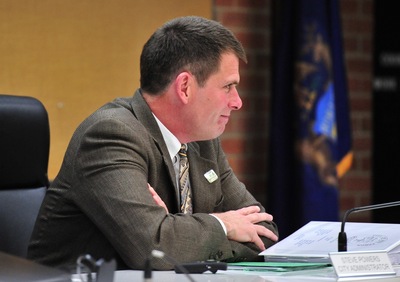
Powers has had to sit through many late-night City Council meetings since becoming city administrator a year ago.
Ryan J. Stanton | AnnArbor.com
AnnArbor.com: One hope when you were hired was that you could help restore the relationship between the city's administration and the labor unions. What progress has been made on that front?
Powers: One of the priorities for me was to get out and meet with employees. I've met with most of the union leadership. I made a point to go out and meet with each of the public service units. I've done police ride-alongs, fire ride-alongs. I certainly made a point to sit down with the fire union president and the police union president. I've very much had an open, accessible style. Employees have, I think, felt comfortable to stop by and talk. It's something that needs to continue.
AnnArbor.com: Many people are interested in what happens with the North Main corridor, which is being studied by a city task force right now. The city owns 721 N. Main where there are plans for a greenway anchor park. The city also has set up a blight fund to help address other properties along that stretch. What do you see coming out of those efforts?
Powers: One of the things I'm proud of is that I helped bring forward the dangerous/blighted building process and the funding for demolition. One of our challenges as a community is continuing to reinvest to make our community strong and the city's role in helping put the markings on the playing field to help with that reinvestment, whether it's clearing off dangerous buildings, whether it's selling five downtown parcels. I certainly can't take for granted that Ann Arbor will always be a community of choice. We're fortunate that we are a community of choice for people to move to and work in, and we need to continue to improve upon that. I think the city's work with the dangerous buildings is a small but important example of that for the neighborhoods, and the five parcels is an important part of the playing field for the downtown, as are the planning initiatives we have under way.
AnnArbor.com: There is a lot of concern about the flooding issues on the southwest side of the city in and around the Lansdowne neighborhood. I know the city is looking into that. What do you see as the likely outcome? Are we going to solve the city's flooding problems once and for all?
Powers: No. Stormwater really requires a systems response, and the system has many pieces. Each piece needs to be evaluated and each piece needs to be planned carefully so we're not making the flooding situation or basement backup problems worse. There is always a bigger storm, which is really why I said we're not going to solve the problem. I think we can make improvements, but will there never be flooding in Ann Arbor? No, I can't say that. We have some challenging topography.
Development decisions of the past, development decisions made by previous generations of city councils or planning commissions, have added to the topography challenges. Building has occurred in floodways, stream beds, so it really requires a systems approach and our goal is to reduce the frequency and severity of flooding. But can we prevent flooding? No.
AnnArbor.com: Our last city administrator, Roger Fraser, stayed on the job close to a decade. Could you see yourself staying here that long?
Powers: Potentially. I'll stay as long as I'm adding value — as long as I'm contributing something positive to the organization and to the community, and as long as City Council will have me. If they think I'm doing a good job, and if I think I'm doing a good job, that's what's important.
Ryan J. Stanton covers government and politics for AnnArbor.com. Reach him at ryanstanton@annarbor.com or 734-623-2529. You also can follow him on Twitter or subscribe to AnnArbor.com's email newsletters.
Comments
Alan Goldsmith
Mon, Sep 17, 2012 : 10:26 a.m.
"There is always a bigger storm, which is really why I said we're not going to solve the problem. I think we can make improvements, but will there never be flooding in Ann Arbor? No, I can't say that. We have some challenging topography." I don't think anyone ever asked if the City if they could make sure there was no flooding ever Mr. Powers. Nice little dance there around the issue of flooding in the 4th Ward.
timjbd
Mon, Sep 17, 2012 : 2:28 p.m.
Developers were allowed to build, and people bought, houses over an underground stream (system). Damage done. Caveat emptor.
snapshot
Mon, Sep 17, 2012 : 2:17 a.m.
A budget retreat? does that mean an all expense paid wek on Makinaw Island doing what council could be doing in a city boardroom without all the additional expense on the taxpayers dime. what damage has been done to unions? the fact that unions did not "get what they wanted" is considered "damages". What about having "open meeting" union negotiations with the public invited to argue on their own behalf. After all, public employees serve the public so we citizens should have a say, or at least know who wants what, and why. That unions support politicians in their elections and campaign funding, and then sit down at the "negotiations" table in secret does not instill confidence in me that the "public" is getting the best deal. It stinks of the "public' getting the shaft. Who's responsible for repairing the damage that has been done to the public trust and confidence in our public employees?
snapshot
Tue, Sep 18, 2012 : 4:02 a.m.
Thanks Ryan....that's one issue i feel better about.
Ryan J. Stanton
Mon, Sep 17, 2012 : 2:24 a.m.
No, it's a little more modest than that. The city's budget retreat is an all-day meeting in a small room over at the city's maintenance facility.
LXIX
Sun, Sep 16, 2012 : 11:38 p.m.
Mr. Powers, a man of action. I like it. Difficult position to be in but it seems that he is holding his own in this good old smooze town. Not so sure about being eager to sell off land and promote 'choice' like more development for some and moving away for others - although the city has a nack for annexing virgin land (look out township Scio, Pittsfield, Ann Arbor, Ypsi....). Wise enough to know the city is not out of the economic turmoil still yet to come.
Kai Petainen
Sun, Sep 16, 2012 : 11:03 p.m.
great interview. seems like he is doing a decent job, but perhaps i'm just behavioral biased to those from the UP (i'm from the soo). this is a fantastic answer, as it shows great 'health' in the city: "What surprised me, and it's a pleasant surprise, is the intensity of people's interest in the community in what's happening in the city. I had been told that Ann Arbor values process, that there is an active citizenry, but I guess what surprised me was the level and intensity of that interest."
Kai Petainen
Sun, Sep 16, 2012 : 11:17 p.m.
"I certainly can't take for granted that Ann Arbor will always be a community of choice. We're fortunate that we are a community of choice for people to move to and work in, and we need to continue to improve upon that." that's a humble answer, and it's nice to hear someone who doesn't take it for granted.
brimble
Sun, Sep 16, 2012 : 2:56 p.m.
Mr. Powers seems to take the right approach -- a realistic one -- on many topics. He is uniquely positioned to help the wayward politicians who keep making news focus on the real, fundamental issues facing the City government: supporting police and fire, managing water, stormwater, and sewer challenges, and maintaining the fundamental infrastructure of the City. Good luck to him as he continues to pursue those endeavors.
RUKiddingMe
Sun, Sep 16, 2012 : 2:31 p.m.
I wonder if Mr. Powers can enlighten us (or A2.com) as to the benefits provided to the city by SPARK, who will apparently get a boost from a proposed INCREASED enonomic development millage. And so will its SISTER company (which I had not known about) SPARK East, which is apparently the Ypsilanti citizenry money siphon. Readers need to read this: http://annarborchronicle.com/2012/09/13/county-tax-hike-for-economic-development/ And then tell your friends.
RUKiddingMe
Sun, Sep 16, 2012 : 2:33 p.m.
Worthy of note, I think is that this increased millage would NOT require a vote from residents; if they decide to do it, it's done. And what reason do they have to NOT do it?
Jim Osborn
Sun, Sep 16, 2012 : 2:22 p.m.
I'd like to know why in so-called "Tree Town" why so many trees are dying due to the drought, and the city has not adequately watered the ones in their parks or street medians? While these young trees are dying, they continue to expend money to plant new ones. I grew up in Southern California, where it never rained during the summer, yet I never saw trees dying. The parks pays someone to spray Agent Orange along the edges of dormant grass instead of shifting their tasks to caring for the trees that they paid to plant. I'm sure they could have rented a water truck instead of fixing the fountan in front of city hall. That could wait, now they need to chop down dead trees.
Brad
Sun, Sep 16, 2012 : 1:29 p.m.
You people want answers to real questions? You'll notice that they worked in the train station, the transfer of the AATA to the county and the N. Main corridor. Right on script.
SonnyDog09
Sun, Sep 16, 2012 : 12:40 p.m.
Why no questions about unfunded retiree pension and healthcare obligations and how he sees that impacting the budget in the future?
Stephen Lange Ranzini
Sun, Sep 16, 2012 : 11:51 a.m.
@Ryan Stanton: why no question, for example, why has city council never passed a conflict of interest policy governing its activities despite discussing it for nearly a decade?
Stephen Lange Ranzini
Sun, Sep 16, 2012 : 11:29 a.m.
Why no question Ryan on questions about conflicts of interest in City Hall or transparency? For example, why no questions about the illegal gag order on the fire fighters and whether or not Mr. Powers supports that.
Kai Petainen
Sun, Sep 16, 2012 : 5:05 p.m.
fascinating... thanks Stephen...
Stephen Lange Ranzini
Sun, Sep 16, 2012 : 4:10 p.m.
@Kai Petainen: The fire chief has illegally ordered all firefighters not to talk to members of the press. See www.annarbor.com/news/ann-arbor-officials-taking-step-back-from-closing-two-fire-stations/ and www.annarbor.com/news/opinion/ann-arbor-city-council-and-school-board-both-need-lessons-in-open-government/#.UFX5VBB5mSM
Kai Petainen
Sun, Sep 16, 2012 : 1:04 p.m.
"illegal gag order on the fire fighters" ? there is a gag order on the fire fighters? i don't remember hearing about that.... ? or did i miss something in the news?
Stephen Lange Ranzini
Sun, Sep 16, 2012 : 11:27 a.m.
"Powers: If the definition of appropriate [staffing in fire and police] means are we staffed to provide services to protect the community, yes. ... One of the areas that I plan on looking at in the next 12 months is what level of resources, what level of staffing, what budgets are appropriate for police, fire and really any city department." How about telling us how the fire and police departments are performing versus the metrics laid out in the budget? The fact that we have no statistics despite the fact that the budget calls for them to be analyzed monthly, hints at the real answer.
a2grateful
Sun, Sep 16, 2012 : 11:13 a.m.
Mr. Powers is an excellent administrator for the city. The mayor and council got it right in his hire. We are fortunate to have him.