

Ann Arbor's new city administrator faces daunting task of restoring trust with unions
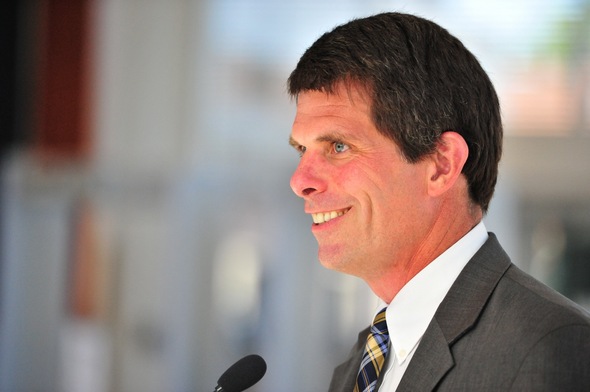
Steve Powers, Ann Arbor's new city administrator, has his work cut out for him to restore trust between the police and fire unions and the city's administration, but he brings plenty of experience in labor relations from his previous jobs and says he's up for the challenge.
Ryan J. Stanton | AnnArbor.com
Powers, a 49-year-old Illinois native, has a lot to learn about Ann Arbor. Things like: Green is important. Transportation doesn't necessarily mean a vehicle. And translucent isn't transparent enough — not to the watchdog citizens surely to scrutinize his every move.
But that's the easy stuff.
Powers, who will receive a $145,000 base salary, also faces the unenviable task of trying to reconcile differences with the city's labor unions — particularly police and fire, which have had contentious relations with the city's current leadership. To put it simply, they saw Ann Arbor's last city administrator, Roger Fraser, as an adversary.
But where Fraser's administration fell short in finding common ground with the city's public safety unions, Powers has a new chance to succeed.
Coming from Marquette County, where he served as county administrator for the past 15 years, Powers has the distinct advantage of being a fresh face. But more so, it's going to be his actions in his first few months on the job that determine whether trust can be restored between the public safety unions and city administration in Ann Arbor.
"I would certainly work toward building trust and earning the respect of the employees," Powers said. "Employees are important. They're the ones delivering the services."
Ann Arbor officials stressed during the recent search process they were looking for an administrator who could communicate well with employees, be a consensus builder and manage in an aggressive collective bargaining environment.
Ann Arbor has eight collective bargaining units and close to 200 of the city's 700-plus employees are represented by the police and fire unions.
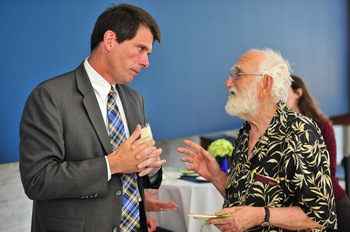
Powers talks with resident Max Heirich, a retired University of Michigan professor, during a public reception for city administrator finalists earlier this summer.
Ryan J. Stanton | AnnArbor.com
Mayor John Hieftje said it was important that the city's next administrator possess the skills necessary to deal with the unions. He said it wasn't a goal to bring in someone from outside the city, but it could make a difference.
"But we have a very good negotiating team that does its best here already, so it's more of a meshing in," he said.
Representatives of both the police and fire unions declined to comment for this story.
To date, the city has been unable to achieve the kind of concessions it has wanted from its public safety unions, and negotiations with both police and fire are now in binding arbitration. As a result of those standstills, many jobs have been eliminated, and police and fire services have been impacted.
In recent years, when city budget cuts came down and deep cuts to public safety were exacted, Fraser was seen as the guy left holding the ax. The city reduced its work force by 30 percent during his nine-year tenure and the unions weren't happy.
Not helping matters were situations like what happened in February 2010. Just three weeks after firefighters agreed to voluntary concessions that included a 4 percent reduction in compensation, which they hoped would save jobs, they were told by Fraser and his administration that six more positions than previously expected were slated to be cut.
One representative of the firefighters union put it this way at the time: "That's like doing a guy a favor and having him come back and hit you with a baseball bat."
During his tenure in Marquette County, Powers worked closely with eight collective bargaining units and seems to have earned a reputation for being a consensus builder.
Sgt. Dave Kent, past president and current vice president of the union that represents sheriff's deputies in Marquette County, had only good things to say about Powers.
"Steve has been good to work with," he said. "He's always been fair, he's been up front with us, he lets us know what's going on. There hasn't been any surprises. He's been pretty open."
Kent said several deputy positions were cut from the budget about eight years ago, and the union also has had to make some concessions, yet he still praised Powers.
"We have had our falling out on a couple of different things, but I wouldn't say anybody disliked him. He helped out in a lot of different ways," he said, adding the sheriff's deputies union never had to go to binding arbitration to resolve a contract dispute under Powers.
"You could work with him," he said. "He's done far more good for this county than harm at any point. And really, in the end, we hate to see him go."
In addition to his time in Marquette, Powers brings experience from his days in Oregon where he was an assistant county administrator responsible for human resources, labor relations, risk management and organizational development.
"In Michigan and Oregon, I've probably negotiated and been part of 50 labor contracts," Powers told AnnArbor.com in an interview earlier this summer before being hired. "We have eight bargaining units in Marquette County, so I have extensive experience in labor relations with collective bargaining. I sit at the table with three of the groups. I would sit at the table with all of them if that was helpful, so I have hands-on experience."
In Ann Arbor, the human resources director and a city attorney sit at the negotiating table. Depending on the union and the discussion, other city managers might get involved.
Powers said his office was in charge of administering labor contracts in Marquette, so he was involved in day-to-day dealings with grievances and other issues that came up.
"My style in Oregon, which I've continued in Michigan, is one of collaboration — being as open as possible with information," he said, adding he also prefers to deal with issues before they become grievances and to deal with grievances early "so they don't fester."
Powers, who oversaw 240-plus employees, reports success in negotiating concessions and notes most Marquette County employees have had their pay frozen for two years.
Asked to cite a specific example of a savings he helped achieve, Powers pointed to a health insurance coalition the county formed in 2005 where all the bargaining units came together to explore options and set up a consistent and sustainable health plan for all employees. He said the approach helped contain health insurance increases.
"The 2006 health insurance premium was $500,000 less than 2005, despite an increase in the number of covered individuals," he said.
Powers knows he's stepping into a contentious environment in Ann Arbor, but he's hopeful an open and honest approach can restore lost faith.
"It's challenging in local government and employees feel the brunt of those challenges," he said. "And I think the employer, whether it's a city or county, needs to be sensitive to that and needs to try to work toward identifying those common interests.
"So I think I certainly bring a new face, a fresh face, and I think I would bring a style that would be more collaborative than combative. Whether that would be successful, that I don't know."
Ryan J. Stanton covers government and politics for AnnArbor.com. Reach him at ryanstanton@annarbor.com or 734-623-2529. You also can follow him on Twitter or subscribe to AnnArbor.com's e-mail newsletters.
Comments
snapshot
Fri, Sep 16, 2011 : 2:58 a.m.
First, the AFSCME did NOT take major cuts, they were coddled with minimal cuts before a state law took prcedent that would impose major cuts. A complete betrayal of taxpayers not properly represented by elected officials. Second, Steve Powers is not responsible for "building trust" with the unions, the unions should be building trust with administation. Third, 8 collective bargaining units is absolutely ridiculous. What the hell is going on? These folks all work for the government, there's ONE government, why multiple unions? It's time to streamline. We need to rein in the unbalanced power that these unions wield. It's unfair that the miniority is responsible for the majority of debt. Washtenaw county pension funds are 240 MILLION dollar short. Michigan is 54 BILLION dollars short in pension funding. Who's going to pay? Unions need to go away. They are making a mockery of democracy!
Macabre Sunset
Thu, Sep 15, 2011 : 6:44 p.m.
Umm... union leadership is set up to be an adversary with any employer. Anything less, and you get the sweetheart deals that are bankrupting our country. It's the union's choice, unfortunately, whether we have adequate fire and police staffing. So far, they have chosen to keep those with seniority bathed in luxury at the expense of jobs for others and the public safety.
Tom Todd
Thu, Sep 15, 2011 : 2:10 p.m.
Awesome now I can make a million as a city manager(delast)
DaLast word
Thu, Sep 15, 2011 : 2:02 p.m.
Groups that are paid with tax payers money shouldn't be allowed to unionize, plain and simple!
Jhonny
Thu, Sep 15, 2011 : 5:06 p.m.
nowwayjose Nobody says that hurt the general fund. Fundementally it is wrong for public employees to form unions. Read Mike article above. Also nobody said the city would pay the whatever they want. Prevailing wages would be used.
nowayjose
Thu, Sep 15, 2011 : 4:53 p.m.
Sure it's the unions that hurt the city's general fund not years of mismanaged government and a bad economy. We should allow the city to pay the fire dept and police whatever they want. That way we can have a corrupt and inept safety services.
Mike K
Thu, Sep 15, 2011 : 2:47 p.m.
I think FDR agreed too. "It is impossible to bargain collectively with the government." <a href="http://www.nytimes.com/roomfordebate/2011/02/18/the-first-blow-against-public-employees/fdr-warned-us-about-public-sector-unions" rel='nofollow'>http://www.nytimes.com/roomfordebate/2011/02/18/the-first-blow-against-public-employees/fdr-warned-us-about-public-sector-unions</a>
Jhonny
Thu, Sep 15, 2011 : 2:24 p.m.
I agree 100%. As it is, the current employees feel like they are being taken advantage of. If prevailing wages and benefits were used, neither the tax payer or the union would feel victimized.
KeepingItReal
Thu, Sep 15, 2011 : 1:21 p.m.
In response to the headline, what about restoring the trust with the people who pay the bill to run the city.
Mike K
Thu, Sep 15, 2011 : 2:46 p.m.
A+ KeepingItReal. That goes for State and Federal Governments too.
Stephen Landes
Thu, Sep 15, 2011 : 1:48 p.m.
That's really keeping it real.
Craig Lounsbury
Thu, Sep 15, 2011 : 12:30 p.m.
God help us if the City Administrator and the Unions are on the same page.
Craig Lounsbury
Thu, Sep 15, 2011 : 5:46 p.m.
or or God help the private sector workers who pay the public sector workers paychecks if the attack on the middle class continues....which it will because we are in a world economy where the American middle class is doomed to find a middle ground with the third world. So as the American middle class makes less and less and chips in more and more for their benefits can we expect them to also pay more and more in taxes so the public sector can remain insulated from the private sector realities
CincoDeMayo
Thu, Sep 15, 2011 : 3:37 p.m.
Or, (God) help protect these workers and families if they are not on the same page.
Goober
Thu, Sep 15, 2011 : 11:30 a.m.
We welcome this new face and position with our city leadership team. Now all we need to do is replace our mayor and all of city council so we have a clean slate of new faces leading the city. This would be a welcome start to rebuilding core values.
Mike K
Thu, Sep 15, 2011 : 2:45 p.m.
That would be nice Goober, but Ann Arbor is a one party town. All the new faces on council would gravitate to the same spot eventually. Maybe I'm cynical?
Alan Goldsmith
Thu, Sep 15, 2011 : 10:18 a.m.
"But we have a very good negotiating team that does its best here already, so it's more of a meshing in," he said. The Mayor, once again, is clueless. His 'good negotiating team' has gotten us to the point of Union and CIty Employee bashing, all under his 'leadership'. If that's 'doing its best', either he's being dishonest or he's so out of touch with political reality it's pathetic.
ToddGack
Thu, Sep 15, 2011 : 2:10 p.m.
He is also dishonest
Stephen Landes
Thu, Sep 15, 2011 : 1:47 p.m.
I vote for completely out of touch.