

Borders' expansion hastened its implosion
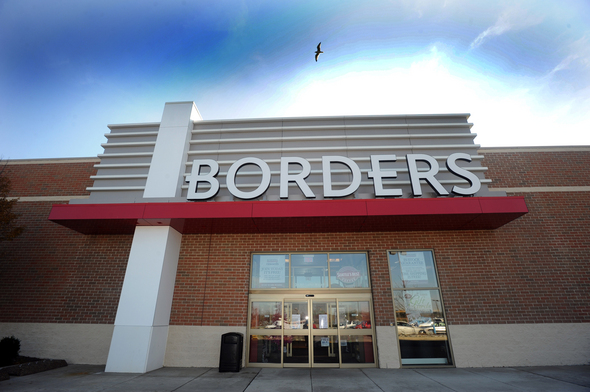
Borders stores — such as the concept store the company opened on Lohr Road in Pittsfield Township in 2008 — averaged about 25,000 square feet.
File photo | AnnArbor.com
You can plausibly fault the company’s executives, its competitors, the Internet, electronic books or even our culture itself.
But the biggest single reason for Borders’ fall was its rise. Its rapid expansion.
Borders liquidating
- Borders plans to liquidate, ending 40-year-old bookstore chain
- Column: Borders' expansion hastened its implosion
- Borders' rise and fall: a timeline of the bookstore chain's 40-year history
- What's next for downtown Ann Arbor Borders store after chain closes?
- Downtown store closure also means a loss of arts and music venue
- Expected closure of Borders superstore in Pittsfield Township leaves shopping center with vacancy
- Disappearing act: Borders brothers nowhere to be found
- Residents express disappointment and sense of inevitability at closing of flagship Borders store
- Read Borders CEO Mike Edwards' letter to employees announcing liquidation
- Media watch: What other news sites are reporting on the Borders liquidation
- Share your memories of Borders' 40-year heritage in Ann Arbor
Much of the coverage of Borders’ liquidation — which the company announced Monday after five months of navigating Chapter 11 bankruptcy — is sure to center on the role of e-books in weakening Borders.
And, to be sure, it’s probably fair to say that e-books crushed any hopes Borders still had of staying alive.
And, yes, the company’s decision to outsource its online sales to Amazon.com in 2001 was a shocking blunder that the company was never able to recover from.
But the company’s descent can be traced back to the corporate expansion that started after founders Tom and Louis Borders sold the 21-store chain to Kmart Corp. in 1992. The Borders brothers left, Kmart combined Borders with its Waldenbooks unit and the new company went public in 1995 under CEO Robert DiRomualdo.
By that point, Borders already had 158 superstores, averaging $259 per square foot in annual sales, according to Securities and Exchange Commission filings. Borders’ sales performance peaked at $261 per square foot in 1997 when the company had 204 superstores.
Then the sales decline started — but the expansion continued. In fact, Borders didn’t stop adding stores until 2007, a decade after its sales per square foot peaked. By 2009, sales per square foot had tumbled to $173, some 33.7 percent less than its peak 12 years earlier.
“They failed to recognize that the company needed to be downsized,” said Jim McTevia, a turnaround consultant with Bingham Farms-based McTevia & Associates.
Borders superstores
This table shows the rise in the number of Borders superstores at the end of each fiscal year and corresponding fall in the average sales per square foot of those stores in the years since the company's 1995 initial public offering, according to U.S. Securities and Exchange Commission records.
- 1996: 158 superstores ($259 average sales per square foot)
- 1997: 204 ($261)
- 1998: 256 ($256)
- 1999: 300 ($255)
- 2000: 349 ($255)
- 2001: 385 ($245)
- 2002: 434 ($237)
- 2003: 482 ($223)
- 2004: 504 ($227)
- 2005: 528 ($232)
- 2006: 567 ($236)
- 2007: 541 ($228)
- 2008: 518 ($203)
- 2009: 511 ($173)
A little bit of basic calculus could’ve stopped Borders from expanding too quickly. Borders was so focused on just increasing revenue that it apparently never paused to examine the percentage change in its revenue increases. That is, revenue was still increasing — but the pace of the revenue increases was falling, an early indication of troubles.
Put it simply: Borders got too big, too fast.
Once it became obvious that Borders' store footprint was too large, the company was locked into hundreds of expensive leases that extended beyond 2017. Borders was paying $1 billion in annual rental costs when it filed for bankruptcy.
Bankruptcy helped the company shed unprofitable leases, but the company was still relying on a broken business model centered on massive physical stores.
When the Internet emerged as a legitimate sales opportunity, Borders was too focused on running 25,000-square-foot superstores instead of pursuing new market opportunities.
And by the time e-books came onto the scene, Borders didn’t have the cash to invest in its own e-reader.
“The failure to recognize the transition of the industry, the failure to downsize their retail operations, and exit the mall” store business were key mistakes, McTevia said.
In a rare interview in May, Borders Group Inc. President Mike Edwards — CEO of the company’s bookstore unit, who joined the company two years ago — said Borders fell prey to the superstore rush of the 1990s.
Opening more stores, he said, “hides a lot of sins.”
The consequence of those sins is now painfully obvious.
Contact AnnArbor.com's Nathan Bomey at (734) 623-2587 or nathanbomey@annarbor.com. You can also follow him on Twitter or subscribe to AnnArbor.com's newsletters.
Comments
Elaine F. Owsley
Wed, Jul 20, 2011 : 11:38 a.m.
You would have thought early on someone would have seen the correlation between sales drop and store numbers. Bigger is not better. Better is better, or at least at the quality you've become known for.
A2comments
Wed, Jul 20, 2011 : 11:31 a.m.
Well written. Same thing (rev per sq foot falling) has been going on at Sears/KMart for years.
hermhawk
Wed, Jul 20, 2011 : 11 a.m.
Lots of groups, especially the far right and especially the tea party, blame big government and spending for the country's ills. Corporate America however, is not immune either. Business, like government and individuals, need to live within its means as well. The Borders fiasco should be a lesson in that matter. Once the Borders brothers sold, greed set in with those who ran it from that point. That is why I lean toward doing business with smaller, privately owned firms who prefer to stay lean and are intimate with their customers, something clearly lacking in large, publicly owner companies.
talker
Wed, Jul 20, 2011 : 3:35 a.m.
Dangers became apparent many years ago when I'd see people reviewing books at Borders and say they'd buy their books through Amazon. I recall saying that if they did that, Borders wouldn't be around for them to review physical copies of books. I know someone (wealthy) in a large city who bragged about lounging at Borders and reading books there instead of buying them. It was just a comfortable library to some people, but it was obvious that in order to maintain that comfortable atmosphere, knowledgeable staff, and thousands of books there had to be enough revenues and sufficient profits. Now, we need to push for a fair playing field for other local businesses and on-line businesses. I've heard that the profit margin on some items such as televisions is about the same as some sales taxes. Thus, by not collecting sales taxes, on-line merchants can afford to beat brick and mortar retailers on price. This robs localities of jobs and in some cases local entrepreneurs are prevented from starting and growing businesses. We need to require on-line merchants to collect sales taxes and give them to state government and ignore threats that on-line businesses will take away jobs. Actually, the jobs they "kill" are those of local brick and mortar businesses.
Cendra Lynn
Wed, Jul 20, 2011 : 2:03 a.m.
You've missed it by a mile! Borders failed because it forgot its mission: to be a great bookstore. The reason Borders succeeded was twofold: books and knowledge. They not only knew all the answers on the test one had to pass before being hired, they were all readers. Going to Borders was a way to wallow in literature and non-fiction. You could spend all afternoon just browsing one section. The reference books were to die for. They carried books not because they were selling well, but because they were good or important or piqued the interest of customers or the staff liked them. Staff comments on books were influential because of the high quality of those readers. The store did not sell kitch and shlock. They didn't have a coffee shop; they didn't try to sell music nor would they have sold dvds and games if they'd existed then. All the hubbub about Amazon and kindles and online selling was not the problem. Rapid expansion and greed is a duh, but not the actual cause. The problem is that they tried to be a bookstore that wasn't interested in books any longer. One by one they got rid of the books and rid of the staff. They brought in management that wouldn't know a bookstore if they were held captive in one for a week. When they got rid of Joe Gables and then threw out the dogs, that was it. They might as well have liquidated then, because that was the error of no return. As business management is supposed to know: never forget your mission. As soon as you stray from your mission, you begin to degrade. I doubt one of the CEO's could have passed the Borders test. Steps one to infinity are do what you say you are doing, and let none of your staff betray your mission. It's not simple to do, but if you build it they will come. Disney's revivals after stumbles are due to returning to it's three-word mission statement: to create happiness. Borders lost its way when it stopped trying to be a great bookstore.
Kai Petainen
Tue, Jul 19, 2011 : 8:50 p.m.
Nathan... nicely done. Fast growth can certainly lead to problems...
Tru2Blu76
Tue, Jul 19, 2011 : 8:20 p.m.
I don't accept that online book purchases are economically beneficial to the customer: there's added shipping cost in many cases *unless you buy above a certain level in dollars*. Also - the shipping itself is a problem for many - who don't like being tied to the big carriers' delivery schedules. I do (did) very much like ordering and reserving books from Borders online - then walking to the store for a nice browsing session before picking up my purchases. That one feature beats the pants off of Amazon or any other online retail operation. I weaned myself from the notion that "Borders Books" was the original store I loved so long ago. Borders Books is just a name - behind that name are people we've never met personally and they have done things we'd never have approved in the first place IF Borders Books was still a hometown book store. Overall: this analysis seems to fit and provides all the explanation of What Not To Do for businesses: not that I expect any of them to pay attention.
tim
Tue, Jul 19, 2011 : 5:54 p.m.
Things change fast today. Boarders was just to slow on their feet to adjust. They would have had to take on the Amazon model years ago ( when they were more credible as a book store).
Orangecrush2000
Tue, Jul 19, 2011 : 5:14 p.m.
Corruption at the management level, I'd say. But, that's just my opinion.
snark12
Tue, Jul 19, 2011 : 5:13 p.m.
There just isn't much of a future for taking an information product (book, music, video, software, etc.), printing it or burning it on plastic, wrapping it in a box, shipping it in a truck, and letting it sit in a building to be watched over by humans. That ultimately includes things ordered over the net and shipped via Fedex from a warehouse. Ultimately all of that will be downloaded.
dotdash
Tue, Jul 19, 2011 : 5:07 p.m.
It seems as if Amazon.com was the iceberg, but by the time they saw it, the ship was too big and unwieldy to turn. (cue the life boats)
15crown00
Tue, Jul 19, 2011 : 4:55 p.m.
get big,get bigger QUICK,QUICK !go out of business.So BE IT
tommy_t
Tue, Jul 19, 2011 : 4:46 p.m.
Talentless, Knuckle-Headed, uninformed, out of date, unimaginative, slow to respond, direction from the top. Period
KJMClark
Tue, Jul 19, 2011 : 4:38 p.m.
This is funny. The economists point out the higher margin disadvantage of having to collect sales tax on every transaction. The real estate analysts point out the large amount of real estate and high rents. Management experts point out the rapid changes in top management. The technologists point out the lack of ecommerce. Nathan pulls out the business analyst case that it was a mismatch between expansion and sales rates. I like Edward's take on it too - bubble mentality. Yup, all of the above. I still go back to see why their sales were declining - and find that Amazon in particular was eating their lunch, especially of new media. That strikes me as the tax cheat explanation at the root of the problem, since online transactions are *very* sensitive to price, and that 6-8% extra on every transaction is a killer. Nathan had me going for a second with the "basic calculus" bit - I'm thinking "I bet you meant arithmetic; what would they be deriving or integrating?" But then he actually used a derivative to make the argument. Excellent! I'm still thinking Barnes & Noble's days are numbered. I expect Amazon and their tax cheating to kill off major competition on any shippable consumer items, as well as most electronic media. But to the extent B&N is still viable, the management/growth rate/bubble-mentality problems explain a lot.
Jeff Frank
Wed, Jul 20, 2011 : 9:39 p.m.
This Amazon customer really doesn't care if they have to collect the sales tax. It's about the convenience and the base price of what I'm buying. Free shipping over $25 more than makes up most of the sales tax difference so that certainly isn't going to drive me away. If I need something today or even a couple days from now, I go looking locally but if I have a week or two I'll shop online and save gas, time and frustration.
Tom Joad
Tue, Jul 19, 2011 : 4:06 p.m.
Amazon
Steve in MI
Tue, Jul 19, 2011 : 4:05 p.m.
Well done, Nathan; dead-on analysis.
Elaine F. Owsley
Tue, Jul 19, 2011 : 8:15 p.m.
And it isn't like there weren't examples of the folly of fast growth without knowing where you were going.
81wolverine
Tue, Jul 19, 2011 : 3:54 p.m.
Personally, I'll be sad if Borders going under is a trend and most other bookstores go out of business. I have always loved shopping in bookstores. Amazon can never recreate the experience of exploring the shelves of actual physical books and discovering new, interesting titles to learn about. I'd like to think there's room for both (online and offline) in the marketplace. Maybe I'm old school.
KJMClark
Wed, Jul 20, 2011 : 3:42 a.m.
"Amazon can never recreate the experience of exploring the shelves of actual physical books and discovering new, interesting titles to learn about." Actually, yes, it can. And that's one of the nicer features they've added in the past few years. It includes both "Related Items" and "Customers who looked at this also viewed". Sometimes it also includes a "after looking at this, people actually bought" section. We don't buy many books at Amazon, but we do buy a decent amount of our small electronics and odd items there. I've been looking for a replacement head for a high-volume bike pump there, for example. I think brick-and-mortar small bookstores could still do fine, but the tax cheating on Amazon's part really should end. I don't think the world needs any big-box book stores (excepting maybe Powell's in Portland - that place is a tourist destination!) If Amazon had to collect sales tax and (sometimes) charge for shipping, like it's supposed to, there would be a level-enough playing field for small bookstores to carve out a niche.
snark12
Tue, Jul 19, 2011 : 5:16 p.m.
Yes, Mick, they could have bid but the tax consequences prevent them from considering it.
Mick52
Tue, Jul 19, 2011 : 5:10 p.m.
Snark, isn't Amazon in place now to be a "buyer" of Borders?
snark12
Tue, Jul 19, 2011 : 5:08 p.m.
Amazon fights hard to avoid paying any state sales taxes, which it feels will hurt its business. It just shut down its California affiliate program, for instance, rather than pay sales taxes in that state. Physical stores would create a tax nexus with any state with a store and could cost them business. Eventually all states will charge an Internet sales tax, something I think Amazon cannot avoid forever, and maybe they'll open stores at that time. I've thought for the last few years that Amazon could have been an attractive buyer for Borders. But the tax consequences would have been far more expensive than the actual acquisition.
Mick52
Tue, Jul 19, 2011 : 4:43 p.m.
Interesting point 81. I fear with some time, bookstores will go the way of record stores and DVD stores like Blockbuster due to technology and the internet. There is a good book on the topic, "The Cult of the Amateur," by Andrew Keen. Mr Keen was very fond of a Tower Records store in San Francisco that closed in part due to the ease of downloads. Many other jobs have been discontinued by the advent of certain types of machinery, technology and advancements like you scan check outs at stores, on line news service (like this one) etc. The impact of technology and the internet on unemployment is a factor that is not often brought up. I have not purchased any music for years from a real person. I prefer reading from printed media but I imagine that the younger generations will determine how future reading will be delivered.
Anthony
Tue, Jul 19, 2011 : 4:07 p.m.
It wold be interesting to see if Amazon doesn't fill the void of physical stores once the competition goes bottoms up. What is really stopping them from creating a Apple Store like platform for cheap books, movies, DVDS, and other products? Is it viable? Probably not, but it is a good idea as many readers still want that store experience. Doubtful though...
Justin
Tue, Jul 19, 2011 : 3:20 p.m.
I might add that the concept of adding TVs, music download stations and filthy bathrooms didn't help either.