

Year of unemployment helped Al Borges create his Denard Robinson-led Michigan hybrid offense
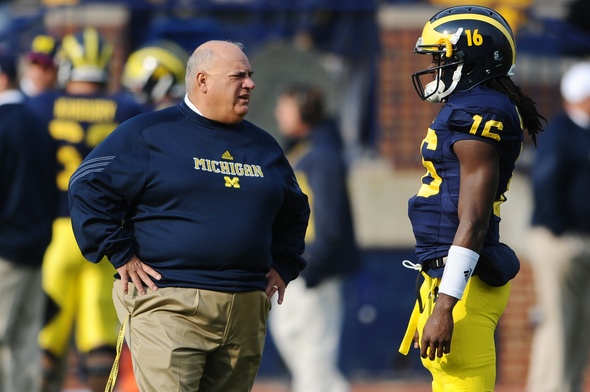
Al Borges, left, was out of work in 2008. He spent that year studying the spread offense. In 2009, he joined forces with Brady Hoke and two years later inherited Denard Robinson, right, one of the most prolific spread quarterbacks in college football history.
AnnArbor.com file photo
Al Borges took over as Auburn's offensive coordinator in 2004, and promptly guided the Tigers to a 13-0 season. They led the SEC in scoring.
Just three years later, as Borges' offenses floundered, he was out of a job -- and nobody wanted him. So for the first time since 1981, he was out of college football.
He didn't sail off into the sunset, though. Instead, he cracked open the books, queued up some film and called a few colleagues.
He was studying the spread offense.
Borges has always been a West Coast offense kind of guy, and had no intentions of changing that. But he saw the spread as an innovation in college football -- perhaps even the wave of the future -- and figured he could enrich himself by studying the system, even if he never employed it.
Turned out to be a sage move.
He hooked up as Brady Hoke's offensive coordinator at San Diego State in 2009, then followed him to the Michigan football team last year.
And, just like that, he inherited one of the most prolific spread quarterbacks in college football history.
Borges knew right away he would have to change who he was as an offensive coordinator to suit Denard Robinson's skill-set, but much of the legwork had already been done.
"When you have a player that dynamic, you make what you are work," Borges said. "If it means not running your prototypical West Coast offense, well then it means that and that’s fine.
"But I wouldn’t trade that kid for anybody."
It wasn't always easy, however, as Michigan went through something of an identity crisis. Was it a pro-style team? Or spread? Spread-option? Or some kind of hybrid?
"It took us a few games to really realize what we were," Borges said.
That partly was because Borges was insistent upon making sure his spread offense was different, if he was going to have to run it.
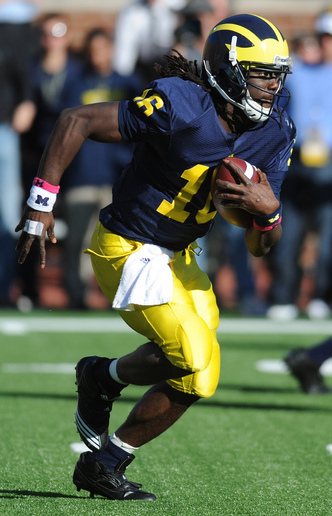
Denard Robinson's rushing numbers took a hit in 2011, as he gained 1,176 yards on 221 carries (5.3 yards per carry). In 2010, he racked up 1,702 yards on 256 carries (6.6 average), an NCAA record for a quarterback.
Melanie Maxwell | AnnArbor.com
"Belly-button spread," Borges said. "Everybody had one, right?"
Instead, Michigan developed its own unique blend of the spread and West Coast offenses. It evolved from about two-thirds spread to begin the season to more than 80 percent spread by the end.
Robinson's rushing numbers took a hit, as he gained 1,176 yards on 221 carries (5.3 yards per carry). In 2010, he racked up 1,702 yards on 256 carries (6.6 average), an NCAA record for a quarterback.
Much of that dip had to do with diversifying the offense, as Robinson went from featured runner to part of a two-pronged attack with tailback Fitz Toussaint.
Robinson's carries dropped from 19.7 to 17.0 per game.
Michigan's scoring increased from 32.8 to 33.3 points per game.
Through that process, Borges said Robinson made him a better coordinator.
"It has professionally enriched me," he said. "It’s forced not just myself, but everybody in my room to think a little more out of the box, to do a little more research."
Borges said he is not changing Robinson's target carries next year, shooting for 15 to 17 per game, although that can slide depending on circumstances.
Where the evolution will persist is in the passing game. Robinson was erratic for much of last year, completing only 55.0 percent of his throws and tossing 15 interceptions.
Borges said his top offseason concern has been preparing Robinson to limit his interceptions. They've worked on mechanics, such as avoiding throwing of the back foot, and also improving the recognition of coverages.
Their stated goal is fewer than 10 picks next year, although Borges would like to see that closer to five.
"Interceptions is an area where we were weak," Borges said. "The completion percentage was not good, either, but that didn’t kill us. That part of the game didn’t kill us.
"The interceptions can get you beat, so that’s the one area -- and I’ve talked to Denard about it -- but we have to reduce that number. ... And if we do, it will represent at least one or two more wins we may not have had."
It's been a productive relationship, both for Robinson and Borges. But the days of the spread-West Coast appear to be numbered.
Borges maintains he has no interest in running a spread offense in the long term, and already has picked up a commitment from highly touted pocket quarterback Shane Morris for 2013.
"We’re recruiting to (the pro-style offense) because we’re the most familiar with that, and we feel that’s the best way to win at the University of Michigan," Borges said. "We don’t have those kinds of players right now, so we’re going to do what we think is the best way to win at the University of Michigan.
"If it’s more spread, then it’s more spread, and that’s fine by me. This is not an identity. This is not about me. This is about our team and trying to do what’s best to win."
Kyle Meinke covers Michigan football for AnnArbor.com. He can be reached at 734-623-2588, by email at kylemeinke@annarbor.com and followed on Twitter @kmeinke.
Comments
MGoBlue1995
Tue, May 22, 2012 : 12:21 p.m.
Listen to Coach Borges' comments about Denard's evolution as a QB and you'll understand why the VT defensive scheme worked so well -- it's basically the exact same game plan that MSU has used so effectively against Denard's skill set. Borges has explained that mobile QB's like Denard have a tendency to want to break contain at the first sign of pressure, and both DC's basically brought the house on every play. Their goal was to flush Denard about of the pocket right into the waiting trap of the LB's spying him. This is defeated by coaching the QB to step up into the pocket, or get "into the fight" as Coach Borges terms in, while staying in a passing profile and keeping your eyes down field. It's understandable that Denard would react this considering he's always been the fastest player on the field and can score from pretty much anywhere. To a QB like Denard, this ability to "get into the fight" is a nuance, while to a pure pocket passer it is near instinct. I have complete faith in Borges and his staff in guiding Denard evolution. The best part about developing this new skill is that it will provide Denard with near instant gratification -- do it right, and he'll see the passing game become far easier than it was, so he'll keep doing it. Then, the opposing DC's will be in a serious bind -- they're going to have to pick their poison. If they persist in their "flush & trap" scheme to contain Denard, he and the WR's will destroy them; but, if they stop, Denard and Fitz will destroy them on the ground. All one has to do is watch the difficulties teams had against RGIII last season to understand what is (potentially) coming down the pike with Denard. I believe in Denard 100%. He's a true blue Michigan Man and I know he is right now giving everything he has to get better for Michigan. I cannot wait for the season to start. Go Blue!
Hailmary
Tue, May 22, 2012 : 9:30 p.m.
Yes, and I think Denard will be much improved this coming season. Denards future could very well rest on the 2012 season.
Hebner
Tue, May 22, 2012 : 2:12 a.m.
Some comments are off the radar because Michigan improved greatly on offense last year. This article reflects learning lessons for Al last season. He was overwhelmingly successful! You just have to know football.
Tally10
Sun, May 20, 2012 : 9:21 p.m.
What people are trying to do is force all QBs to be the same. But there's no height and weight, arm strength or speed requirements to being a successful QB. The object of the QB is to manage the offense, it doesn't matter if he throws a proper ( to some ) 50yd TD pass or run 50yds for a TD, it's still only 6 points. A good coach will tweak his offense to utilize his talent because it changes regularly in college football, some years a standout QB, some a RB, WR or even a combo, non-the-less, it's always been figuring out how to get the ball in your play makers hands. This year we have a proven QB in DR, AB needs to focus more on scripting plays for the offense he already have than DR's inadequacies or the type of offense he would like to run. SMorris and the pro-style offense has not won anything for M yet, but as I recall last year DR and the team won 10 games and a BCS bowl for the 1st year coaches.
Hailmary
Sun, May 20, 2012 : 8:50 p.m.
Whether or not Borges is the right fit at Mich. remains to be seen. If Al is not the right fit I believe he will not keep his job through to many bad seasons. It is my opinion that Brady Hoke and family like where their at right now. Brady knows that Mich. is not kind to a coach with a losing record. Brady is at the pinnacle of college football coaching which comes with high expectations on Brady. I would imagine that Brady puts the same expectations on his assist. coaches regardless of friendships.
Steve McQueen
Sun, May 20, 2012 : 8:17 p.m.
As a shorter QB, Denard has to find the "lanes" inside the offensive pocket in which to throw the ball. Some shorter QBs such as Doug Flutie or Drew Brees became very adept at making these throws. Denard was still adjusting to this last year, which is a primary reason why he sometimes threw off of his back foot. When a rusher was in his face, Denard would tend to "arc" his throwing motion to get it over the rusher... however many other times, Denard just did this when he did not need to...when he was not rushed.... there was "uncertainty" there that also lead to those bad habits.... at times Denard was uncertain whether to take off running, or let the passing lanes develop as his receivers got open downfield. Borges has Denard stepping up in to "the fight" and in to his throws as well. This will be helpful in improving Denards technique and will give defenses fits because Denard in the middle of the pocket stepping up...is a very dangerous thing to a defense. It keeps at least 1 LB home to spy him and that by itself opens up a ton of possibilities for both improvisation as well as designed patterns to take advantage of this.
Matt Patercsak
Sun, May 20, 2012 : 8:14 p.m.
this is the correct philosophy. I support the pro style. But I'm curious as to why Borges never explored the pistol formation because that offense is the definitive hybrid between pro style and spread concepts.
Hailmary
Mon, May 21, 2012 : 9:03 p.m.
Matt, didn't you teach the Pistol at a local High School ?
Scott Laux
Sun, May 20, 2012 : 7:28 p.m.
Here are some stats from 2010 to 2011. Despite having the ball much more often due to a remarkable turnaround on defense, U of M's offense declined in nearly all statistics: 2010 2011 rushing yds. 3101 2884 passing yds. 3252 2377 TD's 59 53 pTDs/ints 23/15 22/16 Even time of possession went up less than 3 minutes despite going from a defense which could stop nothing to a defense which was one of the best in the country. Also Michigan had a field goal kicker in 2011 when there was none in 2010. Remarkable how everyone is drinking the Al Borges Kool-Aid.
Steve McQueen
Sun, May 20, 2012 : 8:39 p.m.
Remarkable how meaningless garbage yards are when your team is terrible and behind. Also remarkable how your stats from 2010 under your god, included a 63 pt win vs. an FCS school. Borges offense was superior to your boy's in ever way. You can only twist stats to make it look like it wasnt, but it was. BTW 11-2 Kool aid tastes sweet when it is fresh and real and not full of lies.
TheWay
Sun, May 20, 2012 : 8:11 p.m.
I'm not. He doesn't suck. But at least one other time in his career he looked like a superstar in his first year then declined steadily until he was fired a few years later. So some of these folks can drink all the Kool-ade they want, but I'm waiting a few years to judge him. Hell, the guy hasn't even implemented his own offense yet and they gave him a raise. Call me crazy, but I don't think you should fire a coach NOR give a raise after just one season.
Scott Laux
Sun, May 20, 2012 : 7 p.m.
I don't feel this article is accurate. From my perspective what made Al adapt were the loses to Iowa and Michigan State. There was criticism from the Broadcasters covering the games. There was criticism from many fans. People were saying "let Denard be Denard". So Al opened things up, told Denard not to be afraid to run, and Michigan went undefeated. Thanks go to Denard and to the incredible work on defense of Mattison. Credit goes to Borges for not refusing to adapt.
heartbreakM
Sun, May 20, 2012 : 6:06 p.m.
Did anyone else see that picture and think that Borges just rolled over Denard like those old Road Runner cartoons? Borges has just got to get himself in shape!!
Terry Star21
Sun, May 20, 2012 : 4:19 p.m.
The sign of a good coach is to be able to adapt, using all their knowledge and skills - coach Borges has done that very well. Very impressive that coach did not try to change DRob into a different QB, and in turn built his confidence. It will be fun to watch the 'finished product' this fall, as AB has had more time to work with DRob. It's pretty obvious that coach Borges, Mattison and Hoke are a big threat, as is Michigan football right now and in the coming years, as noted by the msu and ohio coaches ridiculous comments. They show extreme fear and frustration of the Michigan program - too cool ! Don't really need to talk about Shane right now, but great to imagine. Such a great time to be a Michigan Football Faithful. MgoBlueForTiM.......'We're the Threat'....
Tom
Sun, May 20, 2012 : 3:05 p.m.
Most say that playing in a bowl is, in many regards, the first game of next year. Congratulations, Al. Your "high powered" offense put up 173 yards against Virginia Tech! Only East Carolina gained fewer yards vs. this defense in its (14) 2011-12 games. That UM 1.6 yard per carry stat in the Splenda was also VERY IMPRESSIVE! With preparation and "genius" like this what opponent even needs to play defense? The UM OC makes Bill Walsh look like a bum. Al is so smart that college football fans everywhere fully expect Denard to complete 80% of his passes in 2012 with 40 TD and 0 interceptions while also averaging more than 10 yards per carry. Fans should expect that that UM will beat a "depleted and rebuilding" Alabama team by 4 TDs, In addition, Denard will win the Heisman Trophy and he will lead the team to an undefeated, national championship season! ALL BECAUSE OF AL! Right? But really...where's the threat? See their team is WEAK... THERE IS NO THREAT!
downtown
Mon, May 21, 2012 : 2:30 p.m.
Everyone is missing his hints in his last two lines as to where this poster's allegiances lie.
tim
Mon, May 21, 2012 : 12:55 a.m.
? What was Ums record in 2011 ,and what was it in 2012? Oh I thought so --- just checking.
Scott Laux
Sun, May 20, 2012 : 7:14 p.m.
Tom- You are totally right. Overall this offense was less effective than last year. Denard was less effective as a passer, less effective as a runner. All this praise on Borges and an outrageous raise. Insane.
heartbreakM
Sun, May 20, 2012 : 6:04 p.m.
Well, Tom--AZ is very hot. Just returning from a weekend trip to Scottsdale, and nobody down there that I talked to cares about that former Michigan coach. (Granted I was not in Tucson but still). In fact, I saw more Michigan fans than AZ fans (got a few go blues wherever I went and NO U-A shirts). All I can say is that despite the poor output and poor play overall in the Sugar Bowl, Michigan came out with a win and a good but not great defensive performance. The win. In a bowl game. Need we say more?
DonAZ
Sun, May 20, 2012 : 4:55 p.m.
@BornInA2 --"I hear Arizona is nice this time of year" ... May and June are the hottest months. Already triple digits here in Tucson. Ugghh. :-) @Tom -- yeah, whatever. *eye roll*
BornInA2
Sun, May 20, 2012 : 3:58 p.m.
Nice to see there are still some kool-aid drink RR slappies out there. I hear Arizona is nice this time of year...I bet they have a fan board, too.
boo
Sun, May 20, 2012 : 2:18 p.m.
great approach to coaching! play to win with what you have right now. Unlike a former coach we once had. Go Blue!
Tally10
Sun, May 20, 2012 : 8:17 p.m.
The caption above says, " BH and AB inherited DR one of the most prolific spread QBs in college football history". Yeah...great approach, WHAT A CONCEPT, AB!!! :-) They also inherited a young top 10 offense. RR had Sheridan, Threet and Cone, the 3 combined didn't have much experience running any type of offense.
Terry Star21
Sun, May 20, 2012 : 4:22 p.m.
Ditto. Old coach not a threat to anyone - our foes wanted to keep him. New coaches - serious threat to all foes. Amen.