

Michigan football coach Brady Hoke favors reform to NCAA's policies on social media, texting
Michigan receiver Roy Roundtree grew up in the same Ohio town as Mike McCray. Five years separated them, but they developed a relationship as McCray, like Roundtree, emerged as a big-time football recruit from Trotwood-Madison High School.
When the linebacker picked Michigan earlier this month, Roundtree reached out to congratulate him. No big deal.
Except, he did it on Twitter. And that, according to NCAA rules, is a no-no. In fact, it's considered a secondary violation.
Brady Hoke sees something wrong with that.
"That one’s really silly," he said.
Michigan reported Roundtree's tweet, as well as a similar missive posted by linebacker Kenny Demens, to its compliance department. Hoke said he does not expect to receive any kind of NCAA punishment, even though the school remains on probation from the Rich Rodriguez era.
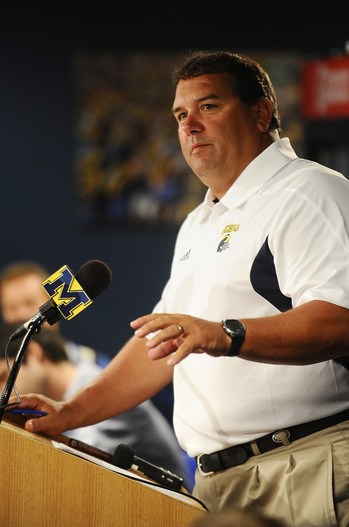
Michigan football coach Brady Hoke doesn't use social media, but he has no plans to ban his players from doing so despite several recent indiscretions. "We can manage eight to 10 knuckleheads," he said.
Melanie Maxwell | AnnArbor.com
Because of these type of situations, the Michigan coach says he is in favor of reform to the NCAA rules that govern social media, the use of which has proliferated among athletes in the past couple years.
"I think social media happened so quickly, and the NCAA is trying to get its head around all that stuff," Hoke told AnnArbor.com last week. "We just need to keep educating our players. We’ll meet at 4 o'clock (last Tuesday) and I’ll mention what they put out there and what they say.
"But there's no question something needs to happen."
Hoke doesn't use social media himself. He has two laptops in his Schembechler Hall office, but says he never uses one of them. The other, he uses for film study.
It's not just that he doesn't use Twitter or Facebook, either. He also claims to have never sent an email, preferring instead to pick up a phone or write a hand-written note because "it's more personal." If an email is required, he has his secretary forward along one on his behalf.
He has a joint personal email account with his wife, Laura, but says he doesn't even know the password.
However, there is one new technology of which Hoke is a fan: Text messaging, which he picked up two or three years ago. He said he would like to see the rules that prohibit its use in recruiting loosened, or excised altogether.
The NCAA announced late last year it is, in fact, exploring revisions to the ban.
"Compliance departments now, can you imagine all the paperwork they have to go through to see if you texted a guy?" Hoke said. "They have to fill out their report and send it to the Big Ten office, and the Big Ten office has to send it to the NCAA. Each time, someone is writing up a report and then sending it back to you. It’s wasting people’s time.
"I think (the rule) was smart and savvy, because kids were getting $100 phone bills and all that, but how do you enforce ‘em? That’s the problem. There’s too many rules."
There is a bit of irony in the fact that, with the NCAA's myriad rules that regulate modern technologies, the most egregious mistakes committed by Michigan football players didn't break a rule at all.
Rather, they were provocative tweets sent by recruits and prospective recruits that gained traction online earlier this year.
One-time Michigan target Yuri Wright drew criticism for posting racially and sexually charged tweets, and he eventually was kicked out of his private school because of them. There were reports the Wolverines backed off their courtship of the elite cornerback for the same reason.
But several 2012 commits tweeted similar churlish, crass and especially sexually charged messages before they signed with the program Feb. 1, and were not dropped from the class. (AnnArbor.com decided not to publish the tweets because of their explicit nature.)
Hoke said it was more important to him to use the tweets as a learning experience for the recruits. He said the program is educating future players more than ever on social media, and how its use represents the program.
"Kids come from all different backgrounds," Hoke said. "Some have great support, some don’t. Even guys with great support make mistakes. And, obviously, there are certain levels of mistakes that are intolerable, but I think at the same time, it’s our job ... to help young men grow and mature."
Hoke said his staff also monitors the tweets of current players, and the issue is addressed about three times per month.
"What I tell them is, if you don’t want your grandmother to see it, or your mother to see it, you probably shouldn’t do it," he said.
Despite all the blips incurred by his players and future players online, Hoke said he has no plans to prohibit tweeting, or limit its use to non-football topics, as some programs have done. He said although he doesn't use social media, he understands its growing place in the modern world and wants his players to have the opportunity to engage in it.
Can Hoke envision a scenario in which he would have to change that policy?
"I hope we don’t have to get to that point. I hope our guys are responsive enough," Hoke said. "You’re going to have knuckleheads in there, that’s just the way it is. You have 115 of them. You take 115 reporters and line them up, you’re going to find eight to 10 knuckleheads.
"Well, it’s no different than our football team, and we can manage eight to 10 knuckleheads."
Kyle Meinke covers Michigan football for AnnArbor.com. He can be reached at 734-623-2588, by email at kylemeinke@annarbor.com and followed on Twitter @kmeinke.
Comments
UlyssesWrong1
Tue, Mar 20, 2012 : 8:15 a.m.
Let's be real here, many other programs do the same thing and worse and never get caught. The NCAA and college sports in general is a joke as far as strictly enforcing rules across the board.
Wally the Wolverine
Mon, Mar 19, 2012 : 10:18 p.m.
From what I'm reading, it's OK to bend or break the rules, as long as we're not as bad as the other guy. Truly embarrassing to know the emphasis on winning trumps all. I thought we held ourselves to a higher standard. Call me naive.
Terry Star21
Tue, Mar 20, 2012 : 7:23 a.m.
Good analysis, I know exactly who your talking about there.
Steve McQueen
Mon, Mar 19, 2012 : 7:32 p.m.
Interesting article Kyle, well written. Regarding other offensive posts in social media that you uncovered but decided not to print... I have seen some of those as well, and you are correct that they are out there. (BTW Bucktan trolls who come here: this happens at every program, kids are kids) so well done on not going all "Freep" over this but still reporting how the system is put together and how an honest but progressive HC like Coach Hoke is dealing with it. As an interesting sidenote to this Social Media issue: Many employers are now requiring that candidates for certain jobs MUST have a web presence, or footprint in some social media. This is often requested pre interview as part of the screening process, or at the initial interview if the candidate makes it that far. The point is that Social Media is now fully ingrained in our society and will continue to root deeper. It is wise for kids to be taught how to responsibly use it, because it carries ramifications far down the line in life/career, then they do not realize at the moment they decide to tweet. As a side note, here is some football fix for today: http://www.youtube.com/watch?v=ACkOg9uNJqY go blue
Nic schweigert
Mon, Mar 19, 2012 : 6:46 p.m.
Ya Wally. You know, cuz tweeting and texting is just as bad as selling memorabilia for cash and tattoos. All rules carry the same weight from what you say. Theres some rules that make sense and ones that are absolutely stupid such as congratulating someone over twitter for a choice they made and then getting in trouble for the twitter
Terry Star21
Mon, Mar 19, 2012 : 6:26 p.m.
I think the rule is good. Players should not be allowed to have a tweet account period. Although a tough one, there should be restrictions on e-mails. Good to see sparty wallmart back, I missed the humor there. MgoBlueForTiM......following the rules for the best in college football.
Wally the Wolverine
Mon, Mar 19, 2012 : 5:03 p.m.
If a rule is violated, call it silly and suggest it be changed. OK.
A2D2
Mon, Mar 19, 2012 : 3:57 p.m.
Cch HK - UR2 cool! LOL @ this hole NC2A thing! Translated: I really appreciate Coach Hoke's position on this. It makes sense. To be honest, this entire subject points to the silliness of the NCAA.....
michboy40
Mon, Mar 19, 2012 : 3:53 p.m.
No email, twitter, or Facebook, and yet, they are lining up in droves. I bet our pretty boy from down under can't even leave the sack in the morning without tweeting that he's about to get out of bed.
SuperiorMother
Mon, Mar 19, 2012 : 3:47 p.m.
What ARE the NCAA's policies on social media and texting?
Scott
Mon, Mar 19, 2012 : 3:02 p.m.
"The team remains of probation from the RR era". Boy that was a crock of pickled herring.
SMC
Mon, Mar 19, 2012 : 2:56 p.m.
The head coach of a major football program doesn't use Email... Wow. Did the athletic department have to hire a telegraph operator for Hoke, or does he have one on personal retainer?
Scott
Mon, Mar 19, 2012 : 3:13 p.m.
Hoke is great and wise. He does things the old fashioned way- he talks to people.
bluemax79
Mon, Mar 19, 2012 : 12:21 p.m.
Coach Hoke! lol you line up 115 reporters and you'll have 8-10 knucklheads LOL more than 8-10 from Detroit alone! love how he explains it so even a reporter will understand.