

Dave Brandon puts Michigan's drug policy results 'up against anybody in the country'
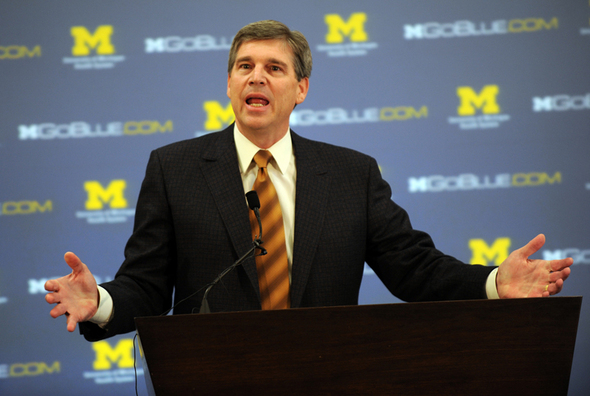
Since becoming the Michigan athletic director, Dave Brandon pushed for more frequent drug testing and stiffer penalties for failed tests. "Our student-athletes understand it's a value, and if they want to be here and participate, it's something they're going to have to live up to and they do," he said.
AnnArbor.com file photo
Michigan athletic director Dave Brandon's more aggressive drug testing policy was profiled recently in an "ESPN The Magazine" feature focused on excessive marijuana use in college athletics.
After taking over as athletic director in 2010, Brandon pushed for more frequent testing within the department, and stiffer penalties for those who failed to comply with regulations.
Two years later, Brandon says he's more than pleased with the results department-wide.
"I'm very, very proud of our student-athletes," Brandon told reporters earlier this week. "The last year, I would put our results up against anybody in the country. And we test for synthetic, as well as regular marijuana and the other drugs.
"Our student-athletes understand it's a value, and if they want to be here and participate, it's something they're going to have to live up to and they do."
Per the ESPN report, Michigan now suspends athletes for 10 percent of their team's season for a first positive drug test, 33 percent for the second and one year for the third.
Additionally, Brandon says Michigan isn't worried about limiting its drug testing policies, no matter what the cost might be.
"To me, drug testing is not something you worry about in the budget," he said. "You worry about making sure you're testing on a frequent enough basis so people know you mean what you say.
"If you don't test frequently, young people think they'll play Russian roulette and not get tested. Our comment to student-athletes was, 'If you do drugs, you're going to get caught.'"
Brandon said he really can't explain why marijuana usage has increased inside the realm of college athletics, nor why it continues to be a lingering issue for several programs across the country.
According to the NCAA's most recent drug-use survey (conducted in 2009), 22.6 percent of athletes admitted to using marijuana -- a 1.4 percent bump from a similar study performed in 2005.
As a result, Brandon said he implemented a re-education process with Michigan's student-athletes about the harmful effects of drug use -- both on and off the playing surface.
"We implemented a new policy and we made it really clear that one of our values of Michigan athletics is to be a drug-free athletic program," he said. "We're not going to put up with it. We think it's bad and we're going to do everything we know how to do to prevent it. And the thing we know how to do is to test incessantly."
Hoops transfers, early exits concerning
The number of transfers within Division I college basketball this season has been staggering. Various outlets have confirmed nearly 400 players across the country opting for a transfer this season.
Michigan was far from immune from the issue.
Three Wolverines -- Evan Smotrycz, Carlton Brundidge and Colton Christian -- elected to leave the Michigan program this offseason.
One more, Trey Burke, nearly left early for the NBA.
During a meeting with reporters earlier this week, Brandon touched on the ongoing concerns of growing college basketball attrition.
"I'm very concerned about the one-and-done, I don't like the two-and-done, I'm not even a big fan of the three-and-done," he said. "But basketball seems to be one of these sports right now where this feeding frenzy over talent by the NBA is putting a lot of pressure on really young kids.
"With short attention spans, you're seeing young people who say 'I didn't play as much this year as I thought, where can I go play?' and so you get the transfer thing going. Then you've got people going out early in the draft. It's not really what college athletics is supposed to be about."
Brandon didn't offer much of a solution for the transfer issue, but did say one way to possibly alleviate the rush of early-entry student-athletes would be the reinstitution of freshmen ineligibility.
Though, he admitted, that's not exactly a viable option.
Could the NBA step in and offer a solution? Again, probably not viable
"People ask me all the time if there's a way to do a deal with the NBA," he said. "And I think that's difficult, because they have a commercial interest with these young players. And it's difficult at times for these institutions of higher learning to try and stand between professional owners with a commercial interest and young people who have a chance to make a lot of money.
"It's a difficult problem."
Nick Baumgardner covers Michigan sports for AnnArbor.com. He can be reached at 734-623-2514, by email at nickbaumgardner@annarbor.com and followed on Twitter @nickbaumgardner.
Comments
michboy40
Thu, Apr 26, 2012 : 6:25 p.m.
Any fool can get past a Marijuana test. DO you really think they are not doing it? No, they are just not getting caught.
7718
Thu, Apr 26, 2012 : 5:52 p.m.
So I presume he will never schedule the spring game on the first Saturday in April (Hash Bash).
heartbreakM
Thu, Apr 26, 2012 : 5:14 p.m.
this idea of frosh ineligibility is never going to work at this point, because the "cat's out of the bag". I think it is theoretically a great idea to allow these young athletes to acclimate to college on a social and mental basis; to allow their bodies to catch up to the adults they face on the field/court; and to stabilize the educational component. Big negative, though, is that these athletes want to play, and they should. I think this one-and-done though is damaging the sport of basketball. Not just collegiate but the NBA too. These guys are not mature enough to play the pro game with all its distractions, they are not getting any sort of education because they are not in college long enough (nor are they even required to do anything in the second semester), and they are not learning fundamentals. The NBA has shown the pains by being a reasonably mediocre sport for most of its season. If the players don't want to come to college, I can understand that, but they need to have something else, and the NBA ought to step it up. The transfer situation is something else altogether. I think players should be allowed to transfer--it's a free world, and colleges fire their coaches all the time (or they leave a la Calipari), but 400 transfers in one year in Div I? That's outrageous. That's more than the Big Ten men and women combined. These players have to get a clue and not think that the grass is always greener. I think a good article would be to follow these players and see how they did after their transfers. My guess is, like football, most do not succeed and most likely will never make an impact.
Eric
Thu, Apr 26, 2012 : 2:48 p.m.
So Brandon wants to make freshman ineligible and doesn't believe the NBA can offer a solution when they're the entity responsible for the one and done rule? Maybe Brandon should go back to selling pizzas because he clearly doesn't get what's going on in college basketball right now.
Forever27
Thu, Apr 26, 2012 : 2:30 p.m.
Weed is evil! oh, you're knee just popped out of socket? let's give you a shot and get you back out there for the game!
UlyssesWrong1
Thu, Apr 26, 2012 : 2:09 p.m.
Making it harder for Michigan student athletes to smoke marijuana will only lead to more alcohol consumption and using substances that won't show up on drug tests. I hope Dave Brandon will be happy to see a decrease in positive drug tests for marijuana and an increase in DUI's, MIP's and other alcohol related crimes by student athletes. The reality is that marijuana is not as bad as Brandon is making it to be, and let's face it, it's more accepted than ever these days. This screams PR move to me by Brandon. As for the basketball issues, Michigan will need to improve their talent a lot, but don't necessarily need one and done level players to be able to compete. The transfers were troubling but it made me think maybe Robinson Jr is just THAT legitimately good.
Jim
Thu, Apr 26, 2012 : 2:08 p.m.
Chase - Brandon's job is not to evaluate if the NCAA rules makes sense. Believe me, there are many, many NCAA rules that don't make any sense at all. His job is to make sure UM follows the rules that are there and I believe this is a good step in that direction.
Chase Ingersoll
Fri, Apr 27, 2012 : 2:16 a.m.
The plantation managers job is not to question the labor practices or dictated rules, but rather to enforce them without question, upon the underclass. Chase Ingersoll
Ron Granger
Thu, Apr 26, 2012 : 1:36 p.m.
The University has major ties to big pharma. So it should come as no surprise that Brandon would rather have athletes use drugs that rot your kidneys and liver (tylenol, ibuprofin, etc), have lengthy lists of potential side-effects, instead of something much less harmful.
umbsme98
Thu, Apr 26, 2012 : 3:38 p.m.
Either that or he is following the law. We may not agree with the law but we are still required to follow it.
clownfish
Thu, Apr 26, 2012 : 1:29 p.m.
One good answer to the one-done issue would be to force the NBA and NFL to have actual farm teams. Those people that want to pursue athletics as a career, and who have no interest in furthering their education, could go that route, freeing up scholarships for those that seek to learn at universities.
mdetc
Mon, Apr 30, 2012 : 9:40 a.m.
That is a good point. Maybe not viable, but surely worth those concerned to investgate further. One question: If a kid opted for the Farm Team option and didn't make it, would he have one or two years to still enroll in a College B-Ball program? Just food for thought.
Chase Ingersoll
Thu, Apr 26, 2012 : 1:04 p.m.
It's a supplement stupid. I appreciate Mr. Brandon's integrity and leadership. But there have been great leaders throughout history, that are personally misinformed or disinformed and accordingly cannot help but lead the masses who submit to their authority in the wrong direction. Looking at the latest scientific evidence and applying some common sense (I wish Brandons leadership would first engage in an honest evaluation of the evidence that is out there), even those of us who have never smoked a joint, need to ask ourselves "if an honest evaluation of the science, indicates that there are beneficial ways for individuals to use cannabinoids, why are we using government's limited resources to socially stigmatize people that desire to use this as a dietary supplement, or in place of a synthetic pharmaceutical, whose sides effects we know to be harmful..." Here is an article that touches on the complexities of the issue: http://www.washingtonpost.com/local/for-pro-athletes-the-risks-of-smoking-pot-are-high--but-so-are-the-benefits/2011/12/13/gIQAgwAhsO_story.html
Rabid Wolverine
Thu, Apr 26, 2012 : 1:45 p.m.
Bottom line. Law over science. It is illegal. Whether your beliefs wish it was legal for recreational use or not, it is still illegal by LAW. I think it is admirable that Brandon wants to ensure the student athletes are not breaking the law. Sorry you don't share the same concern.