

Brady Hoke, Jim Delany don't agree on notion of college football mega conferences
Jim Delany admits his crystal ball doesn't feature 20-20 vision, but when asked Monday if he believes college football is headed toward a four-league super conference model, he said no.
Or, at least, he hopes not.
The Big Ten commissioner surely can't predict the future, and neither can Brady Hoke. But count the Michigan football coach among the crowd who disagrees with Delany about where things are headed across the college landscape.
“I think really, in about three years, you’ll see four super conferences, and I think the Big East will go away and maybe the ACC," Hoke told the Dayton Daily News last week, "But look, I’m just a coach. I don’t know all of it.”
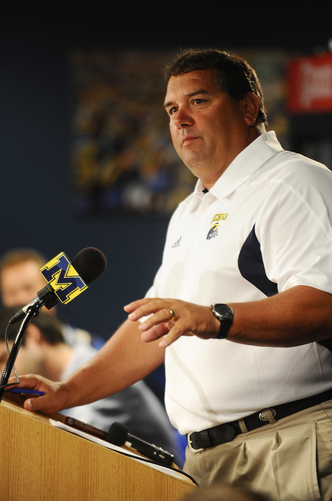
Michigan coach Brady Hoke told an Ohio newspaper that he thinks college football could have four "super conferences" in the near future.
Melanie Maxwell | AnnArbor.com
While answering questions from reporters during a teleconference, Delany said he's not a "consolidationist" by nature, and doesn't foresee a scenario involving four super leagues -- with everyone else left out in the cold.
"I read it on the blogs, but personally, I'm not a consolidationist," Delany said. "I think what you'll see is some conferences grow and some stay where they are (but nothing more)."
Delany went on to explain how history proves that it's not simple for high-volume leagues to maintain full membership and success over time.
He cited the Western Athletic Conference, a league that once featured 16 teams but now sits at eight. Without actually naming it, he also cited the Big 12 as a conference that struggled to find stability and grow during constant realignment shifts.
"We had one 16-team conference, it was the WAC, and it didn't stand very long," he said. "We had another conference that went to 12 members, and then had to add two to get back to 10. We've seen the Big East morph in a variety of ways.
"I think one of the most underrated qualities of any conference is its stability and the glue that holds it together."
Delany has maintained for some time that the Big Ten has no current plans to expand any further, consistently explaining how the league is comfortable playing its current members on a year-to-year basis.
With 16 teams in a league, teams don't get the opportunity to play one another year in and year out. That, in turn, hurts traditional rivalries, and -- at least in Delany's opinion -- hurts the league as a whole.
"The larger you are, the less you play each other," he said. The less you play each other, the less tradition you have and the less those games tend to mean unless they're repeated over and over.
"I'm not a consolidationist, I expect some people will continue to grow, but I don't expect to see the ultimate four 16-team leagues and somehow that feeds into a postseason. I don't think that's likely, but who's to say? My crystal ball's not that clear."
Big Ten to distribute $284 million
Big Ten member schools will see a record level of money enter their coffers courtesy of the league itself.
Delany announced Monday that the Big Ten will spread a record $284 million over its 12-school membership.
According to an ESPN report, the league spread $251.9 million over its 11-team membership in 2010-11. Last week, the Southeastern Athletic Conference announced it was spreading $241.5 million to its 12 teams, also a record.
While the rich are seemingly getting richer, the league's newest member -- Nebraska -- won't get its full share of the wealth just yet.
On a conference call Monday, Nebraska chancellor Harvey Perlman declined to reveal the exact percentage that the Cornhusker programs will receive this season and also declined to say when, exactly, Nebraska will get an even share.
BTN becoming a true national network
Also on Monday, Big Ten Network president Mark Silverman outlined some of the new numbers being enjoyed by the league's official television outlet this past season.
Silverman explained how BTN is now seen in more than 50 million homes, and actually has more viewership outside the nine Big Ten-based states than it does within the conference's current footprint.
Silverman added that BTN has more than 30 million subscribers to "BTN2Go," the network's mobile application. In addition, BTN programming is now seen in more than 20 countries across the world.
And, finally, he confirmed that BTN will introduce a football-based version of the popular program "The Journey," which is set to begin this fall.
Nick Baumgardner covers Michigan basketball for AnnArbor.com. He can be reached at 734-623-2514, by email at nickbaumgardner@annarbor.com and followed on Twitter @nickbaumgardner.
Want to stay connected to Wolverine basketball in your Facebook newsfeed? “Like” AnnArbor.com's Michigan Basketball News & Views.
Comments
Tom
Wed, Jun 6, 2012 : 12:45 p.m.
Michigan needs the money... Hoke "gotta eat". Where's the threat?
Chad Williams
Tue, Jun 5, 2012 : 4:44 p.m.
The Big Ten isnt respected as much as the SEC, another year with Double NC's in the football and basketball. They currently sit at 14 teams, the 16 team conference thing is going to happen. It's in the matter of the Big Ten to either play ball from the start and benefit along with the others, or take a stand and fall behind 5 years. All we hear is the SEC 6 time champs, The big ten has only 1 rose bowl win in that span. If FBS gets to 128 teams overall thats 8 ocnferences of 16 teams. Then you add a 12 team playoff. Within each conference there should be 4 team divisions. You would still play 8 games, so that means all your division opponents, up to 2 rivals outside the division and the rotatoting games from each other division. In four years you will have played all the teams in a regular season game.
SEC Fan
Wed, Jun 6, 2012 : 5:50 p.m.
not to be picky :-) ...but SEC is 8 time champs (6 in a row). But let us not forget that conferences encompass more than football. ACC is a basketball powerhouse. It and the Big East have some significant history in basketball. I can't imagine them ever going away simply because of that.
Blue Marker
Tue, Jun 5, 2012 : 1:28 p.m.
One thing is for sure to this reader.....old cigar smoking rich guys are killing the game I grew up loving. Why don't we just change the name to NFL II and pay the players. Take me back to the days of the wing-formation, conferences were made up of teams in the same geographical area and Keith Jackson called the action.
garrisondyer
Wed, Jun 6, 2012 : 5:15 a.m.
I especially agree on Keith Jackson. Some of the announcing these days is just depressing.
MRunner73
Tue, Jun 5, 2012 : 2:38 p.m.
I agree with you. This whole thing a big money grab. I do not like where this is all headed. A mythical champion in college football Div 1 would be fine with me. A 12 game regular season cannot accomodate all of the conference teams, so something's wrong.
heartbreakM
Tue, Jun 5, 2012 : 1:24 p.m.
I must give Delany credit since he was commissioner at the time the B10 network got started and it turned out to be a success. But I think he is so full of hot air most of the time. He claims to not be interested in expansion, yet added Nebraska. He claims to care about traditional rivalries, yet didn't seem to care that Nebraska would break its more than 100 year rivalry with Oklahoma, or that PSU's rivalry with Pitt was broken (nor does he care that many of the B10 powers don't play each regularly). He talks about a playoff one day, then a plus one the next, regardless of what the presidents say (another group who doesn't seem in touch with the realities). I agree with Craig above--it's all about greed and that is just sad.
PillowRock
Tue, Jun 5, 2012 : 7:05 p.m.
The biggest single driving force behind adding Nebraska was that the NCCA had enacted rules setting 12 as the magic number needed in order to have a proven-to-be-extremely-lucrative conference championship game. Delany & the Big Ten didn't make the rules, they were just making the moves that those NCAA rules make virtually inevitable. There are no remotely similar advantages to going from 12 up to 14 or 16. As for those other old rivalries: 1) Since they are outside the Big Ten, by definition they are not really Delany's concern. 2) PSU & Neb are still free to make Pitt & Ok a consistent part of their non-conference schedule (admittedly that would be after a few year hiatus caused by pre-existing non-conference game contracts). That's no different than what UM & MSU do with ND or what Ok did for decades with Texas when they were split between the Big 8 and the Southwest Conf. It's up to those schools. 3) Neb & Ok as an annual tradition had already been broken up by the Big XII in their conference scheduling. I agree that Delany is far from perfect on a number of these issues, especially with regard to oddly mixed messages on the various playoff proposals. However, it just seemed to me that he was getting blamed here for a couple things that weren't really his fault / responsibility.
bluemax79
Tue, Jun 5, 2012 : 11:53 a.m.
interesting that Dave Brandon mentioned conference realignment when I heard him speak yesterday I would think something is going to happen soon if both our football coach and AD are talking about it. the Nebraska addition was a good one for the league IMO makes me laugh when I hear Delany say if you get too big you don't play each other, we don't play all the teams NOW with 12 teams!
unclefred
Tue, Jun 5, 2012 : 1:57 p.m.
Play 11 conference games so that every team plays each other every year. Michigan should reserve the remaining non-conference game for the PAC12/Big Ten matchup. We'd lose the ND game, but it would improve our conference match ups considerably
hail2thevict0r
Tue, Jun 5, 2012 : 12:15 p.m.
I'd like to see us drop some of the non conference games and play conference teams. I'd rather have played Wisconsin last year than Western Michigan.
Craig Lounsbury
Tue, Jun 5, 2012 : 11:31 a.m.
"While the rich are seemingly getting richer, the league's newest member -- Nebraska -- won't get its full share of the wealth just yet. On a conference call Monday, Nebraska chancellor Harvey Perlman declined to reveal the exact percentage that the Cornhusker programs will receive this season and also declined to say when, exactly, Nebraska will get an even share." and that sums up the state of college sports. There is a tremendous amount of money that drives college sports and greed is ever present.
Milqueman
Tue, Jun 5, 2012 : 11:33 p.m.
Nebraska knew this before they even signed on the dotted line. It was all part of the agreement. Why they don't tell the public the details, I don't know, but it's not a surprise to anyone. Here is an article written back in June 2011. It says a lot, but they mention in there the fact that Nebraska will have to get vested into the B1G before they get their full share: http://sportsillustrated.cnn.com/2011/writers/stewart_mandel/06/29/nebraska/index.html
PillowRock
Tue, Jun 5, 2012 : 6:36 p.m.
Craig Lounsbury "Why do we not even know when they get a full cut?" ===================== Where does that quote say that Neb doesn't know that? The answer is that it does not say that. Declining to answer the question for reporters is worlds away from not knowing yourself. As for why they don't get a full equal share immediately: The BTN did not magically materialize out of thin air. The conference, which ultimately means the 11 member schools at the time, had to put in capital to build up the network up (lease or buy buildings / office space / studio space, hire staff, etc., etc.). Nebraska did not make that investment in the BTN. So it's perfectly reasonable for them to go through a bit of a "vesting period" of reduced returns as a sort of "buy in" for their share of the network ownership. And I don't believe for a second that all of those details were not negotiated before they announced that Nebraska was joining the Big Ten.
Craig Lounsbury
Tue, Jun 5, 2012 : 4:56 p.m.
I agree with everything you just said. bluemax. My "point" or question is, why doesn't nebraska get a full cut now that they are a member? Why do we not even know when they get a full cut? They don't get a full cut because they haven't been around long enough to "earn" it presumably. Which speaks to the greed of the other 11 teams. They aren't going to give team 12 a full cut till they absolutely have to.
bluemax79
Tue, Jun 5, 2012 : 11:55 a.m.
while some programs actually are in the black like Michigan MOST are not, the B1G splitting this money among the teams makes it possible for a LOT of men and women get scholarships in the non revenue sports. it is not like these schools are just taking the money and putting it in the bank.