

Big Ten's insistence on including bowl venues in future playoff is baffling
CHICAGO -- When it comes to intercollegiate athletics, Big Ten commissioner Jim Delany is smarter than the rest of us.
That's an assumption he's afforded after two decades of keeping the league at the fore, through seismic shifts such as conference expansion and TV deals.
But with all due respect, sir: Have you lost your mind?
The Big Ten originally advocated for a college football playoff structure that featured on-campus semifinal sites and a title game that would be bid out nationally. It was a brilliant concept that was popular with fans, and seemed to be in the league's best competitive interests.
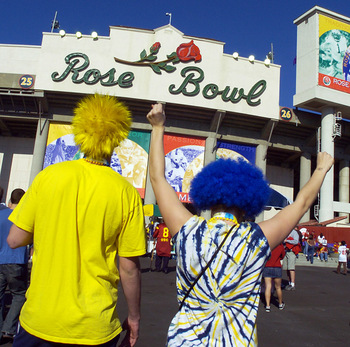
The Big Ten's loyalty to the Rose Bowl in its college football playoff proposal could be detrimental to its own teams.
AnnArbor.com file photo
A semifinal in Ann Arbor? Or at the 'Shoe? Camp Randall or Happy Valley?
It seemed to be the great equalizer, after Big Ten teams played virtual road games for decades by heading south and west to face the SEC, Big 12 and Pac-12 in bowl games.
Players such as Michigan's Kevin Koger, who cried in the tunnel before facing Ohio State on Senior Day, would get to run onto their home field one more time. The fan experience would be thrilling.
It'd protect the regular season, as teams vied for seeding.
Now, the idea is dead. Why?
The Big Ten's movers and shakers met this week in Chicago, and have decided they prefer to play their semifinal games in Pasadena, Calif., rather than East Lansing.
They do so knowing they are ceding what could be a tremendous competitive advantage.
"While we understand that the games on campus could benefit us competitively — it's not like I don't like the competitive advantage (aided) by home field — but in a larger sense, we think the slope is far less slippery within the bowl system than it is outside the bowl system," Delany said Tuesday.
"We think that the Rose Bowl, the Orange Bowl, the Sugar Bowl, the Fiesta and other bowls are aided and helped by a process where 1-4 is inside the bowl system rather than outside."
That's nice for the bowls. Good to know the Big Ten is looking out for them.
But why isn't the Big Ten thinking about what's best for the Big Ten?
The SEC's Mike Slive and the Pac-12's Larry Scott should send Delany flowers -- roses seem appropriate -- considering what the Big Ten is conceding before it even reaches the bargaining table next month.
In fact, multiple Big Ten athletic directors noted they didn't support on-campus semifinals because it wouldn't be "fair" to ask Southern teams to play in the cold.
"Let’s say Ohio State is hosting, and it’s whatever the date may be -- January or December -- let’s say it’s 5 degrees. Is that right for the game? We’re not pro," Ohio State athletic director Gene Smith said.
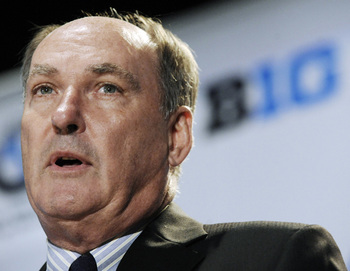
Big Ten commissioner Jim Delany: "While we understand that the games on campus could benefit us competitively -- it's not like I don't like the competitive advantage (aided) by home field -- but in a larger sense, we think the slope is far less slippery within the bowl system than it is outside the bowl system."
Associated Press
"I think we need to figure out what’s better for the game. I think a fast surface, good weather is important for the game. It’s important for the kids."
Huh?
Remind me, Big Ten, are you representing the SEC or the Big Ten?
You don't hear the SEC complaining that it has had a distinct competitive advantage over the Big Ten for years. Know how many SEC teams traveled more than 500 miles last year for a bowl game? None.
Big Ten: Nine (of 10).
Given a chance to balance the weights ... the Big Ten is concerned about having an advantage? Shouldn't it be lobbying for an advantage?
Why is it protecting the bowls, and the warm-weather teams, and not itself?
Even Michigan athletic director Dave Brandon, a longtime dissident of a playoff, finally has come around to the idea of a postseason. Yet, he would prefer to play bowl games in Miami Gardens rather than the Big House.
"I’m a big advocate for playing as many games as possible on campus, but I’m also a realist to know when you get to the point where you got those kinds of national games, with teams coming to various regions of the country, playing outdoors in the Midwest in January probably is not going to be a salable option," he said.
Right. Because Lambeau Field and Soldier Field and Gillette Stadium and MetLife Stadium have such a hard time drawing fans for December and January games.
Of course, Delany revealed minutes later the Big Ten is interested in adding the Pinstripe Bowl to its postseason slate -- a game that's played in late December in New York City. So, apparently the Big Ten doesn't mind playing postseason games in the cold, as long as they're not playoff games.
And what about all the fans, who likely will be asked to travel to a Big Ten championship game, national semifinal and national title game within the span of a month?
"It would be a competitive advantage to have semifinal games at home fields," Nebraska athletic director Tom Osborne said, "but the bowls have been good to us"
The Big Ten is 34-52 in bowl games since 2000, and 3-8 in the Rose Bowl since the start of the BCS era.
The bowls also have gouged conferences through rampant profiteering, including ticket guarantees and other ridiculous contractual stipulations. And let's not forget about corruption.
Yep, they've been great to you -- and, hey, who's ready for some more?
The Big Ten sure is, and you can bet the SEC and Pac-12 won't stand in its way.
Kyle Meinke covers Michigan football for AnnArbor.com. He can be reached at 734-623-2588, by email at kylemeinke@annarbor.com and followed on Twitter @kmeinke.
Comments
Scott Laux
Sat, May 19, 2012 : 4:15 p.m.
This 4 team playoff is bad for a chronic overachiever like Boise State. They never have a chance of getting into a playoffs. Good for the SEC (Big 12, Pac12, and Big Ten). They don't want to play a Chris Peterson team and all their 2 star athletes. They lose and how do you explain that? This 4 team playoff is what is going to happen, but it stinks.
ted
Fri, May 18, 2012 : 8:53 p.m.
Maybe the bowls should re-locate. Also if your in the PAC 10 you cant play in the Rose if you are big 12 you cant play in the sugar. if yoioue are east sec you cant play in florida. ect
ted
Fri, May 18, 2012 : 8:43 p.m.
@ SEC FAN Make it 8 teams using the polls and a selection commitee. Replace the conference championships and replace it with the start of this 8 team playoff with the first round being hosted by the higher seeded teams.
SEC Fan
Tue, May 22, 2012 : 1:23 p.m.
Actually, this would be essentially what is being proposed. If the conference champ automatically gets an entry, it's almost what you're proposing. I guess you're way though, there could - theoretically - be conferences with no participation in the playoffs. My only concern would be the selection committee. If you don't take the 1st eight teams of the polls, then you open it up to the same issues we have today. The real issue is the big conferences don't want a system that could preclude them playing in the championship game...rather, they want one that facilitates it (e.g., automatic inclusion for "big" conference champions). As long as this situation exists, there will be bias.
ted
Sun, May 20, 2012 : 6:05 a.m.
Actually there is no reason it cannot be added into the current plan. Its set up for it.
GoBigBlue
Fri, May 18, 2012 : 11:43 p.m.
Hey Ted, have you read any artIcles on this proposed playoff?? It's going to be 4 teams. And conference championships are not going away. Why keep waisting your breath on this 8 team no conference championship nonsense?? Give it a rest already.
aawolve
Fri, May 18, 2012 : 8:14 p.m.
Well said Kyle, I agree wholeheartedly.
Robert D. Mosley
Fri, May 18, 2012 : 8:07 p.m.
I, for one, am tired of going to a home game to the SEC or PAC 10 and having our teams beaten in most cases. I would love to have them come up north and play here. I also agree of the rampant profiteering that goes on in the other conferences. Has anyone checked out the cheating being alleged in Auburn and other schools down south? It is at a whole different level than what goes on up here. Let's bring these teams up here and give them a cold northern beatdown and make some money to boot.
Rich Rezler
Fri, May 18, 2012 : 7:37 p.m.
To commenters pointing out similarities between this column and one published by Yahoo! Sports: While the two writers clearly are of the same opinion and shared sources for their stories, AnnArbor.com stands behind Kyle Meinke's work being completely original. Did Meinke read Dan Wetzel's story on Yahoo!? Yes, Wetzel is a must-read on all topics. Did it shape Meinke's opinion? No. He did an ESPN radio interview on Wednesday and shared the same insights at that time. It's also worth noting that Meinke was reporting from the Big Ten meetings in Chicago. Wetzel did not attend.
SEC Fan
Fri, May 18, 2012 : 7:20 p.m.
@Bmore_Wolverine. My point is that the Big 10 has never (and has no plans to) played in any outdoor stadium in a cold climate after their final game in November. Who in the Big 10 plays any games outside (and up "north") in December or January? Name one bowl game play up "north" that is played outside? The Big 10's Bowl game isn't even in a cold climate and how many decades has that been going on? The Big 10 even made the decision to play it's conference championship game indoors! The Big 10 made the decision to forgo playing bowl games in their home stadiums a long long time ago and has nothing to do with the SEC or any other conference.
HeimerBoodle
Fri, May 18, 2012 : 6:22 p.m.
I know it was mentioned before, but I think it really does stand to be repeated. The above article is almost identical in tone and conclusions to this: http://sports.yahoo.com/news/ncaaf--big-ten-surrenders-fight-for-on-campus-playoff-games-for-wrong-reasons.html;_ylt=AufV69o.bcJkZX_qysV0NxgcvrYF Posted on Wednesday. Even the accompanying pictures and captions are similar! Even for this site, it's shoddy and shady. Really, how hard is it for a sports reporter in Ann Arbor to come up with his own piece about the Wolverines?
azwolverine
Fri, May 18, 2012 : 3:28 p.m.
Well, here come the playoffs that everyone has always wanted and it sounds like they are going to be as corrupt and indecisive as the BCS system we currently have.
Tim Wild
Fri, May 18, 2012 : 2:39 p.m.
...(Caution, this message contains sarcasm)... I agree with Delany. Who wants to come north when it is cold. Why do some mid-western cities insist on dragging thousands of travelers into their town for days of food and entertainment. Furthermore, I think NCAA basketball games during March Madness should all be moved to the South Region. After all, Minneapolis has an average high of only 41 in March - and they had the gall to host a Final Four. Now we are talking about football in the midwest when Average Indianapolis High Temperatures are 38 in December(or Chicago at 35) . That sounds chilly. Besides, think of all of the traffic and congestion that would create. Jim hates it when he has to make late dinner reservations because visitors fill up the Chicago restaurants. Of course the weather issue doesn't apply to other sports. We don't want to play the summer NCAA baseball or softball, championships here in June because we enjoy the (Average 88 degree) Oklahoma City heat for those.
Scott Laux
Fri, May 18, 2012 : 1:39 p.m.
Whenever guys and gals at the top have an opinion, their opinion it guided by $$$. Sometimes more $$$ for the institutions they represent. Increasingly in our society-by some personal stake they have in the game. Delaney, Brandon, Mary Sue Coleman- you know every opinion they have- if you know the bottom line.
ribs1
Fri, May 18, 2012 : 1:34 p.m.
Isn't this the same article? http://sports.yahoo.com/news/ncaaf--big-ten-surrenders-fight-for-on-campus-playoff-games-for-wrong-reasons.html;_ylt=AufV69o.bcJkZX_qysV0NxgcvrYF
HeimerBoodle
Fri, May 18, 2012 : 6:17 p.m.
Not only is the point of view identical, many of the turns of phrase are very similar as is the structure of the argument. Maybe someone thinks rules of source citation are different when you are an online-only publication!
Jeff Frank
Fri, May 18, 2012 : 3:03 p.m.
Very similar in tone and thought, that's for sure. And one was posted 2 days before the other. Does make you go "hmmmmm."
Rejw
Fri, May 18, 2012 : 1:28 p.m.
Isn't this about the money? Maybe SEC fans won't come north for campus-sited games?
Bmore_Wolverine
Fri, May 18, 2012 : 6:23 p.m.
@SEC Fan - Because they won't. Name the last time an SEC team played in B1G territory after September. I'll even accept indoor games.
SEC Fan
Fri, May 18, 2012 : 3:14 p.m.
It's definitely about the money...always has been. but let's be honest here, the Big 10 has never played bowl games up North (in an outdoor stadium). So why is the Big 10 argument that the SEC won't play up North?
ribs1
Fri, May 18, 2012 : 1:16 p.m.
How would a 4 team playoff really benefit the Big Ten? How often has a big ten team finished in the top 4? We are supposed to participate in a system that will allow one of our conference teams to participate maybe every other year? Why would we do that when we can play in the rose bowl every year? Why do we care what the SEC wants? How often does anyone think Michigan will win this 4 team playoff? There are just too many teams to decide who is national champion. This playoff system would be a disaster for the Big Ten. I believe Delaney is only considering participating in this playoff in order to have a better negotiating position with the Rose Bowl. Consider this. What if the Big Ten and Pac 12 decide not to participate. 1. The playoff system would have no validity because 2 major conferences opt out. These 2 conferences go back to the old way leaving the SEC and others in chaos. Right now, ESPN is trying to dictate the future of college football.
SEC Fan
Fri, May 18, 2012 : 3:12 p.m.
So, if we don't let the Big 10 win some championships, you'll take your ball and go home?
Stephen
Fri, May 18, 2012 : 12:45 p.m.
Location, location, location Im glad people like warmer weather.
Forever27
Fri, May 18, 2012 : 12:28 p.m.
""While we understand that the games on campus could benefit us competitively — it's not like I don't like the competitive advantage (aided) by home field — but in a larger sense, we think the slope is far less slippery within the bowl system than it is outside the bowl system," Delany said Tuesday" read: i have a vested interest in keeping the bowl format as it is and will only begrudgingly progress to what the game needs, a true playoff.
FlintMaize
Fri, May 18, 2012 : 10:41 a.m.
If you play the semifinals at home field sites the Big Ten loses the Rose Bowl forever. How many times will the Big Ten Champion be in the top three or four? It doesn't happen often. They have polled the athletic directors and some Big Ten teams polled their players and keeping the tie to the Rose Bowl won out. You may ready to throw tradition out the window, but many of us are not.
SEC Fan
Tue, May 22, 2012 : 1:32 p.m.
@BuckFanHater. I understand that you "feel that the B1G Champion beats an SEC Champion 2 out of 5 contests on Neutral site in warm weather", however, the SEC is 2-0 vs the Big 10 Champ in BCS Championship games (and 8-0 overall...8-1 if you count losing to yourself). Granted the second matchup wasn't a "neutral" site, but the first blowout (41-14) was in Arizona. Guess you guys need to win the next 5 matchups...
BuckFanHater
Sat, May 19, 2012 : 8:29 p.m.
@SEC FAN I take my hat off to you friend. The three years That Rich Rod coached at Michigan we weren't good enough to hold the Jock Strap of an SEC team. But like some people on here have said...it ebbs and it flows. And those were three Gosh awlful years for UM and certainly not indicitive of the program as a whole. Even Loyd Carrs Final year was pretty ugly with the back to back Losses against the App State and then Oregon at home the following week. The wheels were starting to fall off the wagon that's for sure. But Like my post above states. Any given Saturday afternoon someone can jump up and bite you. I feel the B1G Champion beats an SEC Champion 2 out of 5 contests on Neutral site in warm weather (as the conference stands right now) and perhaps more than that if it is played in cold weather outdoors in late December early Jauary. Let the conference Champions play. And if you're scared to lose the 2 out of five and want to tip the scales in your favor by having a second place Alabama team play a second game againsty LSU then that's just being selfish for the SEC conference and based on opinion polls for where they are "ranked"
Matt Patercsak
Sat, May 19, 2012 : 2:28 a.m.
perhaps a better question to you ignorant people out there, is when does the SEC play in weather that's below 60?
SEC Fan
Fri, May 18, 2012 : 9:28 p.m.
@buckfanhater. Well, you certainly make a strong argument... I "remember" a certain Michigan team getting whooped by a couple of division 2 teams (in consecutive years); going 3-9 the year after your afforementioned win; being humiliated in a bowl game by a 2nd tier SEC team (mississippi state). Saying you beat last year's best team...wow...what an accomplishment.
ted
Fri, May 18, 2012 : 8:33 p.m.
@ SEC FAN. I definitly agree. The best teams should play, not the winner of each conference.
ted
Fri, May 18, 2012 : 8:31 p.m.
If they play an 8 team tourny the higher seeded team can host the 1st round games. That would be EARLY December. then the higher seeded winners play in thier tie-in bowls. IE..Pac 10 and big 10 play their semi final in the Rose.
BuckFanHater
Fri, May 18, 2012 : 8:30 p.m.
@SEC FAN I remember Michigan playing the defending National Champion Florida Gators in the Capital One bowl and Michigan Kicked their Butts (coached by Urban Meyer and QB'd by Tim Tebow) The following year that Same SEC school from Florida one a second National Title. So don't tell me for one second the B1G can't compete with what you "THINK" is an elite conference. If you think the SEC is so fantastic, then let the B1G conference Champion have a shot on any given Saturday to prove they belong at the big boys table along your elite company.
SEC Fan
Fri, May 18, 2012 : 7:27 p.m.
@BuckFanHater. I agree, I would love to see the playoff games played with home field advantage. I disagree any conference champion should get an automatic bid though. The goal should be to have the 4 best teams play, and that should be based upon rankings. Conferences go through ups and downs. and just because a team wins a conference championship when their conference is in a down period (i.e., weak), doesn't mean they can play on a national level. It's especially bad when doing so excludes a better team.
SEC Fan
Fri, May 18, 2012 : 7:21 p.m.
sorry, i posted this in the wrong spot... @Bmore_Wolverine. My point is that the Big 10 has never (and has no plans to) played in any outdoor stadium in a cold climate after their final game in November. Who in the Big 10 plays any games outside (and up "north") in December or January? Name one bowl game play up "north" that is played outside? The Big 10's Bowl game isn't even in a cold climate and how many decades has that been going on? The Big 10 even made the decision to play it's conference championship game indoors! The Big 10 made the decision to forgo playing bowl games in their home stadiums a long long time ago and has nothing to do with the SEC or any other conference.
Bmore_Wolverine
Fri, May 18, 2012 : 6:17 p.m.
@SEC Fan - Way to divert the argument. The average high temperatures in Ann Arbor for December and January is in the mid- to low-30s. For Pasadena it's in the upper-60s/low-70s. That's about a 40 degree change. When I went to the Rose Bowl in 1998, the temperature was in the mid-70s, as was the humidity. After 15 minutes in the north endzone, I thought I was going to get sick. Having come from Michigan the day before where the high was around freezing I was struggling with the heat until the sun started going down. I realize that the team comes out earlier than that, but regardless of that, they have to acclimate; to the time zone, the temperature, to the environment in general. Besides, if the temperature wasn't a factor, then why aren't SEC traveling up north for bowl games? Oh wait, I know... BECAUSE IT'S COLD!!!
BuckFanHater
Fri, May 18, 2012 : 6:08 p.m.
I want home field advantage to be a possibility. Can't they have a system where the Big Ten champion gets an automatic bid to the final 4 teams in the playoff (with possibile home field advantage in semi-final game) with the stipulation that the B1G Champion is a Team with NO LOSSES or a One Loss team only?? Iif a team in the B1G goes undefeated or 1 loss early in the regular season but wins the Title game, how is it possible that that team falls outside of the top 4 in national rankings anyhow? With that scenario they are in the Playoffs and can host a semi-final game. Of course if the B1G champion is a 2 loss team they are OUT. I am fine with that.
SEC Fan
Fri, May 18, 2012 : 4:35 p.m.
@The1Cool. Is it your position that the temperature on Michigan game days is significantly colder than the other 6 days per week? I've lived in Michigan for a few years now and haven't noticed these extreme temperature drops every Fall Saturday...
The1Cool
Fri, May 18, 2012 : 3:47 p.m.
Average temperature for 30 or 31 day months don't tell the story in regards to gameday temperatures.
SEC Fan
Fri, May 18, 2012 : 3:09 p.m.
I guess I'm a little confused about this weather/temp argument. Michigan plays it's last outdoor game in a Big 10 stadium in November. Average temp is, what, about 50? October has average temps in the 60s and September is in the mid 70s. So when exactly do Big 10 teams play in such cold, snowy weather? I'm sure it has happened (e.g., the Snow Bowl of 1950), but generally speaking, the weather for Big 10 games is very comfortable for football...not too hot, not too cold. Bowl games played in the South (Jan 1) tend to be mid 60s/low 70s which is about what the Big 10 plays in all the time. Plus, the Big 10 has always been happy to play in the Rose Bowl (which you guys continuously claim is the best bowl game around) which has an average temp in the mid/upper 60s. If anything, it's the Big 10 that requires a consistent playing temperature. Now, if you want to talk about home field advantage, then I agree...playing the games in the South would tend to make this unfair, even though Michigan does travel very well.
Scott Laux
Fri, May 18, 2012 : 1:23 p.m.
Rose bowl tradition involves flying out west, jet and time zone lagged) and losing to teams playing near or on their home stadium (USC). I hate the Rose Bowl.
Forever27
Fri, May 18, 2012 : 12:30 p.m.
the "tradition" you speak of has been the single worst part of college football over the past 20 years. We have had nothing but controversy deciding bowl bids and national champions for a vast majority of the years. There are a grand total of about 4 bowls that most people care to watch
ribs1
Fri, May 18, 2012 : 12:12 p.m.
FlintMaize, Agree with you 100%. Well put.
Matt Patercsak
Fri, May 18, 2012 : 10:50 a.m.
yeah, let's keep playing the PAC 12 in USC's backyard in 70 degree weather. Let the Southern States stay below the mason dixon, we'll just come to them... great reward wake up. As soon as a top SEC team steps into weather that's below 50 degrees, you will see how fast the mantra of "SEC speed" dissipates.