

Big Ten could move to 9-game conference football season if Pac-12 alliance is scrapped
The Big Ten and Pac-12 jointly announced Friday their scheduling collaboration has been "suspended," a swift turn after Big Ten commissioner Jim Delany said as recently as May that the plan was on track.
He said in Chicago at the league's spring meetings he hoped to have member institutions on board in football, the most difficult sport to coordinate, by 2017. That's no longer happening.
So, what exactly is the fallout?
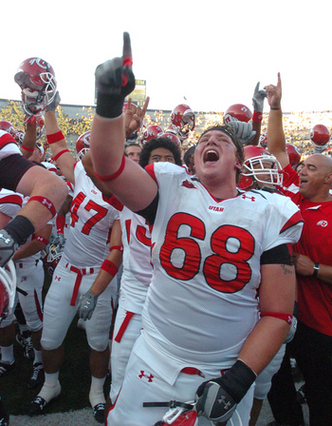
Utah players celebrate a win in 2008 against Michigan. The teams are scheduled to rekindle their series in 2014, despite the Big Ten/Pac-12 schedule alliance dissolving Friday. Melanie Maxwell | AnnArbor.com
Keep in mind, the league already agreed to expand to a nine-game conference schedule by 2017 in August, although the plan was tabled after the Pac-12 agreement surfaced in December.
Delany said in May he would still favor adding a ninth Big Ten game if it weren't for that agreement.
"You know, if we hadn’t done the collaboration, we’d do nine," Delany said of the Big Ten's league slate. "If we do the collaboration, we’ll do eight. So, we’re able to attract a higher quality of game. We’re not expanding the number of games, we’ll still play 12.
"The question is, are you gonna play eight quality conference games and assure there’s a ninth quality game in the mix, one way or the other? ... The idea was to upgrade the quality of the schedules, either through nine or through the collaboration.”
Delany, along with the Big Ten's athletic directors, were in accordance at those meetings that schedule strength should carry more weight now that college football is moving to a four-team playoff format.
So, now that the Pac-12 agreement is stuck in purgatory -- or worse -- conference ADs will be scrambling to fill out their schedules with respected opponents.
It won't be as bad for Michigan, which already has announced a home-and-home with Utah that begins in 2014, as well as single games against Oregon State in 2015 and Colorado in 2016. A message to Michigan athletic director Dave Brandon regarding whether contracts have been signed for those games was not immediately returned.
The bottom line for Big Ten teams is this: Find a respectable ninth opponent, either via new nonconference games or an expanded league slate. And it appears the latter could already be favored.
Kyle Meinke covers Michigan football for AnnArbor.com. He can be reached at 734-623-2588, by email at kylemeinke@annarbor.com and followed on Twitter @kmeinke.
Comments
Rob MI
Sat, Jul 14, 2012 : 1:25 p.m.
"So, now that the Pac-12 agreement is stuck in purgatory -- or worse -- conference ADs will be scrambling to fill out their schedules with respected opponents." What a farce. Let's all get ready to welcome back the directional Michigan schools and other craptastic MAC opponents back into the September non-conference scheduling farce. What a shame.
cutty240
Fri, Jul 13, 2012 : 11:47 p.m.
Jim Delany wants only Big 10 against Big 10 that is dream for the future.I think not playing the Pac 12 hurts The Big 10 more than people realize.This New Playoff deal is going to based on who you play.I'm sure The Rose Bowl People don't like it either.They could of made it work,dumbed it down for right now.
Scott
Fri, Jul 13, 2012 : 9:30 p.m.
I think it's great to play a quality team like Utah. They bring a well coached style of play you don't see in the Big Ten and help prepare for possible wide open teams in the bowl games or playoffs (wish). Don't forget Appalachia State! Please. Oregon state and Colorado stink- they won 6 games between them last year.
MRunner73
Fri, Jul 13, 2012 : 9:15 p.m.
I'd like to know in the future if Mr Brandon did sign contracts already with Utah, and this big Thursday Night opener host by the Utes. If all that goes by the wayside, it will be interesting to see how the next plan is.
D21
Fri, Jul 13, 2012 : 7:09 p.m.
Finally, the B1G got that thumbs down from Pac 12 to wake up. I never cared for that stupid agreement in first place and I prefer more conference games. Also, am glad we don't have to watch the Ducks UUUGGGGLLLLYYYYY uniforms :)
Scott
Fri, Jul 13, 2012 : 9:23 p.m.
That's Oregon. Oregon state are the beavers. They are a horrible football team and only won three games last year.
Craig Lounsbury
Fri, Jul 13, 2012 : 6:20 p.m.
I will be mildly surprised if they ever go to a 9 game conference schedule. I just think the big schools will always not the ability to maximize the home schedule.
Craig Lounsbury
Fri, Jul 13, 2012 : 6:21 p.m.
not= want above "always want the ability to maximize the home schedule."