

Big Ten backs proposal to shift portion of baseball season to fall
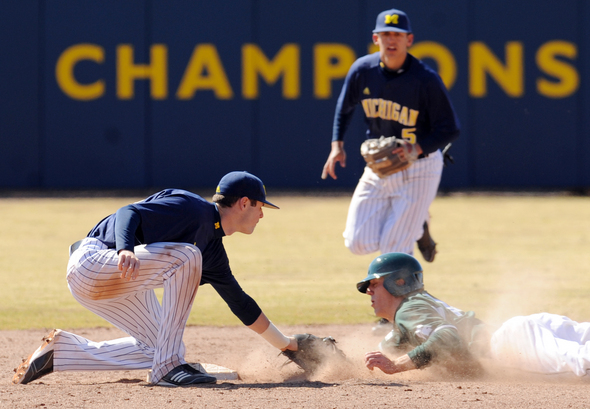
Big Ten baseball teams have retreated into national irrelevancy since 1984, when Michigan made the College World Series. No league team has made it back since. Some think beginning the season during the fall may help the Big Ten level the playing field with southern and West Coast teams.
Melanie Maxwell | AnnArbor.com
'The Michigan baseball team had played 20 games. It had put together both a four-game winning streak and five-game losing streak. It had lost its shortstop and No. 2 starting pitcher to injury.
It had traveled thousands of miles to Florida and Louisiana and South Carolina.
And it had yet to play a single game in Ann Arbor.
Such is the life of a Big Ten baseball team -- but maybe, not for long.
The league, which faces immense hardship in competing with southern and West Coast schools due to unforgiving early season travel schedules, appears to be on the precipice of demanding change.
The Big Ten's athletic directors, as well as commissioner Jim Delany, met last week in Chicago to discuss a wide range of topics. Among them: A proposal to shift a portion of the baseball season to the fall.
"I think it would be incredibly smart in the northern schools to play a partial season in the fall," Michigan athletic director Dave Brandon said in Chicago.
"For weather-related reasons, we’re going have a better quality experience for those student-athletes if we do in those beautiful months of August, September and October play some baseball -- so we’re not starting the season in February and March when we’re scraping snow off the field.”
The Big Ten has retreated into national irrelevancy since 1984, when Michigan made the College World Series. No league team has made it back since.
Only four Big ten teams have advanced to the round of 16 since the tournament expanded to 64 teams in 1999.
Much of those struggles have to do with the geography -- more specifically, the climate -- of the league. Cold temperatures, even snow, persist throughout much of the spring, which drives away many of the best recruits.
It also forces teams to travel thousands of miles to open their seasons, often playing schools that have practiced outdoors for weeks. That is a grueling stretch for most Big Ten teams.
Michigan went 9-11 to open the season -- each game played on the road -- then scuffled to a 22-34 finish. Coach Rich Maloney, who guided the Wolverines to three league championships during his 10-year stint with the school, did not have his contract renewed after the season.
In an interview before the announcement of his departure, Maloney said he would "strongly support" the initiative because it could help curb many of the most significant hardships facing Big Ten teams.
"We have to create some positive changes somehow," Maloney said. "It's such a battle with southern schools, for recruiting and all that. One opportunity to level the playing field a little bit would be to move to the fall.
"I'm not sure how much parity it would create between the North and South. Our challenges are so significant, I'm not sure how much effect this would have. But it's something, and something needs to be done."
Maloney said the idea has been kicked around for at least three years, when Stanford baseball coach Mark Marquess first broached it.
Purdue coach Doug Schreiber is spearheading this initiative, with a 16-game fall season currently on the table.
The Big Ten is strongly behind it.
“My understanding is it’s a great consensus around our coaches, a great consensus around our athletic directors, but we haven’t done as great a job as we need to of selling the other conference leaders and coaches to buy into that," Brandon said. "And we’re not totally sure why that is."
Maloney said although it wouldn't balance the weights between North and South, it would make the schedule more navigable for northern teams.
The Wolverines played 35 games away from Ann Arbor this past season, and only 23 at home. That's a significant disadvantage, considering home teams win about 62 percent of the time, Maloney said.
Compounding the issue is the current formula used to determine the NCAA field -- the Ratings Percentage Index, more commonly known as the RPI -- does not distinguish between home and away games.
That makes the road to the tournament much more difficult for a team such as Michigan, which plays 60 percent of its games away from home.
The RPI is being tweaked this offseason, with home/away taken into account, but will it be enough to help the Big Ten's competitiveness?
"It seems like, right now, no (Big Ten) team can get in unless they win the (league) tournament," Maloney said. "If we're serious about making the Big Ten a competitive conference in this sport, we've got to get to the point where we're getting three representatives in the tournament every year.
"Then you might see things happen -- might see us competitive again on a national scale."
Maloney said the biggest impact of adding a fall schedule would be finally luring intriguing non-conference opponents to Big Ten country. He speculated the Big Ten could partner with the Pac-12 (a heavyweight in the sport), as the two leagues have in other sports.
He said he also envisions the Wolverines packaging weekend fall series around home football games, which could bolster attendance, exposure -- and revenue, in a sport that has become a big-time drain on athletic budgets.
"I'm not sure how much parity it would create between North and South, but it would be an opportunity to draw some fans," Maloney said. "It would help spread out our games, and we wouldn't have to play so many in a row on the road in the spring.
"We'd save some money on travel, the kids could play closer to home and I imagine we'd be a little more competitive. Sounds like a win-win to me."
Kyle Meinke covers Michigan football for AnnArbor.com. He can be reached at 734-623-2588, by email at kylemeinke@annarbor.com and followed on Twitter @kmeinke.
Comments
Craig Lounsbury
Sun, May 27, 2012 : 1:34 p.m.
maybe we should give up trying to be "competitive" with southern and western schools in baseball. I don't see them trying to be competitive in hockey. This fall season makes no sense from a "competitive" standpoint if one defines competitive as going deep in to the NCAA tournament and producing tournament champions. How will the fall season count? will games played in the fall count toward the following spring season? These separate pointless games are not going to entice good high school players to northern colleges.
FRED
Sun, May 27, 2012 : 5:03 a.m.
if weather is such a challenge, why not build a multi-sport indoor domed stadium to be shared by basebaseball, softball and any other weather challeged athletic program? The cost is probably no more than a football field house but would serve more athletic programs, not to mention renting to local high schools and other small colleges / universities. If scheduled correctly, it will be used more often than any football fieldhouse and have a better return on investment.
Del Dunbar
Sat, May 26, 2012 : 7:21 p.m.
Coach Maloney is appropriately managing M fans' expectations when he stated: ""We'd save some money on travel, the kids could play closer to home and I imagine we'd be a little more competitive." A little more competitive may be a stretch. Florida high school coaches often encourage young men to focus on only one sport. Baseball is a warm weather sport. Florida high school players practice and train year round. The better players will likely continue to select SEC and PAC 12 schools were they can continue to enjoy warm weather conditions.
FRED
Sun, May 27, 2012 : 4:49 a.m.
Actually, better baseball athletes would be playing in the minor league. Better solution might be for the minor leaguers to come back and play for the universities if they feel they cannot make it. If NCAA is allowing minor leaguers to come back and play football, why not let them play baseball, stipulating that no scholarship will be given and the returning 'pro' player must earn a degree before going back to pro baseball. This would help this scholarship challenged sport to thrive and offer marginal minor leaguers a chance to earn a degree.
Kyle Meinke
Sat, May 26, 2012 : 7:50 p.m.
Del, I think you hit the nail on the head. That's the gist of it. It's a pretty vicious cycle, and it's hard to see any Big Ten team competing at a national level for any kind of extended time.
rf9
Sat, May 26, 2012 : 6:41 p.m.
why this fascination of playing the pac 12 in the fall the big ten is an eastern loop so why not play another eastern loop in the SEC . in season one michigan would travel to georgia then host tennessee whichever conference has the most wins takes the challenge
rf9
Sat, May 26, 2012 : 5:57 p.m.
its time for the big ten , mac , big east and the ivy league to establish an NIT ! do it the weekend after the big ten tourney with 2 semis and a final !
heartbreakM
Sat, May 26, 2012 : 3:26 p.m.
As much as Mr. Brandon says it would be an advantage to his student athletes, isn't it actually a disadavantage to extend the playing season, regarding injuries, attention to the classroom, and such? Interesting idea, but poorly thought out. unless every league has its season moved, the B10 would be committing a disservice to its teams to do so. Is softball next?
Billy Bob Schwartz
Sat, May 26, 2012 : 3:51 p.m.
Heartbreak: "unless every league has its season moved...." I thought that was the idea. It needs to be NCAA=wide. Also, if you were injured in the fall, you would have time to heal. As far as the classroom is concerned, if the season remains the same number of weeks, what's the dif.? I suspect there has been a lot of thought put into this thing, and it sounds very interesting to me. Why should we not have a chance to compete?
annarboral
Sat, May 26, 2012 : 3:21 p.m.
Football has all kinds of rules about what you can do and when. Seems like baseball needs some that will level the competitive situation. I don't like splitting the season as there would be all kinds of continuity problems. Why not take the simple approach. Baseball is a summer sport! So, why not play into the summer. Let every NCAA team start on May 1 and play the season into the summer so it's fair for everyone.
MRunner
Sat, May 26, 2012 : 1:32 p.m.
Interesting idea to have a split season like this, but I wonder, if weather is a driving factor in competitiveness in baseball, what factors have helped Michigan's softball team overcome those problems and perform competitively on the national level?
semperveritas
Sat, May 26, 2012 : 9:50 p.m.
well, i can offer a couple. as you know CALIFORNIA is the epicenter of softball recruiting. with almost 38 million people, the state turns out hundreds of division 1 players. they can't all earn scholarships to play at PAC 12 schools. many are happy to accept invitations to play at faraway universities------like MICHIGAN. not so in baseball. one more------no high school softball player has the option of turning pro. the ability to recruit topnotch talent to play baseball in the north is very very very difficult. i don't believe a split-season schedule will make an iota of difference.
Jim Mulchay
Sat, May 26, 2012 : 12:40 p.m.
If the "spring" start date remains in February and the NCAA championships remain in late May / June I don't see the incentive for the successful southern and western programs to come to the "north" in the fall. As far as "academics" I'd think it would make the fall semester more difficult for the "student" athletes - right now they just need to schedule around practice and workouts and no travel issues. It would probably provide some nice playing dates and maybe more revenue (more home dates). Overall it would seem to be a step (like the NCAA football BCS conferences) toward segregating the "haves" from the "have nots" in baseball. Note - there are almost 300 NCAA D1 baseball programs currently - six in Michigan.