

Big Ten, Pac-12 announce suspension of schedule collaboration across all sports
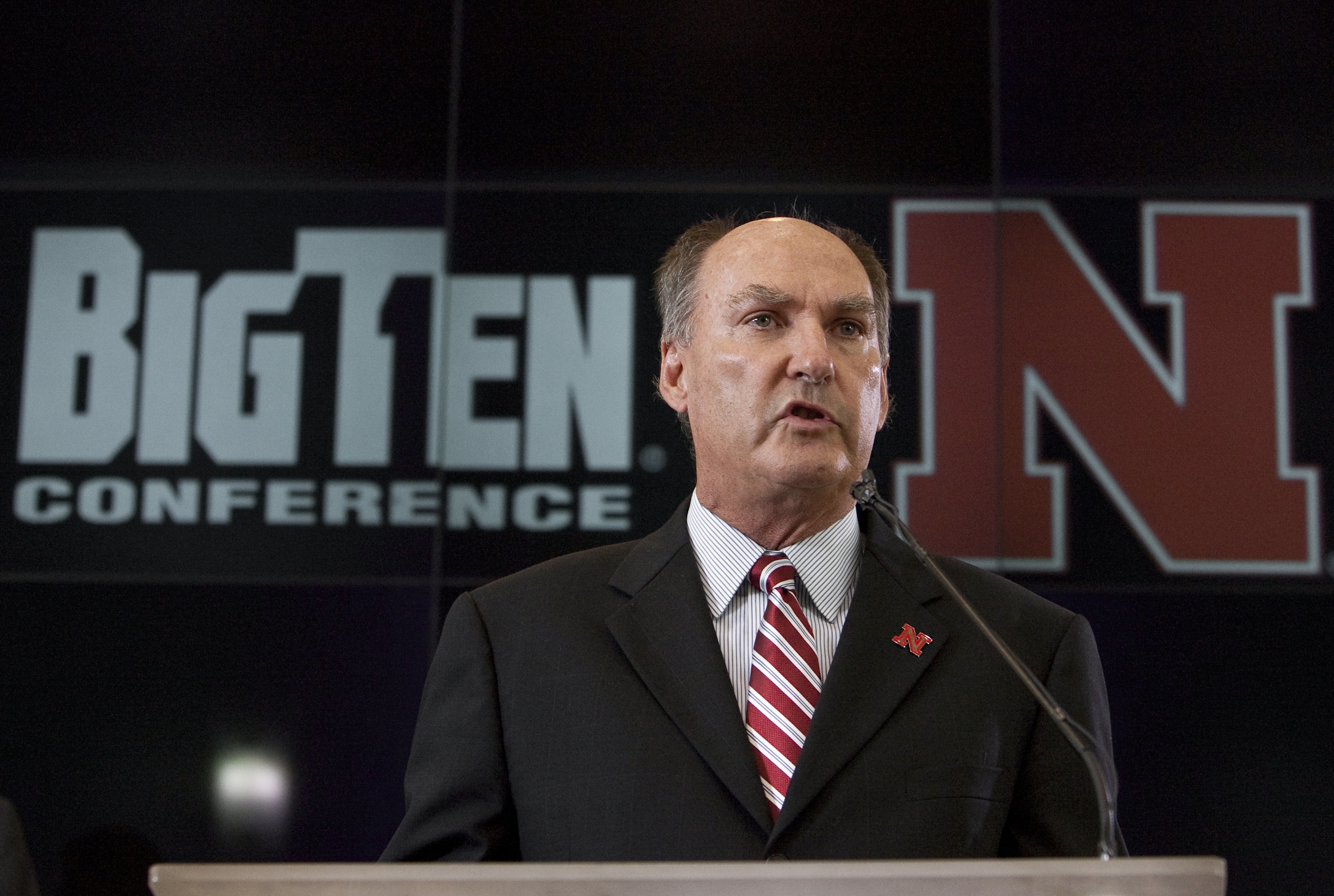
Big Ten commissioner Jim Delany, above, and Pac-12 commissioner Larry Scott announced Friday the immediate "suspension" of the Big Ten-Pac-12 scheduling collaboration.
AP photo
It may have to be, too, as it might not happen again for a long time.
The Big Ten and Pac-12 jointly announced plans Friday to immediately "suspend" their previously hatched scheduling collaboration across all sports -- bringing an end to the cross-country alliance before it ever really began.
“We are disappointed to announce today that the Big Ten Pac-12 strategic collaboration announced jointly in December 2011 unfortunately will not be consummated," Big Ten commissioner Jim Delany said in a statement. "We recently learned from Pac-12 Commissioner Larry Scott that the complications associated with coordinating a non-conference football schedule for 24 teams across two conferences proved to be too difficult.
"Those complications, among other things, included the Pac-12’s nine-game conference schedule and previous non-conference commitments."
Unveiled in December, the plan originally called for every Big Ten and Pac-12 member institution to schedule one game with a member of the other conference each season.
In football, the hope was to have each school participating in the collaboration by the 2017 season.
However, the Pac-12 has decided it won't deviate from its current nine-game conference schedule -- ultimately leading to the alliance's demise.
"While we continue to value our close relationship, particularly our partnership in the Rose Bowl, the Pac-12 came to the conclusion that it's in our best interests to maintain our nine-game conference schedule and maximum flexibility in out-of-conference scheduling," Pac-12 commissioner Larry Scott said in a statement. "Thus, the Pac-12 decided not to lock into the proposed mandatory 12-game schedule in football.”
Michigan got on board late last month by announcing a home-and-home series with Utah (2014-15), as well as single-game home dates with Oregon State (2015) and Colorado (2016).
Shortly after making the scheduling announcements, Michigan athletic director Dave Brandon offered a warning about the collaboration moving forward -- saying that several of the details about how, exactly, it would work across all sports had not been determined.
"The concept is a really good one," he told reporters. "But now it's like, 'OK, we've got to make this happen.' We've got all these teams with schedules out years in the future and now they're juggling all these balls to figure out how to put it together.
"There's a lot of work being put into it. ... Stay tuned."
Nick Baumgardner covers Michigan sports for AnnArbor.com. He can be reached at 734-623-2514, by email at nickbaumgardner@annarbor.com and followed on Twitter @nickbaumgardner.
Comments
Billy Bob Schwartz
Sat, Jul 14, 2012 : 4:04 p.m.
Hey, guys. It's complicated? Buy a computer. There are a lot of feeble excuses in pretty much all facets of the world these days, but this Wimping Out is disgusting. I guess there goes our superconference! LOL
hermhawk
Sat, Jul 14, 2012 : 5:43 a.m.
Wimpy scheduling rules the day. One of these fans fed up fans will vote with their feet. FCS patsies are abound. If the Pac-12 and Big Ten knew there would be these complications, then why get everybody's hopes up. When it comes to heavyweights scheduling each other home and home and not a one game neutral site series, don't believe the hype.
Terry Star21
Sat, Jul 14, 2012 : 2:25 a.m.
Big Ten games are very exciting, and that conference offers some of the best college football in America. I would rather see an additional B10 game then to go to the weaker conferences, like Pac-11, SEC and MAC - those pitiful schools give Michigan no credibility. MgoBlueForTiM....Big Ten - Best football in America.
Doug
Sat, Jul 14, 2012 : 12:01 p.m.
SEC weak. What are you smoking?
ChelseaBob
Fri, Jul 13, 2012 : 7:52 p.m.
I didn't understand the attraction of the PAC 12 in the first place. Utah? Really? A home and away set with Stanford or USC might be interesting but those schools don't want to schedule Michigan or Ohio State. They want Purdue or Indiana. Michigan has proved it's not afraid to schedule tough games. Alabama puts that idea to rest. Now the other schools need to get on board.
15crown00
Fri, Jul 13, 2012 : 6:01 p.m.
it's all about wins,losses,and money.Truth Be Told.
heartbreakM
Fri, Jul 13, 2012 : 7:47 p.m.
It's all about money, money, money. And if there are wins, that is all the better. It's too bad because that sports arrangement would have benefited all student athletes at both schools.
Irvine CA
Fri, Jul 13, 2012 : 5:52 p.m.
"coordinating a non-conference football schedule for 24 teams across two conferences proved to be too difficult. " Really? or nobody likes to play tough non-conference games early in the season. A 0-2 record to start a season would be bad for bowl games, ranking, recruiting.............
Craig Lounsbury
Fri, Jul 13, 2012 : 5:34 p.m.
"We recently learned from Pac-12 Commissioner Larry Scott that the complications associated with coordinating a non-conference football schedule for 24 teams across two conferences proved to be too difficult. " In other words..."we did the math and nobody wants to commit to any non-conference road game because it costs money and risks a loss. Congratulations to all the paycheck teams who were going to lose out on a big payday your back on the schedule.