

Sounding the alarm: How to teach dogs to bark on command, methods to quell excessive barking
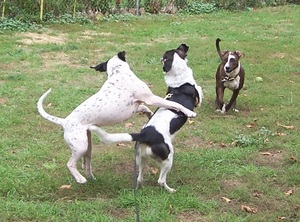
There may be lots of barking during active play.
Amy Samida | Contributor
“Is the door locked?” flitted through my brain in that split second before the sleeping dogs erupted in a resounding cacophony of alarm barks. It was positively deafening, and I realized that it didn't really matter if the door was locked.
My four-footed alarm system was fully functioning, thank you. Well, at least the terrier contingent was on the ball. The Leonberger cocked his head and listened, waiting to see what was up.
For something that can be so good, most of us have also experienced the frustration of a barking situation that can drive you straight up the wall. The dog who barks at every little sound. The dog that just doesn't understand when enough is enough. The dog who catches you unaware as you daydream with one of those spike-in-your-brain, sharp barks that darn near makes crystal shatter.
Many barking problems arise from breed type. Certain groups of dogs just tend to be a little more talkative than others.
In general, terriers and herding breeds, as well as many toys, can be a little noisy. It's not a personality flaw. It comes with the territory when you choose a dog who has been bred to do such things as corral large, obstreperous beasts or drive vermin away.
Your terrier may enjoy spending the day leaping up and down at the fence, giving a piece of his mind to the squirrel tormenting him from the nearest oak. Your sheltie, border collie, or corgi may run the fence line, barking with wild abandon at skateboarders and cyclists, satisfied that she is doing her job when she moves that bike right out of her territory.
This is not to say that problem barkers don't exist in every breed or mix, just that some have a stronger propensity to be real talkers.
Other situations that encourage barking are boredom, lack of exercise, and separation anxiety and other psychological issues.
True separation anxiety is not as common as most people think. Separation anxiety is a topic all on its own, but most “separation anxiety” is simply a dog who is bored, inadequately exercised, and finding something to do with his time. Destructive chewing and barking are common in such dogs as this.
This, actually, is your fault, not the dog's. It's perfectly acceptable to expect an adult dog to spend the day alone while you're at work, but you owe it to the dog to make sure he's been exercised adequately (this varies widely depending on the breed) and has toys to keep him occupied while you're away.
Like most training, the methods of quelling excessive barking are easy. The hard part is working on them consistently.
One common bark is an alarm bark. This is the hardest bark for your dog to control. Like the shriek you emit at the site of a spider on your bed or a mouse in the pantry, it just happens. So it's not fair to expect that you can stop alarm barking completely.
After checking to make sure everything is indeed OK though, it is completely fair to expect your dog to quiet down. Remembering that my dog has done nothing wrong, I teach this by looking out the door or window then saying, in a conversational tone, “Thanks, but it's OK”.
If the barking continues, I snap a lead on the dog and take them to another room for a moment, just long enough to settle. I then drop the lead, letting my dog free but leaving an easy-to-grab handle attached. If he goes back to the window and looks out quietly, goes back to what he was doing before the alarm was sounded, or does anything but bark, I take the lead off. If he immediately goes back to barking, I remove him from the room for a slightly longer time, then repeat. You can see results with this very quickly, if you're consistent.
And here's something really cool. You can easily teach your dog to bark on command. Add a hand signal and you've got yourself the best burglar alarm ever.
To teach your dog to bark on command, get her excited by playing a favorite game. Generally this will elicit some vocalizing. Say “Speak!” or whatever command you want to use as she barks. Before long, your dog will happily bark on command.
Now's the time to add a hand signal. It doesn't matter what you use: a pointing finger or something equally subtle is what you're going for. You may never need this handy trick, but who knows. Once you've got the bark on a hand signal, you can say something like “Fluffy, Watch!!”, while subtly giving the signal, and it will sound like you've got a trained guard dog on your hands.
Anyone who knows dogs would be able to see the lack of aggression in the dog's body language, but your average ne'er-do-well isn't an astute observer of canine behavior.
Amy Samida was a professional groomer prior to her career in veterinary nursing. She began training dogs as a child and has continued training and working with problem dogs through it all. Amy is now the owner of Naughty Dog Cafe in Ann Arbor. She can be reached at amy@naughtydogcafe.com or 734-276-3522
Comments
Dogowner
Sun, Aug 29, 2010 : 5:25 p.m.
I am the boss: I control my barking dogs' lives and my barking dogs control my neighbors' lives.
TrappedinMI
Sat, Aug 28, 2010 : 9:55 a.m.
Good article. Thanks for the tips. Love your pic (with Leonberger)!
John Spieser
Sat, Aug 28, 2010 : 9:22 a.m.
In my opinion, your dogs bark can be an asset, but only if you can control it. I'm glad that you mentioned the need for exercise and interaction. Incessant/obsessive barking can be a real bummer for those who are subjected to it by choice, not to mention those who didn't ask for it, like the neighbors. We teach all of our dogs to cease barking on command. I agree that one way to teach a dog the concept of not barking can be teaching it to bark on command. I've used this method before with jumping behavior as well. Thanks for the topic!
Carolyn
Sat, Aug 28, 2010 : 7:16 a.m.
I hope my 2 neighbors with dogs are reading this article. Both have some kind of mixed breed dog and BOTH dogs can go on and on and on and on and on. What I don't understand is why the owner of the dog don't step out and remove the dog from the yard when this goes on. It can't be pleasant for them, especially since the dog is a lot closer in proximity................ Very curious.
bwebb
Fri, Aug 27, 2010 : 11:13 p.m.
i have two german shephards for two easons. One as pets, the other as a first line of defense of my family. My neighbors love them as they know my dogs will alert all us if something is not right. i have raised dogs my whole life and with due respect to the author of this article her suggestion seems a little ridiculous, though it may work. If my dogs bark at the window I look out, make sure eveything is as it should be and tell them its ok and they are quiet. simple enough.
bunnyabbot
Fri, Aug 27, 2010 : 2:12 p.m.
I have a large watch dog as well, when reading about the breed it said they usually only bark when they feel it is "necessary", luckily that has turned out to be so. I also did teach him to bark on command. I sleep well knowing that the dog will alert me to unusal noises. My neighbor admitted when he saw my dog he was worried about barking, but hardly ever hears him and I don't get many solicitors come to the door, always a good thing :)
Alaina
Fri, Aug 27, 2010 : 12:21 p.m.
I have a herding breed, an Aussie, and she is an excellent watch dog. In fact, I don't even have a doorbell, just my dog :) One thing that I've noticed with her is that when she is feeling a lot more 'Alpha', and is challenging my status as leader, she will bark A LOT more. When she is more sure of her status at the bottom of the pack, she knows that I will do a good job watching out for intruders, and is a lot less likely to bark. Since she will occasionally start to vie for top-dog position, her level of barkiness alerts me to this change, and I can take steps to make sure she knows her place. In my experience, excessive barking can be this situation- a dog who is unsure of their role in the pack, or even under the impression that they ARE the leader, and are acting to protect you.
pvitaly
Fri, Aug 27, 2010 : 12:13 p.m.
Nice article. My problem is my dog is very territorial. It's scary because he is a 1 year old german shepherd / english pointer mix. So, when he starts growling and barking at people that just walk by - I am positive they get freaked out. What's even worse is when he barks and the hair stands on his back when the neighbors are in their back yards. Any idea on how to fix these problems?