

Fostering a dog before you adopt may help you decide if a breed is right for you
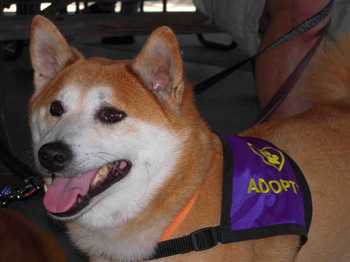
Photo by Shelley
Rescue organizations are desperate for people to foster a dog until their forever home is found. When I volunteered for Greyhound Rescue, we relied on our foster homes because sometimes it takes a while to find just the right permanent home for the Greyhound. During this foster period, you can determine if this is the right breed for you.
The adoption process for Greyhounds has some special challenges. Greyhounds from the track (and almost all Greyhounds are “retired” from the Greyhound track) have never lived in a home.
They don’t know about stairs. It takes time for them to learn to walk on linoleum. Sliding glass doors are introduced so the dog won’t go through them. Of course the dogs are tested to see if they can live with cats.
The dogs that are eventually adopted are adults, but they are not house broken. Our screening process was the same for everyone. The first interview is the “get acquainted” interview, so we can learn about the prospective owner and inform them about Greyhounds.
The second interview is more in depth. We wanted to be thorough. We wanted to make sure this is a good home for the dog — we didn’t want them to be returned to us. We emphasized that if for any reason the dog had to be returned to call us first. Unfortunately we did get calls — sometimes at 11 o'clock at night — and yes, we were willing to take back any dog we had originally placed. Adoption policies are even more detailed than when I was involved in adopting Greyhounds 15 years ago.
Shelley, who volunteers and provides a foster home for Midwest Shiba Inu Rescue based out of Illinois, finds that the adoption process begins in a number of different ways depending on how the dog was surrendered.
If the dog was surrendered and the original owner is available, Shelley prefers to go to the owner’s home to assess the dog. The dog is more comfortable in the home environment . When they meet the owner, Shelley asks for health records. She also brings another dog to see how the dog will get along with another dog. Shelley also asks the owner to give the dog food to see if it is food aggressive.
“I even make loud noises to see how the dog will react,“ she says.
After the dog has been surrendered, the animal is taken to the vet to check out its health. Shelley also gets to observe if the dog’s nails have been clipped; if its teeth are in need of cleaning and if the dog is dirty. There is a good chance it has not been bathed.
“A lot of Shibas” Shelly says, “do not like water."
If the dog reacts strongly to water, it is a safe bet it has never been bathed.
"When we go to a home that would like to adopt one of the rescue dogs, we look for a lot of things. For example, are there ways dogs can escape? Shibus are escape artists. We bring a toy and treats to see if the new owner would like to play with the dog. Shibas are very active dogs. We ask if the potential owner likes to walk. We try very hard to match the right dog with the right person. We do not deny anyone a dog just because they have never owned a Shiba before. We try very hard to teach people about the breed so they can understand them.”
I asked Shelley about fostering a dog before you know it is the right breed for you. Shelley was very enthusiastic about this.
“You can really find out about a dog and help to match it — if not for you, but perhaps to another person’s life style. You get to learn the personality of the breed.”
Shelley and I agree. This is the way to go if you would like to learn what it is like to live with a particular breed. Many foster dogs go in and out of Shelley’s life, but she has found the breed for her.
“I would definitely recommend fostering. It saves a dog’s life and enriches yours at the same time!” she says.
I couldn’t have said it better myself.
P.S. Good news. Shelly just told me that the little guy in the photo has been adopted!
Julia Levitt is the founder of In Harmony Dog Training (www.inharmonydogtraining.com) in Ann Arbor. She can be reached at julia@inharmonydogtraining.com or at 734-645-4707. Julia provides individual training for dogs and their owners, and also conducts dog training classes at Ann Arbor Animal Hospital.
Comments
Julia Levitt
Wed, Nov 21, 2012 : 12:58 a.m.
I am so happy for you Elaine- thanks for writing-Julia
Julia Levitt
Tue, Nov 20, 2012 : 3:13 p.m.
Hi Elaine- what an unfortuate experience you and your family had. Please don't give up- the right dog is just waiting for you! Julia
Elaine F. Owsley
Tue, Nov 20, 2012 : 11:13 p.m.
Oh, we didn't. We've had two dogs since then. Both rescues through a Chow Rescue organization. Part chow, part American Eskimo and another part chow, part corgi. We really like the chow mix dogs. Very smart.
Elaine F. Owsley
Tue, Nov 20, 2012 : 12:48 p.m.
We "sort of" fostered a dog from the Humane Society several years back. We paid the fee, too him home and were never told anything about him. Turned out he loved me, would pull back his lips and snarl at my husband, bit the vet tech who trimmed his nails, refused to go into the building for obedience training - I do not carry angry 60 pound dogs - and was really unpredictable in his behavior. After several weeks of this, i returned him, found out he had been returned by two families before us, and was never offered a refund. They put him to sleep saying he was "food aggressive". The one sin he had not committed with us. Had it been a "foster" it still would have left a bad taste in my mouth.
onemoreminute
Wed, Nov 21, 2012 : 2:19 p.m.
I think our local shelter does a great job, but they aren't perfect, and evaluating dogs in a shelter situation can be difficult and inaccurate, but let's look at this from the dog's point of view. He came from "wherever", was with one family, returned to the shelter, repeated, and repeated again with you. Very traumatic. Chances are, he was scared of your husband, scared of the training building, and scared of having his nails clipped (as many dogs are. I've lost track of the number of dogs I've had to muzzle to trim nails). Fear frequently presents as aggression, and your initial reaction to it set the tone for the rest of his visit. Instead of being given some sympathy and love he was deemed a "sinner". He needed to be put on a slow program to help him learn to love and trust your husband, learn that he didn't need to be afraid of the training building (which is full of smells and sounds that can be scary), and gradually taught to have his nails trimmed without biting, instead, you decided he was "angry", and returned him once again to the scary shelter, where he was killed. I think your heart was in the right place, and he was not the dog you signed up for but my sympathies are for this poor dog. You failed him as much as he, in your eyes, failed you. May he rest in peace now, somewhere safe and secure where he is loved and understood.