

Study indicates that comforting your fearful dog is helpful, not counterproductive
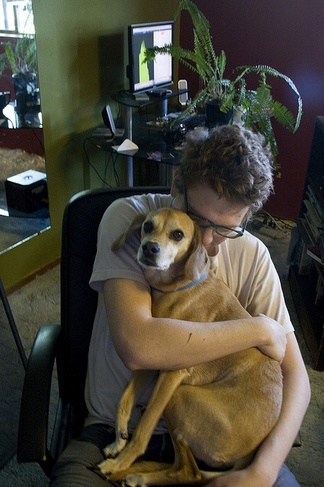
Flickr photo by Katie@!
A fear-based response can happen for a lot of reasons, and whether it be, for example, unfamiliarity with a new situation (as with a puppy) or in the case of an older dog who has been rehomed (whose socialization may be unclear), fear is fear.
With animals, fear serves them well at its core — it keeps them out of harm's way and allows them to quickly distance themselves from danger, enabling them to navigate emotionally and bookmark the experience for later reference.
But when it moves beyond that, it can be a real problem, as with repetitive exposure to profoundly challenging situations or when a pet is not properly socialized.
I often get phone calls from pet owners who understand that their furry friend has difficulty with new experiences or when they are faced with a specific experience that is known to elicit a fearful response. They would rather find a solution (like a pet sitter or a buddy to come in for some one-one-one interaction on a regular basis) than put them in a situation that exacerbates the problem. With some pets, the process of empowering them to get reacquainted with their world with less fear can take years, or it may never happen at all.
Finding the right caregiver who can pitch in when said dog's people can't be there is a good move and can make all the difference.
I ran across a recent article by Stanley Coren, Ph.D. that reminded me how important trusted humans are in a dog's life.
Coren discussed the "Safe Haven Effect" as it relates to canines.
Previously, we've associated this behavior with children while they are experiencing something scary or stressful. During these events, they seek the closeness and even physical contact from trusted adults as a reaction.
By studying the physiological responses and other data, we know that a child's stress is greatly reduced as a result.
But as one study illustrates, this behavior is also seen in dogs.
Researchers at Eötvös Loránd University in Budapest, Hungary decided to explore the "Safe Haven Effect" by employing something called the "Strange Situation Test," a way to test the emotional attachment of children to their trusted people.
The results of the study, led by Márta Gásci, were intriguing.
Behavioral responses were measured, along with physiological reactions, like heart rate. (The latter, when it's increased, indicates a higher level of stress.)
The details of how the study was carried out can be seen by clicking here, but dog owners should find the data from it to be helpful: when dogs meet with a stressful situation, their overall anxiety level is decreased when their trusted humans are nearby. Further, when this is the case, our presence in these situations has a protective effect for future exposure to stress.
The data reinforces the idea that comforting a pet is not counterproductive when they are experiencing something frightening, as well as the importance of properly socializing a dog not only with other animals, but the world at-large.
Lorrie Shaw leads the pets section for AnnArbor.com and owner of Professional Pet Sitting. Shoot her an email, contact her at 734-904-7279 or follow her adventures on Twitter.
Comments
North County Dog Training
Sat, Mar 30, 2013 : 11:15 p.m.
If a child falls down and you make a huge deal out of it, coddling in a concerned manner, the child will react by crying, etc. If a child falls down and you help him up and talk in a more cheerful voice while hugging and brushing him off, he's likely to forego the crying and go back to playing. If a dog is afraid, there's no need to coddle the dog in a concerned manner. You are much better served by moving the dog away from what he's afraid of. Loving the dog, petting, giving attention is good but personally I do not suggest coddling as it has been my experience that this type of behavior can make the fear worse. I've helped many fearful dogs get over the fear without coddling and consoling.
pest
Sat, Mar 23, 2013 : 3:31 p.m.
The human is the "alpha", and the roles and duty of the alpha is not only to lead their pack, but also to protect the pack members. When you have a fearful dog, the dog is looking to it's leader (alpha) to protect them and offer assurance of safety. The alpha must also teach their pack, and that includes teaching them how to deal with fearful situations. You cannot teach a dog (or human) not to be afraid, but you can teach them to overcome their fear of the unknown by offering protection, touch, soothing words and voice and by teaching them to investigate the thing that is causing fear.
nickcarraweigh
Fri, Mar 22, 2013 : 8:57 p.m.
This is no doubt well and good for some kinds of dogs, the ones you see dressed up on calendars and carried around by old ladies with ribbons and bows, sweaters and kneesox. I'm talking about the dogs here. Those dogs, God help them, are inured to the sly laughter and, sometimes, inquiring glances of their fellow canines. But the kind of dog you'd want with you when you go to Iraq or Afghanistan or Detroit? No, sir. Not them dogs. They'd rather lose an ear, and many of them have.
Lorrie Shaw
Sat, Mar 23, 2013 : 1:02 p.m.
nickcarraweigh, In my experience, any breed of dog can exhibit fearful behavior or signs of stress when exposed to challenging situations. As for canines that are used as military working dogs (and quite possibly K-9 dogs, but don't quote me on that) can - and have - suffer from mental anguish and show signs of being stressed as a result of their exposure to events in the field. Though they are well-trained, desensitized to possible activity that they'll see in the field and go through extensive trust-building exercises with their handlers, these canines are not impervious to being affected by any means. As some researchers are discovering, some are experiencing PTSD just as their human counterparts can. Your comment brought up an important issue. I appreciate the opportunity to respond in kind. Many thanks! Lorrie :)
riverguy
Fri, Mar 22, 2013 : 7:32 p.m.
In other breaking news, water has been found to be wet.
Lorrie Shaw
Sat, Mar 23, 2013 : 12:49 p.m.
riverguy, Please see my response to Ignatz and eldegee. Thanks for taking the time to comment. It's good to know that others understand dogs! Lorrie
Ignatz
Fri, Mar 22, 2013 : 7:16 p.m.
They needed a study to discover this? I suppose that next week another study will find just the opposite.
Lorrie Shaw
Sat, Mar 23, 2013 : 12:46 p.m.
Ignatz and eldegee, One thing that's important to remember, is that in the past, some have theorized that comforting a frightened pet would somehow reinforce fearful behavior. I can see why one would think that studies like this are deemed frivolous: but the reasoning behind it really does in my opinion how's how much work needs to be done in better understanding canine behavior clearly. You both make interesting points. I appreciate that. Thanks for your comments! Lorrie
eldegee
Fri, Mar 22, 2013 : 7:26 p.m.
I agree. It's just plain old common sense - which from all these ridiculous (and expensive) studies isn't as "common" as we think.
julieswhimsies
Fri, Mar 22, 2013 : 5:59 p.m.
I have never had a fearful dog, but I think comforting a fearful dog is absolutely the right thing to do.
RunsWithScissors
Fri, Mar 22, 2013 : 2:53 p.m.
This is interesting. I've always wondered about the advice to ignore your dog when it seems fearful - something about rewarding fearful behavior. That might be the case under some circumstances but there are some situations in which I think it's good to let your dog know that you're there and that all is well. My Fozzie Bear and his litter mate, Freyja, have completely opposite reactions to unexpected events. If there's a squabble among other dogs Fozzie will immediately go toward them to see what's up. Freyja, on the other hand, will immediately head toward me and sit on my feet.