

How to train dogs to stay calm and quiet, even when traveling
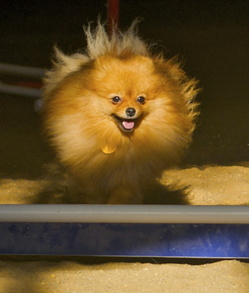
Toshi
Julia Levitt | Contributor
I travel a lot, and I often take my dog with me. Whenever I go to an airport, my Pomeranian attracts a lot of attention. Most people want to pet him, but it is not unusual for Toshi to pose for an impromptu photo shoot. Even the folks working at TSA cannot believe how quiet he is when I take him through security.
As my friend Marilyn reminded me — the reason my Pomeranian is so well behaved in public is that he has been well trained in private.
To back up a little — I began training my Toshi as soon as he moved from Florida to Michigan. Toshi was older and had firmly established bad habits. For example, he was not house broken.
Unfortunately many small dogs get the reputation of being yappy. Toshi was no exception — he barked at everything from butterflies to cars. His over-reactivity also included going after other dogs! Not smart, since another dog does not recognize that this dog is so small; they just see a dog “on the muscle!”
Fast forward to today. Toshi is what I would now call a model companion. This Pomeranian is my “demo” dog. He is the dog I bring to classes and the dog I bring with me to visit clients. I am confident that wherever I bring him, he will act appropriately. He is completely non-reactive to other dogs. But this little seven-pounder did not start out his way. How did this anti-social dog change?
Toshi swaggered into our home “marking” everything in sight. This was now his property! All of that changed when Toshi began to understand his boundaries.
It is common to hear people say they limit a new pet to a small a part of the home. A dog new to the home finds it daunting to patrol his new turf. Often the dog becomes territorial and guards the home. Unwanted behaviors also include high excitement when a new person comes to the door. The excitement can take the form of jumping on a guest or crying and whining from anxiety.
It very important to establish rules, boundaries and — yes — limitations whenever a new dog enters the home.
Toshi had no idea when he came to Michigan that when food was served, he didn’t need to leap in the air and spin around before he was fed. Soon he began to quietly wait for his food. More than that, it used to be that when he finished his own food, he would try to steal our other dog’s food! If dogs are not taught to not go after another dog’s food, a fight could begin.
We started with a simple rule: Before food was given, Toshi had to learn to wait quietly.
Boundaries: Where Toshi could go in his new home was monitored so he could calmly adjust to his new environment. A crate was used to help him feel secure and comfortable.
Limitations: It is never okay during a walk for any dog to lunge at another dog!
What happens when a dog new to his/her home encounters children for the first time? There is a very important rule: Children are not chew toys.
Boundaries: When a human is taking a ball or favorite toy away from a dog, no biting or guarding the toy/bone/ball is allowed.
Limitations: The roughhousing or ball tossing games are over when you, the human, say they are over.
When I am traveling with my dog, there is usually someone who asks “Did you give your dog a tranquilizer to keep him so calm?” No. But I did give him what he needed to become a model companion.
Julia Levitt is the founder of In Harmony Dog Training (www.inharmonydogtraining.com) in Ann Arbor. She can be reached at julia@inharmonydogtraining.com or at 734-645-4707. Julia provides individual training for dogs and their owners, and also conducts dog training classes at Ann Arbor Animal Hospital.
Comments
RunsWithScissors
Thu, Sep 13, 2012 : 1:38 p.m.
Where is the how-to? The article jumps from examples of bad behavior to examples of desired behavior.
Julia Levitt
Thu, Sep 13, 2012 : 2:59 p.m.
I am so happy that people want more info. I will go into more detail in future blogs. Thanks for your comment-Julia
Guinea Pig in a Tophat
Tue, Sep 11, 2012 : 5:18 p.m.
That picture of Toshi is adorable!
Julia Levitt
Thu, Sep 13, 2012 : 2:58 p.m.
Your photo is pretty cute too! Thanks for writing-Julia
jns131
Tue, Sep 11, 2012 : 2:11 p.m.
On a long trip we harness and buckle them in. Most times they sleep. We try to stop every 4 hours if it is a long one. Otherwise, buckle them in. Safer.
Julia Levitt
Thu, Sep 13, 2012 : 2:58 p.m.
Good point JNS. thanks for writing.Julia
Lolly
Tue, Sep 11, 2012 : 1:13 p.m.
I agree with the previous commenter. I was eager to read the article because of the headline, but there are no suggestions in the text.
Julia Levitt
Thu, Sep 13, 2012 : 2:56 p.m.
I am happy to go into more detail for a future blog. Thanks for writitng Lolly. Julia
LA
Tue, Sep 11, 2012 : 1:05 p.m.
I think it would be helpful if you gave more information on setting boundaries and examples of enforcing house rules. Not enough to take away any potential customers but more of a how-to article rather than just the final result. Thanks.
Julia Levitt
Thu, Sep 13, 2012 : 2:57 p.m.
Thank you for your very helpful comments LA. I will go into more detail in a future blog. Julia
Billy
Tue, Sep 11, 2012 : 12:05 p.m.
Or just give them some diphenhydramine....aka Benadryl. And before someone tries to say "DERP DERP YOU CAN'T GIVE DOGS HUMAN DRUGS!!"......this is vet recommended...has been for sometime.
jns131
Tue, Sep 11, 2012 : 2:10 p.m.
Gotta be careful with that stuff. Some dogs take a long time to recover from it.