

Now, is it time to declare a new 'War on Poverty'?
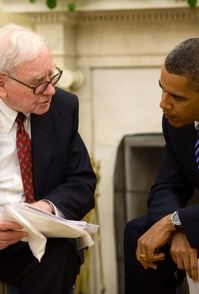
Warren Buffett meets with President Obama.
White House photo in public domain.
How many Americans live in poverty? Poverty means that a household’s income is less than a threshold required to maintain an adequate standard of living. The threshold for one American under 65 years of age, living alone, is $11,139. For a household of three, it’s $17,374.
I have a household of three, and I must say that I would feel pressed to get by at that level. Would you experience an adequate standard of living at those income levels?
Record numbers of Americans now live in poverty: 46.2 million Americans, according to the latest statistics compiled by the U.S. Census. This is the largest number in more than a half-century.
The Census began compiling these numbers 52 years ago. Here’s the entire report. I’ve read it — and, well, my advice is: Brace yourself.
The official poverty rate is 15.1 percent, as of the end of 2010 — the third consecutive annual increase. The poverty rate has increased for non-Hispanic whites and African Americans between 2009 and 2010, but it hasn’t changed for Asians or Hispanics.
The poverty rate for children is most depressing. The poverty rate for children under 18 is 22.0 percent, an increase from 20.7 percent a year before. The number of children under age 18 is now 16.4 million. Others who have experienced an increase in poverty include native Americans, people living in metropolitan areas, people living in the South and those with a disability.
Way back when, in the 1960s, President Lyndon Johnson waged a War on Poverty. This expanded what has become known as the welfare state. Since then, concerns about the poor have declined. Many criticize the whole idea of a state that takes care of the poor and downtrodden.
This might not be the most popular idea, but …
Is it time to declare a new War on Poverty?
If you recall LBJ’s War on Poverty, what did he do right? Or, wrong?
How should we wage such a war today?
Will the Buffett Rule stop our slide into poverty?
Household incomes slid downward in 2010, and a record number of Americans now live in poverty, as we discussed in the first part of this series based on U.S. Census data.
Now, Americans are debating: Can President Obama’s bold new plan kick start the economy and stop the slide?
There’s a lot to the plan, so today I want to focus on one key element: the Buffett Rule. Here’s the definition from the president’s proposal, Living Within Our Means and Investing in the Future. “No household making over $1 million annually should pay a smaller share of its income in taxes than middle-class families pay. As Warren Buffett has pointed out, his effective tax rate is lower than his secretary’s. No household making over $1 million annually should pay a smaller share of its income in taxes than middle-class families pay.”
The Buffett Rule is named after super-investor Warren Buffett. In November last year, he said, “If anything, taxes for the lower and middle class and maybe even the upper middle class should even probably be cut further. But I think that people at the high end — people like myself — should be paying a lot more in taxes. We have it better than we’ve ever had it.”
Increased taxes on wealthy Americans would help to cut the deficit by 1.5 trillion in the next 10 years.
Is the Buffett Rule class warfare, as some say?
“This is not class warfare,” Obama said yesterday. “It’s math. The money is going to have to come from someplace. And if we’re not willing to ask those who’ve done extraordinarily well to help America close the deficit … then the logic, the math says everybody else has to do a whole lot more: We’ve got to put the entire burden on the middle class and the poor…. I will not support — I will not support — any plan that puts all the burden for closing our deficit on ordinary Americans.”
The Buffett Rule is only one part of Obama’s proposal to reverse our downward economic slide. But it’s a key element — especially since many Republicans have pledged to oppose any measure that raises taxes.
Do you support the Buffett Rule?
Does it amount to class warfare?
Originally published at www.OurValues.org, an online experiment in civil dialogue on American values.
Dr. Wayne E. Baker is a sociologist on the faculty of the University of Michigan Ross School of Business. Baker blogs daily at Our Values and can be reached at ourvaluesproject@gmail.com or on Facebook.