

Ypsilanti residents voting on new city charter that eliminates partisan elections
Ypsilanti voters will decide Nov. 6 whether to approve a new city charter.
But the ballot will have no information on proposed changes, including a provision that switches the heavily democratic city’s elections from partisan to non-partisan.
Check out the MLive Voter Guide
That has elected officials who are opposed to the revision concerned it might pass despite that they and at least one charter commissioner are against it.
In the November 2010 elections, Ypsilanti residents voted 2,083 to 1,985 to establish a charter commission for a general rewrite of the city's charter. The charter was rewritten in 1994, and, per that charter, the question of whether it should be revised must be put in front of voters every 16 years.
Among other proposed changes are:
- Addition of a provision prohibiting council from increasing its compensation by more than the rate of inflation.
- Elimination of a provision placing a charter revision question in front of voters every 16 years.
- Requiring the city clerk to report to the city manager instead of city council.
The revision also includes numerous other changes that officials describe as “housekeeping” items and updates to the language.
But the most controversial proposal is changing Ypsilanti’s elections from partisan to non-partisan. Ypsilanti is estimated at more than two-thirds Democratic, and currently has partisan elections and primaries.
The commission is made up of four Republicans, four Democrats and an Independent. Opponents charge it is an attempt by Republicans to get into office because they traditionally fail to do so in heavily democratic Ypsilanti. They say the commission's political make up does not reflect that of the city.
Independent former Mayor Cheryl Farmer, who helped craft the current charter, and Democrat John Gawlas were the lone votes against the proposed change on the provision. Democrat William Fennel was not present at the last vote. Democrats Robert Doyle and James Hawkins joined Republicans Karen Quinlan-Valvo, James Fink, Peter Fletcher and Chair Kim Porter-Hoppe in voting for proposing non-partisan elections.
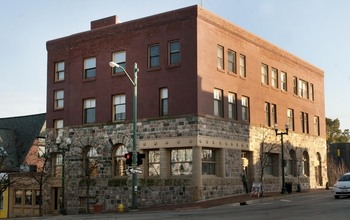
Ypsilanti City Hall
Tom Perkins | For AnnArbor.com
Porter-Hoppe noted Ypsilanti is only one of three cities in Michigan that hold partisan elections.
"If the majority of the cities have gone the way of the non-partisan environment, then who are we to say we won't?" she asked.
Ypsilanti Mayor Paul Schreiber said he doesn’t support the new charter primarily because of the change to non-partisan elections.
He pointed to the August City Council primary race between Mike Eller, Council Member Pete Murdock and Ted Windish in which questions were raised about whether Eller was truly a Democrat and held the party’s values.
He also pointed to the 22nd Circuit Court district race between Jim Fink and Carol Kuhnke, which is non-partisan. It has become a race in which voters have identified Fink as Republican-leaning and Kuhnke holding Democratic principles.
“The fact that the party affiliation is thrown into non-partisan races proves a point that partisanship should play a part in local legislative elections,” Schreiber said.
He added that often times residents don’t have a lot of information on local candidates.
“I think partisan elections are a way to communicate to voters in a very concise way,” he said. “This change would be depriving voters of information that’s easily accessible on people who are running for city council.”
John Gawlas, who serves on the charter commission and served on council for 12 years, said he is also opposed to the charter revision primarily because of the switch to non-partisan elections.
Like Schreiber, he said he felt the change would make it more difficult for voters to have at least some information on candidates.
“You can understand some of the aspects of a candidate’s approach to local government by their party affiliation,” he said. “It moves us backwards in terms of trying to have a better informed electorate.”
Opponents also highlighted that under the proposed change, the top two vote-getters would face each other in the general election, meaning voters could actually have fewer choices than they do now.
City Council Member Brian Robb also opposed the revision and questioned why the charter commission didn’t address issues he said are more important.
“The charter commission could have done so much more to improve the charter but they had a partisan agenda that was disguised as non-partisan politics,” he said. “It just seems like a waste of two years.”
Officials have also raised concerns about how educated voters will be on the revision, especially given the number of proposals at the state, county and local initiatives on the ballot.
“I think it’s pretty much under the radar and I don’t understand how people will be able to make an informed decision on this,” Gawlas said.
There is no apparent organized campaign by the commissioners to let people know what’s in the revision.
Porter-Hoppe said that is due in part to city council not supporting the commission’s efforts by providing an attorney or consultant, and due in part to the commission having so little time between the final rewrite of the language that was approved by the state attorney general’s office and the election.
“We did what we were charged to do and we will let voters decide,” she said. “We had a good group - bi-partisan - that worked well together for the betterment of the city.”
The city recently put the revised charter on its website, and the Advance Ypsilanti political action committee has put out information in a campaign against the measure.
The commission is also proposing eliminating putting the city charter revision in front of voters every 16 years, which Schreiber said would make the process of revising significantly more difficult. He questioned why that provision should be deleted.
Porter-Hoppe said the commission felt it would be better for the City Council to have the power to change the charter if necessary.
The commission also is proposing that the city clerk report to the city manager instead of the city council. That would mean only one member of city staff would report to council and only the city manager could make staffing changes in city hall. Schreiber said that eliminates a check and balance with two departments in city hall reporting to council, but he said he didn’t feel strongly either way.
Robb went so far as to call that proposal “undemocratic” and the city clerk is the only department head who represents city council.
Porter-Hoppe explained that the change is proposed because former City Manager Ed Koryzno said it would be a good idea and the role of the clerk has changed over the years to a point where it isn’t necessary for him or her to report to council.
Tom Perkins is a freelance reporter for AnnArbor.com.
Comments
ypsilistener
Fri, Oct 26, 2012 : 10:24 p.m.
I'm Bob Doyle and I am a Charter Commissioner. While I appreciate the article on the proposed charter, it does not include some of the very good reasons to support non-partisan elections in Ypsilanti. 1. We should not be focused on retaining power, but on electing the best leaders for our community. 2. In practice, elected positions are often determined in August by 1/3 to 1/2 of the people who vote in November. With a non-partisan approach, we'll be electing our representatives when most of us vote, not at the primary. 3. Today, voters are less affiliated with a particular party, and disheartened by bitter and/or partisan politics. Where do independent voters get a voice? We need to break down barriers, not cling to them, and remove the partisan venom from our local elections. 4. The change would bring Ypsilanti into line with the overwhelming majority of Michigan cities that vote non-partisan. 5. Non-partisan elections create a need for candidates to educate the public on their positions on local issues, and require that voters learn the attributes of the candidates. It insults the voters of Ypsilanti to assume that they are not capable of determining the best candidate without a party label. 6. Ypsilanti is an inclusive community that should welcome fuller participation from all: Democrats, Republicans, Greens, other parties, and the completely unaffiliated. The proposed charter includes the use of a primary to vet out the candidates so that we elect the best possible leaders. Focus on leadership, not on power. Vote yes for the new charter.
Martin Church
Fri, Oct 26, 2012 : 4:59 p.m.
I for one will be supporting the change. for the last several city elections I have been unable to vote for any canidate because I am registered as a Republican and can not during primaries split my vote. Therefore the election for office is over in August and I have no say in who I can vote for. This has lead to the water street problems and our city budget. a number of voters have been regulated to the side because of this issue. We ether vote in the city and ignore the higher state races or vote in the higher state races to vote for the choices in the city. It's not fair.
Glen S.
Fri, Oct 26, 2012 : 6:15 p.m.
@ Martin. You are helping to make my point. There is nothing to stop you or any other Republican (or a member of any other party, for that matter) from filing to run in your party's primary. The fact that none choose to do so has more to do with the fact that candidates running as "Republicans" have virtually no chance of winning. If you think that's "not fair," don't blame the system -- accept it as a sign that the philosophy you're promoting is not one that's accepted by a large majority of your neighbors.
David Cahill
Fri, Oct 26, 2012 : 1:47 p.m.
I agree with Glen S. The only way Republicans can win is if they disguise their true identities.
Erik Gable
Sat, Oct 27, 2012 : 1:17 a.m.
Well, that explains the budget deficits.
Glen S.
Fri, Oct 26, 2012 : 1:34 p.m.
Ypsilanti routinely votes 70-80% Democratic in general elections, and hasn't elected a Republican to City office in at least two decades. So, finally realizing that they could probably never be elected if they admitted their true political philisophy, local Republicans pushed through this proposal -- hoping it would allow them to obscure their true leanings, and hopefully, have a chance of getting elected. As a voter, I want *more* information about the candidates and their positions -- not less. herefore, I don't understand how anyone (except a handful of disgruntled local Republicans) could think that taking this key piece of information away from voters when they are choosing from among local candidates. I plan to vote "NO" on the new Charter, and hope that everyone who favors more honesty and transparency in local elections will do the same.
Dog Guy
Fri, Oct 26, 2012 : 1:20 p.m.
Conversely, in the Fink-Kuhnke contest, some Ann Arborites on annarbor.com are upset that the straight-party levers at the top do not apply to judicial elections.
Chase Ingersoll
Fri, Oct 26, 2012 : 1:03 p.m.
I have consistently and publicly maintained that the ballots should on the left side fo the page identify the names of the candidates for all offices, in alphabetical order, without identifying their party, and then list the offices on the right side of the page from President to dog catcher, without identifying who is running for those offices. If you can't remember the name and office for which the candidate is nominated, you probably don't know much about what power that office holds or if that candidate is qualified to hold it. And if you don't know these two things, you probably shouldn't be voting on that office, just because you happen to have a pen and a pulse. We all agree that the "pen and pulse" qualification was a bad standard for qualifying people for mortgages. Please think about applying the same standard to voting. Chase Ingersoll
Erik Gable
Fri, Oct 26, 2012 : 12:55 p.m.
This makes a lot of sense. Party divisions tend to break down and become irrelevant at the local level. Having partisan city or township elections often leads to large-scale disenfranchisement when elections are decided entirely in one party's primary (and thus, people who want to vote in the other party's primary for offices where party IS relevant end up having no voice).
Colby
Fri, Oct 26, 2012 : 11:27 a.m.
Error: "Porter-Hoppe noted Ypsilanti is only one of three cities in Michigan that hold non-partisan elections." Should read "partisan".
Julie Baker
Fri, Oct 26, 2012 : 5 p.m.
Thanks, that's fixed.
Stephen Lange Ranzini
Fri, Oct 26, 2012 : 11:01 a.m.
P.S. Bruce Laidlaw who served the city of Ann Arbor as city attorney for 16 years, wrote an excellent and thought provoking analysis of the pros and cons of whether non-partisan elections were better than partisan elections using the history of Ann Arbor elections, which you can read here: http://annarborchronicle.com/2012/06/17/column-lets-put-life-into-city-elections/
Stephen Lange Ranzini
Fri, Oct 26, 2012 : 10:55 a.m.
If I were a voter in Ypsilanti I'd vote to make the city elections non-partisan. Here in Ann Arbor it is clearly not working well and the city has been mismanaged ($100 million of spending fiascos have occurred (The Big Dig, Roj Mahal, the Huronal) while a $500 million debt has been run up including in the retirement funds). I'm not sure how it works in Ypsilanti, but here in Ann Arbor, since a Republican cannot be elected to office in the city, lots of "former" Republicans run as Democrats and most of the elected leaders never bother to show up for Democratic party events because they are "Democrats In Name Only" (DINOs). It actually weakens the local Democratic party and results in a dysfunctional situation where the only election that matters is the primary. There is a good reason why only Ypsilanti, Ionia and Ann Arbor are the only cities in the entire state to elect city leaders in partisan primaries. Maybe someday we can have a charter amendment to fix the Ann Arbor City Charter, too!