

As Ypsilanti voters reject 2 tax proposals, talk immediately turns to budget cuts
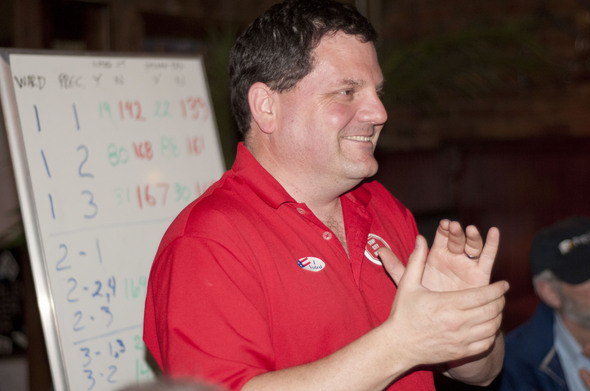
Stop City Income Tax volunteer Steve Pierce addresses campaign volunteers at Aubree's as results favorable to the group came in.
Tom Perkins | For AnnArbor.com
Ypsilanti voters rejected two new tax proposals by a margin of nearly two to one on Tuesday.
With all precincts tallied, 63.67 percent of voters opposed a Water Street debt retirement millage and 64.39 percent voted against a 1-percent citywide income tax, according to the Washtenaw County Clerk’s Office.
Just more than 2,800 of Ypsilanti’s 13,593 registered voters cast ballots.
The vote ended several months of campaigning for the taxes by the city and city council, which called the revenue-generating proposals essential to the city’s financial health over the next five years. City officials say residents can now expect public safety cuts as one starting point for balancing the budget.
The Stop City Income Tax group campaigned hard against the proposals. They contended that taxes in the city are already high, and increasing them further would have a devastating effect on the business community and many residents.
Steve Pierce, a volunteer with SCIT who is active in local politics, said he kept hearing from voters fears that the proposals would be drive away new residents.
“(Ypsilanti’s) millage rate keeps going up and up and up, and then having a city income tax on top of that - people are saying ‘Why would I live here?’” he said. “If my son or daughter went off to college, what would bring them back to live and work here?
"Saying that we have an income tax and the highest property taxes in the region or state; it seems like that’s a barrier and I think that’s what connected with people.”
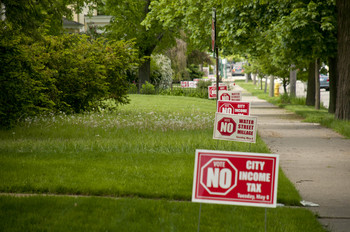
Opposition to the tax proposals was particularly heavy in ward one, pictured here along South Huron Street.
Tom Perkins | For AnnArbor.com
Mayor Paul Schreiber expressed his disappointment on Tuesday and said he believes Ypsilanti is in dire need of new revenue. He said longtime residents who he spoke with during campaign efforts were generally more opposed to the new taxes than those who moved here relatively recently.
“A lot of people move (to Ypsilanti) and businesses open here because they see the good things … but a lot of people who have lived in town a long time were not sure raising taxes was the right thing to do because it might scare people away,” Schreiber said. “However, when I talked to people who just moved in, from what I recall, just about everyone said they support the income tax because 'I like living here and I want to keep police and fire.’”
Beth Bashert is chair of Save Ypsi Yes, which campaigned for the proposals and made the case that cutting city services further will drive away residents and businesses that are alarmed by the likely cuts to city services.
“The voters have spoken and they said very clearly they don’t think new revenue is a solution,” she said as the results came in. “Now it’s up to city council, and I look forward to supporting their decisions over the next period of time. Cuts are going to have to be made and we’re going to have to look for other solutions.”
The proposals were integral parts of a five-year financial plan developed by city staff and city council that officials say will avert a $6.1 million deficit projected for 2017.
Last week, city staff presented a two-year budget that assumed no new revenues and called for the layoff of seven firefighters. If the city can’t secure grants, officials say those layoffs, and further cuts to city staff, will be necessary
The income tax would have been set at 1-percent for residents and corporations and 0.5-percent for those employed in the city, including 6,000 Eastern Michigan University employees. It was projected to generate $10 million through 2017, according to an income tax analysis commissioned by the city.
The city is paying $30 million on its Water Street bond debt. It must continue to make payments through 2031, and the amounts will grow to $1.7 million annually by 2015.
The Water Street debt retirement millage residents saw on the ballot was for 4.94 mills in fiscal year 2013. That rate would have grown to 7.12 mills by 2017. But as part of the five-year plan, city council voted to use savings to pay half the Water Street debt. That would allow the city to cut the millage rate in half.
In that scenario, homeowners would have paid a new millage rate of 2.35 mills in fiscal year 2013, then up to 3.55 mills by 2017. The full millage was projected to generate $7.7 million.
“Council’s chore now is to balance the budget the best way we can with revenues we have,” Schreiber said, adding that they need to talk about cuts to public safety because general fund money that is used to pay for police and fire must go toward Water Street payments.
He also highlighted that the city already has reduced its staff by 30 percent over the last 10 years.
“We’ve really got nowhere else to go,” he said. “The only good thing I can say is council has a very clear direction from voters that (they) don’t want increased taxes or new revenue, and council is going to have to deal with revenues we have. That means we’re going to make some unpopular decisions.”
The first of three budget meetings is on May 10 at city council’s chambers, and several council members said they would “love” to hear SCIT’s suggestions at the meeting.
“I look forward to a lot of people showing up to the budget meetings to offer their input,” Council Member Brian Robb said.
Council Member Pete Murdoch said the city needs to develop a new five year plan but said it is going to be "very difficult." He opposed the 2007 income tax proposal, but changed positions this time around, which has angered many of his supporters.
“The situation is a lot more serious now than it was before," he said. "I tried to spell that out over the last year when we were going through the process of developing the five year plan that if we didn’t develop the plan, we’re just going over the cliff.
“People are just angry ... and this is what you get.”
Schreiber said he “wouldn’t be surprised” if some of those opposed to the taxes ran for city council as happened during the 2008 elections that followed the 2007 proposal. It failed by a similar margin.
“I would say to people considering to run that last time we had that happen, we had people change their minds once they got on council,” Schreiber said.
The deadline to file is May 15.
“Elections in Ypsilanti are always ugly and this one was no different. It’s good that it’s over, but now we have to pick up the pieces and figure out where to go,” Robb said. “Unfortunately we’re going to turn around and have another ugly election in 2.5 months.”
Later in the evening, as Pierce gave a speech to SCIT volunteers following their victory, several supporters called for turnover at the council table, though no specific names were mentioned.
Pierce only replied, “not tonight,” and urged the group to continue using its energy to fix Ypsilanti’s financial situation.
Pierce later said he thinks the city needs to rethink how it delivers services and highlighted that Ypsilanti still has some money in reserves
“This is not a time to celebrate as we have some financial challenges,” he said, adding that he didn’t see any easy answers. “I hope the answer is not to just start slashing employees … but I think we need to change the way we spend money and allocate the resources that we've currently got.”
Comments
The Black Stallion3
Wed, May 9, 2012 : 9:40 p.m.
Still waiting for an answer Vet on who are "These People"?
Judy
Wed, May 9, 2012 : 8:56 p.m.
What about cutting some of the benefits that city employees have, like others have had to pay more for their health benefits? Or maybe cutting hours? I want to think there may be creative ways to make things work. I am unemployed in my sixties, unable to find work, and have had to give up things that I could live without. I t was hard, but lots of people experience change, can the city do that?
The Black Stallion3
Wed, May 9, 2012 : 9:06 p.m.
Judy....we seem to have some very greedy public employee's who want everyone but them to foot the bills. They want us to pay more and more taxes so they can continue to enjoy their lifestyles with our hard earned money. In hard economic times like we are facing you would think they would be willing to sacrifice like the rest of us tax payers but that does not seem to be the case. we will however change some of these contracts and laws soon, you can count on that.
Justice4all
Wed, May 9, 2012 : 8:48 p.m.
"We've really got nowhere else to go,". What a plan. What great leadership. Nowhere else to go? Then step down and get someone that at least has passion.
JMA2Y
Wed, May 9, 2012 : 8:14 p.m.
The mistake the entire city council and mayor made was being short sighted in planning, expecting that someone would buy Water St. from the city and all would quickly end and the city would take in property tax again. They didn't plan ahead and assume what would happen if no one ever bought the land and the city had control of the land and therefore, no property tax coming in.
YpsiVeteran
Wed, May 9, 2012 : 9:28 p.m.
I still can't wrap my head around the fact that the council in place at the time failed to include a single contingency plan. It was an inexplicable failure.
The Black Stallion3
Wed, May 9, 2012 : 7:59 p.m.
YpsiVeteran..........You said "The facts and the law get in the way of these people's parroted "think outside the box" plan." I wonder if you could enlighten us tax payers who have a right to vote the way we want as to who are "These People" you are referring to.
Stephen Lange Ranzini
Wed, May 9, 2012 : 6:47 p.m.
Next since *no one* in the private sector can afford to pay employees a post retirement health care plan, the city could look into eliminating that for everyone but police and fire fighters. Philosophically, I believe that government workers should be paid no less than nor no more than comparable private sector jobs pay. That would probably reduce the annual cost by half, a savings of another $500,000 a year. Over 5 years, maybe $5.5 million could be raised with these two suggestions?
Stephen Lange Ranzini
Thu, May 10, 2012 : 5:06 a.m.
@YpsiVeteran: Medicare is headed towards bankruptcy also. "According to the latest estimate by the Medicare trustees (2011), the trust fund is expected to become insolvent in 13 years (2024). Quote from www.Wikipedia.com "Medicare", section 10.3 "The solvency of the Medicare HI trust fund", footnoted to: https://www.cms.gov/ReportsTrustFunds/downloads/tr2011.pdf With regard to my opinion as to the need for Ypsilanti to scale back post retirement healthcare benefits for current and past employees who are *not* police or fire fighters, please read what I write not what you want to think I wrote.
The Black Stallion3
Wed, May 9, 2012 : 9:39 p.m.
Vet.....we agree...all public employees can retire with SS, Medicare and 401K just like the private sector....problem solved...Right? Now we can use the money to fund our city and State.
YpsiVeteran
Wed, May 9, 2012 : 9:27 p.m.
"Next since *no one* in the private sector can afford to pay employees a post retirement health care plan..." Really? What do you call Medicare? EVERY private sector employer pays into Medicare. Every single one. It's the cost of doing business.
YpsiVeteran
Wed, May 9, 2012 : 9:24 p.m.
Mr. Ranzini, if you were focused on current employees, why are the words "post-retirement health care plan" in your comment? If, as past comments indicate, that it is the police and fire benefits that you believe to be the biggest source of problem, as they take up the biggest portion of the budget, why do you ignore the significance and impact of the fact that police and fire employees coming in will not have any retiree health care?
The Black Stallion3
Wed, May 9, 2012 : 7:34 p.m.
Eliminate it for all of them Now and look forward.
The Black Stallion3
Wed, May 9, 2012 : 7:33 p.m.
We either change the pension and health care or we can stand and watch this city sink......there is only one solution and the people fighting it are the ones benefiting from the current mess.........No More Pensions and Free Medical...It must stop people.
Stephen Lange Ranzini
Wed, May 9, 2012 : 7:24 p.m.
@YpsiVeteran: I am focused on non-police and non-fire fighter current employees AND retirees with my comment, which specifically excluded making ANY recommendation about police or fire fighters.
YpsiVeteran
Wed, May 9, 2012 : 7:07 p.m.
Don't look now, but the city has ALREADY ELIMINATED retiree heath care benefits for all new police and fire employees.
Stephen Lange Ranzini
Wed, May 9, 2012 : 6:46 p.m.
Here are two ideas to consider. Ypsilanti runs three pension and retirement plans, (A) one for police and fire, (B) one for everyone else and (C) a post retirement health care plan, similar to the one that sank GM. The city runs A and C and not surprisingly, both of those plans are in a giant deficit and cost the city a combined almost $2 million deficit. Page 49 of the annual financial audit of the city (CAFR) states: "The annual pension cost (APC) for the year ended June 30, 2011 is $1,018,284," for Plan A and page 52 notes "Contributions made: $949,195" to Plan C. Now the good news is Plan B, the plan the State of Michigan runs, has been well managed and has a very large surplus and page 51 notes "The City was required to make a minimal contribution of $444 to the plan for the year ended June 30, 2011." So, here is my idea. Terminate Plan A and/or terminate Plan B and combine Plan A and Plan B into one combined pension plan for all city employees. Since page 51 notes that Plan B has a surplus of $6,008,058, (Unfunded Actuarial Accrued Liability (UAAL) $ (6,008,058)" and since page 50 notes that Plan A has a deficit of 10,486,606 ("Unfunded AAL (UAAL) $ 10,486,606", the combined plans might have a deficit of only $4.48 million, so the annual contribution required would drop from $1,018,284 to perhaps $400,000 a year, a savings of $600,000 a year.
John Q
Thu, May 10, 2012 : 2:47 p.m.
My comment is in response to the proposal to move employees to a 401k style retirement plan.
Stephen Lange Ranzini
Thu, May 10, 2012 : 5:29 a.m.
@John Q: Why? Because, as I wrote in the next comment, "Over 5 years, maybe $5.5 million could be raised with these two suggestions?"
John Q
Thu, May 10, 2012 : 3:11 a.m.
Understand what? Why would someone want to move from a retirement plan that isn't costing the city money today, for non-police and fire employees, to one that does?
The Black Stallion3
Wed, May 9, 2012 : 8:39 p.m.
Why do some people have such a hard time understanding this? Is it they are the beneficiary of these funds or are they just not opening their eyes to the fact that this can not continue?
Stephen Lange Ranzini
Wed, May 9, 2012 : 7:49 p.m.
Also I should note that MERS is significantly underfunded overall and having the pension funds there is no guarantee of success in the future for the city workers who are counting on them to fund their retirement, so moving the funds might be in their best interest.
Stephen Lange Ranzini
Wed, May 9, 2012 : 7:37 p.m.
@John Q: You are correct, The Municipal Employees' Retirement System of Michigan (commonly known as MERS) was spun out of the State of Michigan in 1996 and is legally no longer a component unit of the State of Michigan. I missed that event. Having said that, MERS would be worse off if the defined benefit plan is terminated and the surplus distributed (which is legal to do *in theory*), so they might be willing to negotiate a deal.
The Black Stallion3
Wed, May 9, 2012 : 7:30 p.m.
Take away all pensions, put any money in them into employee 401K plans and stop all this nonsense of having the working people pay for this, if the employees do not like it then let them find a job elsewhere, they can be replaced.
YpsiVeteran
Wed, May 9, 2012 : 7:09 p.m.
John Q, please don't confuse the issue with pesky legalities. The facts and the law get in the way of these people's parroted "think outside the box" plan.
John Q
Wed, May 9, 2012 : 7:02 p.m.
Ypsi's retirement plan is run by MERS, not the State of Michigan. It's very unlikely that MERS is going to allow the city to do what you propose especially since it wouldn't address why one plan is underfunded and the other is not.
JBurdock
Wed, May 9, 2012 : 6:38 p.m.
A little history, Water Street was a typical urban renewal project hyjacked by the drop in housing values starting in 2006, which had never happened to Michigan before. The developer bailed and left Ypsilanti with a huge amount of property. The old residents of the area were marginal business, not upgrading the property, on the edge of the river, with poorly planned roads and infrastructure. It looked bad and affected Ypsilanti's reputation. Ford/Visteon bailed around the same time. The mayor then, Cheryl Farmer, is a wonderful MD, who loves Ypsilanti and with the best of intentions wanted to help Ypsilanti upgrade and fix itself. She never gained from the project and just didn't forsee this drop in property values. I didn't either, ask yourself did you?
Terrin Bell
Wed, May 9, 2012 : 9:24 p.m.
Much of what you say is true, but let me ask you this. Who would invest 30 million dollars of other people's money without having firm signed commitments? The fact that the City only had one tentative offer on the table should have been telling. It was irresponsible. Further, why didn't the City just take the property by eminent domain like it has done with some of the Kirchner properties? The land was a environmental catastrophe. It way over paid.
Rodney Nanney
Wed, May 9, 2012 : 8:08 p.m.
JBurdock, Your retelling of the history of Water Street is most remarkable for its complete lack of accuracy. Yes, Cheryl Farmer was the Mayor when the key Water Street decisions were made that led to the huge debt. Yes, Michigan's economy in 2006 was stagnant and beginning to tail off again. Yes, Water Street is located on the edge of the river. Those three facts are correct, but not much more. For the real story, click here: http://stopcityincometax.com/the-water-street-story/
Woman in Ypsilanti
Wed, May 9, 2012 : 7:13 p.m.
Thanks for pointing that out. I've been a little sad to see the way people have been attacking Cheryl Farmer about this. There is no way anyone involved could have seen what was coming as far as the drop in property values. If that hadn't of happened, we would have a really nice development there now. The city took a risk and lost. That is why they call it a risk though, there is always a chance of losing. I knew that when I bought my own property in Ypsilanti but I thought the risk was that the value of my property wouldn't appreciate in relation to surrounding communities. I *never* anticipated that the value of my house would be half of what it was just a few short years ago. I never anticipated that I would be underwater on my mortgage. So how could Cheryl Farmer or the others on city council at the time? At any rate. Even if water street was a mistake easily anticipated (which it wasn't), it isn't like anyone has a wayback machine they can use to change things. We have no choice but to look forward and I would prefer it if we could do it without blaming our past elected officials. At worst, they made an honest mistake. I mean, it isn't like we had Kwame Kilpatrick as our mayor. There is something to be said for that. I believe that everyone on the council currently is honest too. That is a huge strength for our community.
jns131
Wed, May 9, 2012 : 5:38 p.m.
Glad I was able to stay out of both districts. In the township? We already increased our mileage so we can have better deputies and other stuff. Good luck Ypsi City.
Rita Book
Wed, May 9, 2012 : 3:41 p.m.
I am not a whiney anti-tax individual. I have seen how tax money managed correctly can benefit a community. However, our property taxes are VERY high and remain VERY high - so where is this money going? If I was sure the City was to really benefit from a new income tax and millage - I would have voted for it. No one wants to cut fire/police department. But I couldn't vote to continue to pay for pensions/benefits when other services are needed to be maintained. When we constantly see mis-management in this City and there has been little to no effort to reduce pensions/health care as other cities have done - I had to vote no. To this day, it irritates me to know that if I lived 1 block east, my property taxes would be much lower and would have the same services.
The Black Stallion3
Wed, May 9, 2012 : 8:24 p.m.
Vet...the circus is here and they were just defeated......sorry for your loss.
Terrin Bell
Wed, May 9, 2012 : 8:05 p.m.
That is just it, City pensions will not be effected as the City is allowed to raise property taxes at will to pay for pensions as voters over 40 years ago approved this. So the City is not worried about paying for pensions and they will not be cut.
The Black Stallion3
Wed, May 9, 2012 : 8:02 p.m.
You are so funny Vet...should have been a comedian
YpsiVeteran
Wed, May 9, 2012 : 7:53 p.m.
JohnQ, the city obviously has a future marketing its unique species of typing parrots. Perhaps we could get the circus to move here.
The Black Stallion3
Wed, May 9, 2012 : 7:27 p.m.
We must go to a 401K type pension where employees finance their own retirement and medical. We can not continue to force the average working man and woman to take care of these people for the rest of their lives.
Rita Book
Wed, May 9, 2012 : 7:26 p.m.
Yes. Why should my very high property tax dollars go to the police/fire who have a very nice pension and benefit package that should be reduced slightly to help the city? Why not re-negotiate as other cities have done? Especially when some police/fire have decided to go to work for another city while the City of Ypsi continues to pay for pension and medical benefits!
John Q
Wed, May 9, 2012 : 7:05 p.m.
The city's pension fund for employees other than police and fire is overfunded. Are you suggesting that the pension benefits for police and fire be cut?
SW40
Wed, May 9, 2012 : 3:20 p.m.
I think the residents made the correct decision last night and sent a message that excessive taxes to fix city government aren't the answer. City government is already helped with state legislation mandating employees pay more of their healthcare, now the city must move all employees to 401k or 403b type retirements. The times are a changing and although the current city council and mayor aren't responsible for the water street debacle it is there job to fix it and taxes aren't the answer. Just a quick point on consolidation its great that Ypsi and Willow Run schools are consolidating but if you people think for one second there will be a consolidation of public safety you are wrong its called a take over. There will be one police force in Ypsilant and it won't be a police authority or any other nonsense it will be the Washteanw County Sheriff's office if Ypsilant doesn't figure out this mess. There is no other department to consolidate with, Ypsilanti Township doesn't have a police force and Ann Arbor isn't interested in getting involved in Ypsilanti's mess. HVA takes medical runs in Ypsilanti and the more likely fix for fire services will be contracted service with Superior Township and Ypsilanti Township Fire. These changes will either be made by elected officials or an emergency manager.
The Black Stallion3
Thu, May 10, 2012 : 1:36 p.m.
u812.........watch your own parents.....why do yu expect someone else to do your work for you? Entitlement is a bad attitude to have son
u812
Thu, May 10, 2012 : 1:10 a.m.
yes BS3 maybe you can watch my parents for me too at your house when there old and elderly.
Terrin Bell
Wed, May 9, 2012 : 8:03 p.m.
One council member from Water Street is still on the Council. The City isn't going to move employees from Pensions because voters 40 years ago allowed the City to increase the millage at will to pay for the pensions. Further, it is sad that a life long employee should have to give up a pension. 401(k)s stink.
The Black Stallion3
Wed, May 9, 2012 : 7:24 p.m.
You are so right SW40............The pensions of public employees is taking the country down and we must put a halt to it now.
John Q
Wed, May 9, 2012 : 7:06 p.m.
Moving to a 401k plan would actually increase the city's costs.
Terrin Bell
Wed, May 9, 2012 : 3:15 p.m.
I found the Mayor's comments about new residents not seeming to mind the proposals interesting. New homeowners bought in really low. You can buy a house in Ypsilanti for $70, 000 or less for what would have cost $160, 000 several years ago. The longer residents are paying significantly higher taxes already for homes that are substantially under water. Of course, they don't want to pay more. Further, the longer residents have a better understanding how the City promised taxpayers that Water Street would not cost them a dime and how the City irresponsibly took on this debt without having a firm deal in place from a developer. Many of the new home owners also haven't discovered the true cost of ownership such as when the property taxes adjust upward and the surprise mandatory assessments like when the City decides to fix the sidewalk in front of your house and charge you for it. Moreover, new residents, like college students, who rent and work outside the City wouldn't' feel the effect of the proposals.
Enso
Wed, May 9, 2012 : 3 p.m.
Who is going to protect the businesses from theft and fire if we can't pay city workers, i.e., police and fire? Who is going to take out the businesses trash? What business is going to want to drive their vehicles around on roads filled with potholes? In an area increasingly falling victim to crime? The whiny, ideologically-driven, anti-tax, right believes this type of situation is attractive to business. Their incoherent, illogical, thought-stupefying religion of Deregulation is taking all of us down with them.
u812
Thu, May 10, 2012 : 1:07 a.m.
Do not Worry BS3 will do it for free.
The Black Stallion3
Wed, May 9, 2012 : 7:18 p.m.
Keep calling anyone who disagrees with you, and that is the majority by the way, names because it shows your intelligence off.
Ross
Wed, May 9, 2012 : 6:04 p.m.
Well said, Enso. Terrin, everyone agrees that water st. was a huge mistake, and now voters are being asked to pay for it. BUT WHO ELSE IS GOING TO? There is no magical source of revenue to bail us out of this mess. Yes, shame on council for the whole water st. fiasco. But there's nothing to do about it now but pay for their mistake. Say no to initiatives like these all you want, but the end result will be a reduction in the quality of city services. Period.
Terrin Bell
Wed, May 9, 2012 : 3:53 p.m.
I consider myself to be pretty liberal. I am willing to pay taxes and support government institutions like the EPA. I also think rich companies and individuals need to pay more. I, however, am unwilling to be ripped off. Ypsilanti is a nice City. It, however, is not nice enough to justify paying more taxes than any other City in Michigan. The City tried to get this passed in an special election hoping nobody would show up. Unlike the last time it tried to get just the income tax passed, it actually came up with two huge new taxes. Who is going to vote for City officials who have made irresponsible financial decisions in the past to be able to increase the Water Street Millage as they see fit, and an income tax that never expires even if the City's financial health improves? Voters were essentially being asked to fund what was largely a City mistake that the City promised voters they would never have to fund. Further, between higher property taxes, personal property taxes, the DDA costs, businesses in Ypsilanti pay a lot. More than in Ann Arbor. The City should have went for one or the other, and gave voters plenty of time to digest the information, and hold the election in November. Moreover, the mayor and former mayor Farmer promised the last time they put this on the ballot is to start a State Constitutional Amendment to address tax inequities Cities endure over townships, and places with large colleges also have to endure. This didn't happen.
smc1971
Wed, May 9, 2012 : 2:55 p.m.
I've owned my home in Ypsi for 5.5 years. I bought right before the real estate crash so I can't move if I wanted to (which I don't). I don't know why people say residents are fleeing - many of us can't because we aren't going to walk away from our homes. I couldn't rent a place for my family for the price of my mortgage. I care a lot about the future of Ypsi, not just because of property values, but because I care about the working and middle class, and want to see communities like Ypsi thrive. I don't want to live in A2 or Saline. They aren't communities where I feel most comfortable. I haven't seen a real effort made on the part of the city or school district to bring in the average Ypsi citizen and hear what we want. Sorry, but most of us are busy with families and trying to make ends meet, but I have attended neighborhood meetings when asked and would attend citywide gatherings to talk about the community. I just don't have time to organize it. I hope some of the energy of the community can be focused on true democracy...assessing the needs of the citizens, what our strengths and weaknesses are as a community, and creating a plan from the bottom up. I think people do step up if asked to contribute to what they care about.
eastsidemom
Wed, May 9, 2012 : 6:37 p.m.
Yes LC (?) I have known many reps over the years that I have lived in Ypsilanti. I do not see it as a lack of trust or a matter of friendship to want to have community input in some other forum than the very stilted manner in which council interacts with the public at their meetings. Not to mix the apples w/ oranges but the schools have done this better in the past. Stakeholders meetings where all voices are hard and respected. Not the dog and pony shows we have been invited to in the past.
LC
Wed, May 9, 2012 : 5:36 p.m.
eastsidemom / wetdolphinmissile / maryd, you've know your council reps for years. is your distrust of them so great you need a pubic meeting to ask questions in a give and take manner?
eastsidemom
Wed, May 9, 2012 : 5:13 p.m.
I think that smc1971 speaks to a meeting where the citizens are heard in a give and take manner, not what occurs at city council meetings.
YpsiVeteran
Wed, May 9, 2012 : 3:24 p.m.
The City Council meets twice a month. All the information is on the city website. Several budget hearings are scheduled. All the information is on the city website. Why are you waiting to be asked? People either involve themselves or they don't. What effort to "bring in the average citizen" do you expect in addition to well-publicized regularly scheduled public meetings?
John Q
Wed, May 9, 2012 : 2:51 p.m.
Bye bye Ypsi. The "no new taxes" crowd thinks that people and businesses will move to Ypsi because they said no. Why?
Roger Dodger
Wed, May 9, 2012 : 11:54 p.m.
You know, I spent a lot of time thinking of how I would vote. I read everything about it here on annarbor.com and Mark Maynards blog. I discussed it with my wife and neighbors. I put a lot of effort into looking at both sides of the issue, and was really close to voting yes. I've voted yes on every other millage put before me here since 1996. It wasn't an easy decision. I think that you guys should face that there was no good choice here. Both choices are losing choices. Who put us in that mess? It wasn't me, so why are you so angry with me? I'm not going to tell you your choice was wrong because I'm assuming that you thought about it a lot too. I expect the same respect from you, and the fact that you don't give people that respect says a lot more about you then me.
The Black Stallion3
Wed, May 9, 2012 : 8:04 p.m.
Hey Vet....You will be right here with them....hang on !!
YpsiVeteran
Wed, May 9, 2012 : 7:49 p.m.
They don't mind nailing themselves in, JohnQ, because they "won." Wait till they get stuck with the consequences of their "victory." That's when the real caterwauling will begin.
John Q
Wed, May 9, 2012 : 7:08 p.m.
People and businesses aren't going to move to a community that is run by an emergency financial manager, that can't police the streets and doesn't respond to calls for assistance or for fires. Voting "no" guarantees that's your future. Good job nailing the coffin shut on yourself.
Roger Dodger
Wed, May 9, 2012 : 3:03 p.m.
It's not that we think they will move here because we said no. It's because we think people WON'T move here if we said yes. These are two different things. Do you understand why? If the millage passed and the income tax passed, those are just two more checkmarks in the Con column when deciding where to relocate or open a business.
Useless
Wed, May 9, 2012 : 2:31 p.m.
Looks like an Emergency Financial Manager might be in future for Ypsi...
JMA2Y
Wed, May 9, 2012 : 1:32 p.m.
At least 20% of voters voted. For me it was either/or. I voted for the millage and against the income tax. We can't afford both to hit our family budget. It's too bad one of them didn't pass.
YpsiVeteran
Wed, May 9, 2012 : 1:19 p.m.
""This is not a time to celebrate as we have some financial challenges," he said, adding that he didn't see any easy answers." ...said the person photographed clapping and celebrating. No conflict there. I hope some people who have offered no solutions to any of the problems being faced come up with something soon.
eastsidemom
Wed, May 9, 2012 : 2:09 p.m.
Oh come on...celebrating an end to this terribly divisive campaign was and is a time honored tradition all sides participate in. We know water street looms and the pensions.
The Black Stallion3
Wed, May 9, 2012 : 1:30 p.m.
We are offering solutions but some people are too hard headed to listen....have no fear though we will overcome and we will make changes.
Ypsilanti City Resident
Wed, May 9, 2012 : 1:15 p.m.
YpsiVeteran: Do you really believe everything you read in the News? Pierce said he stands by the accuracy of the flyer's statements. "I don't believe the facts are wrong. They're well-researched and well-referenced," he said. "More importantly, no one from the campaign has contacted us to dispute any of these facts."
The Black Stallion3
Wed, May 9, 2012 : 7:14 p.m.
And the actions of us voters has spoken.......and we won !!
YpsiVeteran
Wed, May 9, 2012 : 1:23 p.m.
Yeah, I read that. The paper also provided contradicting information. The fact that the campaign didn't "dispute" it doesn't mean they agreed with it, or couldn't have disputed it if they had cared to. The information stands on its own. Believe what you want. I'm not trying to convince anyone of anything. Actions speak louder than words, as illustrated clearly by the picture of a person celebrating while being quoted as saying there's nothing to celebrate.
YpsiVeteran
Wed, May 9, 2012 : 1:14 p.m.
Personally, I'd like to see the city hire a city manager with extensive experience immediately. Then I'd like to see the current council avoid panic and ill-advised, knee-jerk reactions to the results of this election. I'd like to see them take the summer to gather a variety of perspectives from people who actually know what they are talking about...marketing professionals, city finance experts, etc. I'd like to see some serious marketing of the city and what it has to offer in places like California, where several film companies have already had great experiences here, and marketing directed at industries that have money to spend (professional and semi-pro sports leagues, pharmaceutical companies, technology firms, for example). I'd also like to see a contingent of local reps (Ypsi city reps, not county reps) visit places that have successfully navigated similar downturns to bring back strategies that have been proven already. On the pension issue, I found this interesting, also: http://www.aefpweb.org/sites/default/files/webform/Stuart_Buck,_Legal_Obstacles_to_Pension_Reform
eastsidemom
Wed, May 9, 2012 : 2:07 p.m.
that is what I am talking about Vet, some forward thinking ideas and a bigger tent.
YpsilantiLoyalOne
Wed, May 9, 2012 : 1:35 p.m.
It is time for new leadership on council.
YpsilantiLoyalOne
Wed, May 9, 2012 : 1:34 p.m.
I agree, hire a city manager immediately. The Road Commission candidate is the most seasoned and experienced candidate. I believe he has a lot to offer if council would open their eyes.
The Black Stallion3
Wed, May 9, 2012 : 1:19 p.m.
And why have we not seen any of this happening before the vote? I find it hard to believe this group of elected officials are capable of reform. The pensions must go or the city will die, not much of a choice is it?
YpsiVeteran
Wed, May 9, 2012 : 1:05 p.m.
It's interesting to me that the same Steve Pierce who was caught spreading half-truths and outright distortions by reporters in the past continued that habit during this ballot proposal: http://www.annarbor.com/news/literature-distorting-record-of-ypsilanti-mayor-paul-schreiber-circulated-to-residents/ Then he was attacking sitting council people and the mayor for suggesting cuts to police and fire, hiding the identity of the group he purported to represent, and getting himself disavowed by the candidate his literature was supposed to be supporting. Please remember this when you look for honest information about whatever situations come up in the future.
The Black Stallion3
Wed, May 9, 2012 : 1:11 p.m.
Sounds like we have some sore losers today......this will all work out though when we get an EFM to put these contracts into perspective and get this city on the right path.
JBurdock
Wed, May 9, 2012 : 12:48 p.m.
Less than 1,000 voters made this an overwhelming decicion, yet more than 10,000 registered citizens did not vote. Outreach to all the citizens is needed here. Can you strategically sell parts of the Water street property? Can citizen groups provide enhancing services, such as cleaning up and planting trees, flowers, etc. at Water Street? Sincerely, Concerned Local (Pittsfield) citizen ps we (outsiders) could help too
The Black Stallion3
Wed, May 9, 2012 : 12:46 p.m.
I am happy to see that the citizens of Ypsilanti did the right thing by voting NO. Now we may be able to look at the benefits and pensions the public employees are getting, This is all paid for with our tax dollars and they are unwilling to sacrifice like we the tax payers are currently doing. Once we get these employees on a 401K, a medical plan that requires them to pay a large percentage in and delete their pensions we will start to see money available to right this city.
Enso
Thu, May 10, 2012 : 8:19 p.m.
And without unions, you wouldn't be here.
The Black Stallion3
Thu, May 10, 2012 : 1:32 p.m.
Enso..............just think.....without the 1% you would not be here......think about it son
Enso
Thu, May 10, 2012 : 12:37 p.m.
@Stallion Without the 1%??? Go ahead and read ANY history book on the beginnings of industry in this country, Conservative OR Liberal. When the 'Job Creators,' as your people are so fond of saying, had control in the early 20th century, working conditions were terrible and employees lived in squalor. The 1% back then shot people down in the streets for the rights you enjoy today, the 40 hour work week, sick days, the weekend.... the list goes on. The middle class was created entirely by UNIONS. Without them you'd be in poverty. So on behalf of the unions and people who fought for your right to everything you have today, you are welcome! What's that saying about those that don't know their history? They are doomed to what?
The Black Stallion3
Wed, May 9, 2012 : 7:12 p.m.
Enso....why are you so hung up on the 1% ? Without the 1% there would be no middle class, just like without our brave warriors in our military there would be no USA.
The Black Stallion3
Wed, May 9, 2012 : 7:10 p.m.
Happens all the time Terrin....life is hard sometimes and promises must be broken...these will eventually be broken as well.
John Q
Wed, May 9, 2012 : 7:10 p.m.
The pensions aren't going anywhere. The existing pensions are protected by the state constitution.
Terrin Bell
Wed, May 9, 2012 : 6:10 p.m.
So just because you got your benefits taken from you, others should as well? Further, if you give somebody a job telling them they will get a pension and health benefits, it isn't easy to just take them away.
Enso
Wed, May 9, 2012 : 2:47 p.m.
There is also a group that isn't sacrificing a thing, the 1%. Why do you insist on suffering the middle class and poor of this country when not only are the richest in the country not suffering, but there are overwhelmingly the cause of the financial mess we are in?
The Black Stallion3
Wed, May 9, 2012 : 1:28 p.m.
If we do not reform these pensions the city is doomed....bring in the EFM
YpsiVeteran
Wed, May 9, 2012 : 1:09 p.m.
Please do some reading. No one's pensions are getting "deleted." http://www.aefpweb.org/sites/default/files/webform/Stuart_Buck,_Legal_Obstacles_to_Pension_Ref http://news.yahoo.com/analysis-public-pension-fixes-face-stout-legal-challenges-192420659.html http://lawarchive.hofstra.edu/pdf/academics/journals/laborandemploymentlawjournal/labor_vol28no2_secunda_final.pdf
Ypsilanti City Resident
Wed, May 9, 2012 : 12:42 p.m.
While I was out talking to City Residents, I was asked these questions? Why don't we sell the Freighthouse (vacant) The Boys Club property (vacant) Riverside Art Center( very successful, but no taxes to the City, Rec Park and the Senior Center (not a popular idea) Seniors are eligible to join the Ypsilanti Township Senior Center. Why did we turn down SESI when they wanted to locate to Water Street? Carole Clare
u812
Thu, May 10, 2012 : 1 a.m.
hey joe lets clear out your pension.
Woman in Ypsilanti
Wed, May 9, 2012 : 6:58 p.m.
I have to admit that one of the reasons I voted for the income tax and the increased millage was to avoid having the city lose assets like the Freighthouse and the Boys and Girls Club. It is very sad that both are vacant right now but they haven't always been and my hope was that both could be put to use again in the future because I felt both were exactly the sort of thing I loved about Ypsilanti.
Terrin Bell
Wed, May 9, 2012 : 6:08 p.m.
Yes, but who would buy them and for how much? Property taxes for investment property are extremely high in Ypsilanti. To overcome the high property taxes, the properties would have to be sold for peanuts. Selling these properties might make three or four Water Street monthly payment, but is hardly going to solve problems. Further, how was allowing Sesi to use the Water Street property going to solve any problems? It would have still moved from its former location. Moreover, it would have had to sell a lot of cars to pay off the Cities 30 million dollar debt. The City is hoping for a multi-story residential business investment.
Joe
Wed, May 9, 2012 : 6:06 p.m.
truthiness, you do what you have to do. Adding more taxes to an already astronomical tax rate isnt going to fix the city. Clear out the pensions and the city would be in reasonable shape. Use those savings to pay off and.or renegotiate the water street bill. After that, lower property taxes down to a reasonable level and the city is back to being some place people and businesses want to live.
truthiness
Wed, May 9, 2012 : 5:40 p.m.
Ok, Carole and Joe. Why stop there? Let's add Riverside Park to the list. Who needs parks and festivals - that's some prime real estate there, right?
Joe
Wed, May 9, 2012 : 3:46 p.m.
truthiness, the difference is, Water Street has/had a set price tag. No one wanted anything to do with that price tag (and if you think adding more property tax and an income tax was going to attract a buyer, I've got a vacant 38 acre plot of land on a river to sell you) The other city resources could be sold for current market value.
truthiness
Wed, May 9, 2012 : 3:07 p.m.
Yes, and how about that 38 acres of land by the river? Surely someone will jump at the chance to develop that. Oh, wait... I'm sorry, but who is going to buy these?
tiredofmess
Wed, May 9, 2012 : 12:29 p.m.
We understand that a cut's are needed, but must we always open with police/ fire or is this a scare tactic to get the votes needed. Why not start with other city services, Mayor, City Council and City Hall. Next let's look at public works I see enough blight to know that they are lacking in leadership. Then let's move on to Police administration and parking services (the one's who stalk our parked cars). And last but not least work with the unions for a reduction in cost and of course an EFM so we can get past all of the you scratch my back I scratch yours
truthiness
Wed, May 9, 2012 : 1:52 p.m.
An EFM? Why don't you talk to the people in Flint and see how that's working out for them?
Ignatz
Wed, May 9, 2012 : 12:18 p.m.
It's kind of sad, really. I know many fine Ypsilanti residents and have a very favorable opinion of the city. However, the citizens voted to not fix things themselves, albeit at a cost they perhaps should not bear. The State will not give money that's "due" this or any other town. The Water Street situation is not going anywhere, but will continue to fester and drain ever more scarce resources from what was a fine community. I'm sure nobody in the city wished the current conditions to be present, but they are. The residents can choose to have their community sink or swim. We see the choice they've made.
CroseW
Wed, May 9, 2012 : 3:10 p.m.
We can not bring the income tax for another 5 years. We can bring the millage again. When people see what it really means to have less snow removal in a real winter, and slower police response, plus higher insurance rates, and fewer resources to support bringing customers in to our businesses.... Let's not be fooled again. I wonder how many of the "voters" against this were coerced or pressured by their Landlords to vote NO?
pseudo
Wed, May 9, 2012 : 11:48 a.m.
This new resident home owner is deciding to leave. The crime in this town, even in both the 'good' neighborhoods is too much as it is. I figure I have about a year to sell my house and cut my losses.
Glen S.
Wed, May 9, 2012 : 11:30 a.m.
"People are just angry ... and this is what you get." Obviously, for those wishing to get elected (or re-elected), stoking voter anger and mistrust of government seems to be a much more effective strategy than explaining complex problems or discussing unpleasant realities. But, somehow, I'm guessing Mr. Murdock already knows that.
Rodney Nanney
Wed, May 9, 2012 : 8:03 p.m.
Wow, Glen. Turning on your fellow "yes" guy already?
Glen S.
Wed, May 9, 2012 : 2:20 p.m.
@Eastsidemom Honestly -- what's left to "strategize?" What's left to discuss? The voters have spoken and their decision was loud and clear. You all have made your decision -- and now the rest of us will have to make ours.
eastsidemom
Wed, May 9, 2012 : 2:02 p.m.
Stoking anger? I think talking truth. You speak out of ignorance too. Now is the time for strategizing and discussions, not bitterness and backbiting.
Murf
Wed, May 9, 2012 : 11:20 a.m.
"The only good thing I can say is council has a very clear direction from voters that (they) don't want increased taxes or new revenue, and council is going to have to deal with revenues we have. That means we're going to make some unpopular decisions." Actually that is not what the voters said at all. Who doesn't want new revenue? The voters just want the people in charge to start thinking outside the box for once. Also, what a surprise to now see comments from Brian Robb after all this peace and quiet of the last month or so.
Ross
Wed, May 9, 2012 : 5:55 p.m.
Murf, why don't you tell us how to magically raise some other revenue.
Get Real
Wed, May 9, 2012 : 11:06 a.m.
"We've really got nowhere else to go," [the mayor] said. "The only good thing I can say is council has a very clear direction from voters that (they) don't want increased taxes or new revenue, and council is going to have to deal with revenues we have. That means we're going to make some unpopular decisions." Such short-sightedness . . . what are they doing to attract businesses to Ypsi? We want the city to have revenue, we're just tired of it being sucked out of our veins and squandered by officials who are incapable of running a city.
pjeffuller
Wed, May 9, 2012 : 6:02 p.m.
@Get Real. I agree that the city needs to think of new ways to generate revenue. I've lived in the area most of my life, but I actually reside in Superior Township. I've stayed in the area instead of moving away hoping to see the city's true potential realized. I have such high hopes for Michigan Ave and the downtown area only to see business after business close altogether or relocate. I've had multiple conversations with people who also want better for the area and would like to spend their money in the area, but don't have quality places to spend it. The money I spend on evening activities and my daily needs generally go to Canton, Ann Arbor and Detroit. We need quality restaurants, evening entertainment and retail businesses that can keep Ypsilanti and the surrounding township residents spending money here instead of giving it to the surrounding cities. We especially need this for twenty and thirty somethings (and even older) who aren't college aged and would like somewhere nice to spend an evening without the college bar atmosphere. I've tossed around the idea of running for township supervisor thinking that maybe I could help to make a difference in the area and bring fresh ideas to the table. One idea for the people currently running the city of Ypsilanti now would be to shadow and model a successful city. Call up the mayor of a successful city and pick their brain. Ask them what's worked to make their city a success. That's the advice that successful entrepreneurs give to wannabe entrepreneurs. Study the successful and model your career path after theirs. If they find that the successful city did so by raising property and business taxes then they will have evidence that this approach has worked and been successful for a city in the past and can again propose an increase. If increased taxes wasn't their secret to success, they will maybe find that a different, possibly innovative approach to running a successful city is necessary.
Ross
Wed, May 9, 2012 : 5:55 p.m.
Yeah, what are you talking about? How can the city raise revenue in other ways? Sell off city owned property? Like, maybe the water street parcel? Oh wait... The taxes are already high. No one disputes this. But raising them just a little bit more is not going to "scare people away". Having a blighted city with no police or fire, now that will. Whats that you say? Don't cut those services first? Ok, how about road maintenance and trash collection? What? you want those services too? The water street fiasco was a big mistake. BUT NOW WE HAVE TO LIVE WITH IT! There is no other choice. Either we pay for city council's past mistake, or all suffer a crappy city with no services. 64% of those voting apparently think that it's better to cut our already thin services than to just pay a little bit more to keep the city afloat. Rather sad, but that's how it goes.
Andy
Wed, May 9, 2012 : 2:23 p.m.
LOL! Translation: We want the city to have more revenue, but prefer it comes via *MAGIC*! Looks like it's time for your council campaign, Get Real, you obviously know better than those elected losers! I can't believe they tried to raise revenue using non-magical thinking, how dare they?!
truthiness
Wed, May 9, 2012 : 1:50 p.m.
Great, looking forward to hearing your ideas at the budget meetings. Since you'd clearly do things differently, I'm sure you have plenty!
PattyinYpsi
Wed, May 9, 2012 : 1:24 p.m.
Thanks for making the point. I'm tired of hearing city leaders say that the voters "don't want new revenue." Of course we want new revenue--we just don't want it taken out of our hide, since our tax burden is already extremely high. I wish the city council would stop thinking only in terms of Tax-or-Cut and start coming up with some creative ways of attracting new businesses and residents that would produce more revenue.
Leaf
Wed, May 9, 2012 : 11:02 a.m.
Looks like roughly 64% of the 2,800 Ypsilanti residents who cast their votes don't care about the success and well being of the city they call home. This is a sad beginning to a decline that will lead to the inevitable city manager takeover that will run this beautiful city into the dirt.
Leaf
Wed, May 9, 2012 : 7:48 p.m.
Yes Really?!, I am a homeowner here in Ypsilanti. I saw these proposals as a way to better plan for a successful future for my family and others. I looked beyond the immediate me me me selfish mentality that a number of people seem to be hung up on. We are a community and to live as part of a community I am prepared to put a share of my chips on the table to have a city that my children can grown up safely in. I don't think stomping around and sulking about some salaries and pensions is going to get anything done for this city. And Roger Dodger, this city has seen several new businesses come here as of late. But, as our money runs out and cuts are made the quality of Ypsilanti will drop and the businesses will flee or fail.
Gretchen Ridenour
Wed, May 9, 2012 : 7:17 p.m.
Excuse me! 64% of those who voted yesterday may have had a different opinion than you. But we cared enough to vote. You should be talking to the 79% of Ypsilanti residents who did NOT vote.
Really?!
Wed, May 9, 2012 : 3:34 p.m.
Curious Leaf, do you live in the city?
Roger Dodger
Wed, May 9, 2012 : 3 p.m.
What an offensive comment. Ypsi already has the highest taxes in the state and the Water Street project has been a long string of poor decisions and now the city government was insisting that they be bailed out by raising taxes even higher. Don't you see how that can lead to city decline as well as it discourages new businesses and residents from coming here? I most definitely care about the success and well-being of my city which is why I voted against these taxes. It's time for Ypsi to live within its means, whatever that requires. And hopefully, the Water Street mistake will never be made again!
Leaf
Wed, May 9, 2012 : 11:46 a.m.
People who don't vote also have little regard for their communities. Everyone heard the word tax and lost their minds; that mixed with a general short sighted view on progress led to the awful results of this special election.
Cash
Wed, May 9, 2012 : 10:35 a.m.
To paraphrase.....No city is an island...... Stop thinking like one. Stop thinking in terms of isolation and start thinking in terms of cooperation and consolidation for all services, including DPW, fire, police, payroll, accounting, garbage, parking, ALL clerical and administrators....all can be shared. No matter what, the General Fund contribution to the Fire and Police pension has to be pared down. You could see 20 years ago that this was the hole causing a slow leak in the raft....that is now sinking. Ypsilanti and Willow Run schools are looking toward consolidation. This should be the next move for a small city that has nowhere to grow and can no longer support itself. I believe it is the only way to avoid an EFM. I hope that council and admins can think beyond themselves and their positions and start thinking about saving a city that I believe they really love. Would they be willing to lose power and position to make Ypsilanti work again? I hope so. Because giving some control away to neighboring communities may be the only way to save Ypsilanti.
u812
Thu, May 10, 2012 : 12:57 a.m.
401k are junk what are they going to cover, gas in your car!
CroseW
Wed, May 9, 2012 : 2:57 p.m.
Really? Our City council is not about this. We have been in discussions with the Townships for years. They fear taking on our DEBTS. Paying our Debts was one of the keys to moving forward. The Township has had to fight the cost of coverage from the County. The County Sheriff's mandate is to run the jail. In spite of the fact that they may have fine officers; we wouldn't have, and now won't have the community policing efforts that have reduced our crime rate. Our city Council and Staff had already prepared a two-year budget based on the proposals not passing. Without the millage, the payments for Water St. will come from the set-aside and the general fund. The two-year plan includes cutting personnel. We will lose valuable experience and talent. As has been pointed out there will be cost associated with overtime. We will be lacking in matching funds to pull grant dollars here. It is clear that the non-owner occupied housing overwhelms the interests of single families purchasing their own. I can only hope that the incentive program for EMU employees to purchase homes in Ypsilanti will help. Fool me once, shame on you, fol me twice; shame on me. I was not fooled. Too many were. Let's come out for Ypsi PRIDE, Shine the place up, and show ourselves what we are really made of.
The Black Stallion3
Wed, May 9, 2012 : 2:09 p.m.
No myths here...sorry.the pensions of public employees must be reformed to a 401K and we all know it.
Murf
Wed, May 9, 2012 : 1:36 p.m.
That would be great. Now if only the Township would think along the same lines.
YpsiVeteran
Wed, May 9, 2012 : 1:11 p.m.
Wow Cash. In 2001 the pension fund was more than 100% funded. Any more myths to perpetuate?
YpsilantiLoyalOne
Wed, May 9, 2012 : 12:57 p.m.
I agree as well, starting with police and fire. Let's face it, using the county sheriff will save money. Regardless of what is being said by council about the cost per officer, the city wouldn't need to replace every officer so cost savings would be realized. Swallow your pride and bite the bullet or an EFM will!
Jimmy McNulty
Wed, May 9, 2012 : 11:32 a.m.
I agree with you Cash, consolidation of services is a great place to start.
jinxplayer
Wed, May 9, 2012 : 10:31 a.m.
How much exactly does the city council and mayor make annually? Those are the first things that need to be cut.
u812
Thu, May 10, 2012 : 12:54 a.m.
So drop the OT and hire more police and fire, oops benefits are not free either,oh well get rid of police and fire, Ypsi is safe right?
YpsiVeteran
Wed, May 9, 2012 : 6:31 p.m.
Yeah jinx, that six thousand dollar per year stipend they make is really hurting the city badly. Why, the Water Street bonds wouldn't even be an issue it it weren't for those highly paid council members.
Ypsilanti City Resident
Wed, May 9, 2012 : 6:16 p.m.
CITY COUNCIL ============ EXPENDITURES 101-7-1010-703-00 SALARIES AND WAGES ELECTED = $38,658
KeepingItReal
Wed, May 9, 2012 : 2:35 p.m.
Start with Lois Richardson. She is the only Councilperson left who got us in the water street mess. As a matter of fact, all of the previous Council members and staff who spearheaded this fiasco should be sue for recovery fees on that property. This is one of the biggest messes in Government I've seen in a long time. And the voters of Ypsilanti will continue to elect Lois Richardson.
PattyinYpsi
Wed, May 9, 2012 : 1:21 p.m.
Mayor Paul Schreiber takes no salary, jinxplayer. Although I disagreed with him on this issue, there's no question that he's a devoted civil servant.
jjc155
Wed, May 9, 2012 : 12:32 p.m.
@cash, my guess is a lot. but think about how much more it will be now if the city cuts more police and/or fire. Gotta staff the shifts whether it is at straight time or 1. 5 time. Less employees equals more OT when it comes to public safety. Same goes for the Police/Fire pension fund, less people paying in, more the millage has to make up for it. Unfortunately cutting/eleminating the pension system is not an option as it is Statuetorily (sp) protected by state law.
jinxplayer
Wed, May 9, 2012 : 11:32 a.m.
Cash, I would much rather pay for people who could potentially save my life, rather than a group of buffoons who make ineffectual policies.
Cash
Wed, May 9, 2012 : 10:37 a.m.
A more interesting question is how much does overtime cost fire, police and DPW.