

Ypsilanti mayor: Redevelopment, preservation key to 'destination college town' transformation
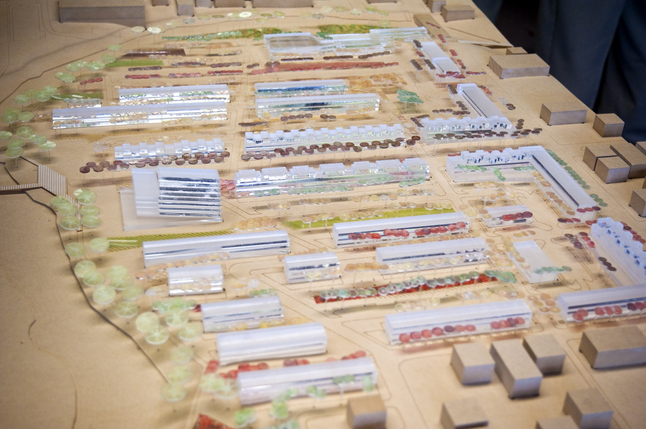
Ypsilanti Mayor Paul Schreiber said in his state of the city address that Water Street development is key to the city's future.
Joseph Tobianski | AnnArbor.com
Redeveloping Water Street, historic preservation, and retaining city service levels are all key to furthering the city of Ypsilanti's growth and transformation into a destination college town, said Mayor Paul Schreiber in his State of the City address Tuesday
Schreiber's 24-minute address entitled the State of the City 2013: Shaping Ypsilanti, focused on these topics and urged public involvement in the city's master plan revision process.
The draft master plan is expected to be available for review in the summer and completed by the end of this year.
"When I was writing the state of the city, it occurred to me that it was the perfect time we were having the state of the city," Schreiber said. "We haven’t had a master plan update since 1998 to look back on last year or the last number of years."
Schreiber said his past addresses typically focused heavily on the city's budget, but he decided to digress from that this time.
"I’ve always talked about the budget in past state of the city’s and it certainly helps to make the city run but it's not all of it," he said. "In fact it’s a small part when you look at everything else going on, all of the changes… .The artistic community coming in. Ypsilanti is really changing and I think its becoming a destination college town."

Paul Schreiber
Schreiber mentioned the master plan update will address what type of developments should happen on Water Street and will continue Ypsilanti's transition from being a predominately manufacturing town.
Schreiber reiterated Water Street development is key for the city's future.
The proposed Family Dollar store may be the first development to come into fruition on the Water Street property.
Schreiber noted the proposal has "sparked spirited comments."
"Critics preferred independent retail or a supermarket to attract customers to other businesses downtown," Schreiber wrote in his state of the city address. "Supporters wanted to start development now with a viable proposal."
The City Council is expected to consider the purchase agreement at its March 19 meeting and a public hearing will be held.
The city's budget
Since the rejection of the city income tax and Water Street debt millage proposals last spring, city staff has been reduced due to retirements and resignations, even though property values and property tax revenues have stabilized, Schreiber said.
As a result, the city's motor pool fund is being reallocated to account for a smaller city workforce and a number of other changes are coming down the line, according to Schreiber.
"The city solid waste or garbage fund is out of reserves and will require hard negotiating for the new contract this year," Schreiber said. "The major and local streets funds are depleted and will not allow major road repair without the help of other funding. Many cities are in much worse shape than Ypsilanti, but running the city with reduced staffing under the current structure is unsustainable."
As a result, the city is considering a hybrid public safety model that would include a smaller fire department and cross-trained police officers who can also respond to a fire.
"This system is projected to be more cost effective than the current system or consolidating with other municipalities," Schreiber said.
Street lighting costs amount to about $500,000 per year and the city is considering a streetlight special assessment district to pay for that cost as well as an upgrade to LED technology.
"The combination of savings and increased revenue pursued by city council will bring Ypsilanti closer to a balanced budget," he said. "...These changes will allow the city's general fund to be solvent until 2018.
Ypsilanti's transportation system
Last year the Ypsilanti Downtown Development Authority conducted an extensive parking study that included several recommendations that would make the city safe and accessible for all means of transportation.
"Parking study recommendations included weekend parking enforcement, locations for additional bicycle racks, decreasing parking rates in zones farther away from business hubs, and instituting a pay-by-cellphone pilot program in addition to metered parking," Schreiber said. "These changes will be considered by Ypsilanti City Council in the future and will lead to more convenient and accessible parking in the city."
The city is continuing to work with other elected officials throughout the county to create a viable transit option.
Right now Ypsilanti, Ypsilanti Township, and Pittsfield Township all have purchase-of- service agreements with the AATA that are subject to annual budget scrutiny by each government, Schreiber said.
"The AATA can’t depend on this funding and can’t permanently expand bus service," he said. "As a temporary pilot program, AATA expanded weekday and weekend service on route 4 along Washtenaw Avenue from Ypsilanti to Ann Arbor. This has increased ridership by 30 percent and demonstrates that bus transit can be successfully expanded; however, a permanent funding mechanism must be identified."
Historic preservation and broad redevelopment
Schreiber believes preservation of the city's historic buildings will further the city's redevelopment efforts.
The Ypsilanti Historic District was created in 1978 and is the seventh largest in the state, Schreiber said.
"Only Detroit, Grand Rapids, Kalamazoo, and Ann Arbor have more historic buildings," Schreiber said.
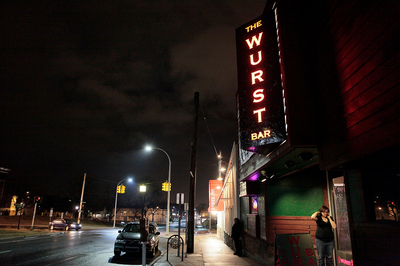
Schreiber said the Wurst Bar is one of several businesses to open recently in Ypsilanti, signaling the city's growth
Over the years, the city council has saved historic structures by transferring them to responsible owners or by expanding the historic district.
"In the 1970s, the Quirk City Hall, the old Ypsilanti Firehouse, the Ladies’ Library, the Gilbert Mansion, and the Towner House were saved by the actions of Ypsilanti City Council," Schreiber said. "In 1983, Eastern Michigan University preservation students successfully fought to save Welch Hall from demolition and its site from becoming a parking lot."
Welch now is home to the university's administrative offices, including the president's office.
Schreiber said the revitalization of several downtown buildings, led to the creation of many of the city's current successful businesses such as Beezy's, MIX, Bona Sera Cafe and B-24's.
" The long-neglected Campus Town corridor on West Cross street across from EMU now boasts the trendy Wurst Bar, the Crossroads Bar and Grill and dependable good food at the Tower Inn," Schreiber said. "Last November, the owners of Sweetwaters Coffee and Tea shop in Ann Arbor signed a lease agreement for office space in Andrew O’Neil’s redevelopment of the former Campus Drugs."
Schreiber said the city is continuing its effort to target blighted properties and those structures are being sought out by the Administrative Hearings Bureau.
"Currently, 43 of 47 targeted dangerous properties have been abated or demolished," Schreiber said. "Most recently, through the efforts of the AHB, City Council has ordered three blighted properties to be demolished and the Smith Furniture building roof to be repaired."
Katrease Stafford covers Ypsilanti for AnnArbor.com.Reach her at katreasestafford@annarbor.com or 734-623-2548 and follow her on twitter.
Comments
wereintroubl
Fri, Mar 8, 2013 : 8:04 a.m.
Sorry, retail, and "Dollar Stores" are not the types of jobs that prosper a community. The entire payroll at a Dollar Store probaly doess not equate to two full-timers working at one of the GM and Ford plants. Regarding being a "college town" isn't Flint trying that as well with zero results? Ypsi has to get in line with Ann Arbor, Adrian, Spring Arbor, Big Rapids, Kalamozoo, Detroit, etc- other college towns; and that is just in the state of Michigan. The question is, where are these students going to work after they graduate and they are done patronizing the bars and stores? The Dollar Store? There has to be a revised manufacturing base to create the engineering and management jobs that actaully pay a decent wage. Unfortunately, there appears to be little leadership or effort on all levels in this state to recruit living-wage employers to this area and other economically troubled communities.
Ypsi Eastsider
Thu, Mar 7, 2013 : 2:14 a.m.
6 years into his term and he finally figures out Water Street is key to the city's future. All the while jobs and people continue to leave the city. The Mayor's solution, higher taxes and a dollar store.
dading dont delete me bro
Wed, Mar 6, 2013 : 6:03 p.m.
nothing says, "college town" more than a family dollar store. no?
wereintroubl
Fri, Mar 8, 2013 : 8:06 a.m.
dading- agreed! These politicians get excited about these "village economy" jobs while other areas like the City of Wyoming Michigan, Texas, Alabama, etc actually have a plan to get the good manufacturing jobs that we once had here.
Crusader 53
Thu, Mar 7, 2013 : 1:18 a.m.
It was a commuter biased college when I went to EMU in the early 70's. The trick is to give those commuter students a reason to spend more of their time and money in town. Manufacturing should always be a part of the equation but the reality is that any and all municipalities , not to mention states, are clamoring for those manufacturing jobs. That presents itself as a huge uphill fight for Ypsilanti's elected representatives. In other words , a need to be careful in picking your fights where your energies may garner some success.
beardown
Thu, Mar 7, 2013 : 12:21 a.m.
I don't think the mayor remembers that most of the students at EMU are commuters. It's hard to have a "college town" when most of the people who go to the school leave the second their classes are over.
Katrease Stafford
Wed, Mar 6, 2013 : 3:44 p.m.
What I found interesting while listening to the mayor's address was the repeated mention of the city transitioning from being a manufacturing town into a "college destination town." Readers, are you seeing this transition as well?
Ben Petiprin
Wed, Mar 6, 2013 : 7:28 p.m.
Sorry, some time dilation issues on my end. The last one wasn't a response to you, Katrease. But yeah, I think both ideals can be pursued. The only thing that annoys me is that it's only the college artsy stuff that's being encouraged. One thing that can be done is getting the factory on Harriet/Spring/Factory St going full tilt again. Making anything really, but if you want to kill two birds with one stone make solar panels there. Then it's a manufacturing town that's still somewhat artsy, which is what Ypsi has always been really.
Cash
Wed, Mar 6, 2013 : 7:28 p.m.
No doubt that Ford Motor and GM deserting Ypsilanti area was devastating. It was a manufacturing center and now it is not, due to Ford and GM . What is it going to be now? Hard to say right now. For me, it's totally dependent on the crime issue. We don't hear the leaders speak a lot about it....the elephant in the room...but it is true. A safe Ypsi could become a trendy place, especially with the rec center downtown. Otherwise...well ,you know.
Ben Petiprin
Wed, Mar 6, 2013 : 7:18 p.m.
As much as some places are thriving, you're leaving out most of the city and township. And while you might theoretically be able to make money by constantly funding one segment of the population at everyone else's expense (see any dictatorship for example) that's not a healthy city. In a healthy city, the people WHO LIVE THERE have full time jobs. When the people who live there have full time jobs (not necessarily great jobs) they put that money back into the city for food and services. Then you have the majority paying back into the community instead of just one favored demographic. If you rely on a small piece, you resign yourself to a small revenue. This is why manufacturing needs to come back. Or if not manufacturing, then a few big employers that pay living wages.
Katrease Stafford
Wed, Mar 6, 2013 : 6:51 p.m.
Interesting thoughts, Ben. What's your vision for the city? Do you think it's a way to mesh the two or do you think the city should just completely move away from trying to be a "college destination town?"
Ben Petiprin
Wed, Mar 6, 2013 : 6:33 p.m.
They're trying really hard to make this transition, but I don't think they're likely to succeed or that it's even a good idea. This plan is strictly for the short money. No one benefits from this template except business owners around campus or Depot Town. You're putting all your faith in people who are gonna leave in 4 years. And I know there will be and endless stream of them but they're not putting anything into the city except money to buy pizza or beer.
dading dont delete me bro
Wed, Mar 6, 2013 : 6:10 p.m.
a college town is cool for ypsilanti. depot town is booming and the whole atmosphere is young college kids and young professional families. bring them too (to the city)
dading dont delete me bro
Wed, Mar 6, 2013 : 6:09 p.m.
there is more opportunity for manufacturing and light industrial in the township. there's parcels across from the old state police post and the willow run plant area. bring it, and bring your tax $$'s with you.
ahi
Wed, Mar 6, 2013 : 4:46 p.m.
I think the manufacturing town died a very long time ago and people were in denial. I am not sure what a "college destination town" is, but we definitely are seeing things improving. More families, presumably priced out of A2, are moving downtown which gives everything a bit more life. EMU seems to be engaging a bit more with the city, having finally realized that the surrounding area matters for recruitment and retention.
Cash
Wed, Mar 6, 2013 : 12:30 p.m.
Make the city safe. Good things will follow. Until then, nothing improves. "The city is continuing to work with other elected officials throughout the county to create a viable transit option." Mayor, why isn't something done to make the Ypsi Transit Center a safe place? AATA needs to reallocate funds from their new mansion in Ann Arbor, and hire a safety officer to be on guard at that center. As the City leader, please push for that to happen. Perhaps EMU would help to fund it.
Jonathan Blutarsky
Thu, Mar 7, 2013 : 3 a.m.
I walk downtown every day, and usually this includes the bus station and I have never have had a problem. The worst I've ever noticed is some stupidly baggy pants and some pretty bad tattoos. So let me guess, sometime ago there was a rash of fights there, right? Some one posted it on boobtube and it was ugly. Well get over it!
Cash
Wed, Mar 6, 2013 : 3:26 p.m.
Oh course the YPD can't police that transit center. They are short staffed and have an entire city to cover as it is. It should be an AATA priority....that should have come ahead of their luxurious new headquarters in Ann Arbor.
ahi
Wed, Mar 6, 2013 : 3:04 p.m.
A YPD officer is frequently hanging around the Transit Center, but I'm sure they can't cover all hours. I have never felt unsafe in the city. Reading the police blotter, a majority of the incidents are moron vs moron or personal disputes gone violent. These aren't really preventable by better policing. The stupid and desperate will always be doing something stupid or desperate.