

Mayor Paul Schreiber thinks countywide transit tax would pass comfortably in Ypsilanti
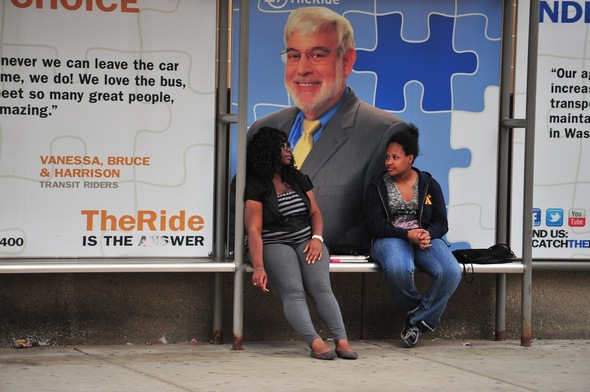
Two riders sit under a billboard featuring AATA Chairman Jesse Bernstein as they wait to catch a bus in front of the Blake Transit Center in downtown Ann Arbor.
Ryan J. Stanton | AnnArbor.com
And the fact that Ypsilanti voters in May turned down two city tax proposals by a 2-to-1 margin doesn't change anything.
"There were a number of issues with the tax proposals we just had," he said. "I would keep in mind, when it comes to transit, Ypsilanti voters voted 3-to-1 for public transit in November 2010, so I don't think people have changed their opinion on that."
The nearly 1-mill transit tax that Ypsilanti voters approved in 2010 was done as an amendment to the city's charter, similar to Ann Arbor's 2-mill transit tax, meaning it doesn't expire.
The Ann Arbor Transit Authority is counting on revenue from both those taxes, in addition to revenue equivalent to a half-mill countywide transit tax, to feed a new countywide transit authority. Ypsilanti and Ann Arbor officials finalized an agreement to make that happen this week, and it awaits ratification from the AATA and the county board now.

Ann Arbor City Administrator Steve Powers, left, and Ypsilanti Mayor Paul Schreiber chat at a meeting earlier this year.
Ryan J. Stanton | AnnArbor.com
Schreiber laughed it off.
"Actually one of the amendments that we put into the four-party agreement is that, when it goes to the voters, all of our millage would go toward the new authority," he said.
"So there's no chance of only part of the millage going there and part of the millage going to rail or something else," he said.
Schreiber said he knows some Ann Arbor City Council members think Ypsilanti can pull its millage back, but he said that won't happen.
"What we plan to put on the ballot is something that would put all of the millage, plus the half-mill regional, for the transit authority — the Washtenaw Ride as it's going to be called," he said.
"I think it's going to pass comfortably. We're going to have to mount a county campaign for it, and we're going to have to justify it, but I think the voters are going to seriously consider it."
The AATA already registered the domain www.WashtenawRide.org on May 10, according to public domain registry data.
AATA CEO Michael Ford said Ypsilanti is a critical piece of the countywide transit puzzle that's starting to come together after years of work.
"Ypsilanti is a critical piece," he said. "People are coming into Ann Arbor every day to work from Ypsilanti. You can't think about regional transportation without including Ypsilanti.
"That's why we want to work with them in any way we possibly can to at least maintain the existing services we have right now with an eye on even more services."
Ford plans to appear before the Washtenaw County Board of Commissioners for a special working session on the countywide transit plan next Thursday. The board could take a final vote on the countywide transit agreement as soon as July 12.
At some point after that, the county clerk's office would perform the administrative role of filing the approved articles of incorporation for a new countywide authority. After that, each municipality in the county would get 30 days to opt out should they choose.
In municipalities that choose to participate, such as Ann Arbor and Ypsilanti, a countywide transit millage could appear on the ballot at some point.
Schreiber said the current Ypsilanti transit millage — atop which a new countywide millage could be layered — brings in somewhere around $300,000 a year, but the city projects 3 percent tax revenue declines each of the next two years.
The millage in Ypsilanti is projected to fall $21,000 short of covering the full cost of the city's purchase-of-service agreement with the AATA for the coming year starting July 1. And it's projected to come up $75,000 short the year after that.
The AATA is talking about covering the $21,000 shortfall for the coming year, with the understanding that it won't be an issue once a countywide authority is funded.
"We want to be able to maintain existing service, so we're trying to do what we can to help out," Ford said. "Obviously it's not a solution, but if we're able to bring on a countywide transit system, I think that starts to resolve a lot of the problems and brings opportunities."
Both Ford and Schreiber noted the large number of Ypsilanti residents who rely on public transit to commute to work in Ann Arbor, which is why the AATA has ramped up services along its Washtenaw Avenue bus route. They said that benefits both communities.
"I think the voters of Ypsilanti will vote in a half mill or whatever it is in order to keep transportation going in Ypsilanti," Schreiber said. "From what I understand, over half of the Zingerman's employees are living in Ypsilanti, so a lot of them take the bus.
"You have people outside of Ann Arbor coming into Ann Arbor and spending money and working and getting the economy going," he added, "so it's only natural that you'd want to have transportation for people coming into Ann Arbor and leaving Ann Arbor."
A survey conducted for the AATA last fall showed a majority of residents in Ypsilanti, Ypsilanti Township and Pittsfield Township would support a countywide transit tax, but there's less support in outlying townships.
Ryan J. Stanton covers government and politics for AnnArbor.com. Reach him at ryanstanton@annarbor.com or 734-623-2529. You also can follow him on Twitter or subscribe to AnnArbor.com's email newsletters.
Comments
Vivienne Armentrout
Mon, Jun 11, 2012 : 3:21 a.m.
I appreciate Ryan Stanton's reporting on this subject. He often delves into the connections and side alleys on this very complex issue (the "countywide" transit plan). Mayor Schreiber is supporting this plan because he has a very acute knowledge that it benefits Ypsilanti. Actually, a good fraction of Ypsilanti's current service is being supported by Ann Arbor taxpayers. Most recently, the Ypsilanti city council deleted the portion of their general fund budget that would have made up the shortfall between their charter millage and the Purchase of Services Agreement (POSA) for service to Ypsilanti. The AATA has agreed to absorb that amount, which means that the Ann Arbor tax base is picking up the difference. AATA has also added additional service on major routes going into Ypsilanti. Part of that is supported by a Federal grant, but the residue is being paid by Ann Arbor taxpayers. I looked at regional contributions to the new transit plan in my post http://localannarbor.wordpress.com/2012/03/10/fairness-and-transit-ii/ and concluded that Ypsilanti will benefit from the new plan, even though their residents will be paying more in terms of millage percentage than all other jurisdictions outside of Ann Arbor. So it is a sensible decision for them. The argument that lower-paid workers live in Ypsilanti and work in Ann Arbor, thus Ann Arbor should pay for them, is complex. I agree that we need to have a strong integral urban transit system, and that Ypsilanti, as our sister city, must be successful. But the businesses who employ those lower-paid workers are in effect being subsidized by Ann Arbor property owners, many of whom are homeowners who themselves are not making exceptionally high incomes. ( I have calculated that Ann Arbor taxpayers, who will pay 2.5 mills under the new arrangement, will be carrying about 75% of the total tax for the entire system.)
Terrin
Sun, Jun 10, 2012 : 6:54 p.m.
Ypsilanti recently approved a library millage and did vote to protect transportation. That is very different then trying to force residents to pay for the failed water street project that the former mayor promised that no resident would be responsible for. Moreover, the City got greedy on the other taxes. The income tax never expired, and the water street tax essentially allowed the city to tax people whatever it wanted.
whatsupwithMI
Sat, Jun 9, 2012 : 10:41 p.m.
IMO the recent anti-tax blog commenting and to a small extent, actual voting, are atypical for Ypsi. In fact, this community has a history of voting for taxes that benefit the city and residents long-term, that is why the rate is relatively high per taxpayer at this time. This is a tiny, 4-square-mile boundary, almost 40% of which is tax-exempt. SOMEONE has to pay for sh*t. Until Water Street failure made for feelings overwhelming reason, decisions about finances were made based upon data. These days, that is harder to accomplish. Ypsi leadership has not I feel shown that the Water street attempt was completely reasonable, and has earlier succeeded in many many cities regionally -- Royal Oak, Farmington Hills, AA, for example--- but a city with limited resources and one single attempt got crushed with bad timing on a completely reasonable venture. Other cities in the region also do not have major AA business-owners afraid of competition, who thus quench growth in Ypsi any time they can (data not shown as it is a digression). RE transit: Better and more direct transit will benefit all in both AA, Ypsi, Detroit, and the surrounding communities. I would have killed to have time-sensitive transit to my workplaces in Detroit, AA, and ports along the way. AA needs to keep in mind that the majority of the jobs in their city are now service-industry jobs, which won't let people buy homes there, and barely rent in AA or even rent in Ypsi. With the demise of Pfizer, there just are not high-paying jobs within AA itself. Even the average faculty wage at U of "EM" was 55k, last I looked, and this Ypsi resident left that wage behind a long time back. For those of us who commute, time spent thinking on a bus from Whitmore Lake or on a train from AA/ Ypsi to Detroit will translate into more discretionary income, and more orders from local eateries. Local food is all that AA or Ypsi has to offer for industry at this time.
Ypsidoodle
Sat, Jun 9, 2012 : 11:22 p.m.
As far as the metro Detroit area is concerned, Washtenaw county is just a place where football gets played and maybe a few kids go to school... very disconnected that area is.
Honest Abe
Sat, Jun 9, 2012 : 9:28 p.m.
I would like to add one word to describe Paul Schreiber, Ypsilanti City Council, Ypsilanti City Manager, Ypsilanti DDA and the Ypsilanti DPW director = Incompetent.
martini man
Sat, Jun 9, 2012 : 9:12 p.m.
Even if the mass transit bus tax passes ..the roads and streets in Ypsilanti are so bad that they will need Tanks rather than busses to navigate them. The Mayor needs to concentrate on the streets rather than the busses. Ypsi's street condition is a total disgrace. Anyone driving on Grove or Packard will agree.... whole heartedly.
Ypsidoodle
Sat, Jun 9, 2012 : 11:19 p.m.
Yes, I know... but as a frequent traveler along this route, it has been a major inconvenience for some time and I'd rather have sooner than later for this repair... and if the city wants to generate some more revenue, park a speed patrol along that route rather than put up the cute radar signage, no one does the speed limit there or stops at the stop signs and it could really be a money maker, probably save some lives to boot...
whatsupwithMI
Sat, Jun 9, 2012 : 10:18 p.m.
I'm a fan of a martini also, sad that that eatery closed, but: the section of W Cross you mention is slated for repaving, it was mentioned even on this blog.
Ypsidoodle
Sat, Jun 9, 2012 : 9:20 p.m.
Nice little slice of West Cross that needs some big help too... almost everyone drives as close to the curb as possible going westbound!
greg, too
Sat, Jun 9, 2012 : 8:55 p.m.
Does he have proof those employees take the bus to Zingermans? I used to ride the bus from around EMU to downtown and it was a 45 minute ride on a good day. I just started to drive and paid for parking instead of wasting an hour and half on the bus. If they put the money towards improving the service (more buses, better routes, working with the city to maybe increase bus lanes or turnouts) I would gladly support it. If it is for more billboards, then I will just continue to drive.
whatsupwithMI
Sat, Jun 9, 2012 : 10:47 p.m.
But that's the point! Better bus service means better DIRECT routes. Targeted in directions that people actually need.
Honest Abe
Sat, Jun 9, 2012 : 8:50 p.m.
City Hall is getting desperate. Seems they are scrambling to "find" a reason to tax, in order to make up for their poor spending with of OUR money in the first place. You would think that Schreiber received the hint after the most recent vote that we shot down to raise our taxes. You think a county wide transit tax will pass comfortably in Ypsilanti? Think Again!
Ypsidoodle
Sat, Jun 9, 2012 : 8:42 p.m.
How about instead of spending all this time and effort in trying to pass another tax that basically encourages more jobs to stay out of, or move out of Ypsilanti, we put our collective energy together and find ways to get jobs to come to Ypsilanti? Much less need for busing services if the jobs are all right here...
wolfman jack
Sat, Jun 9, 2012 : 8:06 p.m.
I don't like you well enough to sit next to you on mass transit. That's the story. No mass transit fee. No tax support.
martini man
Sat, Jun 9, 2012 : 5:55 p.m.
More taxes and more spending Wow what a deal !! I am sure the folks who live outside the cities.. say in western parts of the county etc, will be estatic, about getting to pay for other people's bus service. Let the folks who actually use the busses as a form of transportation pay for it . Most busses that I see going by have about three people on them. The routes that are used by large numbers of people can have the bus fares raised . The people who ride will pay it ..what choice do they have ??? As far as the AATA saving money and operating efficiently ??? Probably just a pipe dream, since most things funded by taxpayer money are usually just the opposite of efficient. I think I'll vote NO should this ever appear on the ballot .
Ypsidoodle
Sat, Jun 9, 2012 : 9:15 p.m.
Go to a zone system whereby the farther the route, the more expensive... kind of like toll roads, many of which are run by for profit entities btw...
Ricardo Queso
Sat, Jun 9, 2012 : 5:02 p.m.
Of course he does, just like any other government entity dependent on the tax dollars of others, he must support increased spending to keep his job. If put up to a vote this farce would fail miserably.
Mike
Sat, Jun 9, 2012 : 3:59 p.m.
1/2 mil here 1 mil there nickel and dime the taxpayers to death one piece at a time .Most don't seem to consider the multitude of taxes hidden in places like phone bills , cable TV, etc and much of the taxes go to places they are not supposed to. Hard to believe Americans were angry enough to want to separate from the British, compared to today they hardly taxed or infringed upon our freedom at all.
Ben Petiprin
Sun, Jun 10, 2012 : 4:39 a.m.
You're right, man. Americans have grown very scared. Revolution's supposed to be part of the template for the country. "The tree of liberty must be refreshed from time to time with the blood of patriots and tyrants. It is its natural manure." Thomas Jefferson. Pollute our shores with an oil spill... Whatever. Take our houses... Cool. Sell them back for a profit... Get MONEYYYY! COWARDICE.
newsboy
Sat, Jun 9, 2012 : 2:58 p.m.
The University and The City should increase parking rates simultaneously to for non-residents. With this in place the acceptance of mass-transit would increase. As a resident and tax payer in Ann Arbor of many years, I'm just tired of paying for infrastructure that is not supported by tightwads outside of Ann Arbor. Just can't wait for $10 a gallon. Come on free market economy!
Jeffersonian Liberal
Sun, Jun 10, 2012 : 2:57 p.m.
Hey newsboy, we are tired of funding the never ending waste that is the government run transit system. These programs are run by people who would fail at running a lemonade stand. You and your delusional citiots can tax yourselves into oblivion, we're done paying for you!
ahi
Sat, Jun 9, 2012 : 8:50 p.m.
too much truth for a2 readers.
shepard145
Sat, Jun 9, 2012 : 2:35 p.m.
County tax!? Ham fisted and laughable – proposed by citizen representatives who know little about finance beyond the checkbooks squirreled away in their kitchens. Was the Mackinac Bridge paid for with a tax on Mackinac County? LOL Busses are an adequate form of low cost transportation for students, the poor and indigent - folks who will show up to public meetings and demand MORE tax dollars be spent on them at every opportunity. Busses are adored by many politicians because they know systems can be expanded when the money is available and vanish over night when tight. Of course knowing that 99.999% of commuters driving cars will never set foot in any form of bus, the AUTO INDUSTRY has no problem with them either. Few seem to understand how a true MASS TRANSIT system benefits a region or is otherwise important. Certainly there is some vague nonsense about it being "green", but transit was important long before the "green" gimmick. Why do so many other states have large, well organized, successful but expensive rail transit systems? Why do major cities depend on them? Why do states that are far less successful than Michigan manage to pay for them in ways that are acceptable to their voters? The answer is that it is about predictability/permanence, daily tax paying commuter choice, efficient development (TOD) and offering a regional amenity that can make the difference on whether a large business will relocate to Michigan. …all the reasons BUS RAPID TRANSIT is a long term FAILURE. Paying for a multi billion dollar system has been accomplished countless times by states with far fewer resources then Michigan but who enjoyed something we lack: enlightened leadership. …and today, regardless of public support, that's where meaningful Michigan mass transit dies.
DJBudSonic
Sat, Jun 9, 2012 : 2:04 p.m.
Half the Zingermans employees live in Ypsilanti? Either they need to pay better wages or Ann Arbor needs more affordable housing, or both. Maybe Zingermans needs a transit levy on their $16 sandwiches?
Superior Twp voter
Sat, Jun 9, 2012 : 3:18 p.m.
Can't afford Zingermans. No way. Can't afford any more Ypsi taxes, either.
JRW
Sat, Jun 9, 2012 : 3:09 p.m.
Zing's pays low wages for many of the workers. A2 needs more affordable housing, no question about that. $16 sandwiches? WAYoverpriced. The only ones making the big bucks at Zing's are the owners, thanks to the $16 sandwiches and low worker wages. Maybe Zing's should offer a high priced "Transit" sandwich filled with bologna.........
Craig Lounsbury
Sat, Jun 9, 2012 : 2:44 p.m.
"Maybe Zingermans needs a transit levy on their $16 sandwiches?" an award winning line.
Bones
Sat, Jun 9, 2012 : 1:44 p.m.
The only ones that would vote for new taxes in Ypsi are renters and students. None of which have to pay the taxes.
ahi
Sat, Jun 9, 2012 : 8:46 p.m.
property taxes go up, rent goes up. why is this hard to understand?
stunhsif
Sat, Jun 9, 2012 : 1:42 p.m.
Hum, spend taxpayer dollars to run a campaign. Then put this on the ballot with the hope of sucking even more tax dollars out of taxpayers so they can provide a service that 85% of the taxpayers will never use. Sounds fair to me, NOT ! People that use mass transit are renters, they don't pay property taxes, this will never pass. ABO
Ypsidoodle
Sat, Jun 9, 2012 : 9:19 p.m.
And renters have to bear almost none of the same responsibility as homeowners as far as upkeep, etc., as well as the absentee landlords, which is why many of the rental properties in this city have just continued to decline in value, dragging down the values of the properties in their vicinity and as such, the tax base...
ahi
Sat, Jun 9, 2012 : 8:45 p.m.
Renters and their landlords subsidise homeowners' homestead and mortgage deductions. You're welcome.
Ricardo Queso
Sat, Jun 9, 2012 : 5:07 p.m.
Sorry JRW, until a renter is faced with an actual tax bill they have no idea how much they are "spending" on property taxes. I think if their rent bill itemized property tax they may have a different opinion.
JRW
Sat, Jun 9, 2012 : 3:03 p.m.
Just to clarify: Renters pay property taxes when they pay rent to the landlord, who pays the property taxes. I do agree with you that this will not pass, but because Ypsi is broke and needs to fix a lot of other problems first.
blahblahblah
Sat, Jun 9, 2012 : 1:22 p.m.
OK, here is how the pending millage ballot should read for Ypsi residents: Sorry, if you want to keep your current level of bus service you HAVE to pass this millage. We need about half this new tax to cover the estimated $75,000 shortfall for current services and the remainder will go to the new county wide transit authority to a.) hopefully fund increased service, or b.) cover future funding shortfalls for the existing service, or c.) be used for other things such as the 30 year plan which contrary to Mr. Schreiber's misleading statement above, does include RAIL.
dading dont delete me bro
Sat, Jun 9, 2012 : 1:20 p.m.
i already live here. why would i pass a tax for something ima not going to use?
dading dont delete me bro
Wed, Jun 13, 2012 : 10:38 a.m.
no
ToddAustin
Tue, Jun 12, 2012 : 3:53 p.m.
That's an easy one. Better public transit means businesses can more easily hire workers, which means more people working and paying taxes and improving your community. It means transit available to seniors, children, and young college grads who don't want to deal with a car, which means a stronger community with lower unemployment and higher incomes and property values. Whether or not you decide to get on one of the buses, it makes your life better and your wallet fatter. Investments in public transit pay off in a big way wherever they are made.
xmo
Sat, Jun 9, 2012 : 12:46 p.m.
If Ypsi's mayor is so sure that the AATA tax will pass in Ypsilanti, why not let Ypsilanti residents pay for it all? This way, they get higher taxes and we don't. Sounds fair to me!
jcj
Sat, Jun 9, 2012 : 12:27 p.m.
The problem is it does not matter by what margin a proposal is defeated by they will beat this horse into submission by hook or by crook. Most likely the latter!
The Picker
Sat, Jun 9, 2012 : 12:18 p.m.
I think the Mayor has never seen a tax he didn't like. I think the Mayor should focus on straightening out Ypsi's problems before he takes on more of the world !
Markus
Sat, Jun 9, 2012 : 12:12 p.m.
On what does Schreiber base his confidence of new taxes passing? This is the same guy who was promoting the last round of taxes that were recently defeated 2 to 1. Did he conduct a survey of local voters this time? Besides, I thought when the last transit millage passed, it was with the promise not participating in exactly this type of countywide transit tax in the future. Also, the current transit millage passed based on a dedicated, special-interest constituency, on a single-issue ballot, right? The odds of passing this time might not be as good as the Mayor thinks.
braggslaw
Sat, Jun 9, 2012 : 11:59 a.m.
That is laughable... there is no appetite for more taxes.
Top Cat
Sat, Jun 9, 2012 : 11:30 a.m.
Only 3 people would vote for it in Webster Township. One lives in Sarasota, FL, one is here illegally from Guatemala and the other is dead.
ahi
Sat, Jun 9, 2012 : 9:09 p.m.
So that leaves two people to vote against it?
Craig Lounsbury
Sat, Jun 9, 2012 : 2:41 p.m.
but since the dead guy votes twice that's actually 4 votes.
murphthesurf
Sat, Jun 9, 2012 : 11:16 a.m.
perhaps the aata could save some $'s by not spending so much on advertising,do we really need to see a huge picture of mr bernsteins face plastered all over the place? wonder how much this cost? !
Ypsidoodle
Sat, Jun 9, 2012 : 8:51 p.m.
So, if you don't advertise public transportation, what do people do... walk? Not go anywhere? Heck, they might even car pool or ride their bike? This is kind of like USPS advertising which new stamps are coming out next month... yes, a total waste of money imho...
Ron Granger
Sat, Jun 9, 2012 : 1:13 p.m.
Well said. It is always disgusting when public servants decide to spend money advertising their personal brand and image everywhere at the taxpayer's expense. There should be a law against it.