

Years after accident left Saline resident in a coma and unable to move, she prepares for her first marathon
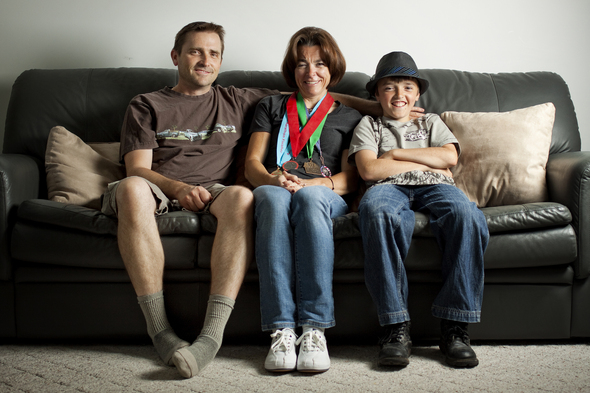
Steffanie Siefker sits with her husband, Mike, and 11-year-old son, Spencer, Friday afternoon in the living room of their Saline home. Siefker, who sustained a traumatic brain injury in a motorcycle accident 24 years ago, is participating in her first marathon this Sunday. "I read that running helps build neurons in your brain, so I started running," Siefker said. "I'm just glad to have survived, I feel blessed to have Mike in my life."
Jeffrey Smith | AnnArbor.com
Steffanie Siefker’s son, 11-year-old Spencer Siefker, left a very special message for his mom on her birthday cake this year.
“Shut Up and Run,” it read.
That’s one of the bits of advice Siefker says will be on loop through her head as she faces the challenge of running the Ann Arbor Marathon this Sunday.
A 26.2-mile race is a tough prospect for anyone, but Siefker is attempting it while still dealing with the lasting effects of a traumatic brain injury she suffered after being hit by a car while on a motorcycle 25 years ago. That accident, which occurred when she was 17-years-old, left her in a coma for a week and unable to walk, talk, eat, move or do anything else.
But 10 years later, after extensive rehabilitation, she began running. She first completed a 5k run, then a 10k run and most recently three half-marathons.
There are several reasons Siefker started and continues running, but being able to prove to herself that she can still be what she was before the accident is the driving motivation.
“I was highly athletic before the accident, and part of me wants to get that back,'' Siefker said. "I’m not competing against other people; I’m competing against myself. I want to prove to myself that I can still do this.''
Siefker says she "lost everything'' in the accident. Along with her ability to physically function, she lost her boyfriend of three years, all her friends and her athletic ability.
“There has always been a part of me that wants to get some of that back,'' she said. "When I cross that finish line, that’s when I get a little piece of me back.”
Siefker grew up in what she described as a strict family. Heading into her senior year, she was a math whiz about to take her first calculus course, part of the color guard team and an exceptional athlete.
The family was in Myrtle Beach in 1987 when her father allowed her to take a motorcycle ride with a trusted family friend. Siefker said they weren’t doing anything reckless - there was no alcohol involved - when a car struck them.
She spent the next week in a coma in the intensive care unit, underwent surgery for blood clots on her brain and suffered multiple fractures on her skull. Her body was useless afterwards, her ability to do math was - and remains - gone and she described herself as a toddler at the time.
But Siefker’s family stuck with her, and she said she was fortunate that her brain recovered enough so that her body could again function. She began reading articles and books about brain injuries, trying to understand what happened to her and trying to figure out how to improve herself, when she came across some information that said that running could help prevent the onset of dementia. People who have suffered traumatic brain injuries face a significantly higher risk of dementia when they grow old, so Siefker began running as a hobby.
But running soon turned into more than that. She began to find the endorphins produced by running eradicated the regular bone and muscle pain she feels. Furthermore, she found that it put her mind more at ease.
“It’s therapy that I don’t have to pay for and, more importantly, it’s 'me' time. It’s really good for me,” she said.
Siefker said she still runs with a slight gait, suffers headaches and suffers from seizures if she doesn’t take medication.
But the mental realm is more challenging in her daily life. Siefker struggles with basic addition and subtraction. She requires around 10 hours of sleep a night or has trouble functioning. She doesn’t like to break routine or travel outside her comfort zone and Siefker finds herself overwhelmed easily.
She said the outcome of an attempt to work at the University of Michigan Department of Pathology in May illustrated her mental and emotional struggles. Siefker had to go through a 40-hour per week training course for eight weeks. The tasks weren’t entirely complicated, she said, but she was overwhelmed by the amount of learning. She felt sleep-deprived and had to drop out after three weeks.
Similarly, the Ann Arbor Marathon is a daunting challenge.
“I’m scared; this is my first marathon,” she said. But she added that she feels better with the support of her husband, Mike, who she described as “on a one-way road to heaven.”
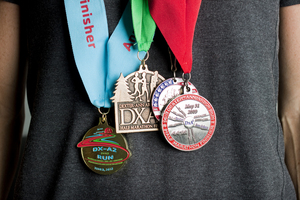
Steffanie Siefker wears medals from other runs she has completed.
Jeffrey Smith | AnnArbor.com
“He asked me, ‘What’s the worst thing that could happen? I have to walk a few miles at the end?’” Siefker said. “He really put it in perspective.”
Siefker said she sometimes wants to give up or not train the 40 miles she has been running regularly to prepare for the event. When she starts to give up or feel down, that’s when Mike Siefker only half-jokes “Shut up and run”.
Siefker's sister, Tracy Wright, and friend, Kelly Weiseman have also been supportive and said they will see Siefker at the finish line. She also puts herself at ease by repeating a quote from John Bingham, a famous runner who has penned several books on amateur running.
“The miracle isn't that I finished. The miracle is that I had the courage to start,” reads the quote.
“When I start to feel bad, I think of my sister, I think of my son telling me to ‘Shut up and run’ and I think of my husband, and I think I can do it,” she said.
Aside from her family, Siefker will have the support of the Wolverine Chapter of My Team Triumph. The group provides “angels” who run with people with traumatic brain injuries known as "captains." The angles usually push the captains in wheelchairs or assist them in some other way, but Siefker is able to run, so she has always served as an angel.
But this time, facing a full marathon, she will have three angels running with her for support throughout the race.
Bisi Adewunmi, president of the Wolverine chapter and Kennedy Care, a TBI homecare agency, described Siefker as “really fast”, and said she finished a mile during one of her recent races in 8:30.
But he said speed is not the objective for her this time.
“We’re trying to coach her and let her know she can slow her pace down and that she can do it; she can finish” he said.
Mike Sieffert is fully confident his wife will be able to finish the race and said the biggest obstacle is her nerves.
"I'm super proud of her and I know she can do it," he said. "She runs all the time, and I think she worries a little bit about being able to do it, but she can do it. She can do whatever she wants to do."
Despite her anxiety about the marathon, Siefker is eager for this weekend. As part of her training, she isn’t supposed to run for the final week before the race, and that's enough to get her pumped up for Sunday.
“I’m starting to go bonkers not running! I need to get out and run!” she laughed.
Comments
S. Siefker
Thu, Jun 21, 2012 : 2:42 a.m.
I finished the run. Thanks for the nice comments. I did fall twice during the race, I constantly need to think about foot placement, especially on a new coarse. I wanted to finish under 4 hours and I did at 3:55.28. My ipod wouldn't work and I think if I had that along with not falling I probably would have done better, but I have no regrets!!! I really think I was able to finish becuase of the "MY TEAM TRIUMPH" angels who ran with me and encouraged me.
golfer
Mon, Jun 18, 2012 : 11 a.m.
any one know how she did?
A2newbie
Sun, Jun 17, 2012 : 4:07 p.m.
I hope you enjoyed your experience running the marathon today, Steffanie, and that you keep on running! You're very inspiring!
SlackMFr
Sun, Jun 17, 2012 : 10:44 a.m.
Now this is a great story. Good luck to Steffanie with the A2 marathon & her continued success in life. I too am a runner & want to run a marathon in the future. This gives me more inspiration to drive towards that goal.
julieswhimsies
Sun, Jun 17, 2012 : 3:20 a.m.
Good for you, Steffanie! Rock it! I have had quite a few TBIs over the years...the latest in a fall down the stairs at home, 2 years ago which left me with memory deficits and other problems. I'm a retired swim coach, and one of my former swimmers invited me to swim with her in the Coastal Crawl, a 1 mile open water swim in Lake Michigan up at Harbor Springs. She won her age group last year, and I intend to win mine this year. (60-64) I've been training hard, and my times are quickly dropping. We are on a similar path. I wish you the very best, and a sold finish. You can do it! Keep on truckin'! You are a fierce woman, and nothing can hold you back! You go, girl!
Wondering
Sat, Jun 16, 2012 : 8:33 p.m.
Sleep is a way for the brain to rebuild itself after challenging learning experiences following traumatic injury. Is it possible to find an employer who might be willing to let you gradually ease into the challenges of full employment--allowing a more gradual learning trajectory, and time to process all the new learning your brain is needing to do and to sleep as needed to heal? I think we have only begun to scratch the surface of the power of the brain to heal itself (o matter what our age), if we provide carefully graded challenges in all areas of life--motor, cognitive, metacognitive, emotional--and are surrounded by lots of love and support so we believe deeply that we can do it. I have found that all four areas reinforce each other--so it is helpful to alternate between them--so that learning in one area can help you move beyond a learning plateau in another area. Very best wishes on this very special journey--showing us all that we have much to learn about what the brain is capable of doing--with the appropriate kind and level of challenge, and with the needed emotional support to believe we can succeed in stretching the limits of our current capacities--cognitive, metacognitive, and emotional, as well as motor.
Wondering
Sat, Jun 16, 2012 : 8:32 p.m.
A book that you, Steffanie, and your family might find interesting to read, if in your studies you have not already read it, is a book entitled The Brain That Changes Itself by Norman Doidge, MD. I wonder if anyone has supported you in reconstructing your math capacities, in much the same way that you have been supported in reconstructing your motor abilities......starting with the small steps that children do to learn math. And redoing over and over again simple mental and hands-on math tasks that you used to be able to do as a child. It will feel frustrating in the beginning to be doing things you could easily do as a young child--but as your capacities return, perhaps eventually very enabling. In my experience, anxiety can result from triggers associated with a previous traumatic event. And what could be more traumatic than to awake one day and find that you have lost everything that mattered to you in your life. When feelings of anxiety are recognized and understood in that way, it can give a person better understanding of and control over those feelings.......so that those feelings do not loom so large in interfering with the task of continuing to take one's life back.
BhavanaJagat
Sat, Jun 16, 2012 : 6:15 p.m.
Prayers for Spiritual healing : I define spiritualism or spirituality as the potency that generates functional harmony in the interactions between the cells, tissues, and oragn systems of the body and the human person who lives because of their living functions. After injury, body heals itself using a natural healing mechanism called Repair and Inflammation. This is a divine, spiritual mechanism to regenerate, and restore the structure and function of the tissues that have been injured. We can help this healing process by a prayer in acknowledgment of the divine mercy, compassion, and grace that has placed this mechanism in our human body. Hence, spiritualism or spirituality is an attribute of interrelationships; between body and its tissues and organs on one hand and on the other, between the human being and the creator.
Madeleine Borthwick
Sat, Jun 16, 2012 : 5:03 p.m.
Steffanie, may God send his angels(in running shoes, mind you)to run alongside you! You are an inspiration!
Modern_Atheist
Sun, Jun 17, 2012 : 7:53 a.m.
not so much 'God'... the doctors who were able to bring her out of a coma and gave her the ability to run again should receive the praises.
T Wall
Sat, Jun 16, 2012 : 2:21 p.m.
Congradulations Steffanie on accomplishing this Sunday the 26.2-mile race while dealing with the lasting effects of a traumatic brain injury. You are an inspiration to the hundreds of Special Children the T. Wall Foundation ( www.twallfoundation.org ) supports throughout Washtenaw County. When our children with disabilities have a dream on what they want to do with their life, we encourage it 100%. This Monday, June 18th the T. Wall Foundation has their 4th Annual Golf Outing 100% of the monies we raise go back to helping special children and their families in need. Hey Steffanie, would like to extend an invitation for you and your family to attend any of our events for FREE. Monday, June 18th at the Ann Arbor Polo Fields, 5200 Polo Field Dr, A2 48104 8:00 am to 10:00am - Everyone can recieve a FREE Pedometer and prizes at our Health and Wellness 5 Mile Walk. 10:00am to 10:30am - Health tips from Coco Newton a well known Nutritionist and Registered Dietitian. 1pm - If you play Golf please come to our Shot Gun Golf Tournament. We still have room for you. 6:00pm Banquet 7:30pm - Comedian Mike Green If you and your family wish to participate please email me at tom@twallfoundation.org We all wish you good thoughts for tomorrow.
OLDTIMER3
Sat, Jun 16, 2012 : 1:52 p.m.
Way to go girl. May Gods Angels will be with you Sunday as you run as they have been the last 25 years.. You can do it. Sounds like you have a very supportive family and friends.
shine16
Sat, Jun 16, 2012 : 1:22 p.m.
What a great story! You're doing more that most who have not gone through what you have. What an amazing role model you are for your son, too. Good luck tomorrow!
Linda Peck
Sat, Jun 16, 2012 : noon
Good luck Steffanie! Have a great run on Sunday!
Carole
Sat, Jun 16, 2012 : 11:54 a.m.
God bless - you will do totally awesome. Thanks for sharing your story -- very inspiriting.
golfer
Sat, Jun 16, 2012 : 11:24 a.m.
give them you know what. finish the run who cares what time just finish. good luck