

Washtenaw County schools officials gear up for May 3 vote on special education millage renewal
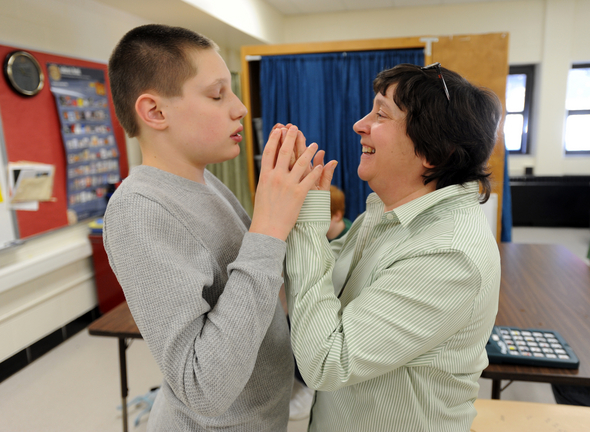
Carol Smith, a special education teacher at Scarlett Middle School in Ann Arbor, interacts with autistic student Jon Reed, 13. One in every seven students in Washtenaw County receives special education services, such as overcoming learning disabilities, speech or language impairments, or for more severe physical, mental, or emotional problems.
Lon Horwedel | AnnArbor.com
He said the WISD, the ten public school districts in the county and charter schools throughout the county have done their part to provide information to the public and are looking forward to the vote.
“There’s such a climate out there with concerns with any sort of taxes and there are people who will vote against it because they’re against any sort of tax issue,'' he said. “It’s all about, do people go to the polls who are invested in their schools? And if they do, I think we’ll get their support.”
The WISD is asking voters to approve a .985-mill renewal of the special education millage that expired in December. The millage will run for seven years and will cost the owner of a home with a taxable value of $100,000 about $98.50 per year.
Educators are emphasizing that the request is not a tax increase, but rather a continuation of a millage that county residents have been paying since 2004.
The vote on May 3 will determine whether school in Washtenaw County will receive approximately $14 million in reimbursements from the WISD for special education services. Ann Arbor Public Schools would receive the largest amount from the millage renewal — about $5.8 million — with the lowest amount going to the county’s nine public school academies, totaling about $190,000.
The millage renewal vote comes at a time when school districts are beginning to figure out what reductions they will have to make to balance their budgets for the next school year.
Many school districts have been presenting budget plans with the assumption that the millage renewal will pass. Last week, Ann Arbor schools interim Superintendent Robert Allen presented budget reductions to fill a $15.6 million deficit and Saline Area Schools Superintendent Scot Graden said in March that his district will be facing a $5.9 million deficit.
For a PDF with a breakdown of each school district’s reimbursement from the special education millage renewal, click here.
Brian Marcel, WISD assistant superintendent for business services, said many districts are coping with the loss in state funding they’re expecting this year after Gov. Rick Snyder proposed a new $300 per-pupil cut on top of a $170 per-pupil cut from last year that will not be restored. A $230 per-pupil increase in retirement costs is also expected.
“It’s almost too big of a problem to grasp at that point, that we’ll have to (cope with if the special education renewal is) not successful,” Marcel said. “They’re still coming to grasp with what they know is coming from the state level and then they’ll worry about this as a step two if this would happen.”
Allen said with the cuts that Ann Arbor schools are expecting from the state, the renewal of the special education millage has always been vital.
“We knew we were facing a $15 million deficit if the millage passes; if the millage doesn’t pass, we knew potentially it could be $6 million more,” Allen said. “We’ve always known how important this is, I don’t think that’s changed at all. I think just seeing some of the things we’ve proposed for the tough cuts we’ve had to make, there’s a realization it could be even tougher. That’s the new piece to this puzzle.”
Special education services are required by federal mandates and will continue regardless of whether the millage renewal passes.
Leyshock said the main concern of WISD officials is the impact on special education in the county if the millage renewal doesn’t pass.
“They do have the figures; they do know what the impact will be,” he said, referring to the county's public school districts. “What we’re concerned with is if it’s not there, it will reduce the overall services for the school and the environment special education students learn in.”
Washtenaw County school districts spent a total of $117.1 million on special education in the 2009-10 school year, according to WISD documents. About $10.3 million of that was covered by federal grants, $30 million was paid by the state and $58 million was reimbursed by the WISD.
For a PDF showing a breakdown on how much each district spent on special education in 2009-10, including the amount reimbursed by the WISD, click here.
Although the millage renewal funds are specifically designated for special education services, WISD spokesperson Gerri Allen said the decision made by voters on May 3 will impact all students.
She said about one in seven children in the county receive special education services — more than half receiving services for speech therapy or learning disabilities, which may not be obvious.
For a PDF showing a breakdown of students receiving special education services by district and disability, click here.
Allen said the WISD has been providing special education services for decades and the millage renewal would provide stable funding for the continuation of those services.
“Special education has been making a difference in children’s lives for 35 years and we look for that to continue,” she said. “In particular, special education helps many students become productive citizens so they can be contributors in their own communities so they don’t have to rely on tax-funded social services.”
Kyle Feldscher covers K-12 education for AnnArbor.com. He can be reached at kylefeldscher@annarbor.com or you can follow him on Twitter.
Comments
Stephen Landes
Fri, Apr 29, 2011 : 9:32 p.m.
@ Kyle Feldscher I heard that WISD has selected a new superintendent, but that they don't want to publicize this hire or the salary before the election on May 3. Is this true? If yes, why are they withholding information from the electorate? Can you find out what is going on?
roadsidedinerlover
Tue, Apr 26, 2011 : 4:30 a.m.
Sorry, I am voting no. I can't afford my taxes now...I have nothing against special needs students. Cut the fat from the administrative end now!
Mark Reed
Mon, Apr 25, 2011 : 12:04 p.m.
Enough already, I' going to throw up the next time I hear we must vote yes or we don't care about the kids! Thats just plain non-sense, we are already paying a huge protion of our earnings for multiple taxes and stop saying its not a new tax its an extension, a tax is a tax is a tax and to say it doesn't cost anything is hogwash! The bottom line is if we vote NO! (which we must) the special ed will not be effected period, it will be funded through the general education fund period. so stop with the lies and guilt. If you don't like the way the Feds and state goverment is cutting funding for education and misappropriating tax dollars then vote for someone who won't ! Stop buying imported goods and support local buisness, had every person in the school systems purchased an American Vehicle insteadof an import GM, Ford and Chrysler wouldn't have laid off over 800,000 michigan workers in the past 2 years and Michigan wouldn't have lost a 1/4 of its tax base. I asked a teacher from Ann Arbor why she drove a Toyota and not an American made vehicle to support Michigan workers, her reply was, she didn't care about over paid GM workers and Toyota was a better car and she was free to drive what ever she wanted, she was right she can drive wht she wants but I hope she knows now that it wasn't free! Things are going o get a lot worse than they are now so you might as well get used to it, hey maybe GE will contribute some of their tax free profits , now do you buy GE products ? watch NBC ? stop supporting companies who stopped supporting you !
Mark Reed
Tue, Apr 26, 2011 : 4:25 p.m.
I'm not in 1982 I'm in 2011 , where big companies pay no taxes, where politicians sold our country down the road, where Americas don't support each other, where our future is based on competing with 3rd world countries, unfortunately this started back in 1982 with Regan and his trickle down effect. But please do not think I'm behind the times. We are dismantling the middle class of this country and Americans driving imports and shopping at Walley world only help expidite the process.
Basic Bob
Tue, Apr 26, 2011 : 1:39 a.m.
@DBlaine, You have a choice to keep sending your money to Japan and China, but don't count on anyone over there sending it back to Michigan. We have nothing that they can't do without. I don't remember 1982 being a very good time, but certainly it was better than back-to-back single-state recession and Great Recession. If we keep doing what we have been the last 8 years it isn't going to fix itself.
DBlaine
Mon, Apr 25, 2011 : 3:10 p.m.
I'm sorry Mark, but you're still in 1982. 2011 is calling.
Stuart Brown
Mon, Apr 25, 2011 : 6:24 a.m.
The bad management by the AAPS deserves a no vote on this millage. Rose Ray Taylor was fired for pointing out that the AAPS could afford to build Skyline but could not afford to operate it; the AAPS board proceeded to build it anyway. The AAPS board does not believe in shared sacrifice; rather than across the board cuts for all employees of the system, selective, gang-up-on-the-weakest (the bus drivers and janitors) techniques were used. We should ditch the local boards and fire the redundant admins; save money by having a county wide school system with one administration not 10. Vote No!
johnp
Mon, Apr 25, 2011 : 3:40 a.m.
I'd like to support the renewal, but when they think that they can get a 7 year commitment I have to draw the line. Since I don't know if I'll have a job next week, going that long puts a bad taste in my mouth. If they were in tune with the community, I'd be on board for a 3-4 year deal.
KJMClark
Mon, Apr 25, 2011 : 1:05 a.m.
I'm inclined to vote for this millage, but some of these arguments drive me nuts. 1) It's a renewal - in 2004, around the height of the housing bubble, we voted to increase our taxes to help pay for special education. Not saying this is one of them, but the country made a lot of bad future promises at the height of the housing bubble. I don't fault anyone for saying times have changed and they don't think they can make the same decision now. 2) $56,000 raise shows they don't get it - don't forget that it's Ann Arbor schools that are hiring a new Superintendent, and the millage supports special education throughout the county. If you vote no, you're hurting kids in all the districts in the County, not just sending a message in Ann Arbor. 3) They need to live within their means - the problem is the State keeps going back on its promises. The local districts *have* been cutting - it's one of their few options. It's the State that's weaseling out. And yes the state has ways to fix its problems that don't involve drastic cuts to school funding. For me, if you can afford it, voting yes is the right thing to do, and thank God if you were lucky and your kids didn't need this help. However, if you can't afford it, and there are a lot of people in this boat now, no one should fault them for voting against it.
Betty
Tue, Apr 26, 2011 : 2:15 a.m.
You have written the most thoughtful and refreshingly respectful comment I have ever read on AnnArbor.com. Thank you for putting so eloquently the very thoughts that is in my head.
ccc12
Mon, Apr 25, 2011 : 1 a.m.
Thank you to all who will vote yes. One of my sons receive special education services in Washtenaw County.
cette
Mon, Apr 25, 2011 : 12:54 a.m.
@ bull 3058 Charters are public schools they are publicly funded and they have to take all children like regular public schools. However, they don't like to have special ed kids, because they costs too much for their budgets and tell the parents to go somewhere else. This is an illegal practice on their part. But absolutely, they are obliged to take all special ed children by law and teach them. They just are poorly overseen entities that get away with that kind of poor performance.
Macabre Sunset
Mon, Apr 25, 2011 : 12:21 a.m.
I'd like to see all public education covered through charter schools. Special education should be handled through regional clinics tailored specifically for this cause. Yes, I understand federal law prevents this, but changes can be made at the local level to bring us closer to this goal.
Macabre Sunset
Mon, Apr 25, 2011 : 3:57 a.m.
The pro-millage groups are the ones conflating violent students with special education students. The social engineering is what bull3058 referred to - that somehow having a disabled child in the classroom builds compassion. I see nothing to indicate that it would not save an enormous amount of money to consolidate special education services to children who can be expected to complete a K-12 education.
DBlaine
Mon, Apr 25, 2011 : 2:18 a.m.
I'm sorry, I don't see how providing services to special education students is "social engineering." And to conflate being a special education student as somehow the same as being a violent student is just wrong and inaccurate.
Lisa Starrfield
Mon, Apr 25, 2011 : 1:53 a.m.
Macabre, Most of the children who receive special education services will join the work force. Children who stutter, children who have a hard time holding a pencil, highly functioning autistic students, children with specific learning disabilities. The ONLY children who are not likely to join the work force are those with severe multiple impairment (123 in the county), cognitive impairment (374 in the county), maybe some of the EI students (467 in the county) or TBI (20 in the county) and a small portion with autism (658 in the county though most of these are high functioning and will work as adults). Most of those children are clustered in special programs. For example, my building offers a self-contained CI classroom. The SMI program is I believe at WISD. That means more than 80% of our special education services will be joining the workforce and many of those that won't are already served at WISD.
Macabre Sunset
Mon, Apr 25, 2011 : 1:27 a.m.
The purpose of the school, the public interest, is in creating young adults capable of entering the work force. We have diluted this goal in the name of social engineering. Some kids, especially those who are violent, need to be kept separate from those who will contribute to society some day. In the case of disabled children who are non-violent, the goal is very different - self sufficiency rather than work force. Working parents still have a responsibility toward their children. They need to do the same things they do during the summer or during the 40-50 whimsical annual school holidays (like Friday).
Lisa Starrfield
Mon, Apr 25, 2011 : 1:13 a.m.
How are working parents supposed to get their kids there? How much class time will the kids miss to participate in these 'clinics'? How will that help them academically?
bull3058
Mon, Apr 25, 2011 : 12:35 a.m.
Charter schools do not educate student any better than the public schools, and charter schools do not have to take all the students that the public school system must educate. Why should special ed students be singled out as different and taken away from the general student population. It has been my experience that in many cases the interaction between the special ed student and the regular ed student in school has shown benefits to both students. The special ed student feels like he is part of the school and the regular ed student begins to show more compassion to the student with disablilities.
PittsfieldPerson
Sun, Apr 24, 2011 : 11:57 p.m.
A defeat of this millage would accelerate the momemtum towards general ed students going to the charter schools. School districts will trim athletics, transportation, and increase class sizes to make up the lost revenue, and then we'll have more empty public schools and more charters. Meaningful changes in teacher and staff compensation will have to come from Lansing. School board members have kids in school too and they're not going to war with the teaching staff. It's not right but it's the truth. Please vote yes to keep Washtenaw County strong and expres your frustration with compensation to your state legislature, not with a no vote.
Mark Reed
Tue, Apr 26, 2011 : 4:18 p.m.
We are expressing our frustration with a no vote, you can't seperate local and state taxes, get a grip ! VOTE NO on all taxes no matter what they are for!
Vivienne Armentrout
Sun, Apr 24, 2011 : 11:52 p.m.
We've already voted yes (absentee) for this renewal millage (which will not raise the taxes we already pay). Although we are childless, we (my husband and me) understand that if we want to live in a civilized and just society, education of the young is a critical requirement. The special education required by state law is a special challenge for local schools, and of course it improves the outcome for each individual life it touches. The roughly $100 a year (which we are already paying) is simply the dues that we owe as part of a civil society.
Mark Reed
Tue, Apr 26, 2011 : 4:17 p.m.
You make it sound like free money ! geez wake up, Vote NO!
Vivienne Armentrout
Mon, Apr 25, 2011 : 4:13 p.m.
Will, I can't address the issue of waste, though the recent (unrelated) decision to pay the incoming AAPS superintendent such a high salary gives me pause. I'm also not conversant with the budget and effectiveness of the WISD itself. It is a leap of faith, which I make, to assume that this money is used properly and is needed. However, I'm getting to be very impatient with the anti-tax rhetoric in this country at all levels. The stance seems to be that if it is a service or activity that benefits me, it is a good one, but I'm not paying taxes to benefit anyone else. That is what my comment was aimed at - that we all must contribute to have a civil society.
Will Warner
Mon, Apr 25, 2011 : 12:14 p.m.
Vivienne: "The roughly $100 a year (which we are already paying) is simply the dues that we owe as part of a civil society." All of my experiences with the public schools in Saline have been positive, and I am voting "Yes" also. But your statement doesn't really address the positions of most of those here who are urging a No vote. Primarily they are saying two things: we already pay enough in taxes, and there is too much waste of the money we do pay. These are not necessarily my views, but they are not incompatible with doing one's part in a civil society.
Edward R Murrow's Ghost
Mon, Apr 25, 2011 : 1:22 a.m.
Buster, Please do enlighten us. You, quite obviously, know something we do not. Good Night and Good Luck
Edward R Murrow's Ghost
Mon, Apr 25, 2011 : 1:05 a.m.
Unfortunately, Vivienne, we no longer are a civil society. Good Night and Good Luck
Buster W.
Mon, Apr 25, 2011 : 12:59 a.m.
You really should dig into the numbers and see how inefficiently that $100 is spent.
Wolf's Bane
Sun, Apr 24, 2011 : 10:47 p.m.
I have and I always will vote 'yes' on anything that has anything to do with our children's education in Ann Arbor and Washtenaw county.
Mark Reed
Tue, Apr 26, 2011 : 4:16 p.m.
A sucker is born every minute !
Wolf's Bane
Mon, Apr 25, 2011 : 11:59 a.m.
What choice to we really have? I mean if we don't, we ruin our children's future and if we do, we go into debt. So, it is about the lesser of two evils.
sbbuilder
Mon, Apr 25, 2011 : 3:30 a.m.
Wow, there's optimism in government for you!
bull3058
Sun, Apr 24, 2011 : 9:37 p.m.
Public schools were never intended to provide this kind of education, What kind of education are public schools suppose to provided? Special Education is a Federal mandate along with NCLB, and race to the top (unfunded mandates most of them). So should we institutionalize many of these students and if the public does not see them then they must not exist (what was done prior to the 1960's). Many of these services provided are speech and language and OT services, many students receiving these services are in the general classrooms and functioning as well as the students who do not require these services. I do not fully understand the the hatred against teachers and their benefits (we never hear much about a sacrifice of the politicians IE: cutting their salaries, benefits or pensions) teachers also make contributions to their pensions and some to their health care cost. Teacher benefits are negotiated with the school boards that you elected. I am sure someone will soon tear apart my arguments and chastise my opinions. But as a father of children who receive services I, my wife, and my oldest son will be voting yes. For those who think I am being self serving I also spend upwards of 10k each year to supplement the services my sons receive at school.
Macabre Sunset
Mon, Apr 25, 2011 : 3:59 a.m.
For the same reason I do not pay for stores where I don't shop. Apples and oranges.
grye
Mon, Apr 25, 2011 : 3:55 a.m.
Macabre: Why don't you separately pay for the use of the roads on which you drive? Why do you pay taxes for road repairs and construction for roads you will never drive? Is this because it is a necessity for all? Then why should parents of special needs children need to pay separately for their children's education?
Lisa
Sun, Apr 24, 2011 : 10:39 p.m.
Macabre, Most special need students function in the classroom with minimal supports. Under FEDERAL law, we are required to educate them in the Least Restrictive Environment. For most kids, that is the regular classroom. Unless you want to pay a parent to stay home and shuffle their child from therapy to therapy for 18 years, the most efficient place to serve them is at the schools...where the kids already are. Where the therapists and special education services can work with the teachers to match the child's needs in the classroom with the therapies. I find it outrageous that you think health insurance should cover these services (not that they shouldn't) because you have also been screaming about teacher's 'Cadillac benefits' which include one of the rare programs that pay for some of these services.
Macabre Sunset
Sun, Apr 24, 2011 : 9:44 p.m.
Yes, I still think you're self-serving, and should pay the entire extra cost. Special services should be regional, not provided in every school district. They also should be provided by the private sector, and payment should be the responsibility of the individual. Or part of a medical insurance program. A disagreement about funding does not equal hatred. That's a childish response to a political difference.
macjont
Sun, Apr 24, 2011 : 9:09 p.m.
I'm voting "yes," as we owe it to these kids. As for responding to the mindless, selfish ranting from the "no" proponents, I give up. The know the price of everything and the value of nothing.
Basic Bob
Mon, Apr 25, 2011 : 1:46 a.m.
@Lisa Starrfield, the WISD administration required to comply with federal reporting requirements, grant applications, etc., is not the issue. Although this is an indirect cost, it is necessary. This money goes back to the same districts that pay administrators that have been relieved of their duties but are under contract and get to keep collecting their pay. This wasteful practice needs to be eliminated. Administrators should be at-will employees with reasonable severance pay.
Lisa Starrfield
Mon, Apr 25, 2011 : 1:18 a.m.
The value of the administrators' is nothing... except the data collection, analysis and reporting by state and Federal law, except the management and evaluation of teachers (which I thought you felt was underdone as it currently stands), and the collection of reimbursement funds. Nothing at all. What's so bogus about Basic Bob's argument is so many have been screaming for all the districts to consolidate services under WISD and yet the area which has been consolidated the most is abused as being inefficient.
DBlaine
Mon, Apr 25, 2011 : 12:38 a.m.
@Basic Bob, Dude, what are you talking about? Talk about building a strawman and setting it on fire!
Basic Bob
Sun, Apr 24, 2011 : 9:43 p.m.
We owe it to the kids. That's why it is federally mandated and supported by the general fund. The supplementary millage does not support additional services, it pays the failed administrators in the special assignment room. And the value of that is nothing.
Buster W.
Sun, Apr 24, 2011 : 8:29 p.m.
How many times does this need to be explained? Regardless of the outcome, Special Ed will still get their funding due to federal mandate...it comes down to the effect on the general fund. My wife and I (with two in elementary school) will be voting NO. We will continue to vote NO until the non-teaching positions are reigned in.
Will Warner
Mon, Apr 25, 2011 : 12:24 p.m.
Ghost, I used to paint rocks at Ft Bragg! Small world...
Edward R Murrow's Ghost
Mon, Apr 25, 2011 : 4:02 a.m.
Sb, Yes, when the infantry isn't busy, it paints rocks. But they've not been painting rocks for going on a decade now. But the fact that, fifteen years ago, they might have been painting rocks at Fort Bragg didn't mean that the XVIII Abn Corps strength should be cut. And I didn't see a lot of painted rocks the last time I was up at WISD. I'm not so naive as to think that there aren't administrative costs that could be cut. But to suggest as some do that there are enough such cuts that the savings gained thereby could replace the special ed millage is either specious or disingenuous or both. Good Night and Good Luck
grye
Mon, Apr 25, 2011 : 3:51 a.m.
sbbuilder: If you think the administrators don't do any real work, how about spending some time with them and finding out what they really do. There undoubtedly could be some consolidation of responsibility but they all could not be eliminated. I could say the same thing about many jobs but without having any first hand knowledge, I would be showing my own stupidity.
sbbuilder
Mon, Apr 25, 2011 : 3:29 a.m.
Ghost You, of all people, having been in the military, should know all about 'make work'. Do these administrators 'work'? Probably. Is it useful, or truly necessary? Ahhhh, there's the rub.
Edward R Murrow's Ghost
Mon, Apr 25, 2011 : 1:02 a.m.
"Admin...where the real costs lie...and, again, the physically disabled and autistic will still be covered by federal mandate." 1) Can you specify, exactly, what "real costs" you are talking about? All admin? Just some? Who, exactly? And, with administrators gone, who will take on the tasks they do. Yes, believe it or not, they do work. 2) Yes, it is a federal mandate. An unfunded mandate. A mandate that sets bare minimum standards. You can bet that if this millage is defeated the services provided to special needs children will be cut to the bone so that they receive exactly what is required by law and no more. But I'm certain that that won't bother you at all. Good Night and Good Luck
Buster W.
Mon, Apr 25, 2011 : 12:55 a.m.
Admin...where the real costs lie...and, again, the physically disabled and autistic will still be covered by federal mandate.
Buster W.
Mon, Apr 25, 2011 : 12:53 a.m.
Sorry, I should clarify...reign in Admin.
Lisa
Sun, Apr 24, 2011 : 10:35 p.m.
What non-teaching positions do you wish to see reined in? The teacher's aides who toilet our physically disabled students and assist our violent autistic students? The janitor's who clean up your kids' vomit? Our secretaries who care for our sick students' until their parents come and get them? Our school psychologists and social works who evaluate struggling students, provide counseling and testing, work with our homeless population and more? Our occupational, speech and physical therapists? We've already sacrificed our cafeteria workers and a bus driver's to this obscene ideology. Who is next on your chopping block?
sh1
Sun, Apr 24, 2011 : 9:34 p.m.
So you admit the general ed classrooms will suffer ill effects, but will still vote no....
Macabre Sunset
Sun, Apr 24, 2011 : 7:25 p.m.
The public schools were never intended to provide this kind of education. Training programs for the disabled should be an entirely different matter. While public funding may be necessary, this is definitely a service that should be provided at a higher level, not by each individual school district.
Macabre Sunset
Mon, Apr 25, 2011 : 4 a.m.
Ah, the Republican straw-man comes out for a burning. No, I am not a Republican. But if you take an honest look at Obamacare, you'll see that it dwarfs even the worst Reagan and Carter had to offer.
DBlaine
Mon, Apr 25, 2011 : 2:37 a.m.
@Macabre, Oh please, that old trope! And the tax hike in 1982 was at that time the largest tax hike in American history. But you probably voted for Reagan so you didn't care....
Macabre Sunset
Mon, Apr 25, 2011 : 1:31 a.m.
Blaine, Obamacare is the largest tax hike in the history of America. If you actually look at what's being done, rather than the rhetoric the left-wing foisted upon us when it was being pushed through, it's in the neighborhood of a trillion-dollar hike per year. And that's a conservative estimate. As some of the mandates have become law, insurance companies are raising rates. It's hitting the self-employed with high deductibles first. And hitting hard. We don't have unions to protect us from the worst of it. But all of you will face that tax hike soon. The biggest costs are due to hit after the next election. That's how cynical the left wing has become - they knew how bad it would be when they forced it through.
Tony Livingston
Mon, Apr 25, 2011 : 1:28 a.m.
What? So someone with a speech impediment, ADHD, or a reading disability should be in a separate trainng program? Special Education serves a very large variety of types of students. The majority do quite well in mainstream classrooms with some extra help and accomodations.
cette
Mon, Apr 25, 2011 : 12:59 a.m.
It is absolutely practical to renew this millage and assist these children. Best deal around right now. Write to your legislators about how you want to fix the system going forward.
DBlaine
Mon, Apr 25, 2011 : 12:37 a.m.
@Macabre, Speaking of strawmen... yes, the reason your health insurance is going up is because of federal law, or Obamacare. LOL. That must mean it never went up before! I just spit out my coffee. You're so funny. I also love how you blame "diversion" on our roads crumbling. Uh, yeah, it's not because our 19-cent per gallon gas tax can't keep up with our autocentric infrastructure... The state is borrowing to pay for road work, which actually diverts money from other sources to pay the bonds for roads... But I'm guessing you wouldn't support any alternative means of transportation... So it's going to be single-family homes, subdivisions, and more roads, roads, roads. But when we don't have the money to pay for them... You'll probably blame autistic kids... Oh. Man. Good Comedy.
Macabre Sunset
Mon, Apr 25, 2011 : 12:16 a.m.
That's an awful lot of straw men to burn. Hope you have a burn permit there. I'd love to pay for everything for everybody. Unfortunately, there's only so much money out there, and it's not practical. The roads are crumbling because we're diverting funds that used to pay to keep them whole. My health insurance rates rose 50% in the last six months, and I received a note last month they're being raised again. Why? Because Obamacare forces healthy individuals to pay for everyone else's insurance. Atlas is shrugging, darling.
thing1
Mon, Apr 25, 2011 : midnight
Amazingly uninformed and self centered. Special Education services include everything from reading assistance to speech and physical therapy. Insurance does not pay speech, OT, PT or any of the services needed by children with developmental delays or autism. "Training" for disabled would include what in your world? Do tell...
Lisa
Sun, Apr 24, 2011 : 11:50 p.m.
I see. You don't believe in shared responsibility, only shared pain. How dare you not cut my taxes but how dare those teachers not take ANOTHER pay cut? (You do realize that the demands of some on this board to cut wages and benefits of school district employees actually impedes their ability to care for their own special needs children? ) You don't believe in community yet you believe you have the right to control public decisions. What a self centered and self absorbed position.
Macabre Sunset
Sun, Apr 24, 2011 : 10:50 p.m.
Their parents.
Lisa
Sun, Apr 24, 2011 : 10:31 p.m.
Macabre, There is no way turning down this millage will overturn 35 years of FEDERAL law. Nor should it. And just for curiousity, what should be paying for the education of our special needs children?
Macabre Sunset
Sun, Apr 24, 2011 : 9:41 p.m.
I'm well aware of this. The laws need to be changed. Part of that process includes voting down this proposal.
DBlaine
Sun, Apr 24, 2011 : 9:33 p.m.
"The public schools were never intended to provide this kind of education." Uh, well it's the law. That train has left the station.
sh1
Sun, Apr 24, 2011 : 4:58 p.m.
Like many votes, this one comes down to a choice between giving a small amount for the public good and or keeping a small amount for oneself. I'm surprised at the number of people who would rather buy an extra "dozen eggs" than give to the neediest of children.
Marshall Applewhite
Mon, Apr 25, 2011 : 4:57 a.m.
@Tony Livingston Can you please research the differences between American unions and the ones in these countries you've identified? I think you would be very surprised at the results.
grye
Mon, Apr 25, 2011 : 3:44 a.m.
And Louis, none of that money will go to help teach the kids. Really smart move.
Tony Livingston
Mon, Apr 25, 2011 : 1:26 a.m.
There is an article today in the New York Times. The 3 countries that have the best school systems -- Singapore, South Korea, and Denmark -- all have unionized public schools.
snoopdog
Mon, Apr 25, 2011 : 1:05 a.m.
Lisa, You have not a clue whether or not I've given money to kids in need. Fact is I have, this year and last year I wrote my local high school checks totaling hundreds of dollars to go to a particular sport my son participates in. In addition I donated equipment worth several thousands of dollars. Good Day
Edward R Murrow's Ghost
Sun, Apr 24, 2011 : 10:31 p.m.
MA: Just read the angry posts that proliferate on this website and there could be no greater proof of the necessity to protect teachers from the whims of people who clearly are clueless about what happens in classrooms, much less what happens in special ed. classrooms. Good Night and Good Luck
Lisa
Sun, Apr 24, 2011 : 10:30 p.m.
Marshall, We need a union because there are people who are putting ideology before sound education.
Lisa
Sun, Apr 24, 2011 : 10:29 p.m.
Snoop, You can give money directly to the student's in need in our community. You are choosing not to for ideological reasons.
sh1
Sun, Apr 24, 2011 : 9:32 p.m.
@louisrenault, good luck finding a non-profit organization that can do the same amount of good with your money with less overhead than the school system.
sh1
Sun, Apr 24, 2011 : 9:31 p.m.
Marshall, I would submit that teachers need unions during times like these when they are being scapegoated by a frustrated public (that sometimes sounds more like an angry mob).
Marshall Applewhite
Sun, Apr 24, 2011 : 9:10 p.m.
Edward R Murrow's Ghost said......... "In other words, you oppose paying the highly educated, highly skilled, and highly motivated teachers required to teach these special needs children." Tell me Edward R Murrow's Ghost........if these people are so "highly skilled, highly motivated, and highly educated", why do they need the protection of a union? Please go into detail.
Edward R Murrow's Ghost
Sun, Apr 24, 2011 : 6:58 p.m.
"The trouble is that the money provided is not beig [sic] used wisely." Really? How so? Sources of your data and facts? Good Night and Good Luck
Racketgal2
Sun, Apr 24, 2011 : 6:45 p.m.
The trouble is that the money provided is not beig used wisely. Why would anyone want to pour money back into a failed program? Many teacher aids and para-pros are not performing. Hold these people accountable and improve the program before asking for more money. That is the way business is conducted. Para-pros do not do their job. They avoid it. Get rid of the bad appleas that work in a system where they are not held accountable. Improve and identify accountability before asking for more. It is administrative foolishness. Monitor the activities of the para-pros. Responsibility and accountability. Our poor children suffer and become the pawns in the emotion of the moment. Demand quality beofre aking for more.
Edward R Murrow's Ghost
Sun, Apr 24, 2011 : 6:34 p.m.
"For myself, I think I'll vote no, and instead make a donation to one of the associations involved, like autism or Asperger's." The perfect solution. Salves one's guilt, allows one to "donate" whatever they want, and starves the beast at the same time. PERFECT!! That is, unless your a child who depends on the services provided by the WISD. Then, not so good. Good Night and Good Luck
louisrenault
Sun, Apr 24, 2011 : 5:57 p.m.
This is a false dichotomy. Many of us are more than happy to give money to needy kids or needy families, but do not trust the administrators who are in charge a) of telling us what they claim they need, and b) administering the money, given their track record of poor management. For myself, I think I'll vote no, and instead make a donation to one of the associations involved, like autism or Asperger's.
Edward R Murrow's Ghost
Sun, Apr 24, 2011 : 5:46 p.m.
"I wish I could give the money directly to the children in need but unfortuantely it gets snatched from my hands by the unions who use it to fund their pensions,retirement and healthcare in retirement." In other words, you oppose paying the highly educated, highly skilled, and highly motivated teachers required to teach these special needs children. Good for you!! Let's sell those services to the lowest bidder. I'm certain that will work. Good Night and Good Luck
snoopdog
Sun, Apr 24, 2011 : 5:36 p.m.
I wish I could give the money directly to the children in need but unfortuantely it gets snatched from my hands by the unions who use it to fund their pensions,retirement and healthcare in retirement. Good Day
Hot Dice
Sun, Apr 24, 2011 : 4:51 p.m.
My favorite part about an AnnArbor.com comment section is not that you will continually read the same few platitudes written by the same few people, but that these same few people continue to monitor the comment section so that they can reply with what they've already said to anybody that might post something that doesn't adhere to their logic. To see posters posting five or six times in this comment section with little substance beyond what they've already stated in their original posts borders on the realm of spamming… but, then again, the limited scope of their vitriol amuses me – so, carry on, good day, and anything else that effectively punctuates the point you've beaten to death. I'll be voting "yes," and I'll do it with a smile. Cheers!
Carolyn L. Grawi
Sun, Apr 24, 2011 : 4:49 p.m.
This is a vote "YES" for continuation of what is already being collected. My friends that you see picutred and can read stories about in the Vote YES ads or the annarbor.com insert in today's paper ACCESS Magazine from the Ann Arbor CIL starting on page 26 in today's paper are among the 7,000 students in Washtenaw County who require and succeed because of the special services that help them access the general curriculum and achieve educational goals. This millage renewal will continue to provide those needed resources for many people without negatively affecting other school services. The systems have cut and cut again in the schools. Voting yes on this millage would keep $14 million from being pulled from the general education fund to provide the needed services. Please vote YES! The "YES vote benefits 7,000 students who receive services and by doing so you are also voting yes for all of our students in the community. This money stays local and allows you to makes a difference everyday!
kittybkahn
Sun, Apr 24, 2011 : 4:26 p.m.
There is nothing more important to the future of all of us than education. I am sick and tired of people saying no more taxes of any kind. Give me a break!! Enough of this selfishness. It's about time we thought about what is best for all of us, not just each individual out for himself.
AA
Sun, Apr 24, 2011 : 4:22 p.m.
I am voting no, and I do not like lattes.
David Cahill
Sun, Apr 24, 2011 : 3:19 p.m.
I'm voting yes. It's only a renewal. But if the proponents of this millage are "cautiously optimistic", they're whistling past the graveyard. If they expect the millage to pass, they will need an effective get-out-the-vote operation. So far I don't see any signs of one.
Edward R Murrow's Ghost
Mon, Apr 25, 2011 : 6:28 p.m.
"It is only a renewal of a failed program." Really? Evidence? Statistics? By what metric do you judge it a failed program? Inquiring minds want to know. Good Night and Good Luck
Racketgal2
Sun, Apr 24, 2011 : 6:47 p.m.
It is only a renewal of a failed program. Demand better quality before sking for more money.
marzan
Sun, Apr 24, 2011 : 3:17 p.m.
Yes. Let's cut funding to disabled kids. That's a smart move. /sarcasm One of my coworkers has a girl with downs. Can I honestly go to him and look him in the eye and say, "I denied your girl a proper education." For all the talk of budgets, this and that, whatever, you have to make a choice and at the end of the day, that choice is about that girl with downs. Also hilarious, the top voted commenter could have used some more schooling.
Mark Reed
Tue, Apr 26, 2011 : 4:13 p.m.
We are not responsible for funding shortages marzan the Federal and State Goverment created this when they went to a Global economy, when americans stopped supporting american jobs and buying imports! The tax payers are not responsible for misappropreaited funding and we do not deserve to be taxed into poverty ! We must vote NO and not be bullied or guilted and shamed into something so unfair. And stop the lies, if we vote know the special needs will not lose a dime of funding it will be made up from the general funds period!
Macabre Sunset
Mon, Apr 25, 2011 : 4:02 a.m.
With competition, they will. We'll even see private schools specializing in serving the children too violent to be accepted elsewhere.
Lisa Starrfield
Mon, Apr 25, 2011 : 1:56 a.m.
Conveniently enough for you, privates schools are not required to serve anyone they don't want.
Macabre Sunset
Mon, Apr 25, 2011 : 1:33 a.m.
I am suggesting privatization of the school system and vouchers.
DBlaine
Mon, Apr 25, 2011 : 12:48 a.m.
@Macabre, what are you talking about? Education IS a local matter -- that's why we have local taxes, local school districts, local school boards, locally-determined curricula. Are you suggesting federal management?
Lisa
Sun, Apr 24, 2011 : 10:27 p.m.
Says someone who knows nothing about education or disability.
Macabre Sunset
Sun, Apr 24, 2011 : 7:30 p.m.
It's not downs, it's Down Syndrome. And a proper education for his daughter has nothing to do with a traditional public school education. This is not a problem that can or should be solved at the local level.
aataxpayer
Sun, Apr 24, 2011 : 3:02 p.m.
One side seems to be saying, "Vote No! Starve the beast and force real changes to be made." The other seems to be saying, "Vote Yes! There will be huge negative impacts if we vote no." In a sense they are saying the same thing. There will be major change if people vote no. Will the changes be major cuts in overhead and teacher concessions or will they really hit the classroom. My guess is that while we would see some overhead reduced and might get some concessions from teachers, we will certainly see, in addition to cuts already planned, at least an additional 100+ teacher and/or para support positions lost in this county if the no vote wins. That's cutting way too much. Vote yes. Remember, unlike other school funding, this money stays local. For most of us this is the best "bang for the buck" tax we can approve.
Edward R Murrow's Ghost
Mon, Apr 25, 2011 : 6:31 p.m.
Glad to know that your wife cannot speak for herself, stun. How 1950s of you. Good Night and Good Luck
stunhsif
Sun, Apr 24, 2011 : 4:07 p.m.
wrong, I will be voting no as will my wife.
Racketgal1
Sun, Apr 24, 2011 : 3:01 p.m.
There is a much better solution to raising taxes. Schools should follow the example of the Dicken School Principal. Avoid categorizing any student that might need specail education as such. Group these students with the lower income segment of the school population in targeted classrooms and everyone will be happy. Save money and make people happy that is what it is all about. Give the ones that suspect something strange is happening special treatment. Look at the data sheets at your local library and figure things out and see that this is indeed the case. Sooner or later people catch on to what is going on and leave the school. Enough leave and then you can save a lot of money because keeping the school open can not be justified. Guess who will take credit of this cost savings? Anybody care to guess? You don't need to raise taxes just group all of the special needs students into one classroom and hide the ones that are on the fringes. Put the lower income families in these classrooms to balance things out. Everybody is happy.
ViSHa
Mon, Apr 25, 2011 : 3:03 p.m.
what do you mean by data sheets? also, do you mean the principal groups the lower income segment with students who receive services (assistant) so the assistant also helps the lower income students?
Dr. Vag
Sun, Apr 24, 2011 : 2:53 p.m.
Most voters in this county will spend more on lattes and blueberry muffins in a year than they will on this renewal. Do the right thing, VOTE YES.
RUKiddingMe
Sun, Apr 24, 2011 : 11:09 p.m.
A lot of voters in this county have probably stripped a lot MORE than this amount from their monthly budget due to economical conditions. I see no reason to take a step back. If I'm in the middle of cutting expenses, why would I add one? And sometimes muffins are a smarter purchase than signing up for the continuation of another needless expense.
louisrenault
Sun, Apr 24, 2011 : 5:51 p.m.
I grant that the cost to an individual for this millage is not astronomical. But the question is not "is this a good expense to incur," but rather "is this a good expense for *the public* to incur, at a time when the School Board has shown itself consistently inept." If I could drop off my $1.89, or more, and know it was actually getting to the kids who need it, I'd vote yes in a heartbeat. But the local school system has such an astounding record of bait-and-switch, lying, incorrect calculations, and cluelessness, I simply can't trust their assertions any more. I agree witht poster who proposes docking the incoming superintendent 20% of her grossly inflated salary to fund this need.
DonBee
Sun, Apr 24, 2011 : 5:50 p.m.
I have not bought coffee in more than 5 years, just like we don't get HBO and a number of other services. We have slashed our budget to keep from running up our credit cards. But in this instance I will vote yes. I hope the WISD and the district understands this is a 1 time vote from me.
stunhsif
Sun, Apr 24, 2011 : 4:06 p.m.
I brew my own coffee at home , I don't have money to waste at Starbucks or Coffee Beanery.
Basic Bob
Sun, Apr 24, 2011 : 3:34 p.m.
You must spend a lot of time in the coffee house to make that conclusion.
debling
Sun, Apr 24, 2011 : 2:52 p.m.
Until our school systems demonstrate they have cut all unnecessary expenses, reduced administration pay and costs, brought teacher compensation and benefits in line with industry standards, moved all non educational activities such as sports, music and arts to a pay as you go system, I WILL BE VOTING NO to any additional funding. To continue providing special education services in the way we have been doing it is to continue a disasterous program. Not only do these special needs students not get the help they need, but they interfere with the education of the rest of the students. Clearly special schools are needed where the students can be removed from the general population and taught to cope with their disability.
DonBee
Mon, Apr 25, 2011 : 5:36 p.m.
cette - I will not argue about the cost of not educating students, or of treating diseases. That was NOT the issue. I agree with you on that point. I did, they don't have specific numbers for reimbursement of school district expenses. I ask you again, do you? That was and is the issue.
cette
Mon, Apr 25, 2011 : 12:31 p.m.
The costs of not treated a child with appropriate educational and behavioral supports is much higher in lifelong dependency than not. I said contact them, not scan the website.
DonBee
Mon, Apr 25, 2011 : 11:48 a.m.
cette - Autism Speaks - "We do not have numbers for the cost of local school districts, Please contact your local school district" So do you have the numbers, or are you using generalizations?
skigrl50
Mon, Apr 25, 2011 : 11:39 a.m.
@grye Who do you think provides special education services to the private schools? Yes, it is the public schools...
cette
Mon, Apr 25, 2011 : 4:18 a.m.
In case you think it's cheaper to go somewhere else... <a href="http://www.nytimes.com/2009/04/19/education/19autism.html?_r=1&ref=nyregion" rel='nofollow'>www.nytimes.com/2009/04/19/education/19autism.html?_r=1&ref=nyregion</a>
grye
Mon, Apr 25, 2011 : 3:40 a.m.
Incredible. You think the private schools don't have music, arts, and sports? They have all that. But at the same time they have parents that are involved with the operation of the schools. Are you willing to go to the public schools and help with the operation and maintenance of the schools or do you want to pay someone else? This is not an apples to apples comparison.
cette
Mon, Apr 25, 2011 : 1:56 a.m.
contact Autism Speaks.
DonBee
Mon, Apr 25, 2011 : 1:53 a.m.
cette - I would love to see you prove your statement. Let's see the data.
cette
Mon, Apr 25, 2011 : 1:20 a.m.
So you are going to vote not because you don't want another dime to go to the schools, no matter what it means to the kids. I like the touch about pay as you go for sports, music and arts. Your feelings of goodwill are noted. Special education services need more money than they are getting, but that's a different argument. Better behavioral intervention will improve your complaints about disruptive services, and it's coming. FWIW, it is much more expensive to have "special schools"and the outcome aren't as good.
bull3058
Mon, Apr 25, 2011 : 12:08 a.m.
Lets remove them from the general population if they are not seen with the general population they must not exist. Easy solution if you are not the parent of a special needs child
Lisa
Sun, Apr 24, 2011 : 10:24 p.m.
In other words, until our schools are equivalent to a third world nation's schools.
northside
Sun, Apr 24, 2011 : 6:12 p.m.
Until everything is done EXACTLY the way I WANT IT I'm not going to support this!
Lac Court Orilles
Sun, Apr 24, 2011 : 2:49 p.m.
I wish there was a way that tax money could be sent directly to the schools that deliver the services to the students so WISD could be bypassed completely. After being a classroom teacher for four decades, I have yet to figure out what all those people in their offices at WISD do that benefit special education students in my classes. The pace of work for those at the WISD building was almost nonexistent as compared to that of a classroom teacher on the front lines. I often have more special education students in my classrooms than teacher consultants are assigned yet I am not a special education teacher. Unfortunately for teacher consultants in the buildings, they were so over burdened with reports that they didn't have enough time assist me with my special education students. After all is said and done, it is the hard working regular education classroom teacher that gets laid off during budgets cuts.
Lisa
Sun, Apr 24, 2011 : 10:24 p.m.
Turning this millage down will not make this situation better. ONly worse.
Cash
Sun, Apr 24, 2011 : 6:19 p.m.
Thank you for standing up and saying what I have been told by many teacher friends. Many have good intentions. And yet they don't notice WHERE this money is TRULY going. Thanks for your comments. Note - no response the past several days from administrators to post their salaries and the number of non-teaching positions.
AMOC
Sun, Apr 24, 2011 : 2:49 p.m.
Andrew Thomas made a great reply to a Nay-Sayer in the comments above, one I'd like more people to see than those who always click to show the comments. So I'm quoting him here, in hopes that a few more people will see the millage question in this light. Andrew said: "So let's look at this another way. Let's say you rent an apartment for $800 a month, and your one-year lease is expiring at the end of the month. Your landlord offers to renew your lease for a slightly lower amount, say $790, for another year. You can react in one of two ways: 1. OWWWW! A new expense! How unjust! How awful! At the end of this month, I have absolutely no obligation to pay anything, and he wants to stick me with a NEW EXPENSE!!! 2. Gee, that sounds like a pretty good deal. I have to live somewhere, I don't want to go through the hassle of moving, I don't want to live out of my car. So I'm guessing you would go for the first option." We the taxpayers of the entire State of Michigan are obligated to provide education to ALL our children. Renewing this special education millage will help the WISD districts continue to provide these mandatory services at approximately the same levels as they have been. You have to live somewhere, and so do the families with special needs kids. If we do a good job in educating them, more will go on to become responsible, productive, tax-paying citizens who can pay it forward to the generation after them.
Mark Reed
Tue, Apr 26, 2011 : 4:08 p.m.
Grye I am not taking funding away from anyone by voting no, the funds were taken away when our politians decided to reward companies for moving over seas, when they gave tax breaks to wealthy and big companies,when they jumped on Global economy! I didn't do it nor did anyone else who votes no. Schools need to cut back, cut wages, eliminate retirements altogether, cut medical benefits. If we hope to compete on a global economy we may have to close 1/2 the schools in this country and sever all public programs. No jobs no taxes no servces. But don't blame the tax payers for being over burdened with taxes and voting no !
grye
Mon, Apr 25, 2011 : 3:36 a.m.
Mark and RU: So if you choose not to renew the millage, you are happy taking the funding away from the rest of the school systems? Make not mistake, this will happen since this a federally mandated program. You are already paying for it now. This will continue to fund the program.
RUKiddingMe
Sun, Apr 24, 2011 : 11:06 p.m.
AMOC, I think that's a fallacious analogy. A more apt one would be the landlord charging for rent, but then there's a new line on the next lease that adds a small amount to help pay the groundskeeper; you know, the one who never cuts the grass, was found drunk in the bushes, found sleeping in the maintenance closet, is paid by a placement agency but whose pay will be increased using this new lease addition, etc. Comparing this millage renewal to an obligatory rental agreement is not sound. Nor is renewing the millage.
Mark Reed
Sun, Apr 24, 2011 : 3:05 p.m.
on the contrary if I was already paying my landlord 800.00 a month and the landlord comes to me and say's we are no longer applying the 800.00 on your rent we are going to use it to give big buisness a tax break and you will now make a second payment to cover your rent would you vote Yes this is fine with me or would you vote No I have already paid for it once why should I have to pay double! which one would you vote for ? I'm assuming you would use common sense and vote NO!
Jim Magyar
Sun, Apr 24, 2011 : 2:34 p.m.
This is one of those moments in time when voters get to ask themselves the question: "If my child or grand child needed additional help in school in order to achieve their full potential, would I want my school system to have the resources to respond? If your answer is yes, then please vote yes on May 3rd. If your anser is no, then please call your school and tell them that you would like to be a volunteer tutor.
Lisa
Sun, Apr 24, 2011 : 10:22 p.m.
Racketgal2, Actually, money can help the visually challanged, the hearing impaired and other educable (and non-educable) special education students. It buys equipment to translate written material into braille and the personnel time to type it. It buys equipment to enlarge books so that those students who have some vision but are legally blind can read books too large to put into braille. It pays for our visually impaired specialists' time. It bought Soundfield systems for classrooms which are used, amongst other ways, to meet the needs of our hearing impaired students in the classroom. It pays for speech therapy, OT, PT, teacher consultant time, special resources and equipment, and self contained classrooms. Those things would not magically exist without money.
Racketgal2
Sun, Apr 24, 2011 : 6:49 p.m.
It is a failed program. Demand better quality before voting yes. How about some accountablility and responsibility before a foolish waste of taxpayers money. Bling monety spent doesn't help the blind.
stunhsif
Sun, Apr 24, 2011 : 2:50 p.m.
My answer is no , the cost will come out of the general fund and then these WISD's can finally demand the teachers unions to sit down, bargain in good faith and help the kids and the taxpayers out for once in their lives. Time for pensions to go, time for healthcare in retirement to go. Change state laws, do whatever we have to do to get costs in line, period.
Mark Reed
Sun, Apr 24, 2011 : 2:29 p.m.
If we do not join together to defeat this tax increase we are fools! And yes Mr. and Ms. educators this is a tax increase ! The schools are going to have to cut back just like the rest of us and if you don't like it then vote for candidates who support American jobs ! Stop driving your honda's and toyota's to school and support American made products. Americans shoot themselves in the foot, we drive to Wal*Marts in our imports and buy imported goods and then complain we have no tax base to support our infrastructer because we have sent all our jobs over sea's! We should not be guilted into supporting a Tax that State and Federal Goverment cut funding for. In Manchester we can no longer even sale our homes due to falling prices and extreme high property tax! I have lost medical coverage and a 30% reduction in wages ! stop bleeding us out ! enoug is enough!
grye
Mon, Apr 25, 2011 : 3:32 a.m.
Mark, this is not a tax increase. It is a renew of an existing tax millage that was previously approved.
grye
Mon, Apr 25, 2011 : 3:31 a.m.
Interesting Don. Let's see the numbers and a description of all the cost cutting that has occurred in Ann Arbor over the past 5 to 10 years. I have asked the school board and interim super to put this information together. Should be coming out shortly. There has been a number of cuts and they have affect teachers in many negative ways.
DonBee
Sun, Apr 24, 2011 : 5:47 p.m.
sh1 - Several years? You and I both know better than that. If you like I can trot out the numbers again.
sh1
Sun, Apr 24, 2011 : 4:55 p.m.
Schools are already cutting back $340 per student next year after several years of similar cuts. Where do you want it to stop? Do you have a number in mind you will be satisfied with?
zip the cat
Sun, Apr 24, 2011 : 3:14 p.m.
WOW,you took the words right out of my mouth. Excellent thinking
AA
Sun, Apr 24, 2011 : 2:19 p.m.
Ask the new A2 superintendent to donate 20% of her outrageous salary.
skigrl50
Mon, Apr 25, 2011 : 11:02 a.m.
That has absolutely nothing to do with the special education millage renewal!
Jack Panitch
Sun, Apr 24, 2011 : 1:37 p.m.
I'm using rough figures here, but if there are over 16,000 students in the AAPS and we make a quick assumption of 1.5 kids per family, that's about 10.667 families. Every family isn't a two-parent family, so I'm going to multiply by 1.8 to get to a potential vote count somewhere close to 19,000. Next, reduce that 19,000 by, maybe, 2K, the number of folks who can't vote. Moving to immediately interested parties, teachers, graduating seniors and recent alums, there may be 18,000 potential, very interested voters in this May 3rd election. Will they all vote? This is a critically important election: the law requires the District to provide the services whether or not this renewal millage passes. That means if it doesn't pass, the funds come out of the general (unrestricted) fund. We just cut $18 million out of the general fund for the 2010-2011 school year, and if state legislators share Governor Snyder's myopic, astigmatic, vision of "shared sacrifice", (and everything coming out of Lansing suggests that they mostly will), we will be cutting another $15 million out of the general fund for 2011-2012, assuming the special education millage renewal passes. If it doesn't pass, we're looking at a $21 million hit. Last Wednesday night, the District briefed the Board of education on its proposal to achieve the $15 million budget reduction for the 2011-2012 year. Monday and Thursday nights this week, there are two community budget forums scheduled to provide greater detail on the proposed cuts and to garner community input. The ensuing discussion is going to test our community's ability to maintain civil discourse and reach appropriate, well-informed, well prioritized decisions; and it comes, with all due respect to Robert Allen (who is doing a tremendous job under the circumstances) in a year when our leadership is down one visionary. Feeling powerless? You're not. You hold the future in your hands. On May 3rd get out and vote!
DonBee
Tue, Apr 26, 2011 : 8:35 p.m.
a2flow - The lower 2 plans at AAPS fall under the $12,153 cap on health care costs. Only the top level MESSA plan is over that cap. The MESSA plan is indeed over the cap.
a2flow
Sun, Apr 24, 2011 : 10:24 p.m.
@Jack Panitch...I'll go a step further... The 3% doesn't cover current teachers' retirement health care , it covers current retirees' health care. They have required teachers to give 3% without guarantee that their will be health care. The Mackinac Center, a center that is almost never kind to public unions, labeled Ann Arbor Public as a model for health care reform. Health care costs are capped, and if teachers elect a more expensive plan they must pay the difference. Currently, the difference would be ballpark 3000-4000 per year.
Jack Panitch
Sun, Apr 24, 2011 : 6:58 p.m.
@Snoopdog The dollar figure attributed to the concessions made in last year's contract negotiations, as reported by Annarbor.com, was $5+ million. That didn't even include the 3% figure you cite, which, someone correct me if I'm wrong, had nothing to do with the contract between the AAEA and the AAPS. So $5+ million in coin isn't meaningful? And, again, someone jump in and correct me if I'm wrong, but the 3% figure Snoopdog cites is a mandatory contribution to an MPSERS health insurance trust, deducted from current employees' salaries to pay for current retirees health insurance, sorta, kinda like perpetuation of a giant ponzi scheme . . . or social security. I don't expect to change your mind, Snoop, but I'll keep correcting the record, so that we can get to what's real.
eom
Sun, Apr 24, 2011 : 5:58 p.m.
Meaningful? Clearly Snoop, you haven't been in a classroom in quite some time. We have been "sacrificing" for years - in a million different ways. AND, despite the cuts and the additional workload, continue to have one of the best school systems around. How do you think AA continues to get rated so highly as such an outstanding place to live and raise your children? But, I realize I am writing to deaf "eyes" and am sad that your ignorance could hurt the children of Washtenaw County. They don't deserve it.
snoopdog
Sun, Apr 24, 2011 : 2:13 p.m.
OK Jack, I will spell it out for you. I meant "meaningful sacrifice". The custodians and transportation unions took "meaningful cuts". The teachers have taken 3% but that goes to fund their retirement and is not really a cut. Good Day
Jack Panitch
Sun, Apr 24, 2011 : 2:06 p.m.
@snoopdog Your observation is factually inaccurate (just plain wrong). Informed readers know that we have been to the well recently with the teachers and the custodians and the transportation workers and they have, indeed, shared in the sacrifice. Annarbor.com has a search function, and you can find the stories from last year.
Basic Bob
Sun, Apr 24, 2011 : 1:57 p.m.
And there is no shared sacrifice from the administration. Until that happens, the teachers union won't budge.
snoopdog
Sun, Apr 24, 2011 : 1:49 p.m.
Thus far Jack there has been no "shared sacrifice" from the teachers unions. Until that happens I will vote no . Good Day
sh1
Sun, Apr 24, 2011 : 1:34 p.m.
For those saying they can't afford the millage, I'm curious what you'll do with the $1.89 a week you'll be saving?
RUKiddingMe
Sun, Apr 24, 2011 : 11 p.m.
A loaf of bread one week, a couple onions the next week, a bag of rice or beans the next week, 4 cans of vegetables during a good sale the next week, printer paper the next week, etc. That question you ask is often the proof that something should NOT be supported. Maybe not this one issue just because of your one question, but the fact that it seems like little money is NEVER a reason to support something. A quarter is just a quarter, but I don't drive down the street chucking them out of my window. A can is just 10 cents you know, but I take those back. $1.89 is a LOT when it's wasted money. I VERY heartily agree with those that wish there was a way to get this money straight to the people who are actually providing a service, bypassing the wasteful, often bloated middlemen of services like these. And I will be voting no.
Racketgal2
Sun, Apr 24, 2011 : 6:52 p.m.
Bad money spent on a failed program that is why. The program doesn't work.
sh1
Sun, Apr 24, 2011 : 4:52 p.m.
@Mark, $1.89 a week is what this millage will cost. @snoopdog, where is your research showing this millage goes to pensions?
Mark Reed
Sun, Apr 24, 2011 : 2:34 p.m.
VOTE NO! And for your information I already pay over $375.00 a week in taxes not $1.89 , you really need to think that through a little ! Taxes are outrages already.
snoopdog
Sun, Apr 24, 2011 : 1:46 p.m.
buying a dozen eggs, a half a gallon of gas, a can of albacore tuna. That 1.89 per week means a lot more to my stomach than it does to my "well being" knowing I am funding some teachers healthcare benefits and pension in their retirement. Good Day
Basic Bob
Sun, Apr 24, 2011 : 1:33 p.m.
@Brian Kuehn, Low turnout is part of the strategy for getting this passed. You can bet that every public school employee in the county will be voting. Their tapeworm tells them how to vote.
Lisa
Sun, Apr 24, 2011 : 10:13 p.m.
Their tapeworm? You are saying that teachers are diseased? Or controlled by a parasite? Wow. That's pretty slimy of you.
zip the cat
Sun, Apr 24, 2011 : 1:31 p.m.
Lets see a change in spending and rein in all the perks and schools lit up like its christmas every night when no one is there,then and only then give them more money. The money you waste on leaving lights on all night would put a huge dent in your spending. It'll be a cold day in, before any administrator is held accountable.
Racketgal2
Sun, Apr 24, 2011 : 6:54 p.m.
Remove the principal at Dicken school and you save a lot plus everyone is happy.
snoopdog
Sun, Apr 24, 2011 : 1:28 p.m.
Tax foreclosures set Washtenaw County Record in 2011: Auction dates next" Above is the heading just below this article this morning on A2.com. Ignore reality, keep asking for more or at least the status quo. Public school districts have done very little to address their bloat and large living. They have made minor cuts in 20% of their costs. The other 80% (pay-pensions-healthcare costs) have not been addressed and until they are, millages are likely to fail time and time again. Good Day
sbbuilder
Mon, Apr 25, 2011 : 3:11 a.m.
Probably the single most prescient reason for voting this down. Foreclosures on homes. This is their potential revenue source, and it doesn't look to stable, does it?
Cash
Sun, Apr 24, 2011 : 1:27 p.m.
Whether voting yes or no, I think we might all like to know.... how much we are paying each administrator at WISD? Also how many direct teaching positions to non-direct teaching positions? Please respond with that information. Thank you.
Tom Bower
Fri, Apr 29, 2011 : 3:15 p.m.
Cash, You'll find a wealth of information here: <a href="http://www.wash.k12.mi.us/busservices/transparencyreporting.php" rel='nofollow'>http://www.wash.k12.mi.us/busservices/transparencyreporting.php</a>
Brian Kuehn
Sun, Apr 24, 2011 : 1:25 p.m.
Does anyone know why this millage vote and others are not taken along with other elections? Is the timing mandated by law or could these millage votes be consolidated with either the primaries (August?) or the general election in November? It seems sort of a waste to gear up the election machinery several times a year if it is legal to consolidate votes into one or two days a year. We might even get more than single-digit participation rates.
Kyle Feldscher
Mon, Apr 25, 2011 : 5:48 p.m.
Brian: I asked Gerri Allen from the WISD that same question last week. Her response was that WISD leadership didn't want the millage renewal lost in everything that was on the November mid-term election ballot in 2010 and districts couldn't wait until August or November 2011 after the budget process had already taken place — they needed to know if they would have this money before then. WISD interim superintendent Leyshock also said on Friday when I met with him that May elections are traditionally when school elections have taken place, so that was taken into account as well.
DonBee
Sun, Apr 24, 2011 : 5:43 p.m.
Brian - It is simple, the number of interested parents plus district employees is usually enough to carry the election. Most folks are not going to vote in an off cycle election. It was a way to ensure that millages would pass.
AMOC
Sun, Apr 24, 2011 : 1:52 p.m.
Brian - The WISD administration chose the May election date so that they could truthfully bill this millage as a renewal. I believe the original vote in which the 7 year Special Education millage was passed was in August of 2004. The standard August election date this year would be three or four days past the expiration of the millage. For that reason, holding the vote in August, or better still for your point about multiple issues on one set of ballots, November, would have required that this millage be described as a new tax. In this economic climate, the school districts didn't want to chance that.
snoopdog
Sun, Apr 24, 2011 : 1:30 p.m.
They do it this way because it has a better chance of passing ! What will the cost be to the taxpayer for this special millage vote ? Good Day
DonBee
Sun, Apr 24, 2011 : 1:19 p.m.
This millage is needed, and I support it. That being said, there is a need to get the administrative costs in the county for education under control. We have 11 districts (including WISD), each with their own HR, Accounting, purchasing, superintendents and other administrative staff. We have programs in the county run by the WISD that seem to compete with programs run by individual districts. If we want outstanding education, more money needs to be focused on the students and not on administration. I do NOT see a focus on getting the administrative costs in line. Rather I see a push to take money out of the classrooms to support wage increases for administration. Please vote for this millage, but hold people's feet to the fire on getting the administrative costs under control.
sbbuilder
Mon, Apr 25, 2011 : 3:09 a.m.
DonBee If you want to hold their feet to the fire, then vote 'no', otherwise they will simply not feel the heat. The children who are mandated to receive special aid will continue to receive it. Those funds will simply be diverted from other revenue sources. Remember, a millage is optional. Anyone who tries to badger you into believing that the special millage is solely what pays for special ed is trying to sell you a bill of goods.
DonBee
Sun, Apr 24, 2011 : 5:42 p.m.
stunhsif - If I thought that the leadership of the districts could actually make rational decisions and fix things in the next 120 days, I would vote no. But, I do not believe either the school boards or the administrations can move that fast or make the right decisions (e.g. AAPS BOE on the Superintendent or the AAPS decisions on teacher cuts and busing). So to keep the children whole, I have to vote yes.
stunhsif
Sun, Apr 24, 2011 : 2:45 p.m.
Based on what you say above DonBee how can you support voting yes, it makes no sense. You are smarter than this !
Mark Reed
Sun, Apr 24, 2011 : 2:36 p.m.
That is horrible logic ! Vote NO! No more taxes period!
zip the cat
Sun, Apr 24, 2011 : 1:16 p.m.
Gear up all you want,I'll be voteing NO Anyone who squanders thru money like wisd does does not need a renewal. This crutch that its for the kids is bull. The kids will get the same as they have in the past if it fails. Its mandated by the state that they get the same education,just the money will come from some where else. Any time you give a new un proven super a $56.000 raise when times are tuff,then you need to get your own house in order before asking for a renewal
Buster W.
Sun, Apr 24, 2011 : 2:32 p.m.
I believe the "somewhere else" is the general fund.
sh1
Sun, Apr 24, 2011 : 1:33 p.m.
The money will just "come from somewhere else." Where?
David Briegel
Sun, Apr 24, 2011 : 12:31 p.m.
My family attended a WISD run school for our elementary years and found outstanding teachers who were teaching 3 grades in one classroom. They were simply amazing! My younger sister had a very bad speech problem that was remedied by an outstanding speech therapist named Bill Mays who later served on the State Board of Education. Mr Mays became a family friend and an outstanding individual. He was typical of the caliber of people at WISD. I wholeheartedly support this millage renewal!
Tony Livingston
Mon, Apr 25, 2011 : 1:14 a.m.
WISD runs schools? Where? If you are talking about Honey Creek school, it is chartered by WISD but is "run" independently by a board of trustees and paid staff. WISD has nothing to do with it.
David Briegel
Sun, Apr 24, 2011 : 12:33 p.m.
He was obviously an outstanding individual before he became a family friend! bad editing!!
Neal Elyakin
Sun, Apr 24, 2011 : 11:24 a.m.
Jon is one of over 7,000 students in Washtenaw County who require special services to help them access the general curriculum and achieve educational goals. Regardless of what your politics, this millage renewal will continue to provide those needed resources for Jon and so many others without negatively affecting other school services. We have cut and cut again in the schools, sometimes getting close to the kids and sometimes affecting classrooms. Voting yes on this millage would keep $14 million from being pulled from the general education fund to provide those needed services for Jon and the other 7,000 student with speical needs.
Mark Reed
Sun, Apr 24, 2011 : 2:53 p.m.
So what your saying is this tax is for the GENERAL EDUCATION FUND ! ok got it now So the special education children will not be effected if the mills are voted down ! Thats a big relief, I feel good about voting no now thank you for clearing this up!
DennisP
Sun, Apr 24, 2011 : 11:06 a.m.
I'm normally quite skeptical of taxes--renewals as well as increases, but there are few options to parents of children who benefit from these programs. I think this is a good investment because the students and parents, otherwise, will be left to their own resources meaning that most of the kids won't get the help that will better their chances of being productive and happy in the future. If you consider a school system part of what government is supposed to provide--and that's been, perhaps, the greatest American ideal, then it follows naturally that this is part of such a system. There's bang for the buck here.
Mark Reed
Sun, Apr 24, 2011 : 2:35 p.m.
They already got our buck! Vote NO!
Brad
Sun, Apr 24, 2011 : 12:38 p.m.
A2comments is correct: "Special education services are required by federal mandates and will continue regardless of whether the millage renewal passes." Why it is immediately followed by this sentence is sort of a mystery: "Leyshock said the main concern of WISD officials is the impact on special education in the county if the millage renewal doesn't pass." Seems pretty non-sequitur to me.
A2comments
Sun, Apr 24, 2011 : 12:18 p.m.
"I think this is a good investment because the students and parents, otherwise, will be left to their own resources meaning that most of the kids won't get the help that will better their chances of being productive and happy in the future." Doesn't the article point out that if the village isn't passed, the services will still be provided, but the money will come out of the general fund, thereby decreasing funds for other services? So if you vote yes, you're saying you want to fund special needs vs. having the funds taken out of the general budget.