

University of Michigan groups visit Cuba after Obama eases travel restrictions
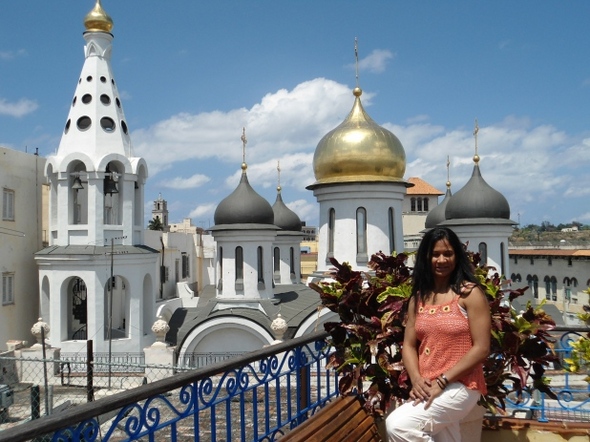
Jacqueline Haber during her recent trip to Cuba.
Photo courtesy of Jacqueline Haber
In April, 45-year-old Haber, a nurse for the University of Michigan Health System, stepped foot on Cuban soil for the first time.
She and 34 U-M alumni became a few of the first Americans to visit Cuba since U.S. President Barack Obama eased travel restrictions in 2011. The group was the first of three U-M contingents to tour Cuba as part of U-M Alumni Association-backed travel expeditions. The last group, which includes Lisa Rudgers, U-M vice president of global communications, is touring the country now.
"It was a bag of mixed emotions," Haber says of her trip to Cuba. "My father always wanted to take his family back to Cuba, to the country he left behind to go to the States for freedom."
In many ways, the Cuba Haber experienced during her visit was similar to the one her father left for America. There's been little construction in the 50 or so years since the U.S. closed doors to Cuba. People drive bike taxis and pre-revolutionary cars and pay to use public restrooms, where toilet paper is rationed by the square and toilets don't have lids.
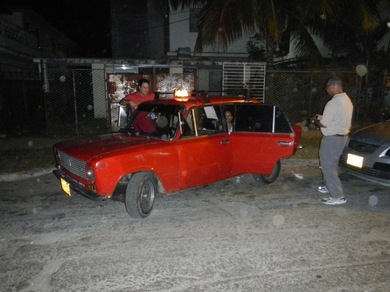
University of Michigan alumni enter a pre-revolutionary taxi during a visit to Cuba.
"Havana is a city frozen in time, with buildings that are just crumbling. The infsatructure is just a mess over there," Haber said.
In other veins, however, the city has changed vitally.
"Almost all of these very large, old estates and homes that were built by the very rich in the (1940s and 50s) have all been turned over to renters," said U-M Alumnus David Morrison, a retired foreign service worker who traveled to Cuba with Haber beginning March 19. "There are huge numbers of families crowded in each of these places."
Morrison and his wife, along with other travelers, paid $3,845 each for the eight-day trip to Cuba, during which they visited with Cuban artists, ballet performers, economists and students and toured several cities, including Havana, the island's capitol.
U-M Alumni Association travel coordinator Carrie Fediuk originally planned for just one departure but response was "so overwhelming" she decided to tack on two extra trips. Fediuk applied for an educational travel visa to Cuba in June 2011 and received the go-ahead in November.
Travel to Cuba has been heavily restricted since the 1960s and in 2003 George W. Bush fully eliminated licenses to travel there. Obama in 2011 eased restrictions, allowing educational trips to Cuba, and the first group of U.S. citizens landed in August. Other elite universities, such as the University of California at Los Angeles and Harvard University, have since led similar trips to Cuba.
"It was a very labor intensive process. The U.S. government wanted to know everything about our program, our history, what our intentions were to travel there," Fediuk recalled, adding that officials circled back with her twice requesting additional information. Fediuk, who regularly arranges trips to countries like Egypt, Machu Picchu, the Galapagos Islands and Turkey, said she can't recall a more detailed vetting process.
The difficulty, she said, was well worth the eventual reward.
"It was uncharted territory," Fediuk said. "Cuba is a place we knew our travelers would want to go. They're curious and they wanted to see a place that's been closed off to U.S. travelers for many, many years."
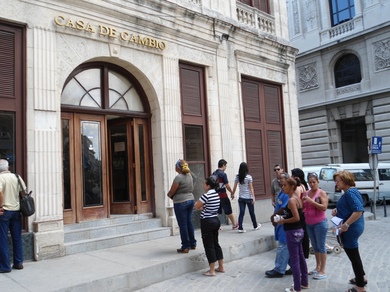
University of Michigan alumni during their visit to Cuba.
That's not to say the expedition didn't stir up a little controversy.
"Cuba is a communist regime that not necessarily everybody approves of. We know people have lost their lives trying to flee the country and that's bothersome. So when we opened the trip up I knew there would be some people who didn't agree with our decision to go," Fediuk said. "They were concerned about our traveling there and supporting their economy. Based on the fact that it is a dictatorship and not a free economy."
It was the effects of the restricted economy that shocked Morrison the most.
"The irony is that you have doctors and university professors who stand on street corners and offer guided tours to earn a decent living, which they can't get from either being a professor or a doctor," he recalled.
For Haber, the short trip was "an eye-opener."
"Now I totally understand why my family is the way they are," she said. "Cubans are definitely survivors. They do the most they can with the little they have."
Fediuk says she is planning additional trips for 2013.
Kellie Woodhouse covers higher education for AnnArbor.com. Reach her at kelliewoodhouse@annarbor.com or 734-623-4602 and follow her on twitter.
Comments
Jim Walker
Mon, May 7, 2012 : 4:22 p.m.
We went to Cuba for 10 days in February through the cultural exchange trip licensed to the Grand Circle Foundation. We found Cubans to be uniformly welcoming, well educated, and eager to have their country join the "modern world". Every Cuban we met and all 20 of our trip members wanted the embargo lifted as obsolete. The embargo is more harmful to the USA than it is to Cuba. As just one example, HOW does it help the USA to have the new pickup trucks be mostly from the Great Wall Company in China? Regards, Jim and Molly Walker
Arborcomment
Mon, May 7, 2012 : 7:40 p.m.
Jim and Molly, Glad you enjoyed your trip. Your hard currency assists keeping the government in power. Read the Human Rights Watch report and get back to us if you still consider it well spent.
Kronoberger
Mon, May 7, 2012 : 2:13 p.m.
It is interesting how "victims of oppression" "flee" Cuba but "illegals" cross from Mexico into to the US to "take American jobs." In the majority cases both are economic refugees forced from their homes by US policies. In the case of Cuba it is the economic embargo. In the case of Mexico it is the free trade agreement that impoverishes rural peasants. Cuba is embargoed because it is a "dictatorship" even though the US has over the years maintained relations with some of the most bloodthirsty regimes in Latin America (Argentina, Chile, Paraguay, Honduras, Guatemala, etc). Cuba is a single party totalitarian state and yes there are doctors and engineers who work as guides and drivers and while Cubans can't get Whoppers Cuba does feed and educate its people, take care of their medical needs, and support their athletic and artistic expression. This cannot be said of most of the aforementioned tyrannies that the US has armed and trained at its School of the Americas.
Technojunkie
Mon, May 7, 2012 : 3:30 a.m.
"We know people have lost their lives trying to flee the country and that's bothersome." Yes, you'd think more Americans would be bothered that so many Cubans feel compelled to attempt fleeing Castro's island gulag on anything that floats for the trip to America, often dying in the process like Elian Gonzales' mother. There may be a clue in there somewhere. Maybe we could even show a little respect and not glorify the image of one of Castro's executioners on T-shirts and posters and such? That said, having lots of American tourists running around Cuba could be... interesting. Of course, if the Castro regime decides that it doesn't like you probably won't get any serious help from the Obama regime, as Alan Goss has discovered. Best of luck to the traveling students.
Lui Segui
Mon, May 7, 2012 : 1:34 a.m.
The Cuban Revolution was for the poor, the Afrocubans, the have-nots. For that they get to be in a cruel time warp and bullied! What ever happened to TOLERANCE!! I have over 40 family members living in struggle for 50 years! Cuba being kicked out of the World Bank and labeled a terrorist, communist, etc USA=BULLY #1 That's why Cuba is in such a condition If the US embargoes Israel, what would happen? Or maybe Mexico? How long would they last? Its called the Freedom of Information Act, Kellie. The US has been terrorizing Cuba for a long time! Your article avoids the 500 pound gorilla in the room!!!
Lui Segui
Mon, May 7, 2012 : 1:23 a.m.
Wow Kellie! You did not mention that the USA has been waging covert war on Cuba for 50 years with the cruel EMBARGO! Really? Would you blame an abused wife for her bruises? The EMBARGO is a tool of the USA to make the Cubans scream and blame it on Castro! My father went to University of Havana with Fidel before the Revolution and he said Castro as a lawyer was doing pro bono (free) work the poor. USA foreign policy makes enemies of anyone not wanting to be exploited. Kellie Woodhouse, you went to college??!! Ouch
no flamers!
Mon, May 7, 2012 : 1:13 p.m.
Exclamation marks and capitalize letters are no substitute for facts, accuracy and honesty.
Arborcomment
Sun, May 6, 2012 : 11:55 p.m.
Yes! Please plan more trips for 2013! Yankee dollars from "fellow travellers" are most welcome in this communist dictatorship. It helps keep me and my brother Raul in cigars. Signed, Fidel ps - give a big fist bump to barrack for me
Arborcomment
Mon, May 7, 2012 : 2:46 a.m.
Easy there Lui, Let's run through a few things: Read Human Rights Watch report on Cuba: "New Castro, Same Cuba" detailing how Cuba's political and religious activists live in constant fear and growing poverty under the regime of Raul Castro. Alan Goss, US citizen and USAID contractor, imprisoned since 2010 for distributing cell phones and lap tops to a religious group. And if you want to go "Pre-Fox" - nope don't watch it. Angola. SS-4s and SS-5s: these are the type of nuclear-tipped Intermediate-Ranged Ballistic Missiles, your friendly brothers tried to install on their little slice o' paradise.
Lui Segui
Mon, May 7, 2012 : 1:41 a.m.
Arborcomment, I take it you also think the Vietnam war was a just war. Why dont you look into why Nelson Mandela thinks that Castro is a great man! Cuba helped end Apartheid! Keep watching FOX News Arborcomment
David Frye
Sun, May 6, 2012 : 10:38 p.m.
A few notes about the article: 1) Bush did not "fully eliminate licenses to travel" to Cuba in 2003. That would have been against the US law that established the Cuba embargo, which prohibits tourist travel but grants "general licenses" for Cuba travel to people in certain categories, including journalists, scholars working on Cuba issues who intend to publish their work, family members, and people on humanitarian and religious missions. Bush did severely restrict these general licenses, most severely in the case of family members who were allowed only one trip every three years, but he also restricted educational trips to those lasting at least 10 weeks. Obama returned travel restrictions to their pre-2003 interpretation, which again makes a 1-week educational trip possible. 2) There have been more than a few travelers from the US to Cuba in recent years. To look no further afield than UM, the University of Michigan had semester-abroad programs in Cuba in both 2010 and 2011. What is true is that this was the first UM alumni trip. 3) That "pre-revolutionary taxi" in the photo is a Soviet Lada -- not exactly pre-revolutionary!
u812
Sun, May 6, 2012 : 6:40 p.m.
Bring on the Real Cuban cigars!
tdw
Sun, May 6, 2012 : 7:01 p.m.
Funny....I was going to ask if someone could get me a box