

Experts say Michigan faces uphill battle in fighting NCAA charge against Rich Rodriguez
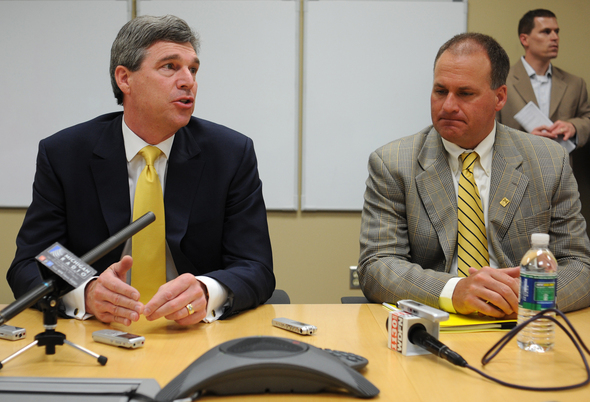
Michigan athletic director Dave Brandon and head football coach Rich Rodriguez answer questions from the press regarding their response to the NCAA allegations at the Ross Academic Center on Tuesday afternoon.
Melanie Maxwell | AnnArbor.com
As the University of Michigan’s athletic department prepared its response to alleged NCAA violations, it carefully selected self-imposed punishments to match each allegation based on previous case precedents.
Too many practice hours? Take away two hours for every hour of overage. Too many coaches? Limit what some members of the staff can do. A staff member lying? Fire him. Athletic department not adequately monitoring the situation? Probation, meaning more scrutiny over the next couple of years from the NCAA.
The university broke that pattern when it came to head coach Rich Rodriguez.
The university and Rodriguez don’t think he failed to foster an atmosphere of compliance in the football program, so his only punishment is a letter of reprimand, athletic director David Brandon said.
Experts, and a review of other NCAA cases, show the university and Rodriguez face an uphill battle in their efforts to get the committee to overturn that allegation.
“Between now and the hearing, there will be meetings between the (NCAA enforcement) staff and the university, where they will discuss any disagreements,” said Tom Yeager, the commissioner of the Colonial Athletic Association and a former chairman of the Infractions Committee. “Sometimes they agree to disagree and come to the committee."
If the committee sides with Michigan, then additional penalties are unlikely. If the committee doesn’t buy Rodriguez’s argument, then more severe penalties may be ahead.
“It was interesting how they (the university) were trying to shield coach Rodriguez and trying to disperse the liability or blame among many people,” said Michael Buckner, an attorney who has represented universities before the NCAA for 11 years. He has read the responses from both Rodriguez and the university. “I don’t know if that will work with the (infractions) committee. It may backfire on Michigan," he said.
“I think Coach Rodriguez did a better job in his response in detailing why he wasn’t liable (than the university did.) The fact still remains that there was a lack of cooperation between his staff and the compliance office.”
The dispute
The heart of the disagreement between Michigan and the NCAA on that particular allegation centers on how much Rodriguez knew or encouraged the other alleged violations.
The NCAA, in its notice of allegations in February, said he was aware and should have stopped the violations.
Rodriguez became the sixth head coach to be alleged to have violated the rule since the rule was implemented in 2005.
In his 89-page response to the NCAA, Rodriguez and his attorney repeatedly argue Rodriguez was unaware rules were being violated, either because he misunderstood the rule through the compliance office, or because his staff didn’t keep him informed.
“Rodriguez denies that he failed to promote an atmosphere of compliance,” the report says. “However, as explained below, Rodriguez agrees that his actions or inactions caused or contributed to some - but not all - of the violations. …
“In summary, Rodriguez acknowledges that violations occurred and that with respect to some of the violations - but not all - he could have done a better job of monitoring the activities of some members of his staff. However, Rodriguez did not fail to promote an atmosphere of compliance.
“He and his staff attended rules education meetings, he invited the compliance staff to his Hideaway meetings, he ran a transparent program and he encouraged everyone, including the compliance staff, to bring any concerns directly to his attention.
“Rodriguez hopes that this Response and the Committee's Infractions Report will set the record straight. Rodriguez and his staff are not rogues, renegades or cheaters.
“Yes, there were violations. But they were not done deliberately or knowingly. Rather, they were inadvertent and in many cases isolated. The underlying activities were done openly and transparently.”
The university echoed those themes in its own response, and again in a teleconference with reporters Tuesday.
“The reality is we had failures across the athletic department,” Brandon said. "Bad decisions were made. The reality is the blame for this complex set of issues spans different areas and entities in football program and athletic department overall.
“If there was one single person to be blamed for this, we’d be doing it.”
The hearing and the aftermath
The university and Rodriguez will join NCAA enforcement staff before the Infractions Committee on Aug. 13 and 14.
“For lots of individuals, it’s an anxiety-producing experience,” Yeager said. “For some coaches, it more like ‘Thank God, it’s finally game time.”
Before then, there will be a pre-hearing conference between enforcement staff and the university.
“The pre-hearing clarifies issues that are still on the table,” said Mark Jones, chair of the Collegiate Sports Practice at the Indianapolis law firm of ICE Miller and the former managing director of enforcement for the NCAA.
Before the hearing, committee members will have gotten the allegations, the response and also a summary document prepared by enforcement staff.
If there’s a lot of agreement on the violations, the hearing can move quickly, Yeager said.
That appears to be the case in regard to Michigan.
Over and over again, the university says the NCAA allegations are “substantially correct.”
The exception to the agreement is Rodriguez’s culpability. That issue is likely to be the center of discussions between the enforcement staff and the university, experts said.
“It’s not unusual for allegations to be modified or dropped (during this process),” Jones said. “(However) when the committee gets it, it will likely look the same as it does today.”
Once the hearing begins, the bulk of the time will be spent on the areas of disagreement.
Which side wins depends on each case, Jones said.
“The staff doesn’t win all the time, that’s for sure,” he said.
Buckner agreed.
“I’ve been in hearings where they have severely questioned the enforcement staff. I’ve been in hearings where they really questioned the university, or the individuals named. It’s really a case-by-case thing.”
Once the committee hears all the arguments, a statement will be read to both parties, warning them not to talk about it. Then the committee will go into a private meeting. The members can often talk about the case and the written findings in a series of conference calls.
Then a ruling is issued. The committee can either stick with the self-imposed penalties or issue their own, based on penalties outline in bylaws.
Experts said just disagreeing with the enforcement staff shouldn’t lead to stiffer penalties if the university loses.
“Practically speaking, it is hard to get as much credit for being cooperative if you disagree,” Jones said.
It can take anywhere between three weeks and several months to get the findings back. Jones said the more disagreements there are between the two sides, the longer the decision can take, citing the recent USC case as one example.
Both the experts and the university agree on one thing - there’s nothing good to come out of this process for a university’s reputation.
“There’s nothing good about the word investigation,” Brandon said. “There’s nothing good about the word violation. There’s nothing good about the word probation.”
David Jesse covers education for AnnArbor.com. He can be reached at davidjesse@annarbor.com or at 734-623-2534.
Comments
BroncoJoe
Sun, May 30, 2010 : 7:24 p.m.
Read the reports on the practice time / CARA reports - the problem started three months BEFORE Rich Rod was hired. The emails and follow ups month after month went on and on, without the Compliance Dept following up and finding out why reports and issues were not being closed. And for the person that mentioned that there have been no apologies to the Freep - UM even said the reporting by the Freep was overblown, if not factually in error. They made it sound like two and three times the amount of practice allowed was being forced. We are talking about 57 of the 65 hours discussed being excess time for stretching, based on an interpretation that (AGAIN) the Compliance Department did not clarify. Read the other article about Brandon saying UM will work with the NCAA to clarify the regulations... Looking forward to the season, hoping for the best. If the program is not successful this season and the people who cannot see further than the end of their noses have their way and RR is gone, we are in for another couple of years of "rebuilding..." In the past, once RR got to the top he stayed there. I'm looking forward to UM being the next team getting (back) there.
davebirkettisatroll
Fri, May 28, 2010 : 1:36 a.m.
I find it funny that the author never writes a single word about sports let alone this topic. It was an obvious handoff by Dave Birkett to this author to look like it has some substance. "Experts" Michigan had it's own experts that wroter their fricking response. You think these experts may have had a slight idea of what to write. This paper is a joke. DFP part 2.
Left is Right
Fri, May 28, 2010 : 12:11 a.m.
Time to pull out of the NCAA and go pro. Don Canham would want it that way.
Robbie Webb
Thu, May 27, 2010 : 9:44 p.m.
I have explained why they struggled. Show me a team that had to deal with youth, no depth, key injuries, walkons at key spots, and very little verteran leadership and experience all at the same time and did well. You keep refering to the team from LAST year. What happened in 2009 is over. It's done. We have matured and gotten older, and with growing experience follows the results that we want.
Jaxon5
Thu, May 27, 2010 : 9:25 p.m.
Fans need to face facts and acknowledge that Mich is the doormat of the Big Ten. They are not a threat to any team in the conference. They also struggle with nonconference teams that were once pushovers. They look disorganized on the field. They turn the ball over to the other team like it's game of ping pong. They can't stop any offense, and underscore the word "any". On top of all that, the NCAA violations make this team a major embarrassment.
Robbie Webb
Thu, May 27, 2010 : 8:37 p.m.
Two years with alot of things going wrong with the depth chart and the players doesn't fall into the category of, ''Not good anymore.''
Jaxon5
Thu, May 27, 2010 : 7:51 p.m.
We need to face facts as fans. Michigan used to be a good team, yes. Nothing can take away all of the great seasons and the wins. But, that's not where we're at any more. Michigan is not a good team any more. Other teams are better. In fact,a lot of other teams are better. According to the Sporting News, 70 teams are better.
Robbie Webb
Thu, May 27, 2010 : 8:48 a.m.
And actually, I've heard from experts, the opposite. I've heard/read that at least they should finish at least 3-1 the first four games.
Robbie Webb
Thu, May 27, 2010 : 8:27 a.m.
First of all, South Carolina doesn't fall into the category of a good sec team. And no, they will not win just because I said so. But I have presented facts from day one and I am still waiting for someone to prove me wrong. ''They lost last year'' ''They finished last, last year.'' are not arguments and does not mean the same thing is going to happen this year. Michigan is returning more players in the big ten than most teams in the big ten if not the most, which is evident that they're young. Michigan has the ability to win any game that is on their schedule.
rightmind250
Thu, May 27, 2010 : 7:53 a.m.
Robbie: No matter how much sugar you pile on a dog turd, its still a dog turd! Will UM win just because you said so? They are already underdogs in their first game against UConn. Thats not me saying it, I heard it on rivals yesterday. UConn is considered the strength of the Big East this year, something Richrod dreams about. They have a strong team back. Oh yeah, they went to a bowl game and beat a good sec team, South Carolina. I can hear the excuses by richy already.
Sean T.
Wed, May 26, 2010 : 11:21 p.m.
All I have to say is "Thank You" Yelmonian! Well said Brother, well said.
Jaxon5
Wed, May 26, 2010 : 9:10 p.m.
A very likely scenario...We'll be out of the running for a bowl after the 4th week. We'll beat Bowling Green, but that's it. Then, the last 3 games of the season are guaranteed losses. We'll win 2 to 3 of the middle 6 games, no more. Done after week 4.
azwolverine
Wed, May 26, 2010 : 8:43 p.m.
yelmonian and point_given, very good points and very well said. This is a sad day for Michigan football, imo. And yes, it is MY opinion. Everyone on here is welcome to their own without slinging insults.
WWBoDo
Wed, May 26, 2010 : 8:11 p.m.
The similarity between Kwame Kilpatrick and Rich Rod, in terms of accepting responsibility (or, rather, blaming others) is frightening. The only difference I can see is that Rich Rod is in the stage where Kwame was,laughing at the authorities and making light of the situation (witness his talk at the Lansing Alumni meeting same day)while Kwame is in the stage of suffering the consequences of his arrogant, flip attitude. As an alum and longtime Ann Arborite, not how I like to see Michigan represented.
Yelmonian
Wed, May 26, 2010 : 6:30 p.m.
Webb, I'm still waiting for most people to apologize to the Freep. I think they did their job. I have not seen the people demanding writers, editors, etc be fired apologize yet. The Freep did their job... reported the facts as they found them, and went on. So... I don't think people here expressing their about RR, and issues that have cropped up after he took over, should have to apologize if he pulls his rear end out of sling (that he created)
Lokalisierung
Wed, May 26, 2010 : 4:41 p.m.
"I will be accepting apologies after our bowl game in January" Well most of us can agree we can't wait till that date so one side can blast the other :) Personally I don't think it'll take till jan. to be out of the bowl running.
Robbie Webb
Wed, May 26, 2010 : 4:37 p.m.
Mr. Sunset, so Rich Rod will be fired just because you say so? Ah! Okay, gotcha. Rich Rodriguez is not going anywhere and I will be accepting apologies after our bowl game in January.
Macabre Sunset
Wed, May 26, 2010 : 4:24 p.m.
Let's not underestimate the impact of losing all that practice time. It's quite precious because it's so limited in college athletics. The reason many schools accept bowl bids even though they sometimes lose money (travel costs, obligations to purchase tickets) is for the extra practice time allowed. Michigan was already suffering from a lack of time on the practice field because of the missed bowl opportunities. This does not bode well for 2010. At least Martin's Folly will be gone by this time next year, and we can get back to winning football in Ann Arbor.
Yelmonian
Wed, May 26, 2010 : 4:03 p.m.
Webb, I agree the penalties are fair. I think they met the "crime". The bigger issue I see at hand, is RR not really taking "blame". He really danced around it. I actually believe he should be given a year or two more, to prove himseslf as far as a coach. The issue of not paying attention to details within adminstration would be of bigger concern to me. And basically he said, hey those aren't my concerns, those issues are supposed to be dealt with by others. Well... hopefully he has changed his opinion about that, and will pay attention to those details, or UM will be here again.
Robbie Webb
Wed, May 26, 2010 : 3:58 p.m.
I think Michigan handled the situation the right way and I personally thing the penalties are fair. Michigan violated practice hours, so they are giving up 130 hours of practice starting June 1st. They put themselves on two years probation. Having too much staff, so they cut the quality control staff from five to three. The graduate that lied to the NCAA has been fired. And of course the one still up in the air is failure to promote an atmosphere of compliance which Michigan is challenging. If they choose to charge them for that, then an extra year of probation or loss of a couple scholarships. Postseason band will not happen. That's more along the lines of lack of institutional control, academic fraud, and things like that.
ironyinthesky2
Wed, May 26, 2010 : 3:55 p.m.
I'll deal with that when it happens - and it might. I just don't think all the speculation is worth the effort.
ironyinthesky2
Wed, May 26, 2010 : 3:53 p.m.
Penn State? It wasn't too many years ago that they were average and Joe Pa was all washed up. I'm Michigan for better or worse.
Lokalisierung
Wed, May 26, 2010 : 3:47 p.m.
"Again, it's time to move on, people, let's get behind our team!" Well the problem here is this matter isn't over yet. Will you still feel this way if the ruling goes south and stiffer penalties come down? lose some scholarships etc... I have no idea becsasue I've read/heard both sides saying they will for sure get a harsher penalty coming, or this will be enough.
ironyinthesky2
Wed, May 26, 2010 : 3:43 p.m.
I don't like the excuse that "all schools do it" We know the rules and we need to follow them. whether you like Richrod or not, his character will be clear in the coming year, hopefully many more. Again, it's time to move on, people, let's get behind our team!
AlwaysLate
Wed, May 26, 2010 : 3:26 p.m.
Don't you all wish you were PENN STATE fans??
Robbie Webb
Wed, May 26, 2010 : 3:06 p.m.
Point given, the O-line will be much improved from last season. Offfense was not the issue, no one is questioning their ability to score. It's defense. Although Graham is gone, the defensive line is not an issue either. There is leadership at the line and linebackers. Secondary is pretty young, but they should be able to hold their own.
Point_Given
Wed, May 26, 2010 : 2:56 p.m.
So, Steve would have everyone believe that the difference between fair weather bandwagon jumpers and omnipotent football gurus such as himself is the willingness of the latter to wait one additional season ("If he doesn't cut it with the program by next year then sure, he should be shown the door,") before jumping off the bandwagon. Even if that additional year really is a good spot to draw the fine line between giving RR a fair chance and ripping the rug out from underneath him, should RR supporters not at least be able to point to one (or hopefully more) isolated area of the football program that is showing signs of progressing towards this supposed Promised Land of sustained competitiveness? What might that area be? Quarterback play? Nope. Running game? Nope. Offensive line? Nope. Defense? Hell no. More highly regarded recruiting classes? Not really. Special teams? Not except for the punting game. Overall team speed? Maybe, but it remains to be seen if the new, speedier players also have the requisite set of football skills to make their speed a true advantage. Back-to-back horrible seasons, no tangible signs of brighter days ahead, and the fact that the program is now dealing with integrity issues (minor or not) is plenty enough reason for "real" fans to have grave concerns about the state of our football program. Very few, if any, true Michigan fans -- those of us who hold degrees from there, who grew up rooting for the Maize and Blue from the time we barely knew what a football was, who send children or grandchildren there, or who otherwise support Michigan -- are hoping for RR to fail. But, to pretend that those people don't have ample cause for concern at this point or to suggest that those people lack the football sophistication necessary to form an opinion of his job thus far (and Michigan's chance at success going forward) is simply painting with far too broad a brush.
treetowncartel
Wed, May 26, 2010 : 2:45 p.m.
Thanks to the downturn in the program and the economy I gave up my addiction to Football saturdays. Pretty hard as a cutter who grew up working concession stands at Michigan games so I could see the second halves of basketball and football. It is nice to enjoy a nice fall day now, especially in Spetmeber when you can still go out on the water.
Lokalisierung
Wed, May 26, 2010 : 2:42 p.m.
"jealous MSU and EMU fans in a room together?" You're so out of touch. I thought minor never got the respect he deserved. I thought he was the best they had for sure.
Robbie Webb
Wed, May 26, 2010 : 2:36 p.m.
Yes, and that's the argument I make all the time. But the injury to Minor certainly didn't help.
voiceofreason
Wed, May 26, 2010 : 2:35 p.m.
Q: What do you get when you put a bunch of jealous MSU and EMU fans in a room together? A: The AnnArbor.com comments section! Have a good day guys!
Lokalisierung
Wed, May 26, 2010 : 2:32 p.m.
Well wasn't the offense more or less not the problem? Where there any injuries on D? Casue that D was horrible.
Robbie Webb
Wed, May 26, 2010 : 2:21 p.m.
Brandon Minor as well was injured and not up to speed for the whole season. And Molk's loss really screwed our line. Tate was a little banged up, but I think he just was a typical freshman as well.
cutty240
Wed, May 26, 2010 : 2:20 p.m.
One person just made a great statement on Coaches.Quit going after the Coaches that have the big name.I'm a Rich friend and WVU fan,but Pat White,Steve Slaton,and Owen Schmitt made Rich a better coach than he really was.He made Pat White and Slaton set the bench,and the only reason they got to play,was the guys in front of them got hurt,so don't tell me Rich is a great coach,he is a good coach that got lucky.Nobody wants you boy down at LSU now either,he came in behind Nick Saban,so he's a flash in the pan too.his days are numbered at LSU.As for Brian Kelly his Bull-s t has caught up with him.He last as long as Weis did at ND.The best young coach in the country is Butch Jones,we should of hired him at WVU.If something happens to Rich,thats who you need to go after.Pete Carroll got out quick,because he ran out of players.Great Players make Great Coaches.Don't ever forget that.Hope everyone has great and safe Memorial Day Weekend.
Lokalisierung
Wed, May 26, 2010 : 2:16 p.m.
"Show me a team that had to deal with youth, inexperience on both sides of the ball, no depth, key injuries, and very little veteran experience and leadership all at the same time and did well." Quite a bit in College football...it's really not that rare. I mean it sounds really bad when you list it all out, but inexperience on both sides, depth, little veteren experience are all the same thing. I also wouldn't say the injuries to Michigan were "key injuries." And Offensive lineman I guess...A rookie QB...I mean those aren't the biggest names there.
Robbie Webb
Wed, May 26, 2010 : 2 p.m.
Rich Rod never won a championship prior to Michigan, but neither did Urban Meyer. Now, I'm not comparing Urban's success to Rich Rod's, but to imply you have to get a coach that has won a championship in order to succeed is incorrect. Coaches don't wake up with a championship. We all know Tressel's record, but let's not kid ourselves, Jim did not have the things going wrong for him that Rich Rod did. Rich Rod came in at a bad time. Even if Lloyd Carr had stayed one extra year, they would have struggled most certainly would not have competed for a big ten championship. And even if Mallett would have stayed it wouldn't have helped tremendously he was young at the time as well. Look at what happened when he started against App. State and Oregon. Show me a team that had to deal with youth, inexperience on both sides of the ball, no depth, key injuries, and very little veteran experience and leadership all at the same time and did well.
Lokalisierung
Wed, May 26, 2010 : 1:39 p.m.
"Michigan is rebuilding from an outdated program to a modern one and that comes with growing pains." My only problem withy this defense is the program to me wasn't outdated...just the coaching. Yelomain said it quite well.
Yelmonian
Wed, May 26, 2010 : 1:17 p.m.
OK... I love the name calling. Steve, RR's record in a Div I school is 68-42. In (9) seasons, he has been in the top 25 (4) times, and top 10 (3) times. Never won a National Championship. Has two losing seasons at UM. No bowl games at UM. Let's take another coach... hired out of "no where". Jim Tressel. In Div I, he's 94-21, has finished in the top 10 (6) times out of ten years, been in the top 25 (9) times, and has never had a losing record, and won a National Championship. Just a point of info... since 2002 (tressel started in 2001 at OSU), UM has a higher average recruiting class ranking than OSU. So.. that's an unfair description. Let's take Mark Dantonio at MSU. His record as a head coach in Div I (remember, he took over Cincinnati which was awful, and MSU which was 3-9 before he got there), and his record is 40-34. He has been to a bowl game 5 of the 6 years he has been a head coach (with less talent than UM had, mind you). OK... you don't like that... let's take Brian Kelly. He is 53-22 at Div 1 level. Out of 6 seasons, he has taken 3 teams to bowl games. But... I guess you believe his team had more talent at CMU and Cinci than UM has. My point being... instead of believing that you have hired "god's gift to coaching", maybe the fans realize that yeah... based on just wins/losses. They have just another coach. They didn't get a Tressel. They got a Dantonio. And oh yeah... now they have the coach that for the first time... has UM on probabtion. There are better choices. OSU took someone from Div II, and did better. UM didn't do real research, they went for the big names. Miles, RR, etc. Of course, I'm just curious if you defended Carr when people were calling for him to be fired? He only had winning seasons every year, finished in the top 25 every year but 1, finished in the top ten 5 times, and won a national championship... not to mention he went to a bowl game every year. But yeah... he couldn't coach. And that guady 122-40 record... pretty impressive since he didn't bring in good recruits. The RR defenders are getting really boring....
Trevor
Wed, May 26, 2010 : 12:59 p.m.
Steve does a really nice job discussing some of the more shrill reactions to the last two seasons of on-field performances. I think there's an even more annoying trend in this comment thread of completely misunderstanding the nature of infractions and what they imply about the state of the athletic department and Rich Rodriguez's personal integrity. Nearly everybody dealing with this issue has some sort of personal bias/agenda, but I think Brian Cook at mgoblog has presented by far the most well-reasoned, cogent assessment of what has actually taken place and what it ought to mean for everyone going forward. His take, as well as those of others who actually followed the initial "scandal", NCAA investigation, and follow-up and thought critically about them, is markedly different from the journalistic malpractice of the Freep et al.
steve
Wed, May 26, 2010 : 12:32 p.m.
Ah, so this is where all the football know-nothings hang out. Fair weather fans unite! Michigan is rebuilding from an outdated program to a modern one and that comes with growing pains. If you go out, do some research, understand things at a more detailed level, you will see that. If you want to pretend that we were an elite program with a bright future on the national level prior to Rich Rodriguez, then by all means, go ahead. You can also keep complaining that candy bars used to cost a nickel and continue to yell at those damn kids to get off your llawn. Modern football is a complex game and if you want to do better than 9-3, M has to catch up. Catching up to the elite programs means starting over and building from the ground up. If M football had 'stayed the course', the team would have remained on the path of slow decline until it was in a state where it would not be able to even hire a coach at the level of Rodriguez and recruiting would have gone further into the toilet. The rebuilding would have been an infinitely more difficult process and taken much more time. I would suggest that those of you who don't know anything more about the football program than the # of W's and L's in the last few seasons, get educated. You are lucky to have a coach of Rodriguez's caliber and you will soon be eating your words. If you still insist on trying to lay the blame of everything currently wrong with the program at Rich Rodriguez's feet, then just go away. No one needs fair weather fans. Give him his due time to build the program as he sees fit and support him as M's coach, or get out of the way. If he doesn't cut it with the program by next year then sure, he should be shown the door, but until then, support them and be part of a great resurgence in michigan football, not a whiny negative influence because you don't have enough W in your sippy cup. The unfortunate fact is bandwagon fans are bandwagon fans. They support winning teams only becuase their own sense of self-worth is a little too dependent upon the success of the football team and therefore they go into a personal crisis when it doesn't provide them with enough self-esteem. They are fickle and fold like tissue paper in the face of a little adversity. Show some fortitude, support the program and coach when they are down. The sad truth is that you will jump right back on the bandwagon when M starts winning again and act like you were onboard the whole time, becuase that's what bandwagon fans do.
GoblueinNE_PA
Wed, May 26, 2010 : 12:03 p.m.
I think the Admin is being very shrewd here. By siding w/Rich Rod on his innocence, they have done a number of things. If RR gets out from under this, then they have innoculated the coach and by default the program. They can legitimately say, "the program is in good hands" and the image rebuilding happens almost immediately. If, on the other hand, RR gets smacked by the NCAA, then as Alan Jackson pointed out, they can easily terminate him and leave him w/almost no legs to stand on in a law suit. They have also created a coaching friendly atmosphere when/if they end up looking for a new HC, since they can say they even went to the mat for RR. The only downside will be explaining why they initially supported him in any post termination pressers.
Mick52
Wed, May 26, 2010 : 11:56 a.m.
So many M fans are so spoiled. Sure Bo was a great coach, but back then the teams were able to award so many scholarships, players who would start at many schools sat on the benches at Michigan, Ohio State, Oklahoma and Nebraska. Now scholarship numbers are reduced and talent it spread. That is part of why so many schools are much better. After Coach Carr had two years in at 8-4, he was attacked too. The Nat Champ saved him. I think he picked a good time to quit, RR was not left with much talent wise. It was clear it would be a rebuilding year. This article does not explain the "violations" but I checked on earlier articles and it appears to me that the NCAA has a regulation book larger than the health care bill. And of course the coach must be aware of every single thing every coach, staff member and player is doing all the time. Nonsense. I kind of doubt anybody knows what all the possible violations are. None of these sound like major violations and its hard to see why all the fuss. I see no real evidence RR is lying about his complicity in this. When you look at some of the earlier articles, you see how picky the NCAA is: "a coach contacted a recruit by phone, but another coach had already contacted the recruit." Good grief, you can't even pick up the phone unless you get a hold of everyone and see if they made a call. And you people who criticize the hiring of RR, name someone else Martin could have hired. Les Miles? Why leave LSU when he was playing for the Nat Champ? Who else? Anyway, what happens in the upcoming season will likely dictate RR's future here. Bowl game or else I suppose. I think it would be foolish to fire him though, and start this mess all over again.
Yelmonian
Wed, May 26, 2010 : 11:50 a.m.
The "all schools do it, we just got caught" comment... sums it up great. UM has always been touted as the "leader and the best". So really, UM football is just like every other football program out there now. UM football also stretches the limits... and this time it got caught. That is where RR failed. He tarnished the brand name.
sandi
Wed, May 26, 2010 : 11:25 a.m.
almost all schools do it we just got caught, the witch hunt for rich rod lives on. i hope he proves them all wrong......go blue and rich rod
Robbie Webb
Wed, May 26, 2010 : 11:18 a.m.
Don't lose faith. Michigan is back and Rich Rod will be great.
JGS
Wed, May 26, 2010 : 10:55 a.m.
I have been on the Rodriguez bandwagon since his hiring. Every year trying to give him the benefit of the doubt. I'm sorry to say that I am officially off that wagon as Rich Rodriguez does not promote "The Michigan Image" Whether he admits to it or not, he knew what he was doing. Look at the issues at W. Virginia. This man has a trail of crookedness following him and to me he has no home in Ann Arbor. Rich Rodriguez will be paid generously for his failed attempts at success. All the while the football team and its fans will suffer enormously. I'll be happy when Mr. Rodriguez either quits or gets fired. He is definitely no "Michigan Man."
Point_Given
Wed, May 26, 2010 : 10:27 a.m.
I think Alan Jackson has it right. The University is starting to lay the groundwork for firing RR "with cause." The article says that RR did a better job in his own response of explaining his lack of culpability than the University did in its response. By doing this they can give the appearance of publicly backing him (while knowing fully well that their chances of winning the argument with the NCAA panel are almost nil) and then feigning surprise when the NCAA drops the hammer on him. Then, they practically would have no choice but to fire him and the NCAA findings would likely mean they wouldn't have to pay him severance.
Yogi
Wed, May 26, 2010 : 10:15 a.m.
Nicely said Tru2Blu!!! Michigan will move forward with or without RR. I'm hoping that he can redeem himself by winning some Big Ten titles and dismantling OSU and MSU along the way. I'm going to root for the team regardless of who is coaching.
Josh
Wed, May 26, 2010 : 9:55 a.m.
The only disgrace in this situation is the lack of research performed by the journalists at most news organizations. Brian at Mgoblog and Jon Chait from the New Republic has done the most research on this situation. Too see who should be fired for this situation, read Brian Cook's latest entry at mgoblog. http://mgoblog.com/content/names-named-heads-should-roll
The Watchman
Wed, May 26, 2010 : 9:35 a.m.
To all that sit and type that whatever the Michigan empire does is okay with them, I ask why the blind loyalty? I enjoy UM football as much as the next guy, but if something is wrong, shouldn't one voice an opinion? Why the vitriol for those that do not believe the Michigan Athletic Department is handling this above board? They certainly are not above reproach. David Brandon will only hang on to Rich Rod till the hammer falls. This may be a losing season this year or if the NCAA finds that Rich Rod was responsible for the lack of control which the NCAA intimated in the initial allegations. This is not the Ann Arbor News. I miss the paper also. But AnnArbor.Com is a blogger's site. Please enjoy the comments and refrain from attacks. Let's have open and frank discussions. Flame suit on.
CountyKate
Wed, May 26, 2010 : 9:23 a.m.
Color me confused. Violations happened, records went missing (or were never in existence to begin with), etc., etc., and - what? There was a grand conspiracy to keep Rodriquez in the dark? Even if this was the case, shouldn't he have gone looking for those records, to review them? Shouldn't he have questioned the informational vacuum he was apparently sitting in? I have a hard time believe he's a proponent of "ignorance is bliss." And @orlandomichfan, winning doesn't mean anything if it's a dirty win.
aareader
Wed, May 26, 2010 : 9:13 a.m.
to -- orlandomichfan I do believe Lloyd Carr did WIN a NATIONAL Championship.
orlandomichfan
Wed, May 26, 2010 : 9:03 a.m.
TO NEWTON. i must watch my words carefully so i don't get deleted again.. anyhow, newton you know darn well you will watch blue play.. those kids are out there busting there butts to win & your dislike for the coach will cause you to not watch or attend games??? no i don't buy it.. you know darn well your going to root for blue.. if not go to east Lansing & get behind them. we need loyal fans not fair weather fans.
Dwaine
Wed, May 26, 2010 : 8:36 a.m.
As a WVU grad, all I can say is THANK YOU UM for buying Rich Frad-guez from us. Don't blame WVU for your problems. You have NO ONE to blame but the AD at UW for not doing his job. And from WVU grads/fan everywhere THANK YOU for the $2 million!!!
Newt Newton
Wed, May 26, 2010 : 8:23 a.m.
Rodriquez and the inept Athletic Department has brought down the best college football program in the US. They stole my vivid memories of Bob Ufer screaming Meechigan and honking Pattons horn and tell us about The hole that Yost dug, Crisler paid for, Canham carpeted, and Schembechler fills up every Saturday. Im in my sixties and used to live two blocks from the big house and parked cars in my front yard, and have cheered for the team for decades, but now I must say I will never watch or root for Michigan football as long as Rodriquez is the coach. There is no doubt in my mind that he will be fired. Why wait? We need to cut our loses and start over again, probably with a few less scholarships to offer. Sadly, he ruined the careers of the players he got rid of, and now a new coach will have to come in and rebuild his mess, and we will have to wait another three years to hope for a winner season. Michigans reputation is tarnished but the big losers are the players, past present and future, and the fans.
orlandomichfan
Wed, May 26, 2010 : 8:11 a.m.
for all you people ragging on rich rod, how many championships did BO & Carr win altogether after all those years???? really, how many????you people make me sick who moan & groan constantly..pull together people & hope we have a winning season..if you are not behind Michigan then i would suspect your not a true wolverine.. but everyone needs something to cry about.. personally i am not a big fan of rich rod, but im a huge wolverine fan and want nothing but the best & for the team to win win no matter who coaches. but nooooooooooooooooo that's not enough for you part time fans..
Alan Jackson
Wed, May 26, 2010 : 7:49 a.m.
Maybe U-M is actually being clever and strategic. If the NCAA says that Rodriquez is at fault then they have a way to dump the turkey. Since they didn't trash the guy it makes it harder for Rod's lawyer to claim that U-M manufactured a reason to get out of the contract. Also, this way the University doesn't scare off potential replacement coaches.
Tom Wilkinson
Wed, May 26, 2010 : 7:30 a.m.
The football team is only loosely associated with the University. It is essentially a private organization that uses the University name, just like those that produce Michigan t-shirts. As an alumnus of a world-class research university, it is embarrassing to have the great institution associated with a trailer trash sports team.
NoBowl4Blue
Wed, May 26, 2010 : 7:13 a.m.
The fact this is even going on, two miserable seasons, NO BOWLS, loses to MSU and OSU, buy outs, broken contracts, questionable acquaintances would make me believe "the king" knew nothng at all. The joke has been on Michigan since he's been here.
outdoor6709
Wed, May 26, 2010 : 6:59 a.m.
Unfortunately new AD has sold out to the football program and has lost all credibility. The lawyers say, the head coach who is a control freak, had no idea what his staff was doing. If the staff really did something the coach/atheletic department did not want done, why are they not all fired? Anyone who paid any attention knew something unusual was going on at U of M stadium that summer. Unfortunately football not education is king at U of M. Money talks and lots of money talks louder.
The Watchman
Wed, May 26, 2010 : 6:59 a.m.
In the words of the immortal Bart Simpson, I didn't do it, nobody saw me do it, there's no way you can prove anything! What might happen if West Virginia threw Rich Rod under the bus when the NCAA made their trip down south. Is is more likely than not that the WV staff laid blame for all it could on Rich Rod.
LGC15
Wed, May 26, 2010 : 6:52 a.m.
Well there ya go Michigan fans, Rich Rodriquez, the one with the blank look on his face has left no stones unturned. He has in 2 complete season dismantled Michigan Football as we know. Bo, MO and Carr must be so proud of Martin's wise decision to hire this WV wannabee...oh yeah and for good measure we also got their basketball coach. I am a 35 year season ticket holder and never have I been so disappointed in what once was a great program. I sincerely hope we don't pull a Weiss...this guy has got to go! The damage he has done to the Michigan Football program will take 5 years to fix. This was a terrible decision to hire Rodriquez right up there with fireing Moeller...way to go Michigan. We are now the doormat of the Big Ten! TTFN43
trespass
Wed, May 26, 2010 : 6:30 a.m.
Everyone is to blame, therefore, no one is to blame. It's an age old excuse.