

U-M scientists contribute six new stem cell lines to registry for disease research
Scientists at the University of Michigan Health System have cultured six new human embryonic stem cell lines that are now available for use by genetic disease researchers across the country.
The new lines, derived from donated embryos, quadruple the number of stem cell lines U-M has made available through the National Institutes of Health’s official registry.
A stem cell line is cultured from a cluster of cells removed from an embryo within several days of its creation. The line can create millions of genetically identical cells, useful in research because of their ability to divide and change into any cell type in the human body.
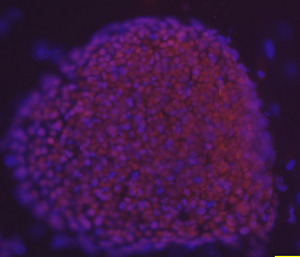
A human embryonic stem cell containing genetic markers for disease. The University of Michigan has contributed six new stem cell lines to the National Institutes of Health's register. They are now available for researchers to use in their studies.
Courtesy of University of Michigan Health System
U-M researchers was announced the creation of the cell line carrying the gene for hemophilia B by in April 2011. It was among the first to carry genetic defects for specific diseases.
The stem cell lines carrying the genetic mutations will be used to study origins of the diseases and potential treatments, U-M officials said.
Federally funded researchers have to apply to U-M for use of the line. The federal registry has 163 stem cell lines, including the new ones from U-M, and most of them do not contain major disease genes.
The lines were derived from clusters of about 30 cells removed from 5-day-old embryos donated for research - each of which were about as large as a period at the end of a sentence.
The embryos were initially created for reproductive purposes, but after testing positive for genetic disorders, they would have been discarded had the couples involved not decided to donate them.
U-M is one of only three academic institutions to have disease-specific stem cell lines listed in the national registry, said Dr. Sue O’Shea, Ph.D., professor of Cell and Developmental Biology at the U-M Medical School, and co-director of the Consortium for Stem Cell Therapies.
U-M scientists announced the creation of their first human embryonic stem cell line in October 2010. The university had its first stem cell line accepted to the national registry in February.
Amy Biolchini covers Washtenaw County, health and environmental issues for AnnArbor.com. Reach her at (734) 623-2552, amybiolchini@annarbor.com or on Twitter.
Comments
leaguebus
Fri, Jun 15, 2012 : 4:23 a.m.
Memo to UM, don't forget to fill out the mountain of paperwork mandated by the anti-science religiously Dogmatic state Republicans. Oh, by the way, once you have done this, you must visit the Creation museum that shows man and dinosaurs on the Earth at the same time, somewhat less than 6000 years ago.
Dog Guy
Fri, Jun 15, 2012 : 2:35 a.m.
"Scientists at the University of Michigan Health System have cultured six new human embryonic stem cell lines". How wonderful! What are their names?
Townie
Fri, Jun 15, 2012 : 1:13 a.m.
I think they should name the new stem lines for the most vocal Republicans who want to impose their religious beliefs on everyone else. Republicans - enemies of 'Big Government' -- until they get in office then they want to stick their noses into everything and dictate their ideology over reason and logic.
Floyd
Thu, Jun 14, 2012 : 10:54 p.m.
Given the legislature's recent attack on this research, this is likely to dry up soon. Too bad the job of "high-tech bio-researcher" doesn't jibe with our current state leaders' notions of economic success.
trespass
Thu, Jun 14, 2012 : 8:41 p.m.
They can report 6 new stem cell lines but it is too burdensome to report the total number of stem cell lines they use to the legislature. It sounds more like the UM is telling the legislature to stay out of our business!
Dr. Rockso
Fri, Jun 15, 2012 : 3:50 a.m.
The GOP dominated legislature which happens to be one of the most least educated group of politicians would look at the data and start babbling incoherently.
Veracity
Fri, Jun 15, 2012 : 2:11 a.m.
Why do you think the legislature wishes to know about the stem cell lines? What do you think they will do with that information?