

Teen smoking 'epidemic' but not as bad as it once was, U-M researcher says
The reports sounded alarming: “Staggering teen smoking epidemic,” “teen tobacco epidemic shocks surgeon general,” “shocking teen smoking report sparks call for action.”
Those were some of the headlines on media coverage of the U.S. surgeon general’s new report on teen smoking, released Thursday.
The report, the first surgeon general's report on teen smoking since 1994, also included statistics like these: Almost one in four high school seniors smokes cigarettes; about 10 percent of high school senior boys use smokeless tobacco; and about 1 in 5 high school senior boys smokes cigars.
The report also included this fact, which got less media attention: Teen smoking rates have dropped — a lot — since 1997, when more than 35 percent of high school seniors reported smoking cigarettes, according to the University of Michigan’s Monitoring the Future Survey of teen drug, alcohol and tobacco use.
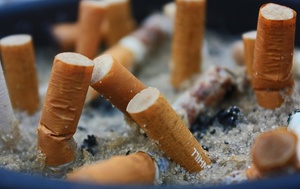
Although teen smoking rates have dropped, they're still too high, the surgeon general says, and the rate of decline has leveled off.
One man who knows a lot about all these numbers is Lloyd Johnston. He’s a prominent researcher at the University of Michigan’s Institute for Social Research and the principal investigator for the Monitoring the Future Survey, which has been surveying national samples of eighth, 10 and 12th-grade students each year since 1991.
The work of Johnston and his fellow Monitoring the Future investigators helped shine a spotlight on the growing use of tobacco among teens in the 1990s. That publicity helped bring about the multi-state tobacco settlement of 1998, which has been used for efforts to help curb teen smoking and resulted in some dramatic changes to tobacco advertising, including the end of cigarette billboard ads and ads featuring the cartoon character Joe Camel.
The surgeon general heavily relied on data from Monitoring the Future in preparing the report released Thursday.
Johnston notes there’s good news in the report. The declining rate of teen smoking shows that messages about the dangers of smoking and societal pressure against smoking have had an impact.
“A newer generation of kids has gotten the message about cigarettes and they’re pulling back,” he said.For Sarah Zimmerman, 16, a junior at Ann Arbor’s Community High School, smoking is a non-issue.
“I don’t really worry about it. No one in my group of friends does it.” Zimmerman said she couldn’t recall the last time she saw someone smoking in the area around the high school.
The declining smoking rate, Johnston said, will have a dramatic positive effect on the health and longevity of this generation, who will have lower rates of smoking -related deadly diseases such as lung cancer, heart disease and emphysema.
That’s not to say there’s nothing to worry about. Teen smoking rates are still high, and the use of smokeless tobacco among teens has risen slightly in recent years. The government is worried that with money from the tobacco settlement running out, the public campaign against smoking could falter, Johnston said.
“The rates of smoking among the age groups that we track reached a record low in 2011. That’s the good news,” Johnston said. “The bad news is we still have 20 percent of kids smoking despite the health consequences we know smoking has.”
Also, for adolescents the risks of smoking go beyond the long-term likelihood of developing lung cancer or heart disease, the report said. Cigarette smoking has almost immediate health consequences for teens, including the possibility of reduced lung function and impaired lung growth and asthma.
Both Johnston and the surgeon general’s report emphasized that a lifelong addiction to tobacco usually begins in adolescence. Every day in the United States, more than 3,800 young people under 18 smoke their first cigarette, the report stated. Almost no one begins smoking after age 18.
“If we want to intervene, adolescence is the place to do it,” Johnston said.
The surgeon general produced the following video to go along with the report:
Contact Cindy Heflin at cindyheflin@annarbor.com or 734-623-2572 or follow her on Twitter.
Comments
f4phantomII
Tue, Mar 13, 2012 : 3:38 p.m.
I don't think the money spent on antismoking campaigns makes much difference. That's because most kids smoke because they're not supposed to. I never smoked because both my parents did. It was disgusting. Driving up north in the Country Squire was the worst. "Put the window up! The air conditioning's on." We were suffocating, but we were comfortable. Both my parents died of smoking-related illnesses. They knew the risks and chose to continue to smoke.
Not Me
Mon, Mar 12, 2012 : 7:53 p.m.
I think annarbor.com is missing out on another topic that is closely related: the rise of ER visits due to "K2" or "Spice" (synthetic marijuana) smoking. It is more potent than organic pot and can cause serious psychotic episodes and may have lasting side effects. That is the drug of choice among teens in these parts and is easily accessible (Bongz & Thongz carries it). Stop buy UM's ER and interview the nurses there--we are seeing more and more of these cases.
Technojunkie
Mon, Mar 12, 2012 : 6:18 p.m.
As much as I hate cigarettes, I despise these nanny-state programs. No kidding smoking is bad for you. Smokers either know the risks and find them acceptable or are beyond help. If they die early and horribly they serve as warnings to others, which I'm sure has done far more to reduce smoking than any propaganda campaigns our government overlords have attempted.
thinker
Mon, Mar 12, 2012 : 2 p.m.
The per cent of seniors smoking has dropped because the smokers have dropped out of school before their senior year.
jns131
Mon, Mar 12, 2012 : 4:06 p.m.
I am thinking same. Why? Because teens do things to drive their parents nuts. Once they graduate? They have nothing to drive us nuts with anymore and move on to college. This is all a way to prove they can do what they want and see if their parents can stop them. I know they are under age, but heck, let them go to jail for smoking under age. I'd be glad to let mine rot for the nite after pulling a stunt like this. Maybe the child might learn something. Or then again, maybe not.
M
Mon, Mar 12, 2012 : 2:35 p.m.
[citation needed]
Dog Guy
Mon, Mar 12, 2012 : 1:57 p.m.
Tobacco taxes should be raised. I started smoking at age 11 to look mature and quit thirty years later when I looked mature.. No one starts smoking after age 18; smokers are de facto victims of child abuse. Taxing helps, but tobacco taxes are obviously not high enough to dissuade; despite being legal, basement tobacco grow-ops are not common. I don't think 23.2% of high school seniors would get away with doing publicly something the Washington government didn't sanction. Taxing is what government does best; other government actions are impotent demonic jokes. Anti smoking campaigns are only long-term job security for bureaucrats who like to count things. The reduction in teen smoking rate is no comfort to the parents of a kid in the 23.2%; as Evelyn Waugh noted of any person, "Quantitative judgments do not apply." Raising tobacco taxes has helped; the only reason not to double taxes is that it would reduce tax revenue as it reduced smoking.
jns131
Mon, Mar 12, 2012 : 4:08 p.m.
Actually it was Granholm who raised the taxes on cigarettes to pay for other things the state needed. Michigan has the highest tax rate on cigarettes ever. Go to Ohio if you want cheap cigarettes. Otherwise, you might want to reconsider starting the bad habit.
Ignatz
Mon, Mar 12, 2012 : 3:28 p.m.
It makes no sense to raise the price of something already far more expensive than before. When you consider the addictive nature of tobacco, it's even more nonsensical. What you get when you add these two things is higher crime through theft and/or tax evasion.
M
Mon, Mar 12, 2012 : 2:52 p.m.
Cigarette taxes are the single highest taxes good in the history of our nation. I hate smoking legislation and anti-smoking people, but at some point even I say "Just make it illegal already". There's a $5.75 tax on a $1.75 good. Why is this ok?
Harry
Mon, Mar 12, 2012 : 1:42 p.m.
I wonder if smokers really understand how bad they smell after smoking. Especially there breath. It really offensive.
Harry
Mon, Mar 12, 2012 : 4:16 p.m.
There is no arrogance. THEY STINK. I had to walk away from someone the other day. It was making me sick to my stomach.
M
Mon, Mar 12, 2012 : 3:13 p.m.
Wow. Your arrogance is astounding.
deletedcomment
Mon, Mar 12, 2012 : 3:02 p.m.
I wonder if people understand how narcissistic they sound when making comments about what other people do with their lives.
M
Mon, Mar 12, 2012 : 12:43 p.m.
How about we stop spending my money to tell me what I should or should not do with my body? Freakin' nanny state.
Harry
Mon, Mar 12, 2012 : 4:15 p.m.
@M I agree the first steps AND I consider myself a consevative. What do you do with a society people that can not plan and save for their own retirement. Do you say " Oh well" go live in a tent. Or do you set up the nanny state to take care of them in there old age.
jns131
Mon, Mar 12, 2012 : 4:10 p.m.
Here is food for thought. If the insurance companies get wind of that you once were a smoker? Your premiums can still go up. So, it is best not to say a word. Otherwise, let the teen try something stupid once, then let the parent lock them in their room until they are 18. Nuff said.
M
Mon, Mar 12, 2012 : 2:50 p.m.
@Harry - those thoughts are the first step towards facism.
M
Mon, Mar 12, 2012 : 2:36 p.m.
@Plubius - I have not found a single health insurance policy that does not have higher rates for smokers. I mean, the whole thing is logically bunk. Smokers pay more, but not fat people, people who don't wear seat belts, people who have extremely risky jobs, etc. Why punish ONLY smokers, and not risk across the board? Why don't alcoholics pay more?
Harry
Mon, Mar 12, 2012 : 1:48 p.m.
I used to have that same opinion. Why should the state care if I buckle up or not. I understand making childrean but I am adult. As I get older, I have came to the conclusion that about 65% of adults are too stupid to take care of themselves. I am not trying to poke fun at people, I am stating an observation. I can give a hundred examples. The state must step in sometimes for the betterment of the society even if we dont agree or want to make our own desicions.
Ignatz
Mon, Mar 12, 2012 : 1:48 p.m.
Plubius, We all make choices that negatively affect insurance rates. The point M is making is that personal freedom, supposedly valued in this country, is becoming more and more under attack.
Plubius
Mon, Mar 12, 2012 : 1:33 p.m.
Deal - as long as your medical insurance policy reflects the higher risks entailed with insuring you and so long as you refuse publicly-funded medical insurance.