

New report shows Ann Arbor schools narrowing achievement gap
A new student achievement report shows test scores are on the rise at Ann Arbor Public Schools and that long-standing achievement gaps between African American students and their Caucasian peers have begun to close slightly during the past five years.
But just as important as the numbers themselves is the new model Superintendent Patricia Green has put forward to compare data and create outcome-based benchmarks for measuring progress, district officials say.
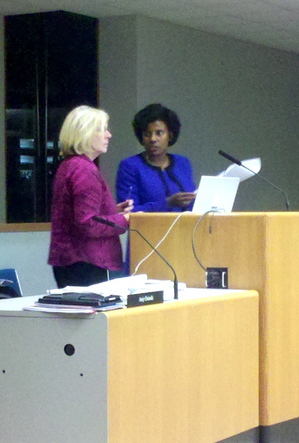
Deputy Superintendent for Instruction Alesia Flye, right, and Director of Student Accounting and Research Services Jane Landefeld present to the school board a five-year snapshot of student achievement data Wednesday night.
Danielle Arndt | AnnArbor.com
The bound report resembled a textbook in its thickness, and trustees jokingly referred to it as the “10-pound report.”
The test data included, when possible, a five-year snapshot of scores from the following assessments: Michigan Educational Assessment Program, Michigan Merit Exam, Northwest Evaluation Association Measures of Academic Progress, College Readiness standards and the ACT.
Green said the district is starting a tradition with this report, which she called an “outcomes report.” She said it will allow the district to benchmark itself against its past and future progress.
“Achievement is based on outcomes,” Green said. “When we talk about achieving, we look at our outcomes. How are we doing? How are we measuring our progress? What is it that we still need to tweak here and there to continue to improve? … It informs the decisions we make in curriculum and instruction.”
Green said in order to do this effectively and efficiently in the future, the district had to develop a meaningful way to bring the data forward for analysis. Green said this is what she means when she talks about helping to make the Ann Arbor Public Schools “data driven.”
“We tried to take all the pieces of the data that normally would reside in many different files … and develop one document that we could utilize with our schools, our teachers, our principals and with our instructional staff,” she said. “They need to know how we are doing, instead of having to always go search.”
The achievement data revealed a pretty picture of Ann Arbor’s student population as a whole from school years 2007-08 to 2011-12.
It shows that despite traditional achievement gaps among Ann Arbor’s African American, special education and low income students, these AAPS kids are still proficient at rates of up to 20 percentage points higher than the state average on standardized tests, said Director of Student Accounting and Research Services Jane Landefeld.
Last year, the state implemented new cut scores for the MEAP and MME to reflect the increased rigor of public education nationwide. AAPS administrators applied the cut scores retroactively to student achievement data for 2007-08 to 2010-11.
“My observation is that as we look at the scores for reading and math for the various desegregated groups, obviously there is still a very significant gap … but it appears there has been some narrowing of the gap for reading and not as much narrowing of the gap for math,” said Board Secretary Andy Thomas. “The conclusion I would draw from this is we need to put additional emphasis … on math instruction.”
AAPS has more interventions in place for reading than math throughout the district, Flye said, and has been looking at how to increase support for mathematics.
On the reading portion of the MEAP assessment, the percentage of students in grades 3-8 who scored proficient or highly proficient increased by a few percentage points in each grade. The biggest improvement was a 5 percent increase in the sixth grade.
In looking separately at the African American cohort, the gains were much greater.
The percentage of African American students in grades 3-8 scoring proficient or highly proficient increased by 5 to 13 percentage points in each grade. The biggest improvement was in the fifth grade.
On the math portion of the MEAP, the gains overall were less. And in grades 5 and 8, there was virtually no change in the scores across the board. This indicates something is happening with math instruction during the transitional years between elementary and middle school and middle school and high school, Green said.

Trustee Glenn Nelson listens as Trustee Simone Lightfoot, left, asks a question about the African American student data reflected in the report.
Danielle Arndt | AnnArbor.com
Flye said this cohort, though the smallest in the district, will require some additional attention from the instructional team. The district clearly needs to look at beefing up its supports for this group of students, she said.
Landefeld said typically, there are only 30 to 50 students in the ELL category, which is for only those children who are not yet proficient in the English language. Once students become proficient, they are no longer counted in the ELL category for testing, Landefeld said.
While Trustee Simone Lightfoot was happy to see African Americans improving at AAPS, 73 percent of African American third graders still are not proficient in math, 66 percent of African American fourth graders are not proficient, and in seventh grade, that percentage is 75.
“I still want to be so wrong in the way I’m reading this,” Lightfoot said. “…I’m less concerned with us beating out the state because … we always beat the state. I’m far more interested with other districts that are comparable to us and how they’re doing.”
Vice President Christine Stead echoed Lightfoot’s sentiments about comparing the testing data to other schools, not just the state averages. She said she would even encourage district administrators to look for comparable districts nationally and globally.
“I think that’s more useful to us because that’s really how we see ourselves. We want our students to compete on a global level,” she said.

Patricia Green
“We have to stay focused here in Ann Arbor on what it is that we in this community value … and make sure that we are looking at the benchmarks that are important for our youngsters here in Ann Arbor,” she said. “All youngsters can succeed at all levels and all need a rigorous curriculum. … Maybe I am cynical but if you keep changing how you look at the data and you keep changing the benchmarks, then how do you measure success?”
Flye said among the next steps is an analysis of the district’s programming to see why the patterns officials have observed in the data are occurring. Many of the next steps also directly coincide with the achievement and discipline gap elimination plans that Green put into place this past spring, Flye said.
The entire “10-pound” student achievement report will be uploaded to the district’s website soon for parents and community members to peruse, Flye said.
Download a copy of the Powerpoint presentation that accompanied the report here.
Danielle Arndt covers K-12 education for AnnArbor.com. Follow her on Twitter @DanielleArndt or email her at daniellearndt@annarbor.com.
Comments
Dog Guy
Fri, Oct 12, 2012 : 2:50 p.m.
Just weeks before the election; is this a Dingell photo op?
SFK
Fri, Oct 12, 2012 : 12:11 p.m.
Great job Ann Arbor teachers! Congratulations are due for your hard work. Enjoy good news and brace yourselves for the haters that only have negative things to say. Bravo!
FormerMichRes
Fri, Oct 12, 2012 : 8:36 a.m.
The numbers are still terrible. Just wondering what would happen if somebody started making the parents more accountable? If one started hitting these folks in the pocketbook more-- namely adjusting their state benefits based on school performance of their children. A little too tough for Ann Arborites, I suppose?
Joel A. Levitt
Fri, Oct 12, 2012 : 2:28 p.m.
FormerMichRes: You can stop wondering. The children about whom we are concerned would be more poorly fed, would be more poorly clothed and would do worse at school.
aamom
Fri, Oct 12, 2012 : 11:16 a.m.
I think the problem is that politicians will never bring parent accountability into the equation because they need to get reelected and all those parents out there make up a whole lot of voters. Wouldn't want to piss them off you know.
J. A. Pieper
Fri, Oct 12, 2012 : 10:07 a.m.
You got it, too much for AAPS parents to deal with. In a previous post, someone mentioned withholding some Welfare benefits based upon attendance, but your idea of school performance is much more valuable. NO ONE puts the responsibility on parents, it is all lumped on teachers. I can't take credit for the student who comes in ready to learn and soak everything up, that goes to parents for preparing their child for the learning environment. But all administrators, school boards, and much of the public puts all the blame on teachers. Not once are the parents brought into the federal No Child Left Behind law. I wonder if it is because all the people who make these laws have had their children do well in school, and they assume this is what parent naturally do!
crayzee
Fri, Oct 12, 2012 : 1:56 a.m.
The comparison to caucasian students is completely missing the mark and seems like 1960s thinking. Caucasian students as an ethnic group are not the highest performing students in the district. The gap to focus on is low-achieving (of any color or ethnicity) vs high-achieving (of any color or ethnicity) - and address it in a way that doesn't hold back the high achievers.
Macabre Sunset
Fri, Oct 12, 2012 : 3:55 a.m.
Or maybe to stop obsessing with race. If you keep telling someone race is the reason he's not succeeding, pretty soon he'll start believing you and he'll stop supporting society.
jackson west
Fri, Oct 12, 2012 : 1:13 a.m.
This is a great day. We are closer to an imaginary solution to an imaginary problem. Unicorn mauling is up 67%. Meanwhile, the achievement gap still fails to focus on socio-economic reasons as a control group but chooses the convenience of race-two races. Kudos.
Blerg
Fri, Oct 12, 2012 : 12:40 a.m.
"Green said...the district had to develop a meaningful way to bring the data forward for analysis. Green said this is what she means when she talks about helping to make the Ann Arbor Public Schools "data driven." ' Two observations: 1. Does she have any idea that parents and teachers are sick and tired of the testing that is required to make the district "data driven"?!? 2. It's fantastic that Dr. Green does very little on the job other than threaten her staff to come up with data that proves they're closing the achievement gap. The report is 10 pounds because she tied principal pay to providing reports proving they were closing the gap in each and every school. Hmmm. Wonder how reliable those numbers are. Maybe we should check with Chicago Public Schools and ask them what happened to their data when they tied it to performance pay.
jns131
Thu, Oct 11, 2012 : 10:12 p.m.
The one thing that will close this gap is something the state did and I applaud them. They are making parents responsible for their childrens education. How? By taking away their welfare. If a child misses more then 10 days their income is gone. So what is a better motivator then sending children to school? Money. Send them to school and this ends low income and welfare.
jns131
Fri, Oct 12, 2012 : 4:54 p.m.
At least they get an education and try to find a way out of poverty? Education is the key to ending this.
J. A. Pieper
Thu, Oct 11, 2012 : 11:48 p.m.
Maybe this is true, but then again, maybe the parents are sending them to get their $$$, but they consider it a way to get their kids out of their hair, like free "babysitting!"
Angry Moderate
Thu, Oct 11, 2012 : 10:08 p.m.
Did I miss the link to the actual report? Would like to take a look, since we all know that statistics can be made to show anything you want--especially when there are highly-paid consultants involved.
Angry Moderate
Fri, Oct 12, 2012 : 12:32 a.m.
Shouldn't a report prepared with taxpayer dollars be public? Do we need to FOIA this?
Unusual Suspect
Fri, Oct 12, 2012 : 12:01 a.m.
I hope not. Ten pounds is too heavy for my laptop screen.
Jay Thomas
Thu, Oct 11, 2012 : 9:30 p.m.
The country will never get over this black/white obsession it has. Whites are only average these days when it comes to test scores and being admitted to college. Why not compare blacks (or even whites) to Asians or whatever group is doing the best?
J. A. Pieper
Thu, Oct 11, 2012 : 11:46 p.m.
No one in the AAPS will do that because the differences are based on the value and respect for education that the Asian parents instill in their children. Oh, and maybe the fact that they have 1 or 2 children that they CAN take care of, rather than 5, 6, 7.......
julieswhimsies
Thu, Oct 11, 2012 : 8:45 p.m.
This is hopeful news.
antikvetch
Thu, Oct 11, 2012 : 8:13 p.m.
For maybe just a few dollars more per taxpayer, maybe we could kinda maybe someday in the future if the conditions are right and the moon is full make some more improvement. Or not.
MyOpinion
Thu, Oct 11, 2012 : 8:10 p.m.
Another issue the report should address is compositional differences. Are we comparing apples to apples? For instance, with all the exits to private schools, charters, and moves to other school district etc., it could be that the population in the 5 year later group is not really the same as the population at the start point especially across race groups. The state is starting to look at the progress of individual kids. So, I'd like to see what the progress was of African American students who were in Ann Arbor schools in Grade 1 and see how they've progressed over 5 years compared to the comparison group. Continue this for each grade. Are the African American students who have been in A2 schools for the 5-year period really catching up with the comparison group who has also been in the A2 schools for 5-years? There is nothing in this report that sounds very rigorous or useful.
Therese
Fri, Oct 12, 2012 : 2:34 p.m.
Very interesting and thank you. Your comments remind me of a wonderful AAPS elementary school principal my children had the honor to learn under. He has since retired, but I am pleased to see that insight like his is still shared in the community.
Danielle Arndt
Thu, Oct 11, 2012 : 8:36 p.m.
MyOpinion, you raise a good point about analyzing the student population. The board actually discussed this with regards to the less significant test score gains that appear to be occurring during the "transition years," fifth and sixth grades and eighth and ninth grades, in particular. The board highlighted that if a family is going to move their child from a private or charter school to a traditional public school, these grades are typically when such moves occur. So the board discussed with administration the possibilities for looking into this trend at AAPS. Trustees said depending on what the district finds is occurring, a question the district may need to ask itself is how to create better personalized learning plans for these transitioning students to make sure teachers are hitting them up with targeted instruction right away to accelerate the transition, and to make up for any gaps in their education to catch them up with their peers. Just thought I'd share this additional insight from the meeting! Thanks for your comment!
Gloriagirl
Thu, Oct 11, 2012 : 8:10 p.m.
Thank you Mr. Goldsmith, when is the board going to "get it" that the achievement gap is not exclusive. There are many parents that don't get paid time off to play helicopter parents and literally have to be at work without exception to make ends meet.
Unusual Suspect
Fri, Oct 12, 2012 : midnight
But then can't the other parent help? Oh... never mind.
Mike K
Thu, Oct 11, 2012 : 8:08 p.m.
And this happened under Gov. Snyder? I thought it was supposed to get worse under Snyder??
sh1
Fri, Oct 12, 2012 : 1:42 a.m.
Snyder took office nine months before the MEAP tests in 2011. Does anyone really believe he had a hand in the data improving?
Angry Moderate
Fri, Oct 12, 2012 : 1:34 a.m.
Yes, and the increase is now compared to 5 years ago.
sh1
Fri, Oct 12, 2012 : 1:04 a.m.
It's five years of data.
Unusual Suspect
Thu, Oct 11, 2012 : 11:59 p.m.
It's grannies that republicans want to push over cliffs, remember? Not kids.
Macabre Sunset
Thu, Oct 11, 2012 : 8:07 p.m.
It seems the parenting gap still exists, and more money will be flushed away that could be spent on education for everyone, regardless of race, gender or ethnicity.
Alan Goldsmith
Thu, Oct 11, 2012 : 7:47 p.m.
Am I missing something but what about "the low income students" gap? Was there any change in those group numbers? Maybe it's in the 'ten pound' report but not in this article.
jns131
Thu, Oct 11, 2012 : 10:10 p.m.
Those with low income and go to school get a better salary. Education removes low income.