

Solar storm might lead to Northern Lights appearance early Saturday
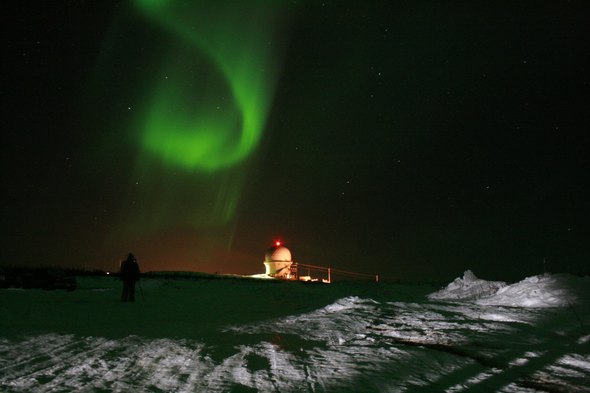
The lights in Michigan may not be as pronounced as this stunning display captured over Fairbanks, Alaska.
AP Photo/Mark Thiessen
“I like to call it a Taco Bell moment. When the sun gets agitated, it can burp something our way,” Norbert Vance, director of the Sherzer Observatory at Eastern Michigan University, said.
That "something" could lead to green or even pinkish and red lights appearing in the very early morning sky.
Vance said that it’s still unclear whether we will be able to see anything in the sky that will take our breath away. It will rely on a number of factors, including whether it’s clear out.
“First, people would have to get out of whatever town or city they live in, and it would be best to go to the northern part of the county so that you’re looking away from the lights,” he said.
“And then the Earth’s magnetic field has to be aligned correctly, and there has to be enough of a solar disturbance for it to create a visual effect for us. When you have all your ducks in a row, you might have a good chance for an aurora.”
The perfect storm scenario for southern Michigan to be able to see northern lights does not happen often, Vance said. Local sky-gazers can only see the lights once every couple of years, and a “really good solar storm” only occurs once or twice in a decade.
“The sun right now is picking up activity and is going to reach its solar max, when activity peaks once every eleven years, next year,” Vance said.
“About two or three years ago we were seeing nary a sunspot, and now it’s getting excited again. But it’s allowed to do that, it’s the sun, we can’t stop it.”
For astronomers it’s not a lack of ability to stop the sun from getting excited that frustrates them. Despite a multitude of satellites watching the star, they still have trouble figuring out what it’s going to do.
“Predicting how the sun will behave is still pretty much luck. We’re getting better, but it’s very difficult,” he said.
A large sunspot forming, and the activity that it creates in the magnetic field surrounding the star, creates the energy that when it passes through the earth’s atmosphere creates the lights.
The burst of light, if it happens, could occur at any time over the four hour period and could last anywhere from 30 minutes to several hours.
“You have to be vigilant and hope you’re out at the right time, but that’s what makes them special,” Vance said.
Ben Freed covers business for AnnArbor.com. Reach him at 734-623-2528 or email him at benfreed@annarbor.com. Follow him on twitter @BFreedinA2
Comments
Tru2Blu76
Sat, Jul 14, 2012 : 4:44 p.m.
This is an election year: I'm surprised that there are no instructions being posted for making our own aurora borealis-proof hats from aluminum foil. I think the astronomers have angered the sun god, which is why the Sun is hurling Coronal Mass Ejections our way. Don't disparage the Sun god, like when astronomers classified the Sun as a "yellow dwarf" star. Wouldn't you be mad if someone started calling you a yellow dwarf (and without provocation, at that)? ;-)
Madeleine Borthwick
Sat, Jul 14, 2012 : 8:56 p.m.
TruBlu76, I'm 6 feet tall. anyone calling me a dwarf, regardless of the color, SERIOUSLY needs to haye their eyesight checked....yak-yak....
Technojunkie
Sat, Jul 14, 2012 : 2:55 p.m.
http://www.washingtonpost.com/blogs/capital-weather-gang/post/solar-storm-incoming-federal-agencies-provide-inconsistent-confusing-information/2012/07/13/gJQAkm06hW_blog.html If power goes out, it might be because this solar storm was a bit stronger than anticipated. I don't think it will happen... this time.
Ron Granger
Sat, Jul 14, 2012 : 2:34 a.m.
Most likely headline: "iphone stolen from man photographing northern lights at 5am in parking lot"
Robo
Sat, Jul 14, 2012 : 12:46 p.m.
who voted this down? cmon its funny.
smokeblwr
Sat, Jul 14, 2012 : 12:29 a.m.
I wish our Mayor would stop wasting our money on streetlights so I could see these tonight!!
jns131
Sat, Jul 14, 2012 : 3:25 p.m.
Head north toward Whitmore Lake. You might see something. Camping is also another good time to do a family adventure.
xmo
Fri, Jul 13, 2012 : 11:11 p.m.
Is this really the end of the earth as we know it? "And then the Earth's magnetic field has to be aligned correctly," Will it be Aliens, Global Climate Change or Mother Nature?
jns131
Sat, Jul 14, 2012 : 3:24 p.m.
I heard fracking will be the nail in the coffin. That and everything else mentioned here.
Tru2Blu76
Sat, Jul 14, 2012 : 6:47 a.m.
None of the above.... grass fires will end human existence, according to some of the articles here.
Goober
Fri, Jul 13, 2012 : 10:34 p.m.
I can hardly wait. Reminds me of the time, driving to work and the northern lights shadowed me along my drive. Quite something to see and experience.