

Snyder tells cities to consolidate, reduce employee compensation to win back state aid
Gov. Rick Snyder delivered his much-anticipated message on local government reform today, outlining a series of steps communities across Michigan must take to win back some of the state funding his budget proposes taking away from them.
Snyder said he's asking the Legislature to partner with him on establishing a new "Economic Vitality Incentive Program" to replace the state's current statutory revenue sharing system, which he proposed to be eliminated in his recent budget. Snyder argues the incentive program would encourage municipalities to pursue best practices and cuts costs.
Snyder proposes a complete elimination of nearly $300 million in statutory revenue sharing payments for cities, villages and townships in the fiscal year that starts Oct. 1.
The new program would make a $200-million pot of money available, and communities would have to compete for those dollars based on performance metrics Snyder outlined today. Funding in the program’s first year would be available to communities that were expected to receive more than $6,000 annually under the existing revenue sharing system.
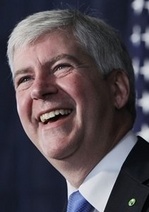
Rick Snyder
To qualify, Snyder said, eligible municipalities must meet best practices in three categories: accountability and transparency, service consolidation, and employee compensation cost controls. Municipalities would receive one-third of their funding for each category of best practices that they meet, Snyder said.
Communities would be asked to produce a citizens’ guide to the community’s finances by Oct. 1, as well as a “dashboard” to measure performance. Snyder also is calling for addressing employee compensation issues as any union contracts are negotiated, including requiring employees to pay at least 20 percent of their health insurance premiums and placing new hires on less-expensive defined contribution retirement plans.
Snyder said he's also asking the Legislature to amend the Public Employment Relations Act so that the consideration of an intergovernmental cooperation agreement by local governments cannot be considered an unfair labor practice.
The city of Ann Arbor would have to compete with communities across the state to win back some or all of the $1.7 million in state funding it stands to lose under Snyder's plan.
Ypsilanti must do the same for its nearly $1.2 million share of statutory revenue sharing, while Ypsilanti Township has nearly $450,000 in jeopardy.
Ann Arbor Mayor John Hieftje said he's not worried.
"I have a lot of confidence that we would be at the top of the list in our ability to win back some of those funds that are being taken away from us now," Hieftje said. "I would say we would be as well positioned or better positioned than almost any other city I can think of."
In terms of regional cooperation, Hieftje said Ann Arbor has made strides in partnering with the county on information technology services, community development and emergency dispatch operations. He also considers Ann Arbor one of the leaders in the state in terms of cooperating with surrounding municipalities on delivery of fire suppression services.
"What he's offering, I think those are all things we're making progress on," Hieftje said of the governor's plan. "I appreciate the acknowledgment that people should be moving toward greater cost sharing on health benefits, and that's a direction we've been moving strongly toward. And the state Act 312 changes he's calling for are exactly what's needed."
Snyder is asking for collective bargaining reforms, saying Michigan has laws that enable government consolidation and cooperation, but they include clauses that prevent the immediate negotiation of new union contracts. He said the laws should be amended so that upon a merger of services, management and employees immediately begin the collective bargaining process.
Snyder also said he's seeking reforms to Public Act 312, which provides binding arbitration for public safety unions, so that a community’s ability to pay is a fundamental factor in a state arbitrator’s decision. He also said the process should take no longer than 90 days.
Snyder also called today for tasking a work group headed by Michigan Economic Development Corp. Director Michael Finney to assess and align the research, planning and development efforts that currently are scattered across the state so there is better coordination.
The Michigan Municipal League said today it continues to oppose pieces of the governor’s budget plan, particularly the significant reduction in funding to communities. However, overall the League is pleased with the governor’s efforts to give local governments the tools they need to reduce costs and share services. The League also supports the regulatory reforms proposed by the governor, including changes to Public Act 312 and the Urban Cooperation Act.
Business Leaders for Michigan, a nonprofit organization comprised of executives of Michigan's largest companies and universities, praised Snyder's plans. “We applaud the governor for his push to eliminate the barriers that hinder local communities’ ability to stretch every dollar farther,” Doug Rothwell, the group's president and CEO, said in a statement. “Service sharing will not only save money, but reduce the divisiveness that has plagued Michigan from acting in a unified manner in the past.”
For any new, modified or extended union contract, Snyder said today that all public employee compensation should be subject to the following criteria:
- Placing all new hires on a defined contribution plan or a hybrid retirement plan that caps annual employer contributions at 10 percent of base salary.
- Where applicable, a 1.5 percent multiplier should be used to determine employee pensions. A 2 percent multiplier should be used for employees ineligible for Social Security benefits.
- Implementing controls to avoid "pension spiking," such as using a three-year salary average that does not include more than a total of 240 hours of paid leave and overtime to determine benefit levels.
- If health care is offered, all new hires must be on an 80/20 employer-to-employee premium split. Alternatively, a dollar amount could be assigned to local health care plans and compared to the state health care plan if it's an HMO or includes other cost-saving measures such as co-pays or deductibles.
In response to Snyder’s message today, Senate Democratic Leader Gretchen Whitmer issued a statement criticizing Snyder for his apparent double standards.
"I think Governor Snyder needs to first look at the taxpayer-funded raises he gave to certain cabinet members before telling local governments how to cut costs, because otherwise it seems painfully obvious that today’s 'special message' was simply another anti-worker attack by this administration," Whitmer said. "We’re all for reforms, but they must be about providing more efficient services for citizens, not wiping them out."
Snyder said today it's time to create a new opportunity for the merger and consolidation of local governments in Michigan, potentially through creation of metropolitan authorities.
"We should permit open minds across the state to not only enter into collaborations, but to consolidate governmental units and activities as appropriate in their respective communities," Snyder said. "The final decision regarding such consolidation should be left at the local level, but the consideration of such consolidation must not be prevented or discouraged by state government. I will support new legislation that permits the establishment of metropolitan government as a metropolitan authority in Michigan."
Under such legislation, Snyder said, existing county government would be superseded by the new metropolitan government, with all the functions of the county and city performed instead by the metropolitan government. In addition, the legislative and executive powers of the city would be transferred to the metropolitan government, he said.
Snyder characterized his plan today as a series of ideas for transforming government in a manner that will strengthen communities, help rebuild the kind of downtowns and neighborhoods that Michigan needs in order to compete in the 21st century, and promote a sense of cooperation and regionalism across the state.
"I ask the people of Michigan to be open to the idea of sharing critical services and embrace the concept of regionalism so that we can successfully confront the economic challenges facing us today," Snyder said today in a prepared statement.
Snyder noted there still would be $659 million in constitutionally protected revenue sharing payments to local units of government next year under his plan.
The city of Ann Arbor has watched its revenue sharing payments from the state fall from more than $14 million a decade ago to just above $9 million last year. That $5 million drop has led to city service reductions and dozens of job eliminations.
Ryan J. Stanton covers government and politics for AnnArbor.com. Reach him at ryanstanton@annarbor.com or 734-623-2529. You also can follow him on Twitter or subscribe to AnnArbor.com's e-mail newsletters.
Comments
Dennis
Wed, Mar 23, 2011 : 6:16 p.m.
"Live....Breathe....Business!!!!" Isn't that what got us into this mess in the first place?
grye
Tue, Mar 22, 2011 : 8:34 p.m.
Instead of just handing money out as has been done in the past by those who are less fiscally responsible, Rick is setting requirements that must be met to be eligible for the funds. What's wrong with that? Oh, open hand, money goes in. That's what many want.
David Paris
Tue, Mar 22, 2011 : 11:13 p.m.
Decent wages & benefits are what most people want. Decent wages & benefits are what Governor Snyder wants to take away. He has no right to do this, it's not what he was elected to do. I can see his tactics resulting in further depreciation in our population, a downward spiral, so to speak.
schlomo
Tue, Mar 22, 2011 : 7:41 p.m.
I wonder how CEO Snyder, our gifted business man, figures he will create more jobs while at the same time applying "employee cost control" (don't you love that wording)...translation- get rid of expensive, disposable employees.
Dennis
Wed, Mar 23, 2011 : 6:20 p.m.
That is exactly why there are unions...at least they can negotiate or lose them to a bankruptcy judge. Additionally what Snyder wants is to get rid of seniority which would allow him rid of "OLDER" workers who have moved up the wage scale. Then he can tax their pensions.
DonBee
Tue, Mar 22, 2011 : 8:58 p.m.
I read it differently schlomo - I read, get the long-term costs under control, at the next contract negotiation. If we don't the union folks are going to find the pension and health care they want, is not there, because the city went bankrupt. Don't believe me, ask a white collar retiree from GM or Chrysler what happened to them. The Governor is trying to prevent that from happening to our state and local employees. Hamtramck is right on the edge, and so are several other small cities.
Wguru
Tue, Mar 22, 2011 : 4:59 p.m.
It's all about centralization vs decentralization. How close to those governed should the decision makers be? How much of taxes paid locally should be spent locally? ... and how much should local government and school spending be reduced to promote statewide business tax cuts? These are issues that have affected state revenue sharing for years... <a href="http://www.michiganinbrief.org/edition06/text/issues/issue-49.htm" rel='nofollow'>http://www.michiganinbrief.org/edition06/text/issues/issue-49.htm</a> Would you want the state to take over the Ann Arbor Water System given the track record of the State in protecting our local area water supplies? Would you want all land use and quality of life issues decided at the state level? What about priorities for fire/EMS/police response times? I'm all for more transparency in local government, but we need it at all levels of government... including knowing who is advising the Governor on his proposals. If the State doesn't meet the same requirements being imposed on the local governments, should someone be authorized to take the State government over? Who would that be? The State Chamber of Commerce? As one who has provided efficient, cost-effective information services to local governments for 40 years, I can attest to the fact that many local governments have already been cut to the bone. The poorer ones do not have the resources to compete with the richer ones for the pot of revenue sharing funds. The result will be more taxes paid in the poorer communities being transferred to the richer communities... and more state takeovers and regime changes of the poorer communities... not exactly a democratic ideal. If you want to see more effective government, work with the local people to find out what they need to make it happen and help provide the resources and expertise to do so. Top-down mandates without bottom-up buy-in is bad business.
DonBee
Tue, Mar 22, 2011 : 8:54 p.m.
Top Down Mandates without bottom up buy in never works. But without incentives to buy-in, it never happens. There are lots of incidents I can think of, where because of an invisible line, response time for a fire or accident was significantly higher than it could have been. Where a child did or did not get the same quality of service in a school, etc. Some consolidation makes sense, there has been discussion about a county wide fire service for years. Huron Valley Ambulance has a great track record as a county wide service. They respond to a large percentage of fire calls, since the calls are for health, rather than fire related reasons.
Dennis
Tue, Mar 22, 2011 : 3:29 p.m.
"Under such legislation, Snyder said, existing county government would be superseded by the new metropolitan government, with all the functions of the county and city performed instead by the metropolitan government. In addition, the legislative and executive powers of the city would be transferred to the metropolitan government, he said." This sounds like Snyder has had too much "China KoolAid". Is he also planning to change his name to Mao of Stalin? Sounds more like a communist state rather than the State of Michigan. If we fall for this one we should all run off the cliff like Lemmings
DonBee
Tue, Mar 22, 2011 : 8:50 p.m.
There are 2314 local governments in Michigan. 83 counties, 533 cities and villages, 1242 townships, and 456 special government units. In addition there were in 2007 - 57 intermediate school districts, 533 school districts and 230 charters which are each their own school district. That means there are more than 3,000 mayors, supervisors and superintendents in the state. Don't you think that looking at getting to say 1,500 is a good idea?
Roadman
Tue, Mar 22, 2011 : 3:33 a.m.
Rick Snyder for President in 2012! How can he lose?
free
Wed, Mar 23, 2011 : 2:58 a.m.
If he can dig Michigan out of the hole in a year, it just might happen.
jns131
Tue, Mar 22, 2011 : 10:58 p.m.
Can we say he might just sell us to the Russians? Cheap? O thats right, China already owns us and we have squandered away our oil dues....guess we are in the toilet, aren't we?
steve h
Tue, Mar 22, 2011 : 3:21 a.m.
This state has been in the toilet for awhile now and 8 years of Granholm only made it worse. Let's give it a shot for 4 years and see what happens. If it doesn't work then we vote him out. Pretty simple people. It may be a little tough but hey, no pain no gain. I'll pay my extra share. I am by no means wealthy but I can cut some things out of my life to pay my share, can you? think about it.
Monica R-W
Tue, Mar 22, 2011 : 3:07 a.m.
As for the recall effort, it is one forming <a href="http://www.firericksnyder.org" rel='nofollow'>www.firericksnyder.org</a>. One of the commenter's had a excellent point. What about cities like the city of Ypsilanti that do not have room to create additional revenue with properly or business taxes for their communities? What about Canton, that is facing a near $15 Million dollar deficit. Does Canton become Westland or does Westland and Wayne become Canton? What about the new employees that are paying 20% of their health costs, plus co-pays, extra gas/food/clothing prices all while having wages frozen? Why does Gov. Snyder, who is a Billionaire, help out these cities by donating his money? Is Ann Arbor happy because they will get to takeover Ypsilanti and possibly Ypsilanti Township in the future if the EFM nullify the votes of the citizens of each of these cities elected officials, thus gutting the One Man/One Woman-One Vote that is a part of Michigan's Constitution? Why is Governor Snyder trying to change collective bargaining rights in Michigan Constitution? Who elected him to do this? What about the city of Detroit losing $60 Million dollars from this plan? Most areas in Southeastern Michigan receive their water from this entity? What will happen to the water to take a simple shower, water our grass or to drink if Detroit goes under? What happens to law enforcement, fire, sewer, local parks & rec and more if our communities go under with Snyder's plans? There are BIGGER QUESTIONS than what Gov. Snyder feels as IF he has a right to do. These actions will impact more than you know. It is time that people start playing attention to the takeover of Michigan Local Governmental rights Snyder is trying to do and organize a Recall Campaign against this former CEO. Government is not a corporation!
DonBee
Tue, Mar 22, 2011 : 8:45 p.m.
Monica - There are lots of ways for local governments to create revenue. Fees for service, franchise fees, and lots of other small taxes most of us don't pay attention to. In California, there are fees to have your yard inspected, fees for cleaning up after an accident, fees to get copies of accident reports, fees to enroll a student in school, fines for not getting your shots, and so it goes. In Michigan there are lots and lots of ways for local governments to raise money without having to go to the voters. I can count at least 20 off the top of my head.
Joel A. Levitt
Tue, Mar 22, 2011 : 9:40 a.m.
Thanks for letting us know about firericksnyder.org. I've signed on, and I'll be at the kickoff in Lansing on Friday.
B2Pilot
Tue, Mar 22, 2011 : 2:59 a.m.
He is doing what has to be done that no previous Governor was willing to do, make a tough decision. we can't keep funding this state with Obama stimulus money like Granholm was doing. And where were all these people complaining when Granholm was funding kilpatricks administration? No politician is coming out opposing these ideas, they may not like it but the reality is this state has been broke for the last 4 years they know it. by the way why the name calling? he is the Governor Just like Obama is the President who by the way inherited a budget crisis and had to make some tough choices
David Paris
Tue, Mar 22, 2011 : 2:41 a.m.
Rick Snyder has yet to do anything positive for the population of this state. So far, I've only heard: Cut jobs, burden the people, benefit the businesses. Will we be better off in four years? I'm not convinced!
DonBee
Tue, Mar 22, 2011 : 8:41 p.m.
And if we are not, he and most of the others in Lansing will be gone. That's how elections work.
Joel A. Levitt
Tue, Mar 22, 2011 : 2:21 a.m.
It's time to get busy recalling Governor Snyder. He is intent on undermining collective bargaining, the major tool for achieving labor peace and the continuation of essential services. He has reduced the size of the revenue sharing pot, which will weaken the services that Michigan citizens and, particularly, businesses need. He will make the poorest among us pay for the enrichment of our wealthiest citizens. He will do all he can to eliminate the democratic institutions that keep Michigan citizens free. Let's redeem Ann Arbor. We spawned Snyder – now let's lead the effort to get rid of him.
DonBee
Tue, Mar 22, 2011 : 8:41 p.m.
How about we trade with Wisconsin? Let's get Scott Walker here? Sound good? That is about on par with your comment about undermining collective bargaining.
Grant
Tue, Mar 22, 2011 : 3:11 p.m.
We certainly did not know his sinister master plan when he was glad handing before the election!
Heardoc
Tue, Mar 22, 2011 : 2:14 a.m.
TO JNS131 Unemployment is really a welfare program now. The insurance is really for a short time -- 6 months -- now the fed subsidies are bringing that to almost 2 years. None of these workers paid for this extension -- just a transfer of wealth. Gov Snyder is correct in stopping this payment. People such as yourself just don't get it -- we are out of money. The well is dry. There is no blood in the turnip. Get a job, quit asking for handouts. Be responsible for yourself. Quit being envious of others. You caused your own problems and only you will solve your problems. Quit looking to others when
jns131
Tue, Mar 22, 2011 : 10:56 p.m.
I get under employment to make up for the part time job I already have. I worked long and hard and got laid off due to a failing economy no fault of my own making. I am only taking what is duly mine. I am being responsible. I don't do handouts, I only take what is mine. Mine is what I worked for called unemployment I paid into. Guess what? I am cashing it in. So stop calling the kettle black. O thats right, you work for Snyder don't you?
Dennis
Tue, Mar 22, 2011 : 3:24 p.m.
What you fail to understand is that the problem is not Unemployment payments....it's the lack of employment. Snyder and his "Business Cronies" are the very ones that have caused this problem by killing manufacturing and outsourcing decent paying middle class jobs. We suffer while he and his cronies invested in Mexico, China, Tiawan, etc. . Unemployment payments help keep people in their homes, and help feed families. What Snyder wants is to put them all out on the street. As far as I know you still have to pay taxes on unemployment payments and these are tax paying people. How didn't they pay for their extensions?
jns131
Tue, Mar 22, 2011 : 2 a.m.
Here is something else I heard that is scary. Snyder is planning to override federal government money to the unemployed. They are going to vote this one out. Kind of scary they can do this. I really hope Snyder gets a clue and realizes that he is going to bankrupt Michigan. Guess this is one vote I want to recant. First queen Granholm and not King Snyder. Time to leave the sate.
DonBee
Tue, Mar 22, 2011 : 8:39 p.m.
I would love to know where you got this gem jns131? Please who told you this one? I know he is trying to get a delay in paying back the federal government for unemployment that was paid to folks in the state of Michigan until the economy is better. Could this be what you are referring to?
1bit
Tue, Mar 22, 2011 : 5:38 p.m.
Goodbye.
lester88
Tue, Mar 22, 2011 : 1:56 a.m.
The pendulum will swing back when the economy is better and the public sector finds itself unable to attract and maintain talented workers. If you are young, talented and work in the public sector: Abandon ship! If you are vested, work in the public sector and able to retire: Abandon ship!
michaywe
Tue, Mar 22, 2011 : 1:55 a.m.
Whoa, boy! After reading this, I'm even more convinced the topics raised would be more appropriate for a Constitutional Convention. Too much, too fast!
Heardoc
Tue, Mar 22, 2011 : 1:47 a.m.
t is so comical to hear all the leftists -- I am always entertained. Seems that if we have a cut in services all the lefties --Townie, David Briegel etc., believe no one should get a raise. I guess this is why many leftists cannot run a business. The fat cat BIG LABOR types have been soaking the the worker for a long time. They force workers to pay the union thugs for a job. Then the Union thugs-- BIG LABOR -- then gives the dues, the worker is forced to pay, to the democrat party. This is the unholy alliance we are all looking to break and are well on the way to destroying this unholy alliance between BIG LABOR and the democratic party. This is why Gov Snyder has signed the Emergency manager bill -- this was done to incentivize the public unions (like AFSCME) to negotiate rather than hold us hostage to their whims. All we are seeing is the leftiss here that are upset that their viewpoint is being diminished and their power base (forced payment of union dues) are now being reduced and eliminated for the betterment of America. Remember -- unions are socialist organs and do not believe in american ideals-- Capitalism, Individual responsibility and the right to equal opportunity and not equal outcomes. This 'Best Practices" philosophy is causing great concern among the union execs as this will reduce the public employee unions manpower and the dues these Big Labor execs get from the working man.
DonBee
Tue, Mar 22, 2011 : 8:37 p.m.
Both sides have their ugly folks. For the left folks like Soros come to mind. Massive amounts of money to be spent on socialist (his words) causes. On the right the ugly of the day are the bothers Koch. Both sides have a deep set of Dogma trenches. And they each have a 24/7 news channel to get the Dogma out - on the right Fox, on the left MSNBC. We need a middle, how I long for the Walter Cronkites of the world. He may not have been strictly down the middle but he was closer than most.
David Briegel
Tue, Mar 22, 2011 : 2:49 a.m.
Union thugs vs Chamber Of Commerce Angels. Golly Chamber of Commerce, Koch Bros, TeaPublicans, Patriots all!! Saints even! Leftists, or leftiss, you left out secular progressives and liberals and socialists and communists. Just say it! Don't be so shy! You mean handouts like the quarter million all of Slick Rick's appointees? I dare you to audit Spark!!
snoopdog
Tue, Mar 22, 2011 : 12:51 a.m.
The more I see Rick's plans for this state the more I believe we actually have a chance to turn things around for a brighter future. I could not be happier with what he is doing. Good job Rick, keep up the good work ! Good Day
macjont
Tue, Mar 22, 2011 : 1:45 a.m.
Rick, why are you going by the name "snoopdog" now?
Tony Livingston
Mon, Mar 21, 2011 : 9:33 p.m.
"Heiftje is not worried". Wow. That is really arrogant. Pension obligations are bankrupting cities all over the country and he is not worried? Let's hear his plan to deal with it.
David Briegel
Tue, Mar 22, 2011 : 12:03 a.m.
Marshall, ART is good for the soul. You will LOVE it! Only the soulless won't appreciate the new artwork!!
Marshall Applewhite
Mon, Mar 21, 2011 : 9:45 p.m.
If you actually read the article, he isn't worried due to the fact that Ann Arbor is better situated than most municipalities for receiving these state funds. By being relatively frugal over the last few years(other than that ridiculous planned City Hall fountain), they are easily within reach of the required thresholds.
Cici
Mon, Mar 21, 2011 : 8:36 p.m.
As far as health benefits, why is there no mention of the same sharing by retirees? My understanding is that they (city, county, state) have free health care benefits... Not all the pain should be born by new employees. Or is this area related to Medicare? And those "50 and out"? That's a long time for free health care.
Barry LaRue
Mon, Mar 21, 2011 : 7:45 p.m.
I'm just concerned that the Governor doesn't understand the history behind the revenue sharing formula. Many communities are older, built-out ones. They cannot grow themselves out of structural deficits. Newer communities and townships have vacant land to try to develop to counteract the impacts of Proposal A and Headlee. In the case of the City of Ypsilanti, we have four square miles, 25% of which is occupied by EMU which pays no property tax and receives no payments in lieu of taxes. A total of about 33% of the city is tax exempt if you add in public schools, parks, cemeteries and the like. Many states compensate host communities for their universities, prisons and other facilities. This should be a part of the contemplated plan. I understand the new incentives won't take into account any anti-sprawl considerations and just opens the money up to all on a level field. Problem is the playing field ain't level. I can attest to the fact that the City of Ypsilanti has been cutting staff and services for years. To imply that all local units of government are either flagrant wasters of money or a pack of criminals merely paints all with the same broad brush. The program needs more work before it is unrolled. As has been pointed out before, state shared revenues were not just a "hand out", but a feature of the 1963 constitution which outlawed many local revenue options. If a city cannot enact a ticket tax or a local sales tax then the state needed to step in and provide it. The Governor could add a provision that allows local votes on various taxes or fees that could make up for the loss of state revenues. I see an immediate future of many municipalities being taken over by the state and citizens being powerless to retain even a modest level of services that they desire or demand. I hope saner heads rule and this goes back to the drawing board before being enacted.
DonBee
Mon, Mar 21, 2011 : 8:53 p.m.
Barry - Two types of revenue sharing: 1) Constitutional which is by far the larger one and untouched by this program. 2) Statutory, which is renewed each year in the budget (but the amount varies). Statutory sharing had a lot of strings attached for some of the money. It was very uneven in how it was shared out, as people made deals on who got what. Many of those deals are for conditions that no longer apply, but the deals do. The local governments have lots of ways to get more revenue, franchise fees are a favorite, because no voter is involved. They go to the electric company, the gas company, the cable company and say "raise the franchise fee" and it is done. If you get a Comcast bill, check it, you pay a fee every month that goes to the local government, on many other bills it is harder to find.
1bit
Mon, Mar 21, 2011 : 8:18 p.m.
I agree that adding efficiency, competition, incentives, etc are only part of the solution. Raising revenue is necessary as well. In a separate post I mentioned that rather than an additional local sales tax, maybe the State should look at collecting sales taxes on items that have been purchased on the Internet (e.g. Amazon and eBay). Unfortunately, many people do not report those purchases and pay sales tax as they are required. Collecting another local sales tax only hurts local businesses who are already playing fairly and benefits the out-of-state businesses who already have an advantage.
mastercraft1
Mon, Mar 21, 2011 : 7:45 p.m.
The give away programs are coming to an end. Its about time that goverments have to justify how their spending money. This seems to me to be fiscally responsible, kind of a refreshing idea in goverment.
David Briegel
Tue, Mar 22, 2011 : midnight
Unless you are a former Spark employee saluting the Governator!
Tony Livingston
Mon, Mar 21, 2011 : 9:48 p.m.
I agree completely on this one. Ann Arbor has been unwilling to change it's very generous golden parachute retirement scheme. We can't go on like this and as a property owner, I am fed up with a Mayor who refuses to acknowledge the elephant in the living room.
1bit
Mon, Mar 21, 2011 : 7:44 p.m.
Rick Snyder is a businessman. The proposals are in line with how failing businesses fix their problems. Consolidation of services does not end those service. He is not proposing eliminating collective bargaining but setting realistic limits for the outcomes. Is it really the end of the world if retirement plans are restructured so that they are economically viable in the future (i.e. making a promise that you can actually keep?) Is it the end of democracy that contracts be negotiated with an understanding of a contribution towards one's own healthcare (i.e. perhaps a higher base salary should then be negotiated?) Is it so terrible that arbitration keep in mind local finances and be done quickly for all parties involved? Change is hard. Complaining is easy.
Jaime
Mon, Mar 21, 2011 : 7:39 p.m.
He has changed from be a nerd to absurd. He should just divide to money equitably and not tell cities how to run their operations. I would like to know where the current $300 million and proposed $200 million come from.
DonBee
Tue, Mar 22, 2011 : 8:33 p.m.
Johnnya2 - They always have, some money is earmarked for roads, some for health care, etc. Some is a pass through with earmarks from the Federal Government. It has been this way for at least 80 years. Budgets have line items, line items tell you how to spend the money. Most of the state statutory money has always been in line items with restrictions.
johnnya2
Tue, Mar 22, 2011 : 1:01 a.m.
1bit, It is not the states role to determine how a city spends its money. PERIOD. It would be like the federal government under Ronald Reagan TELLING the states they MUST make the drinking age 21 or not get highway funding. Oh funny how states rights and local control do not matter once it gets done to the REALITY. I wonder what will be next? The state says they will not hire people who drink or smoke because they cost too much money. OR if their family shows a propensity to live too long they will not hire them because their pensions will cost too much.
DonBee
Mon, Mar 21, 2011 : 8:48 p.m.
Both come from the General Fund. The $300 million was based on the prior budget. The amount of statutory revenue sharing is set each year by passing a law, it has varied up and down. Then there is constitutional revenue sharing which is untouched by this program. The constitutional revenue sharing is much larger. The statutory revenue sharing was the state telling people how to spend money, it always has been. The constitutional revenue sharing was the local government unit's money to do as they pleased.
1bit
Mon, Mar 21, 2011 : 8:20 p.m.
Is it so wrong for the State to set goals and expectations for spending taxpayer money?
Go Blue
Mon, Mar 21, 2011 : 7:18 p.m.
Wow, how interesting. If we are to follow the lead, then I assume the leader will do just that and lead. I expect the compound will be up for sale immediately and there will be prompt downscale downscaling. Children will immediately transfer to public, not private, school. Begin living in Lansing, as predecessors and their children have done, so as not to create an arrogant, better than the rest of you statement. Starts at the top, so we need to see some action. No more blatant expense for the trek to and from Lansing. Best of all, no retirement benefits for any elected official any longer, ever again and that will occur immediately . Anyone unhappy with the agenda coming into play?
DonBee
Tue, Mar 22, 2011 : 8:30 p.m.
My boys are in public school and I pay my taxes. Given a reasonable chance of passage, I would favor some tax increases, even ones that would directly impact my family. I am not in favor of the idea that if we tax someone else all the problems will go away. But, some people seem to think that is the answer. How about you David, willing to pay more taxes? Given the climate in the state overall, it is not going to happen, so the Governor made hard choices, now the Legislator gets to decide if they stand.
David Briegel
Mon, Mar 21, 2011 : 11:58 p.m.
You couldn't expect the teacher of HIS kids to have 60 students. That's just for the little people!! Right Steven and Don??
Stephen Landes
Mon, Mar 21, 2011 : 10:05 p.m.
He is paying for both public and private education. Remember, much as we have tried to get vouchers in this state we don't have them, so anyone who chooses private education still pays their school taxes like everyone else.
DonBee
Mon, Mar 21, 2011 : 8:45 p.m.
He pays his taxes, takes $1 in pay. He paid for his security system and upgrades. He is paying part or all of his transportation costs. He cut the cost for the governor's mansion by not living in it, so the staff costs to clean and maintain it drop significantly. I for one suspect he costs the state way less than the prior governor. I don't have a staff count, but I know at least 1 position that was not refilled, that of Secretary for the First Spouse.
1bit
Mon, Mar 21, 2011 : 7:37 p.m.
If he puts his child in public school(the others went to public school, but maybe that doesn't fit your rant) then it increases class sizes. He can send his kids to whatever school he wants and, to tell him otherwise, is fairly arrogant to say the least.
Dennis
Mon, Mar 21, 2011 : 6:50 p.m.
Here is the list of SPARK MEMBERS: <a href="http://www.annarborusa.org/about-us/governance" rel='nofollow'>http://www.annarborusa.org/about-us/governance</a>
Cash
Mon, Mar 21, 2011 : 6:43 p.m.
"To qualify, Snyder said, eligible municipalities must meet best practices...... employee compensation cost controls." So why didn't he reduce HIS employee compensation cost?
David Briegel
Tue, Mar 22, 2011 : 3:05 a.m.
At 50cents he's overpaid!
Grant
Mon, Mar 21, 2011 : 9:24 p.m.
This is hypocrisy at it's best.
1bit
Mon, Mar 21, 2011 : 9:14 p.m.
So reducing his salary to pay a couple people more doesn't count?
say it plain
Mon, Mar 21, 2011 : 8:35 p.m.
c'mon @1bit, you know we're not talking about *his* salary, we're talking about those of his appointees, whom he granted great raises. I'd guess his justification is that they'd be serving corporate interests instead if he didn't offer them at least the equivalent of top-dog minimum wage these days, i.e., upwards of 200K ya know. It would be demeaning otherwise, how could he look them in the eye at their gala receptions and on the golf courses after making insulting 'offers' for their career-time? Let's see what miracles they work, or whatever else they wreak....
1bit
Mon, Mar 21, 2011 : 7:38 p.m.
He's taking $1. Maybe you want him to take 50 cents?
TC
Mon, Mar 21, 2011 : 6:39 p.m.
For a republican, he sure sticks the nose of the state government where it doesn't belong. He is just passing his problems off on the the local government. We are racing to the bottom with Rick at the wheel.
David Briegel
Tue, Mar 22, 2011 : 3:04 a.m.
heardoc, you didn't like that comment when Obama and Jenny used it! Situational ethics? Or just ethically challenged?
Heardoc
Tue, Mar 22, 2011 : 1:53 a.m.
Granholm got us in this mess -- along with Obama -- Rick is just trying to get the car out of the ditch and keep the keys away from the leftists that put us there-- like you.
DonBee
Mon, Mar 21, 2011 : 8:16 p.m.
Read the linked article on what is really in the plan and then tell me that this is what is happening TC.
Mick52
Mon, Mar 21, 2011 : 7:32 p.m.
I disagree. When local communities need state revenue sharing the state has every right to make sure they are not making dumb decisions that result in high costs. I learned in high school that in govt whoever holds the purse strings really has significant control. The federal govt does this too. To get fed funding, states have to comply with federal regulations. That way the money is not wasted and in re to local govts, so that they do not need bailouts later on. He is not passing his problems off on local govts, he is telling them if you create a problem you have to pay for it yourself. That should make local govts give very careful consideration as to whether or not they can afford their practices.
Mick52
Mon, Mar 21, 2011 : 6:19 p.m.
This is exactly the type of guidance local governments should get from the state. If they make foolish decisions then they will have to pay for it themselves, not continue to expect state aid to cover expensive practices, like defined benefit retirement plans. Here is a good example of a city that made poor decisions over the years and the result. It is not just the problems they face now but what they face in the future if they do not act now. Note paragraph five, which states that hundreds of local govts face this same problem. <a href="http://articles.latimes.com/2011/mar/18/local/la-me-costa-mesa-cuts-20110318-1" rel='nofollow'>http://articles.latimes.com/2011/mar/18/local/la-me-costa-mesa-cuts-20110318-1</a> The reason some compensation is being addressed is, like in Costa Mesa, it is not sustainable. If you do not like the Gov's plans, offer some alternatives. What we have been doing obviously is not working.
Cici
Mon, Mar 21, 2011 : 8:45 p.m.
Just a thought about those poor decisions... Maybe be could even increase the government contribution to 401K plans from 10% to 20%! Wow! 10% is very high - about 3% like many corporations?? Why would overtime etc. be considered in retirement calculations? It's money but not the "salary" agreed to that should be in calculations. That is one alternative. Of course contributions to health should be at least 20%
Wolf's Bane
Mon, Mar 21, 2011 : 6:14 p.m.
Ricky Snyder he is a genius! To paraphrase Ann Arbor Mayor John Hieftje: He's not worried because Ann Arbor is a major economic engine in the state, we'll easily conform to the 3 mandates. However, other municipalities around the state, like for example Canton, Pontiac, Highland Park, and/or Ferndale will suffer greatly because they won't be able to generate new economic incentives, e.g. income, nor will they be able to easily conform to the new requirements; this is the ultimate Darwinian capitalist experiment. It is going to drastically change, if not wipe out a lot of struggling municipalities.
David Paris
Tue, Mar 22, 2011 : 11:20 p.m.
What is it exactly that happens to a municipality that is wiped out? Is it like Sim City, where you just quit one city, and start a new one? Or, is it more like a home foreclosure, but on a grand scale? I don't think that "Genius" is the correct term here!
John Q
Tue, Mar 22, 2011 : 2:30 a.m.
Start reading the newspapers Mick. Canton is facing a $15 million deficit.
Tony Livingston
Mon, Mar 21, 2011 : 9:46 p.m.
According the the NY times, Hamtramck has 90 employees and is saddled with pension and health care obligations for 252 retirees. It would be very interesting to see the same statistics for Ann Arbor. When cities allow employees to begin collecting pensions at age 50, the obligation increases a lot faster than new revenues. Unfortunately, it looks like it will take a mandate from the governor before Ann Arbor is willing to confront it's own very large pension/health care problem.
DonBee
Mon, Mar 21, 2011 : 8:15 p.m.
Bill - It is NOT a competition. It sets benchmarks. If you hit the benchmark, you get the money. If you don't, you do not. No Darwin involved in this initiative. I have lots of benchmarks I have to meet to keep my job. I suspect most employees of private companies do these days.
Dennis
Mon, Mar 21, 2011 : 6:55 p.m.
John Hieftje is also a member of SPARK
Dennis
Mon, Mar 21, 2011 : 6:53 p.m.
John Hieftje is also a member of SPARK.
Mick52
Mon, Mar 21, 2011 : 6:32 p.m.
I was not aware Canton had fiscal trouble. Nor Ferndale. But is it so bad that some of these communities did disappear? For example, Highland Park could be absorbed by Detroit. If you look at the metro Detroit area, you see many small communities, with each providing services like police depts. Each having a chief and command structure? Is that really necessary? Couldn't consolidation lower costs? If you look at Western Wayne county alone, there is Van Buren Twp, Belleville, Canton Twp, Plymouth Twp, Plymouth City, Northville Twp and Northville City. Seven police departments within a ~12 mile spanse. That seems to me to be a lot of duplication. Some years back, there was an idea floated for a Western Wayne Metro PD, but the idea was rejected out of fears of lack of control. Makes no real sense. If you just add up the compensation of those seven chiefs, I think the figure would cover quite a few more officers or money that could be spent elsewhere.
timjbd
Mon, Mar 21, 2011 : 5:42 p.m.
"To qualify, Snyder said, eligible municipalities must meet best practices in three categories: accountability and transparency, service consolidation, and employee compensation cost controls. Municipalities would receive one-third of their funding for each category of best practices that they meet, Snyder said." Why have the republicans force cuts on everyone when you can have every 8-year-old do it for them?: "Gee whiz, Mr. Fireman, why won't you accept a 70% pay and benefits cut and a sell-off of the municipal water system to private profiteers so the governor can afford to re-open my school and the police can afford to arrest pedophiles on my playground? Mommy (and the governor) tells me if you DON'T agree to those cuts, then we can only blame YOU if I get molested or don't ever go to college!"
EyeHeartA2
Mon, Mar 21, 2011 : 5:41 p.m.
"municipalities must meet best practices in three categories: accountability and transparency, service consolidation, and employee compensation cost controls." We're are up that well known creek, without a means of locomotion. I don't think Ann Arbor will be getting much money if the criteria is we use is wisely. Is it too late to put in for an art grant? or maybe we can buy some more farmland.
David Briegel
Mon, Mar 21, 2011 : 11:50 p.m.
Except that Slick can lard the salaries of all his buddies. Isn't that just special?? Only because they are non-union!!!
braggslaw
Mon, Mar 21, 2011 : 5:29 p.m.
A very solid reform plan linked to performance. Huzzah!
fjord
Mon, Mar 21, 2011 : 5:20 p.m.
Yet another chilling anti-democracy proposal from Lord Snyder the Governerd. Funny how Republicans purport to be all about states' rights when it comes to federal-level intervention, but they'll gleefully run roughshod over the rights of local municipalities when they wield the power of state-level intervention. Not hypocritical at all...
Heardoc
Tue, Mar 22, 2011 : 1:58 a.m.
Another silly comment on the part of the far left. This is about states rights -- I do not think the constitution says anything about municipalities within states. Geez, did you go to school in Detroit?
Stephen Landes
Mon, Mar 21, 2011 : 10:01 p.m.
All the whining about overriding local units of government is nonsense. What is being proposed is a set of strong measures to be utilized if a local unit of government is on the verge of bankruptcy. The alternative is to let local governments dig themselves into a bankruptcy hole and then have the rest of us bail them out. That doesn't make sense. If you don't want to temporarily lose control of your local government then get your citizens, locally elected officials, public employees, and unions together to make sure your financial foundation is in order. Take responsibility for yourselves and you will never see an emergency financial manager.
DonBee
Mon, Mar 21, 2011 : 8:10 p.m.
Fjord - So the governor's call to fix Public Act 101 so that any new State requirement on local governments that is not fully funded cannot go into effect is overriding local rights? (yes, that is part of what he wants)
braggslaw
Mon, Mar 21, 2011 : 6:57 p.m.
Arguing... or complaing about preeminence... doesn't seem that different. It doesn't matter because it is the law.
Mick52
Mon, Mar 21, 2011 : 6:08 p.m.
It is not different. When it comes to funding, the federal govt typically puts restrictions on what funds have to be spent on. The idea is to make sure it is not wasted. Here, we have the governor appropriately telling local governments not to make bad decisions, or if they choose to do so, pay for it by themselves..
Forever27
Mon, Mar 21, 2011 : 5:49 p.m.
@braggslaw, fjord wasn't arguing against preeminence. they were simply stating that the political party that usually grand stands against such a policy is using it themselves.
braggslaw
Mon, Mar 21, 2011 : 5:33 p.m.
This Constitution, and the Laws of the United States which shall be made in Pursuance thereof ... shall be the supreme Law of the Land; ... any Thing in the Constitution or Laws of any state to the Contrary notwithstanding.
braggslaw
Mon, Mar 21, 2011 : 5:31 p.m.
It's called pre-emption and that's how a federalist govt. works.
Forever27
Mon, Mar 21, 2011 : 5:26 p.m.
don't be fooled, they do the same thing when the federal government overrides the state governments. Their "states-rights" argument hasn't been a reality for over 100 years.
Basic Bob
Mon, Mar 21, 2011 : 5:07 p.m.
This is a classic carrot-and-stick approach to changing local government behavior. Some people just don't like carrots.
1bit
Tue, Mar 22, 2011 : 1:26 a.m.
johnnya2: Remember the Obama administration's "Race to the Top"? Michigan didn't even "win".
johnnya2
Tue, Mar 22, 2011 : 12:54 a.m.
You mean it is good to propose a plan that is currently ILLEGAL under Michigan law. The whole idea behind the 50% sales tax hike that John Engler foisted on us, was to pay local communities so they did not need higher property taxes. So now they can not raise property taxes, they can not raise sales taxes. If Washington did this to the states regarding funding you would be screaming that control should be for the states. Now that the state is STEALING money and making cities "compete" for money you are basically for CENTRAL CONTROL. Typical inconsistency in the right wing party .
Stephen Landes
Mon, Mar 21, 2011 : 9:57 p.m.
They all want the carrots; it's the stick they cannot stand. I should not be surprised at all the whining on this subject, because I keep hoping for rationality to overtake local partisan interests. The plan is good for the State.
Alan Goldsmith
Mon, Mar 21, 2011 : 5:05 p.m.
"This is all pretty rich (pun intended) coming from a millionaire who drove Gateway into the ground and then sold off what was left to the Chinese (and got a nice chunk of change for himself in the process)." I guess the Governor doesn't have any trouble burying that history when there is no local opposition from the Democratic Party like the Mayor....
local
Mon, Mar 21, 2011 : 4:57 p.m.
What I also like is that communities could meet these requirements and if the money is gone, it's gone. Who decides ultimately which communities get this money, Slick Rick. And if they aren't able to meet his demands/requirements, he will send someone in to take over your community and figure it out for you. More and more it sounds like a dictatorship to me.
David Briegel
Mon, Mar 21, 2011 : 11:43 p.m.
Cut off their funds and then take them over. What a noble quest!
DonBee
Mon, Mar 21, 2011 : 8:08 p.m.
Local - Go to some of the "Public" meetings in the county today and see you actually fills the agenda. You would be surprised to see who is in the driver's seat. It is not the folks you voted for.
Ignatz
Mon, Mar 21, 2011 : 4:51 p.m.
I was hoping that Gov. Snyder's vague plans during the campaign would not be revealed as they have been with more reverse Robin Hooding. It's just the Polyanna in me. Unfortunately, the smile is a cover for more Republican tactics bent on taking away the very things that made the American middle class something to be sought after. Don'd jump too high for the money on the sitck, kids. The ground might not be there when you try to land.
1bit
Mon, Mar 21, 2011 : 10:52 p.m.
We have limited resources. What is the best approach to distribute those resources? I think a system of accountability makes the most sense. If I give a man a hundred dollars and he spends it on drugs and then overdoses, who is to blame? The man I gave the money to obviously, because he did it, but I ultimately was the enabler. Attaching "strings" to taxpayer money is not new. I think the saying that best fits is "Give a man a fish and he eats for a day, teach a man to fish and he eats for the rest of his life."
DonBee
Mon, Mar 21, 2011 : 8:07 p.m.
Ignatz - You could live in Ohio, New Jersey or Wisconsin. At least the Governor is trying to work inside the existing agreements for collective bargaining.
cinnabar7071
Mon, Mar 21, 2011 : 4:48 p.m.
Thats always been my rule when giving away money, use it wisely or your cut off. I see this as being very postitive.
RayA2
Mon, Mar 21, 2011 : 10:06 p.m.
Since when is it Slick's money? Or his fellow west and northern Michigan republican partners in tyranny in the state congress? The state money came from here and I trust the current local government a whole lot more than than I do the reverse Robin Hood bunch in Lansing.
Alan Goldsmith
Mon, Mar 21, 2011 : 4:48 p.m.
Spark? Can we have a list of board members posted here?
Alan Goldsmith
Mon, Mar 21, 2011 : 4:47 p.m.
"Ann Arbor Mayor John Hieftje said he's not worried." Guess I wouldn't worry about the future either if I had feather-beds jobs created for myself and spouse by the U of M. The Mayor's 'price' for sitting out the November election and failing to speak up for Democratic Party values now? Now go ride your bike and hug a tree and spare us you are looking out for anyone other than yourself.
Roadman
Tue, Mar 22, 2011 : 11:41 p.m.
Marcia Higgins, the mayor pro tempore, also gets a nice salary in the School of Engineering at U-M, despite the fact her credentials are not the greatest.
Wolf's Bane
Mon, Mar 21, 2011 : 6:18 p.m.
Ann Arbor Mayor John Hieftje is just lucky and/or smart for being the mayor of the only city in Michigan that counts for something.
Townie
Mon, Mar 21, 2011 : 4:38 p.m.
And Rick gives his former employee at SPARK a huge raise (more than what was paid to the former MEDC director) -- $250,000 and then he wants communities to cut the salaries of their employees? His new government isn't transparent (what he ran on isn't what we're seeing now...) or accountable. This is all pretty rich (pun intended) coming from a millionaire who drove Gateway into the ground and then sold off what was left to the Chinese (and got a nice chunk of change for himself in the process).
johnnya2
Tue, Mar 22, 2011 : 12:49 a.m.
Mick52 \Glad we agree that Rick Snyder is a bold faced LIAR. He said he would run the state a sa CEO. Your position is he is not? So is Rick a liar, or is he acting like a CEO. Imagine that your company claims they are broke, (lets say Borders), and they hire all brand new managers (Ricks "team") and they all get huge raises over the last management teams, BUT the employees are told they MUST cut wages AND MUST cut benefits, and MUST do what he says. If you can not see this you are blind and there is no one as blind as those who do not wish to see. Snyder is worse than John Engler.
David Briegel
Mon, Mar 21, 2011 : 11:40 p.m.
Just click your heels and salute!
Moscow On The Huron
Mon, Mar 21, 2011 : 8:49 p.m.
"His new government isn't transparent (what he ran on isn't what we're seeing now...) or accountable. " I thought this was OK with liberals. See: Obama.
Tom Whitaker
Mon, Mar 21, 2011 : 7:06 p.m.
"What he did in business has nothing to do with what he will do as governor. They are two completely different jobs." Really? Did he not base his entire campaign on being a successful businessman and private job creator? Isn't this what his supporters pointed to whenever he was criticized for having no public administration experience? Funny, but my response to the claim that his private business experience would make him a good governor was always: "What he did in business has nothing to do with what he will do as governor. They are two completely different jobs."
Mick52
Mon, Mar 21, 2011 : 6:04 p.m.
What he did in business has nothing to do with what he will do as governor. They are two completely different jobs. What he is doing is exactly what needs to be done. Local govts have to be careful not to give away the farm and expect the state to cover the mortgage.
EyeHeartA2
Mon, Mar 21, 2011 : 5:49 p.m.
He was just trying to stay under what we paid our new superintendant of schools. - So we must have plenty of money too, I imagine.
RayA2
Mon, Mar 21, 2011 : 4:29 p.m.
Slick rick has come up with yet another way to over ride the votes of local voters. I understand the state has to enforce its constitution with local governments but I don't see how this typical CEO doublespeak is part of that mandate. Slick wants lower taxes for himself and other wealthy people like himself, period. He gets a double benefit because he is further driving down the wages and other compensation of his potential employees by eliminating wage and benefit competition for workers. I will say I am amazed how slickly he has packaged all of these attacks on the middle class and how he is using the shear volume of attacks to confuse and overwhelm his opponents.
RayA2
Mon, Mar 21, 2011 : 10:02 p.m.
DonBee - I went to each link and I don't see what you are talking about. I don't see any inconsistencies between this article and the linked articles.
DonBee
Mon, Mar 21, 2011 : 8:05 p.m.
RayA2 - Did you read the linked articles and listen to the speech or just read the article. The article does NOT match much of what is in the links and the speech.
Wolf's Bane
Mon, Mar 21, 2011 : 6:20 p.m.
He has strategy that's for sure, just not sure if killing off struggling cities is good practice.
Mick52
Mon, Mar 21, 2011 : 6:02 p.m.
Over riding the votes of local voters and governments is exactly what is needed. Take a look at this: <a href="http://articles.latimes.com/2011/mar/18/local/la-me-costa-mesa-cuts-20110318-1" rel='nofollow'>http://articles.latimes.com/2011/mar/18/local/la-me-costa-mesa-cuts-20110318-1</a> This cities problems are the result of years of decisions made by the local govt that has proven unsustainable. When agreements like this cause city fiscal problems, the entire state should not have to support it with state funding. What we see nationwide is that local voter decisions have lead to severe problems, and in this example, the layoff of almost one half of city workers.
Forever27
Mon, Mar 21, 2011 : 5:22 p.m.
precisely why I was concerned, not impressed, by the fact that Snyder was a CEO.