

Four skunks with rabies identified in Ann Arbor this year
Editor's note: The story has been edited to reflect that rabid skunks have not been exhibiting aggressive behavior.
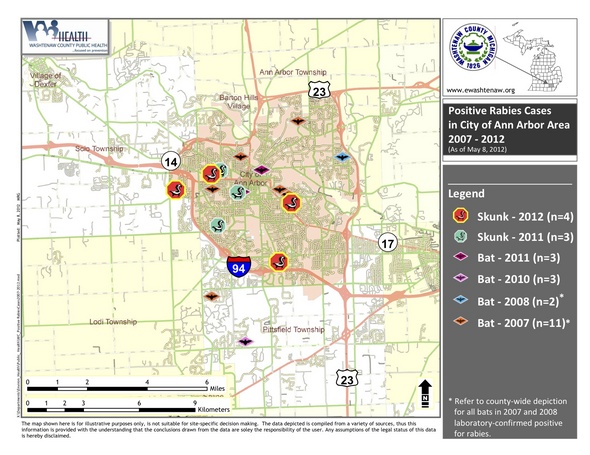
Courtesy of Washtenaw County Public Health
Prior to 2011, the last time Washtenaw County had skunks that tested positive for the disease was in 2005.
Click here to see a larger version of the map above.
In the past two weeks, there were encounters with rabid skunks in south Ann Arbor near the intersection of Eisenhower Parkway and Packard Street and in west Ann Arbor in the Lakeview subdivision off of Jackson Road.
The Washtenaw County Public Health Department has issued an alert today to remind pet owners to have their animals routinely vaccinated for rabies and to avoid contact with wildlife exhibiting strange behavior.
“We’ve been hearing that they’ve been exhibiting strange behavior,” said Susan Ringler-Cerniglia, public information officer for the health department, explaining it’s unusual for skunks to be roaming outside in daylight hours.
In one recent instance, Ringler-Cerniglia said a person had been approached by a rabid skunk and was licked.
The rabies virus exists in an animal’s saliva, and is transmitted from one animal to another through bites or close contact.
In each of the interactions skunks with rabies had with pets this year, the animals got into a “scuffle,” Ringler-Cerniglia said.
Afterward, the skunks ended up dead or injured and were sent to the health department for testing. All of the dogs were up to date with their shots.
Aggressive behavior on behalf of the skunks has yet to be reported, Ringler-Cerniglia said.
There are no known human cases of rabies. The pets that were bitten received booster shots.
“Because we know it’s in the skunk population it could be transmitted to other populations that haven’t been vaccinated -- like raccoons and stray cats,” Ringler-Cerniglia said. “We don’t have methods of controlling the skunk population for rabies."
Pets that haven't been vaccinated and come into contact with rabid animals cannot be treated, according to the health department.
In humans, the symptoms of rabies may not be initially apparent, including fever, headache, fatigue or anxiety. If the virus is allowed to progress, symptoms include paralysis, seizure and coma leading to death.
For more information on rabies, visit the Washtenaw County Public Health's fact sheet or the Centers for Disease Control and Prevention.
Report animal bites to the health department by calling (734) 544-6700 during business hours or (734) 891-4327. Staff will determine if vaccinations or other further actions are needed.
Amy Biolchini covers Washtenaw County, health and environmental issues for AnnArbor.com. Reach her at (734) 623-2552, amybiolchini@annarbor.com or on Twitter @amywrites_.
Comments
julieswhimsies
Fri, May 11, 2012 : 11:04 p.m.
It's simple. Vaccinate!
Matt M
Fri, May 11, 2012 : 9:24 p.m.
This map is ballin'!
G-Man
Fri, May 11, 2012 : 4:22 p.m.
Can we get a description of the affected identified skunks please? Are we sure there are 4 different skunks, or has the same skunk been spotted 4 times? Something smells with this story.......
Amy Biolchini
Fri, May 11, 2012 : 4:32 p.m.
As I understand it, the health department is only able to identify a case of a rabid skunk when it is tested by the department -- and it must be dead in order for the test to take place.
5c0++ H4d13y
Fri, May 11, 2012 : 3:15 p.m.
Where's Katniss when we need her to take out some skunks?
julieswhimsies
Fri, May 11, 2012 : 11:05 p.m.
Well. Hopefully she's been vaccinated.
Ron Granger
Fri, May 11, 2012 : 1:18 p.m.
Rabies is a dangerous disease. Have they tested the city council?
golfer
Fri, May 11, 2012 : 12:09 p.m.
The skunks that I know spray my dogs. I would stay away from them. They are not pets you can pet or play with. If you dog or cat gets nailed need to give them a treatment. This is recommended. 1 quart of 3% hydrogen peroxide ¼ cup of baking soda 1 teaspoon of liquid soap (dawn) Apply it to the sprayed areas. Then wash off with tap water. This solution must be mixed as needed. It can't be contained in a bottle. DO NOT TAKE THEM IN THE HOUSE. SMELL LASTS FOREVER. TAKE THEM TO A GROOMER FOR A BATH. i have used this before it works.
Washtenaw County Public Health
Fri, May 11, 2012 : 11:56 a.m.
Please note that the skunk did not bite the individual in the case mentioned in the article. The skunk licked the person. In general, the skunks reported to Public Health so far have not been displaying agressive behavior. Sorry for any confusion. - Susan Cerniglia, Washtenaw County Public Health
julieswhimsies
Fri, May 11, 2012 : 11:08 p.m.
I was told after I got bitten by a bat by my doc, that even contact with a rabid animal's sputum can give you the disease...
Matt M
Fri, May 11, 2012 : 9:23 p.m.
Licked! Haha! Wonderful.
a2trader
Fri, May 11, 2012 : 3:19 a.m.
We had a skunk in the yard about three weeks ago that just layed around, half dead for about 2 days. It was hard keeping our dog away from it until it finally disappeared. I don't know how it left - we thought for sure it was dying. It didn't show any signs of being injured so we assumed it was rabid. The guy answering the Washtenaw County health department line on a Saturday said he wouldn't have anything to do with it unless it bit someone. I guess they can't chase every strange acting skunk, huh? We live far from the skunks shown on this map - along Huron River Drive, just west of Delhi park, so folks out this way should be watchful. Who knows if it was rabid.
onemoreminute
Fri, May 11, 2012 : 11:42 a.m.
One of the many wonderful services the Humane Society of Huron Valley provides is the picking up of animals like this. If you give them a call, they will send somebody out.
average joe
Fri, May 11, 2012 : 2:14 a.m.
"Four skunks with rabies identified in Ann Arbor this year" Doesn't this title make the claim that someone knows the identity, or the names of these skunks that have rabies?
Hmm
Fri, May 11, 2012 : 1:19 p.m.
That's a weak complaint dude just let it go, it's FRIDAY!
Cleatus12
Fri, May 11, 2012 : 1:29 a.m.
Big Time.