

Washtenaw County schools adjust to serve, transport growing number of homeless students
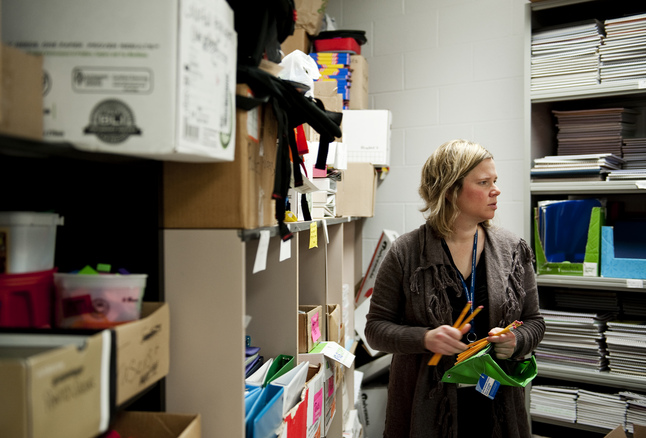
Education Project for Homeless Youth Program Manager Jennifer Martin stuffs a backpack full of school supplies at the Washtenaw Intermediate School District. Martin says many families have to go without the products they offer, like backpacks, food, clothing and more. "Every time we send it, we know we are helping out," she says.
Daniel Brenner I AnnArbor.com
Student homelessness continues to rise in Washtenaw County, and school districts are beefing up training to answer the call. Providing transportation, a federal requirement, also has been a challenge for schools.
From 2010 to 2011, homelessness among students grew 32 percent, according to numbers provided by the Washtenaw Intermediate School District’s Education Project for Homeless Youth.
Numbers increased from 973 students served to 1,282 students served in a year’s time and are on track to jump again for the 2012-13 academic year. These totals do not include homeless youth who haven’t been identified or families who have refused to accept services, said Education Project Program Manager Jennifer Martin.
Each public school district and charter school in Washtenaw County has a homelessness liaison officer who works closely with the Education Project. The liaisons’ primary responsibilities are to ensure their districts comply with the McKinney-Vento Homeless Assistance Act, which was created to ensure all youth, including homeless or transitional youth, have equal access to a free and stable public education.
With that mission in mind, McKinney-Vento requires all public districts and charter academies to provide free transportation for homeless kids to their schools of origin; to enroll homeless children immediately, even if they lack the usually required documents, such as immunization records or proof of residence; and to enroll children who are awaiting foster care placement.
Identifying homeless students is the primary responsibility of the liaison officers. The second responsibility is helping those children get to school, said Ann Arbor Public Schools liaison Azibo Stevens.
Emergency or “stop-gap” transportation is provided and paid for by the Education Project in order to give school districts the opportunity to work with families and discuss the best, most permanent form of transportation for them, Martin said. The project typically will provide this transportation for up to a week after a homeless family has been identified. It also allows time for enrollment and other paperwork to be processed.
Rerouting buses, public transportation passes, shuttles and taxicabs are frequent solutions to homeless families transportation problems. Or if a member of a family member has a vehicle and agrees to drive the child to school, sometimes districts will issue gas cards and mileage reimbursements to families, Stevens said.
The Ann Arbor district spends about $165,000 per year transporting homeless students.
Too many kids to taxi
Under the McKinney-Vento Act, if a child attending AAPS suddenly becomes homeless, the parent has a legal right to keep the child enrolled at AAPS, even if the family is forced to move in with a relative in Ypsilanti, Chelsea, Canton or even Detroit.
Stevens said he might try to discourage a family from doing this, if he thinks the commute is not in the best interest of the child. But legally, AAPS must provide transportation no matter what the family’s decision.
Stevens said he has had children endure an hour-plus ride in a taxicab in the past to get to school.
This fall, because of the volume of requests, Blue Cab, the company the county uses for taxiing homeless students, has had to cut off its services to districts and the Education Project.
“They said they’ve had too many this year. There is no more room in the books,” Stevens said.
In the spring of the 2011-12 academic year, Blue Cab had to make a similar statement, Martin said.
“That does say a lot that the time frame has changed,” she added. “We were surprised they filled up so quickly this year.”
Martin said the lack of taxicabs has not been a huge inconvenience as of yet. The Education Project has been able to work around it and the Ann Arbor district is the primary user of cabs among the county’s traditional public schools, Martin said. Stevens indicated AAPS has adjusted reasonably well.
Martin said if the number of homeless youth continues to grow by 30 percent to 40 percent, as it has the past few years, the Education Project would have to look at other options.
Hope Island, 27, is a homeless mother living in Ypsilanti with her two boys, 9 and 11. She and her sons moved to Ann Arbor from California three years ago for a “fresh start.”
Island had lost her job and her apartment in California and also was needed to help take care of her ailing father and younger sister, both of whom also struggled with homelessness in Washtenaw County.
For Island, whose boys grew up without a father, without grandparents and had been shuffled around a lot, giving her children stability in a school system was important to her. It outweighed the 30-minute cab ride.
Island said while some parents may look down at families who put their young children in a car with a stranger to get to school, it is sometimes the only option she and others in her situation have. Island said she made a point of meeting the cab driver the first morning.
“And my kids know if something doesn’t seem right to let me know,” she said. Island’s children ride in a cab with two or three other students who are also homeless and staying in Ypsilanti.

Azibo Stevens, McKinney-Vento homeless liaison officer for Ann Arbor Public Schools, grabs canned food from a shelf at the Washtenaw Intermediate School District.
Daniel Brenner I AnnArbor.com
‘Hope’ and success
Island has held a number of odd jobs since moving to the area.
Nearly three years ago when she came, the only job she could find was as a bell ringer for the Salvation Army outside of Kroger.
For their first year in Washtenaw County, Island and her boys spent many of their evenings in and out of shelters. But for the past two years, Island has been fortunate to be part of SOS Community Services’ Transitional Housing Program.
Through this program, SOS provides an apartment to approximately 16 families at a time. The families are required to pay SOS 30 percent of their monthly incomes for rent and SOS pays the rest, according to the organization’s website. Families can be a part of this program for up to two years and at the two-year mark, the families can remain in their apartments and begin paying rent on their own.
During the program period, SOS also provides intensive case management and employability services to its families.
Island’s two years with SOS are up this month, and she is both thrilled and anxious to re-take control of her life and her expenses.
Island has found a stable job doing custodial work for the University of Michigan. She said it’s exciting because although she still works the night shift from 5 p.m. to 1:30 a.m., meaning her sister still gets her boys ready and in the taxi for school, she has her weekends off to spend time with her family.
“Before I started at U of M in September, I was out of work for like two months. And SOS was a really big support for me during that time,” Island said. “They helped me with my job search and getting everything around.”
While she doesn’t yet feel “really secure” and she still has some fears about losing her job or losing her home, Island said her confidence is growing.
“I’m ready to be able to do everything on my own again,” she said.
Building allies and identifying homeless students
Connecting families like Island’s to the resources they need to get them back on their feet is a crucial part of a homeless liaison officer’s job.
“Aside from coordinating transportation and finding the most economical and viable way for families to get their kids to school, we sit down to find out what families’ immediate needs are and long-term goals. Then we match them with the resources to help them achieve those goals,” Stevens said.
Stevens said truancy is sometimes an issue among homeless students, so he tries to monitor students’ attendance rates. He also works to provide food to families, including turkeys around the holidays.
This is Stevens’ third year as the homeless liaison for Ann Arbor Public Schools. When he first started, aside from helping families with their basic needs, he also tried to spend time assisting students with their academics — providing homework help, support and mentoring when he could.
Children who are homeless are more likely to experience developmental delays, anxiety, depression, behavioral problems and lower academic performance than housed children, according to an Education Project report.
But now as Stevens’ caseload continues to grow, he is looking elsewhere for mentors and volunteers to help students achieve academic success.
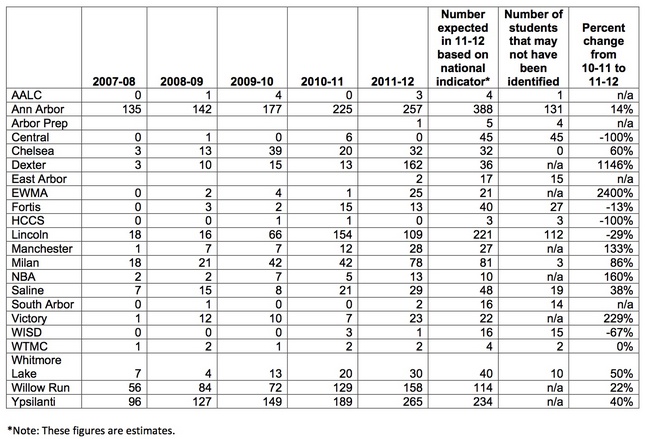
Prior to creating Stevens’ position, Ann Arbor served 135 homeless students in 2007-08, 142 in 2008-09 and 177 in 2009-10.
When Stevens was brought onboard, AAPS served 225 students in 2010-11 and 257 students last year. Stevens said the district is on track to identify and serve approximately 320 students for the current academic year.
According to a national indicator, districts should have a homeless student population equal to 10 percent of their free and reduced-price lunch population.
Martin said identifying homeless students is not an exact science, but districts use this national indicator as a target to see how many homeless students it potentially should be serving.
“In some districts, they could be doing a good job at identifying (students) and it’s more a matter of the national indicator is just not right for their school,” Martin said. “But we have countywide trainings and resources available to help them improve their counts.”
Last school year, Ann Arbor Public Schools had 3,878 students qualify for a free or reduced-price lunch. So, based on the national indicator, there were a possible 131 students that were not identified.
For the current school year, AAPS has implemented a building ally model. This model has been launched at each of the county school districts in the past few years. Essentially, one or two individuals at each school are trained to identify risk factors and homelessness red flags to help recognize potential homeless individuals.
‘I’m not homeless’
Prior to the McKinney-Vento Act, “homeless” was a term used to describe people or families sleeping on park benches or under bridges, Stevens said. But McKinney-Vento has broadened this definition to be more true to form.
The list of who is eligible for services under the McKinney-Vento Act is vast.
“We try not to use the word homeless when talking to families,” Martin said.
In Washtenaw County, the majority of families are “doubled up” or living temporarily with another family, after losing their jobs and then homes to foreclosure or eviction.
“Sometimes parents have a hard time seeing this as being homeless because they have a warm roof over their child’s head (when staying with someone else)... They don’t realize they can receive support,” Martin said. “… We see this as a real strength in our community though, too, that people are willing to pull together and help out.”
She added while families have good intentions when they take in their friends or relatives, often it doesn’t work out to be a viable solution.
Personalities clash, tensions are high and homeless children can act out and start not getting along with other kids in the home due to the trauma of being displaced, Martin said.
Extended illness, hardship due to a loss in the family, bad credit, inability to get a loan — Martin said there are so many reasons these days that families may end up homeless. She said the second largest group the Education Project sees is families living in hotels.
“Often they think their situation is just temporary and they’ll only be there a few nights. But that’s not always the case, and living in a hotel sometimes compounds the family's problems because of how expensive that is,” she said.
Stevens said the recent, national housing crisis helped shed some additional light on the issue of homelessness and has increased education on the topic. He said the stigma around being homeless is decreasing. Service organizations also are realizing homeless shelters are not the solution to the problem and are focusing their efforts on rapid re-housing, he said.
Danielle Arndt covers K-12 education for AnnArbor.com. Follow her on Twitter @DanielleArndt or email her at daniellearndt@annarbor.com.
Comments
Raven
Tue, Feb 12, 2013 : 6:02 p.m.
Children can be some of the most effected by homelessness. Yet they are hidden and not many know about how they are effected by homelessness. SOS Community Services helps these children with many programs to ensure that they can lead as normal lives as possible. Through these programs they serve these children and families to find stability and apart of that stability is going to the same school. SOS is available to help in providing transportation so that these children can lead a normal life as possible.
JRW
Mon, Jan 7, 2013 : 7:22 p.m.
I have to question the definition of "homeless." Lots of folks are in a tough situation, but finances are tight. Class sizes are huge and there is a need to hire more teachers so classrooms are not bursting with 30-35 students in a 3rd grade room. Spending money to taxi a student from Detroit to A2 and then back again is wrong. Yes, there are bad situations all around for many families, but starting out in A2 for a brief time and using the schools, and then moving to Ypsi or Detroit and expecting personalized transportation is not the best use of limited school budgets, nor does it make sense to transport a student for an hour a long distance twice a day. I can see why Blue Cab stopped its AAPS services. Probably was losing money. And there are some very disruptive students who in the past have been put into cabs without an adult. Very risky for the driver. AAPS needs to address the entire issue of students coming into AAPS and not living in the district, regardless of the reason.
Basic Bob
Mon, Jan 7, 2013 : 9:20 p.m.
While I agree in principle, they must follow federal law. I cringe at the thought that we might be running people out of town because they are poor.
T Wall
Mon, Jan 7, 2013 : 4:28 p.m.
T. Wall Foundation (www.twallfoundation.org) has experienced more homeless families then ever before. Two of the families we helped we're living in their car for the holidays. Our Foundation helps children with disabilities and their parents who are in financial trouble. In December we receive hardship letters from Special Education Teachers in Washtenaw County about their students. They see first hand the students who have been wearing the same clothes to school since September. They make home visits and witness that the families in their rented apartment or house have no furniture or beds. These families have much love and do not ask for anything. Red Berenson once said that the T. Wall Foundation flys below the radar. It is becoming harder each year to answer all our hardship letters but through the special angels on earth we are able to accomplish our goals.
Mike D.
Mon, Jan 7, 2013 : 3:33 p.m.
It's literally sickening that the majority of comments on here are of the "I don't want to support lazy welfare queens" variety. You should be ashamed.
JRW
Mon, Jan 7, 2013 : 7:15 p.m.
The forum allows for comments from all spectrums. None should be censored.
Danielle Arndt
Mon, Jan 7, 2013 : 3:07 p.m.
Just one clarifying point, public schools do not receive any grant money from the state or federal government to transport homeless students. Schools are required to pay for this out of their general funds. Granted, they do get the per pupil amount for keeping that homeless child in their district rather than having him or her enroll in another district/charter school. Just wanted to make sure it was clear schools weren't receiving grant money for transporting homeless youth. The Education Project is funded through federal grant money. Sunday's story talked about the structure and organization of the Education Project: http://annarbor.com/news/number-of-washtenaw-county-homeless-youth-on-the-rise-single-adult-totals-declining/. Also, this website has a pretty good list of who qualifies for assistance through the McKinney-Vento Act: http://www.ohiolegalservices.org/public/legal_problem/students-schools/education-rights-mckinney-vento/qandact_view.
annarboral
Mon, Jan 7, 2013 : 2:28 p.m.
How much does it cost for this program each year? Are we sure that those receiving benefits are truly eligible or are we just being generous? It makes no sense to transport a child now housed in Detroit to a school in Ann Arbor. What if the family moved to Alabama, would we fly the student to school every day? This report is full of the compassion that most all of us have but doesn't have enough facts.
JRW
Mon, Jan 7, 2013 : 7:30 p.m.
Personally I think the only students who should qualify as homeless in AA should be those living in shelters in A2. If you are living with a relative in Ypsi, then the student needs to transfer to Ypsi schools. There are a lot of scammers out there who are living with "cousins" that no one verifies and they attend AAPS. Not all of them are homeless at all. Their residences are in other cities and towns, but they want to attend AAPS, so they scam the attendance system. This is a very different population that those who are truly homeless. The homeless definition is too broad, at the expense of needed services in the district for students who actually live here. The district won't hire classroom aides for rooms where there are so many students crammed in that they don't have enough desks! My daughter teaches in AAPS and resources are not being used in a manner that many agree with.
Billy
Mon, Jan 7, 2013 : 2:50 p.m.
More kids in the public schools here means they get more money from the state...at least that's how the school board views it... Calculate in the additional costs of transporting those kids along with no ADDITIONAL tax revenue from those kids parents (that actual new residents with children would bring in)...and it's barely a profit...and then at what cost?
Halima
Mon, Jan 7, 2013 : 1:29 p.m.
Could you please explain why Blue Cab has stopped providing transportation? If they are a for-profit business, and they are being paid the going rate for cabs, why would they want to stop carrying these students? Because normal economic theory states that, ceteris paribus, the only reason for a change in quantity supplied is price. Does the school district pay less than the market rate, thereby establishing a price ceiling and leading to a SHORTAGE?
JRW
Mon, Jan 7, 2013 : 7:14 p.m.
Agree that the program is abused. Some kids are taxied around town to meet up with parents who work for the district in a different building on a different schedule.......
Billy
Mon, Jan 7, 2013 : 1:43 p.m.
They explained it....they don't have enough cabs...period... They do this for ANY kids on assistance who are enrolled in AAPS that don't live in district. This program is HEAVILY abused...
Billy
Mon, Jan 7, 2013 : 1:09 p.m.
"In Washtenaw County, the majority of families are "doubled up" or living temporarily with another family, after losing their jobs and then homes to foreclosure or eviction." No offense...but that's NOT homeless. It's a sucky situation...but that is FAR from homeless. Do you have ANY idea how many people end moving back in with their folks today? Are you calling those people homeless too? Look....I can feel bad for them because they might be suffering hardships....but to put them on the same level as a family that is LITERALLY homeless and living on the street?....that's just wrong...and a downright insult to those who are ACTUALLY homeless... I'm sorry but aid should be going to the ACTUAL homeless family before it goes to one with a roof over their head...and you're telling me they have the SAME eligibility for this program? I don't NOT want those people to get assistance too....but I certainly don't think they should be eligible for the same level of benefits. That's just fiscally irresponsible...and isn't that one of the causes of homelessness?
Michigan Reader
Mon, Jan 7, 2013 : 11:07 p.m.
@Billy--Definitions can often be arbitrary. For purposes of the McKinney-Vento Act, the definition is broad, and liberal on its face. It's to help the most people. Yeah, that leaves the door open to abuse of the programs offered by the school districts.
Danielle Arndt
Mon, Jan 7, 2013 : 2:58 p.m.
Billy, under the McKinney-Vento Act, families who are doubled up or livening with another family do qualify for assistance from their public schools. This website has a pretty good list of who all qualifies and gives some reasons for why homeless children need a federal law to protect them: http://www.ohiolegalservices.org/public/legal_problem/students-schools/education-rights-mckinney-vento/qandact_view
Tom Todd
Mon, Jan 7, 2013 : 11:35 a.m.
for profit schools spend how much getting children to school?
alarictoo
Mon, Jan 7, 2013 : 4:28 p.m.
@AMOC - It will not be as much, because most Charter Schools will find a reason not to accept those students.
AMOC
Mon, Jan 7, 2013 : 2:04 p.m.
If you mean private schools that charge tuition, they spend as much as they chose to on scholarships that may include transportation support. If you are talking about charter schools, by law they spend as much as they must to support their homeless students, just like the public school systems do. It may not be as much, because parents are typically required to transport their students who attend charter schools on their own, unless there are identified special needs.
Billy
Mon, Jan 7, 2013 : 1:10 p.m.
GOGO vouchers!!!