

Rick Snyder: Michigan can beat economic forecasts in 2012

In an interview, Michigan Gov. Rick Snyder discussed the need to improve Michigan's worker retraining programs, addressed calls to tie university funding to performance and discussed why he signed a bill forbidding governmental units from providing benefits to domestic partners.
Chris Asadian | AnnArbor.com
(Earlier story: MLK Day march to Rick Snyder's Ann Arbor area home planned in protest of emergency manager law)
One legacy of Gov. Rick Snyder’s life as an accountant in the 1980s is an affinity for “dashboards.”
The Republican, a former Ann Arbor venture capitalist, rarely lets a speech go by without discussing quality metrics, dashboards and assessments gauging progress.
Snyder’s State of State address on Wednesday is one big progress report — the kind of dashboard Snyder believes is necessary for the state to chart its economic and political progress.
In January 2011, Snyder used the State of the State address to proclaim that “job one is jobs,” setting the stage for a budget battle and a push for tax reform that ended Michigan’s chronic budget deficits but angered many and sent his approval ratings plummeting.
His push for emergency manager legislation — billed as a way to help distressed cities repair their finances — has proved divisive. On Monday, protesters plan to march to Snyder's house in Superior Township to rally against the law.
After the drive for frugality, Snyder turned to other issues, including one of his personal passions — devising economic development strategies to train unemployed workers for 21st Century jobs.
Since he took office, Michigan’s unemployment rate has fallen below 10 percent for the first time in three years — partly due to new jobs and partly due to people leaving the workforce.
University of Michigan economists project that Michigan will add 68,700 jobs in 2012 in 2013, fueling a “sustained recovery” at a “subdued pace."
Looming as a threat to the recovery, though, is uncertainty regarding the federal government’s debt ceiling and the European debt crisis, Snyder told reporters Tuesday at the Detroit auto show.
“If both of those were to be resolved in some constructive fashion, I think we’d see our economy grow even faster,” he said. “My goal, as governor, is to say, how do we beat the forecasts? I think there’s an opportunity to do even better than forecasts if we continue the policies that we’re doing and we see continued consumer participation in the marketplace.”
In an interview with AnnArbor.com's Nathan Bomey, Snyder discussed Michigan’s job market, the prospect of funding changes for public universities and schools, his decision to sign legislation outlawing same-sex benefits for government employees and whether Detroit should be allowed to file for bankruptcy. Excerpts:
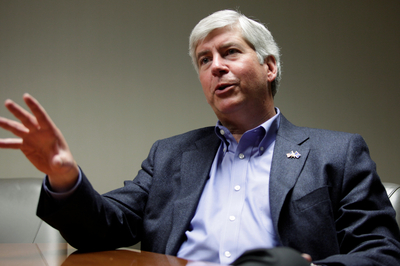
Gov. Rick Snyder will deliver his second State of the State address on Wednesday.
Chris Asadian | AnnArbor.com
AnnArbor.com: What kind of message do you hope to send at the State of the State?
Rick Snyder: It’s about giving a report card, saying this is what transpired over 2011 and here’s the dashboard — and giving an update about the agenda for 2012.
AnnArbor.com: You’ve mentioned this a few times — that Michigan has approximately 70,000 unfilled job openings (according to job listings at MiTalent.org). Are you satisfied with the quality of those openings?
Snyder: Yeah, if you look at that list … there are some really nice jobs. Actually one I was proud of — and you know my background — accountants were on the top 10 list. There was a need for several thousand more accountants, and those are good jobs.
If you looked at the top 10, without doing a lot of analysis, you’d say more than half of them, these are good spots.
AnnArbor.com: You’ve talked a lot and your predecessor talked a lot about how we have the best talent pool in the country. Yet we still have all these job openings. So what’s the disconnect?
Snyder: Well there was no connection between supply and demand. It was a basic economic flaw. That’s where I like the marketplace concept. This MiTalent.org is a portal to make that connection.
I learned this from actually the Ann Arbor SPARK days, talking to Michigan Works. We had SPARK doing economic development with companies and we had Michigan Works doing workforce development, and it was all about training and skills.
No one was doing the equation of … you need to match supply and demand. This is not rocket science. It is economics.
AnnArbor.com: In your talent message in November, you said you’re not satisfied with the way Michigan Works is operating right now.
Snyder: Yeah.
AnnArbor.com: Where does it need to be?
Snyder: It needs to be helping make that further connection. It’s not enough to simply say, ‘Here is a program to give you a set of skills and may the force be with you.’
Actually the analysis should go the other way. Let’s look at supply and demand and help you identify a career where there are real opportunities and then how do we help you acquires skill to be successful in that?
That’s the simplistic way to look at this. Too often we would simply just say, 'What interests you?' Or, 'What do we have open and available — and here are skills,' rather than saying, 'Here’s a solution. Now, how do we get you positioned to be successful on that solution?'
AnnArbor.com: You took a lot of heat, particularly in the Ann Arbor community, for signing the bill that forbids governmental units from offering benefits to domestic partners. Did you grit your teeth when you signed it? Why did you sign it?
Snyder: It goes back to the Civil Service Commission really starting an economic argument during the budget crisis. Basically they added benefits for state employees and it was not a financially prudent measure when we had a billion-dollar deficit.
So that whole dialogue and discussion started back in those days about the public sector in terms of other employees and the need to be cost efficient in these difficult times.
That was the genesis of that whole issue.
AnnArbor.com: Are you concerned at all that it could hurt cities’ ability to recruit talent?
Snyder: As a practical matter, it would really be more in the university context that would be the area of greatest concern — and also they’re autonomous, so they’re supposed to be able to make their own decision.
AnnArbor.com: You’ve hinted that this year universities and schools might get a little more funding, but it would be strings attached. What kind of strings?
Snyder: Well, it’s called metrics, measures and showing results. Clearly if you look at it, that was something that was missing from the entire public sector: accountability, transparency and showing that you’re actually delivering results. It’s not about spending money. It’s about real results for real people — value for money.
AnnArbor.com: Are they spending too much money on programs that are delivering graduates who don’t have any practical skills?
Snyder: I’m not going to speculate on that, but I would say our goal is to make sure they’re graduating people before you even get to that. We have far too many people who start a college education that stop that process or don’t complete that process.
The real question is: Shouldn’t we be doing more to figure out what that issue is and how to get people successful? The universities, to their credit, know that’s an issue and have been working on it.
So I don’t want to sound like they’ve been ignorant of that issue, but that’s been a more recent development that they’ve been very proactive about understanding the consequences of that and how they can help solve it. Eastern, to their credit, has been very good.
AnnArbor.com: What’s the case against allowing Detroit to go bankrupt? Obviously we know the state’s credit rating could be downgraded, but beyond that?
Snyder: Well, one of the challenges with Chapter 9 bankruptcy is there’s very little track record. It’s not like the corporate world, where it’s happened often enough and there’s a whole litany of legal precedent, professional precedent.
Chapter 9 has not been utilized enough to actually say with certainty here are the steps, the stages, here’s how it would operate.
So in many respects, you’re really turning over to a federal judge who doesn’t necessarily have the background and precedent to say this is how the process would work. So it might work great, it might not work great.
But again you’ve got a lot more uncertainty in that whole process.
AnnArbor.com: Not the same as GM and Chrysler.
Snyder: No.
Contact AnnArbor.com's Nathan Bomey at (734) 623-2587 or nathanbomey@annarbor.com. You can also follow him on Twitter or subscribe to AnnArbor.com's newsletters.
Comments
Cash
Mon, Jan 16, 2012 : 12:28 p.m.
"It's all right to tell a man to lift himself by his own bootstraps, but it is cruel jest to say to a bootless man that he ought to lift himself by his own bootstraps." ? Martin Luther King Jr.
John Q
Mon, Jan 16, 2012 : 5:06 a.m.
Snyder's response on domestic partner benefits is pathetic. He's better off saying nothing because his actual response is a joke.
Sparty
Mon, Jan 16, 2012 : 9:25 a.m.
Doesn't even mention that it's already costing the State money due to the Federal lawsuit in the US Federal District Court where numerous violations of the 14th Amenment to the US Constitution are charged.
Homeland Conspiracy
Sun, Jan 15, 2012 : 11:20 p.m.
I bet his lapel pin in "Made In China"
Homeland Conspiracy
Mon, Jan 16, 2012 : 3 a.m.
*is
Kai Petainen
Sun, Jan 15, 2012 : 9:23 p.m.
here's a longer interview with Snyder <a href="http://www.youtube.com/watch?v=CjgoW1Mv_qM" rel='nofollow'>http://www.youtube.com/watch?v=CjgoW1Mv_qM</a>
Kai Petainen
Sun, Jan 15, 2012 : 9:14 p.m.
This is not a comment about policies or what is good/bad about Snyder.... but a comment about the reporting. I really like this type of reporting. Nicely done.... It's a simple Q&A, and some great questions. Excellent stuff.
alan
Sun, Jan 15, 2012 : 5:17 p.m.
I get annoyed when people elected to political office think that they are automatically qualified to discuss economic theory. He is an accountant and attorney, nothing more.
alan
Sun, Jan 15, 2012 : 6:25 p.m.
You have missed the point. Accounting and business are not economics. Being elected governor does not mean that he understands economics any more than anyone else.
Angry Moderate
Sun, Jan 15, 2012 : 6:11 p.m.
How dare a successful accountant, attorney, and businessman discuss the economy of the state of which he's been elected governor! What an outrage.
Sparty
Sun, Jan 15, 2012 : 3:43 p.m.
Talk about poorly phrased leading questions, no follow-up, "let me kiss your ring" attitude ..... , this has to either qualify as the biggest joke or worst interview I've seen in years.
Marshall Applewhite
Sun, Jan 15, 2012 : 4:05 p.m.
"In 4 years, you're going to be blown away." It might actually come to fruition this time.
ViSHa
Sun, Jan 15, 2012 : 4:02 p.m.
Did you not see the interview with Superintendent Green? It's comparable.
Dante Marcos
Sun, Jan 15, 2012 : 1:03 p.m.
We refuse to be highrised, diplomaed, licensed, inventoried, registered, indoctrinated, suburbanized, sermonized, beaten, telemanipulated, gassed, booked.
sbbuilder
Mon, Jan 16, 2012 : 12:08 a.m.
Who is 'we'?
Steve
Sun, Jan 15, 2012 : 12:59 p.m.
Sorry but a leader making the really tough decisions is exactly what we need right now.
Alan Goldsmith
Sun, Jan 15, 2012 : 12:43 p.m.
Wow, still snow on the group but it looks like softball season has started from these questions. I except nothing else from AnnArbor.com. 1. "The Republican, a former Ann Arbor venture capitalist, rarely lets a speech go by without discussing quality metrics, dashboards and assessments gauging progress." Unless you are talking about SPARK--you won't be getting any of that from the Governor or AnnArbor.com. 2. "You took a lot of heat, particularly in the Ann Arbor community, for signing the bill that forbids governmental units from offering benefits to domestic partners. Did you grit your teeth when you signed it?" No gritting of teeth. It was all about 'saving money', not about rolling over, being a wimp and signing a bill passed by your Republican friends that furthers hate and sends a clear message that Michigan is still in the 19th Century when it comes to civil rights. 3. Well, it's called metrics, measures and showing results. Clearly if you look at it, that was something that was missing from the entire public sector: accountability, transparency and showing that you're actually delivering results. It's not about spending money. It's about real results for real people — value for money.' You know, sort of like SPARK--tax dollars going to a private group, including from the City of Ann Arbor, with no openness, transparency, local media review and political and media folks on your Board of Directors who do nothing to further the process. 4. "What's the case against allowing Detroit to go bankrupt? Obviously we know the state's credit rating could be downgraded, but beyond that?" And we know, from repeating this Governor bullet point, how exactly? 5. "His push for emergency manager legislation — billed as a way to help distressed cities repair their finances — has proved divisive." So no reason why it's decisive? You know, spitting in the face of elected democracy, tossing out elected officials, la la la, like some third world c
Stephen Lange Ranzini
Sun, Jan 15, 2012 : 12:28 p.m.
Michigan can beat the economic forecasts in 2012 if: 1. We make it easier to get capital into the hands of entrepreneurs with good business ideas & good business opportunities. Michigan is near the bottom in venture capital formation. To fix this we should leverage our huge pool of pension fund capital to invest in venture capital providers & leverage Internet crowd sourcing techniques to: a. Allow people to post business opportunities that they know would work but are missing some key ingredient & use the wisdom of crowds to bash it into a good business idea & find the missing pieces; b. Match people with good business ideas with people with skills willing to help with sweat labor to lower the cost of start-up; c. Match people with good business ideas with people with capital. 2. Establish a "Buy Made In Michigan" Internet service that makes it easy to find locally grown products to buy & have delivered to our homes and businesses, & makes it easy for those businesses to: a. List their products, prices & product specs in a searchable database; b. Ship those products locally & globally through a logistics portal service leveraging all existing providers; c. Find & sell to additional international customers, including a one stop shop for completing all the paperwork required to export products, leveraging the United Nations' CEFACT "Single Window" standard (I have been the U.S. banking Industry representative to the UN group that built this standard over the past 12 years.) 3. Help create solutions that leverage the White House's National Strategy for Trusted Identities in Cyberspace program to provide Michigan citizens & businesses with an optional online drivers license that allows them to use the Internet in a highly secure manner. This would enable a whole ecosystem of new firms to launch businesses not currently possible because the Internet is still a "Wild West" and r
Kai Petainen
Mon, Jan 16, 2012 : 5:34 a.m.
question... "So, the banking industry is no longer able to make character loans, or to support start-up businesses." .... so is that what SPARK is for?
John Q
Mon, Jan 16, 2012 : 5:03 a.m.
"What I have advocated for many years is that pension funds should only invest in local real estate or local businesses, if an equal or greater amount of funds is invested on the same terms from sophisticated private investors" As was noted, this was done by Detroit pension funds with terrible results. It's a great way to enable fraud and corruption.
Stephen Lange Ranzini
Mon, Jan 16, 2012 : 2:52 a.m.
@YpsiVeteran: After the savings and loan crisis, during which the Congress had to lend $300 billion to the S&L Deposit Insurance Fund (the FSLIC, and then forced the banking industry to pay for the bailout), Congress passed a law that prevents banks from making loans to businesses, except where the business has both excellent collateral AND a proven track record of profits sufficient to pay back any loan. So, the banking industry is no longer able to make character loans, or to support start-up businesses. It's a big problem, I assure you! I am speaking as a bank president who has experienced first hand this problem, and it's an extremely serious problem and one of the reasons why the economy isn't producing as many jobs as before. I agree with you 100% that pension funds have been raided and abused in the past. What I have advocated for many years is that pension funds should only invest in local real estate or local businesses, if an equal or greater amount of funds is invested on the same terms from sophisticated private investors. For example, if McKinley was investing equity in a local real estate deal, I'd be totally okay with the county pension fund to make the same investment, in an amount equal to or less than what McKinley was co-investing.
YpsiVeteran
Mon, Jan 16, 2012 : 12:19 a.m.
You have many good ideas, but I have to take you to task on one of them. Banks are sitting on enormous war chests of funds that can be used/risked for venture capital. Speculative loans for start-ups and other "investments" using pension money is part of the reason people are in danger of losing their pensions today. See any one of the many city of Detroit pension fund debacles if you doubt this. Hundreds of millions up in smoke...poof...separate from the losses caused by the collapse in the financial markets. Leave pension money alone. No one remembers the loans and can't-miss real estate investments that benefitted everyone but pensioners when, all of a sudden, pensions are "unaffordable."
Stephen Lange Ranzini
Sun, Jan 15, 2012 : 1:47 p.m.
If you're willing to do some work & help turn these ideas into reality, think you've got some abilities that are useful for these kinds of start-up activities and some time to get involved, please email me at ranzini@university-bank.com
Stephen Lange Ranzini
Sun, Jan 15, 2012 : 12:49 p.m.
The missing words in the last line of my post are "risky to use". Australia already has implemented a national version of idea #2c and instead of having to fill out over 100 different forms, if you want to import or export anything into the country, you just fill out one web form, and behind the scenes the "Single Window" service makes the forms go where they need to be. South Korea and Italy have also implemented this. If we build it in Michigan and test it along the Canadian border, all the jobs will be created here, since the U.S. Government isn't yet working on building a "Single Window". We can then offer the service nationwide. Amazon.com will white label their existing service to provide ideas #2a and #2b at a low start-up cost. There are other options available. <a href="http://www.cambrianhouse.com" rel='nofollow'>www.cambrianhouse.com</a> was the pioneer who created the first Internet portal to do Ideas #1a and #1b. They will license us their software for a reasonable fee to implement this crowd sourcing business formation idea. There are many existing off the shelf Internet service based solutions to leverage for Idea #1c. For more information on the White House's National Strategy for Trusted Identities in Cyberspace program and to understand what the possibilities are for creating whole new ecosystems of jobs creating businesses if we roll this out first here in Michigan, see their website: <a href="http://www.nist.gov/nstic/" rel='nofollow'>http://www.nist.gov/nstic/</a>
4Bells
Sun, Jan 15, 2012 : 12:13 p.m.
Monarchs tend to have a bounty of gold, gems & doubloons in their treasure chests . . . also at the dear expense of the serfs, peasants & peons.
Angry Moderate
Sun, Jan 15, 2012 : 6:09 p.m.
Monarchs tend not to be elected by the people in free and fair elections, and survive recall attempts backed by a warchest of union funding.
Steve
Sun, Jan 15, 2012 : 1:03 p.m.
People who have been successful typically are responsible for creating jobs. The Granholm 'Monarchy' certainly didn't and her treasure came from....us.