

Public health officials considering mosquito control after woman's death from West Nile virus
After a Washtenaw County woman recently died from West Nile virus, local public health officials are considering whether mosquito control measures should be enacted.
“We’re assessing if we need to make a recommendation to the local communities,” said Laura Bauman, epidemiologist for Washtenaw County Public Health.
The Michigan Department of Community Health announced the death of the Washtenaw County woman Thursday. Health officials said the woman is between the ages of 75 and 85 but released no other information about her. The woman is the first person to die from the virus in 2012 in Michigan.
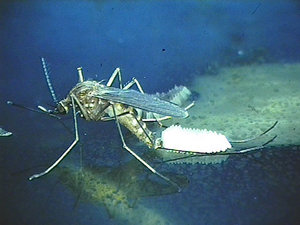
The Culex mosquito transmits West Nile virus from birds to humans.
The Centers for Disease Control and Protection
“All of southeast Michigan is at risk,” Bauman said. “We don’t want to give that message that in one part of the county, you’re safe.”
Bauman described the woman as “active” and the kind of person who didn’t just sit inside.
Though the risk of West Nile virus from mosquito bites is real, most people bitten by an infected mosquito are not going to become ill, said Susan Ringler-Cerniglia, spokeswoman for the health department. The Centers for Disease Control says people over the age of 50 are more likely to get sick if exposed to the virus.
The virus can cause a mild illness to severe illness -- including encephalitis or meningitis, which are inflammations of the brain -- in humans and other animals.
Health officials said the virus is very active in Washtenaw County this year. Dead bird reports collected by the health department through its hot line (734) 544-6750 have indicated widespread activity of the virus in birds across Washtenaw County, Ringler-Cerniglia said.
After consulting with experts at the state level, the county’s environmental health department will be following up with municipalities if further action needs to be taken, Ringler-Cerniglia said.
“The thing that’s tricky about West Nile - this isn’t a wetland mosquito,” Bauman said of the Culex mosquito that transmits the virus from birds to humans. “They just need a small amount of water and small amount of organic matter (to breed).”
Experts stated in July that the hot, dry conditions this summer were “very suitable for an epidemic” of West Nile virus this year.
With budget constraints in recent years, many municipalities that used to have mosquito population control programs stopped funding them. Because nuisance mosquitoes have not been a problem this year, likely because of the drier weather, not many early precautions have been taken, Ringler-Cerniglia said.
In years past, some communities - including Ann Arbor - have put larvicide in storm drains to stop the mosquitoes' eggs from hatching.
Dallas County, Tx. launched aerial spray offense this week to combat a mosquito population that has caused the nation's worst outbreak of West Nile virus. To date, the virus is responsible for killing 10 people and sickening at least 230 others in Dallas County.
“We’re not sure if at this point in the season if larvicide would even be helpful. That’s why Dallas did the spraying,” Bauman said. “To interrupt a human epidemic, you would have to take down the adult mosquito population.”
As of Aug. 16, 30 cases of West Nile virus have been reported in Michigan this year, three of which were in the city of Detroit, and the remainder in the following Michigan counties:
- Macomb: 8 cases
- Wayne: 8
- Lapeer: 1
- Livingston: 1
- Ingham: 1
- Kent: 3
- Allegan: 1
To avoid contact with the Culex mosquito that carries the virus, experts advise to wear long sleeves and pants, as well as insect repellent that contains DEET when going outdoors in the morning and evening when the mosquitoes are the most active. Window and door screens should be repaired. Containers of standing water should be emptied.
Amy Biolchini covers Washtenaw County, health and environmental issues for AnnArbor.com. Reach her at (734) 623-2552, amybiolchini@annarbor.com or on Twitter.
Comments
Epengar
Mon, Aug 20, 2012 : 2:11 a.m.
Like Ms Armentrout, I tried "Mosquito Barrier" last year. It's a repellent made from garlic extract. You can spray it in your yard and garden. It has no odor once it dries, and is harmless to people and pets. I used it relatively late last year, after the population of mosquitos had started to decline, but I think it did work. The manufacturer claims it works on ticks and fleas too. I'm not sure what stores have it, but you can buy it from the County Conservation District office: http://washtenawcd.org/ps/other.php
Itchy
Sat, Aug 18, 2012 : 8:44 p.m.
One person dies (very unfortunate) and our officials are ready to overreact.
Peter Eckstein
Sat, Aug 18, 2012 : 3:04 p.m.
I think it is irresponsible of the health department not to inform us of the location within the county of where the woman was infected. A quick check of the obituaries for the past few days reveals that the only person matching the description given is an 84-year old woman from MILAN. This does not tell us where she became infected, but it at least suggests the part of the county where the greatest precautions might be taken.
Epengar
Mon, Aug 20, 2012 : 2:05 a.m.
Read more carefully. The public health official addressed your concern, by saying that they have no reason to think that the area near where the person got infected is more dangerous than any other area in southeast Michigan. "Bauman said the health department will not release where the woman is from or where she was before she got sick. "All of southeast Michigan is at risk," Bauman said. "We don't want to give that message that in one part of the county, you're safe.""
Tru2Blu76
Sat, Aug 18, 2012 : 1:41 p.m.
RE: " local public health officials are considering whether mosquito control measures should be enacted." -- So it's safe to assume that such mosquito control measures would start .... sometime in September?! A locally famous phrase comes to mind: This IS Michigan. ;-) 1 death (however tragic) attributable to West Nile Virus (a gift from Egypt) in a population of 9 million still only increases the odds slightly (1 in 9 million vs 1 in 11.9 million nationally). Even assuming a more timely application of mosquito control measures would have saved that one victim, it still remains to be determined the total cost to all cities for such a program. I think I'd rather bear the cost of personal protection than have an expense added to the public debt.
motorcycleminer
Sat, Aug 18, 2012 : 11:56 a.m.
Here under the bubble in OZ, they love mumbo jumbo..perhaps the tongue depressor could be melted and resculpted into the form of a mosquito and appropriate offerings placed before it...or who knows maybe the secret radiation from all those smart meters will actually repell them in the first place....
Emily
Sat, Aug 18, 2012 : 11:42 a.m.
Won't somebody please think of the children?
Homeland Conspiracy
Sat, Aug 18, 2012 : 6:52 p.m.
For God sake somebody please think of the children!
Macabre Sunset
Sat, Aug 18, 2012 : 6:08 a.m.
The sprays they use today are nothing like what they used in the past. Very safe for everyone. This seems like a no-brainer.
demistify
Sat, Aug 18, 2012 : 4:17 p.m.
OK, so it is not safe for mermaids with bees in their bonnets.
mermaid72
Sat, Aug 18, 2012 : 12:28 p.m.
Not safe for bees & fish. Not safe if accidentally swallowed. This is the report from Dallas. Doesn't sound that safe.
Homeland Conspiracy
Sat, Aug 18, 2012 : 3:30 a.m.
The sky is falling, the sky is falling, The sky is falling, the sky is falling....
Vivienne Armentrout
Sat, Aug 18, 2012 : 1:03 a.m.
Please, no panic, no aerial spraying of toxic insecticides. Texas communities are considering this, but they have had hundreds of cases and many deaths. Pesticides can cause many short- and long-term chronic and acute problems. Let's not cause widespread morbidity out of panic. Actually, the mosquito infestation has not been so great this year (my personal observation; I've had perhaps 5 bites all season). We had more deaths and more serious sickness in previous years. I think I contracted it when it first became prevalent. That was when we were having lots of dead jays. I had a couple of weeks of sore joints, lassitude, and headaches, and then it was over and no re-occurrence. Last year was very bad and we used a preparation available from the Washtenaw County Conservation District that consists largely of garlic extract. It really worked. It is called Mosquito Barrier. We have not needed to use it this year.
A2comments
Sat, Aug 18, 2012 : 11:52 a.m.
Texas is doing aerial spraying, not considering it.
girlhunter
Fri, Aug 17, 2012 : 9:15 p.m.
We laid this sweet lady to rest today.. She was the kindest, most loving person you would ever meet. God truly took one of the angels on earth. May you bless the the gates of heaven, the way you blessed the doors of our church.
Bob W
Fri, Aug 17, 2012 : 9:04 p.m.
What exactly are "the measures" being considered?
mhirzel
Fri, Aug 17, 2012 : 9:01 p.m.
As is true for ANY illness, it is the condition of the host (i.e. you) that determines how far any bacteria, virus, fungus can get with you. This is why one person may encounter a virus and not even be aware they were infected, and another develops deadly complications. Nutritional and immune status is key, though Public Health officials are more concerned with pushing vaccines and other toxic chemical wonder concoctions, to concern you about that. Being carpet-bombed with pesticides is NOT going to improve the condition of any of us!
Renee S.
Sun, Aug 19, 2012 : 5:15 a.m.
Unfortunately, unless you find a way to stop aging, people over 50 are still going to be more susceptible to disease. I suppose you think we should write them off?
whatsupwithMI
Sat, Aug 18, 2012 : 2:20 a.m.
Keep in mind that your immune system at its very best is great proof that the watchmaker is indeed blind. Yes, immunocompromised individuals are at higher risk- just as they are for anything. You could also just be unlucky, since a lot of this is just random. Not *you* though, clearly you'll be fine. I agree though any discussion of spraying etc. seems unwarranted at this time. Though I take that position based upon different criteria than saying "well, weak people will get sick..."
G. Orwell
Fri, Aug 17, 2012 : 8:16 p.m.
Please no scaremongering like the swine flu hoax and no aerial spraying with toxic and dangerous chemicals. One death from a mosquito is no big deal (although any premature death is a tragedy). Axxording to Johns Hopkins, pharmaceuticals kill an estimated 200,000 people a year. Why doesn't the CDC do something about this?
Renee S.
Sun, Aug 19, 2012 : 4:56 a.m.
Because the CDC is the Center for DISEASE Control. Pharmaceuticals are the prerogative of the Food and DRUG Administration.
ChelseaBob
Fri, Aug 17, 2012 : 8:02 p.m.
What are the symptoms? I'd rather not wait until my brain has swollen and I am unconcious to seek treatment.
Itchy
Sat, Aug 18, 2012 : 8:46 p.m.
You feel sick.
Nunya
Fri, Aug 17, 2012 : 8:34 p.m.
Google can be your friend
Ron Granger
Fri, Aug 17, 2012 : 7:45 p.m.
This is nothing compared to the growing threat of Lyme disease from Ticks - in Michigan. Global Warming - the bug wars are upon us.
Kyle Mattson
Fri, Aug 17, 2012 : 8:14 p.m.
I hear you Ron, I haven't noticed mosquito numbers being any different this year, but it seems that nearly every time that I've gone out mountain biking or hiking I end up with a tick crawling on me...can't stand those things!
A2comments
Fri, Aug 17, 2012 : 7:52 p.m.
RIght. Deer are the biggest threat and they are multiplying in an uncontrolled manner in our area. Time to authorize limited and targeted hunting exercises.
Craig Lounsbury
Fri, Aug 17, 2012 : 7:20 p.m.
Its worth noting I think, that according to the CDC 80% of folks who contract show no symptoms and there is believed to be a near life long immunity developed after. So there are some of us, who knows how many, walking around immune because we had our "episode" and never knew it.
treetowncartel
Fri, Aug 17, 2012 : 9:27 p.m.
Craig makes an excellent observation. Why would this get voted down?
Major
Fri, Aug 17, 2012 : 7:42 p.m.
I hope I have an immunity, I spend a lot of time in the woods and fields. Been skeeter free so far but with the rain we just had...I bet they're coming!