

Public art tax will go on November ballot in Ann Arbor following City Council approval
Ann Arbor voters will be asked in November to approve a four-year tax for public art after the City Council voted Monday night to put the question on the ballot.
The measure — sponsored by Mayor John Hieftje and Council Members Christopher Taylor, Stephen Kunselman and Sabra Briere — passed 10-0 with Margie Teall absent.
Council Member Jane Lumm, an Independent who represents the 2nd Ward, made known she doesn't like that the proposal asks voters to essentially choose between two funding mechanisms. That is, voters are posed with the question of a new tax versus keeping the current funding mechanism.
Lumm said she'd rather see the city first abolish its controversial Percent For Art Program and then give voters a chance to decide whether there should be funding for public art at all.
She brought forward a resolution to that effect, but in a 6-3 vote nearing midnight she was able to garner support only from Kunselman and Mike Anglin.
Marcia Higgins had left the meeting by then.
If voters approve the 0.1-mill tax in November, it would raise nearly $460,000 in the first year and cost the average homeowner a little less than $11 per year. It would replace the Percent For Art Program, which funnels a portion of the budgets for city capital projects toward a special art fund. But if the tax isn't approved, the Percent For Art Program remains in place.
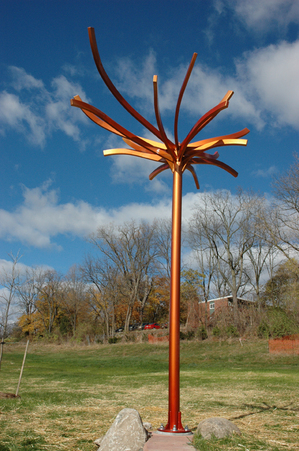
A pair of orange metallic tree sculptures in West Park were paid for with Ann Arbor's Percent For Art Program, which will be suspended if voters approves a new tax in November to fund a new public art program.
Courtesy of City of Ann Arbor
Hieftje and Taylor both said they're confident the public art tax will pass in November, but if it doesn't, they're willing to acknowledge that the voters have spoken and they'll take a careful look at the Percent For Art Program at that point.
Taylor said he wasn't willing to promise he'd introduce legislation to eliminate the program if voters say no to public art in November, though.
"A no vote can mean a number of different things," he said. "A loss by a single vote may mean one thing. A loss by a landslide could mean something else. And I think it's important that we wait and see what the voters have to say and then strive to interpret that accordingly."
Since 2007, the Percent For Art Program has diverted more than $2 million away from various city funds, including the water and sewer utilities and the streets and parks millages.
One of the criticisms of the program has been that it leaves the city's Public Art Commission with its hands tied — able to spend those revenues only on permanent art installations that relate somehow to the source of the funds, such the $750,000 water sculpture in front of city hall that was paid for with water and sewer funds.
Council Member Tony Derezinski, who serves on the Public Art Commission, said Ann Arbor residents are being given a chance to approve a much better program with more flexibility.
"I had led the fight a couple of times to keep the 1 percent for art, successfully," he said. "But that doesn't say it was perfect. It was imperfect, I knew that, but now we've been offered a better alternative."
Supporters of the tax proposal say having a dedicated millage for art will allow more flexibility to fund temporary or short-term installations, and even performances and events such as FestiFools, a parade of papier-mache puppets through downtown.
Council Member Carsten Hohnke, D-5th Ward, said he'd rather keep going with the Percent For Art Program and add a new public art tax on top of it. He failed to win support for that proposal Monday night.
"I think that might concern a lot of people," Derezinski said. "In effect, what you're proposing might very well kill it and that bothers me … not that I don't think the money could be spent wisely."
Hieftje agreed with Derezinski. He said he appreciated Hohnke's zealousness and confidence in voters to support public art, but he didn't want to overreach and ask voters for too much.
Hieftje said he's always supported public art, not only from a cultural perspective, but also the potential for economic development that it fosters.
"This would free the Art Commission and the City Council up to fund some different things — to truly have art spread around the city," Hieftje said of the proposed tax. "It changes the program significantly."
Higgins asked whether the public art millage could help pay for an event such as the Ann Arbor Summer Festival. Abigail Elias, chief assistant city attorney, didn't have a definitive answer.
"I had questioned what does 'performance art' mean," Elias said, adding there's a well-accepted definition and it refers to a "less formal" situation occurring on either a city street, sidewalk or other public site.
"It seems to be pretty flexible but excludes something like a theater performance," she said. "In other words, if you're performing at a venue, within a theater, that's not considered performance art."
Elias acknowledged it hasn't been decided yet how the new program will be administered — whether it would continue to be overseen by a separate art commission or simply the City Council.
"It's going to be left to the people administering the program to set priorities and determine how they want to spend funds," she added.
Russ Collins, executive director of the Michigan Theater, successfully pushed the council Monday night to change the wording so it's technically called an "art in public places" millage, not a "public art" millage.
He said he didn't want people to get the idea that the millage could help fund the Michigan Theater or the University Musical Society or any number of arts and cultural organizations.
"That could be damaging to our types of organizations, because when governmental funds become involved, a lot of times individual citizens pull back on their funding," Collins said.
"So it's very important that we're very clear that this is for art in public places."
Margaret Parker, former chairwoman of the Public Art Commission, said the Percent For Art Program has been responsible for a few completed artworks in five years, but there are 12 more projects on the way under the guidance of one part-time administrator and a revolving band of nine part-time commissioners.
"Before the program started, no one, including the city administration, knew how public art was done," she said. "It's true the Percent For Art funding mechanism is complex and can be restrictive."
Kunselman, a longtime critic of the city's Percent For Art Program, said he's happy to be giving voters a chance to vote on a dedicated millage for public art.
"A millage is the only way to go and I'm going to be wholeheartedly supporting it," he said, acknowledging it will be one of multiple tax proposals on the November ballot, including the city's parks millage renweal and a proposal to demolish and rebuild Ann Arbor's downtown library.
"Whether this is an opportune time for that millage has been questioned by folks in the arts community and I share that concern," Taylor said, adding he's still confident it will pass.
Ryan J. Stanton covers government and politics for AnnArbor.com. Reach him at ryanstanton@annarbor.com or 734-623-2529. You also can follow him on Twitter or subscribe to AnnArbor.com's email newsletters.
Comments
Andrew Smith
Thu, Aug 23, 2012 : 11:16 a.m.
Two reasons to vote "no" on this one: first, the current economy needs to gain more momentum before you drag it down with another tax; second, we've got a proven record of irresponsibly bad taste on previous public art projects.
arborani
Wed, Aug 22, 2012 : 10:48 p.m.
Does anyone know when the various recounts requested will be allowed and/or completed? E.g. Teall/Eaton?
HB11
Wed, Aug 22, 2012 : 1:46 p.m.
Why is Jane Lumm the only city council member who consistently makes perfect sense?
Ron Granger
Wed, Aug 22, 2012 : 12:34 p.m.
I read all these complaints here. People calling the council members and mayor "criminals", etc. But I also read that not a single person showed up to speak against the art program at the meeting. It appears the big stink about firefighter and police staffing is overblown, and it is just something to complain about. Like presidential birth certificates. If this was such a big deal, people would take action and participate in their government. I guess it's mostly just a bunch of whining here, with not the slightest motivation for action. "Full of sound and fury, signifying nothing."
CynicA2
Wed, Aug 22, 2012 : 4:49 p.m.
The "action" is at the ballot box, as some of the lying, thieving, criminals have discovered recently.
ChelseaBob
Wed, Aug 22, 2012 : 10:54 a.m.
When I saw the headline, it seemed like sity council was going to listen to the people. Then I saw; "But if the tax isn't approved, the Percent For Art Program remains in place." And: "Taylor said he wasn't willing to promise he'd introduce legislation to eliminate the program if voters say no to public art in November, though." "A no vote can mean a number of different things," he said. This is a joke. The public is being given a chance to agree with public art funding but no chance to disagree. If they vote no, city council will continue to spend.
racerx
Wed, Aug 22, 2012 : 2:10 a.m.
Hats off to Jane Lumm! The only reasonable person on council who has the audacity to ask a very important question that her peers seemingly fails to see the point. How is it a choice, if its one funding choice or another? Put the question to voters, do you want a percentage of your tax dollars going to fund art in public places (gee thanks Russ! by the way, how can Violin Wolfman gets to perform and not Michael Jackson?-oops!) or not? Envoke the KISS method! Keep It Simple Stupid!
MARK
Wed, Aug 22, 2012 : 1:52 a.m.
Do you want 6 apples or 1/2 a dozen??
shepard145
Wed, Aug 22, 2012 : 1 a.m.
Likely they will choose one or more robots, mistaking them for "art". The ARTS COMMITTEE must make sure they are not full size and have a short cord as a precaution when they revolt and try to chase us.
PineyWoodsGuy
Wed, Aug 22, 2012 : 12:54 a.m.
I will vote "NO." Permit me to declare: I am very, very "pro" art; not gonna go into my bona fides here, just take my word for it. I also know a lot of politicians, in fact: Some of my Best Friends are politicians (although Most of my Best Friends are not politicians). What I know about politicians is that the personality that can generate 51% of the vote is a personality that is totally lacking in any "art sense." Folks, we're talking "Art Neanderthals" here . . . and they appoint similarly "art deficit/art challenged" political hangers-on to "art selection committees." Proof you ask? First they build a City Hall Addition that looks like an Art Deco Toaster. My nomination for Ugliest Public Building in North America. The Germans have a word for it: "Rat Haus." Then our art-deficit politicians go to the other side of the world and pay Three-Quarters of a Million Dollars to a guy that gives them a "Giant Urinal" and calls it "art." On top of that, the urinal does not work! Bottom Line: Don't give firecrackers to small children to play with. Likewise, Don't give hundreds of thousands of Taxpayer Dollars to politicians to play with!!!
JoeNuke
Tue, Aug 21, 2012 : 9:05 p.m.
It is very disingenuous to claim this is a choice. If they want to give voters a choice, it should be whether or not to fund art. However, I think it would be better to have council vote to allocate funds on a proposal by proposal basis with no preset pot of money that can only be spent on art. I think a better alternative is that the council be required to vote to fund each project out of general funding (or maybe a specific capital project). Two problems with dedicated funding: First, Art will be sought until the budget is consumed, regardless of priority/value. Second, no one is accountable for the spending choice - we hear that this money can not be used for other things. Might the priority be different if elected officials needed to choose between funding a specific art project or upgrading the dangerous crosswalk at Washtenaw and Platt, for example? By creating these "bins" of cash, council deflects their accountability.
Sparty
Tue, Aug 21, 2012 : 8:32 p.m.
So Margie Teall was ABSENT Again ? And Marcia Higgins left before the meeting adjourned ? Is that what representation in Ward 4 looks like ? Why yes it does, and continues to look like. It's what the voters continue to vote in. It's a travesty, and Margie Teall is an absolute Hypocrite for holding onto her seat with absolutely no dedication to representing her constituents to the level that they should be served. Let's hope that the recount that Jack Eaton has requested will find those 18 votes separating him and Ms. Teall and he will be declared the actual winner of this contested election so that Ward 4 can actually have the representation it deserves.
Swordsman
Tue, Aug 21, 2012 : 6:49 p.m.
Poll results! 7 total responses. - 28.6% want to pay for public art. 71.4% do not. - All who want to pay for art prefer the millage over Percent for Art program. Completely unscientific, but fun nonetheless. Thanks for voting.
Brad
Tue, Aug 21, 2012 : 7:27 p.m.
Sounds like those 28.6% should have a bake sale and leave the rest of us out of it.
RUKiddingMe
Tue, Aug 21, 2012 : 6:46 p.m.
Why did this story disappear off the regular A2.com pages? I don't find it scrolling even 3 days back!!!!!!
CynicA2
Tue, Aug 21, 2012 : 6:15 p.m.
The current "Percent for Art" skim is the perfect club to beat the Hieftjeites with, until we can get rid of them once and for all. So the right move is to vote down this silly millage, and continue to hammer away at criminals in Hieftje Hall. Once they are vanquished the entire Percent for Art thing can be laid to rest once and for all. Vote NO!
CynicA2
Wed, Aug 22, 2012 : 4:24 p.m.
This is a much more efficient, and effective way to communicate a point of view than schlepping down to city hall and addressing a handful of politicians I don't much like, anyway. Not to mention the time and effort it saves. This is a "virtual town hall", for the vast majority of taxpaying voters, who have neither the time nor the inclination to hang around city hall listening to council and the mayor drone on. And the recent election results clearly illustrate the power of this medium, which is far more "democratic" than council ever will be.
Ron Granger
Wed, Aug 22, 2012 : 12:26 p.m.
I just read that no one spoke against the art fund at the meeting. Not a single person. If this is so important, why didn't you go? If you think these people are criminals, as you claim, why not attend a meeting and speak?
leezee
Tue, Aug 21, 2012 : 5:30 p.m.
The only voice of reason, once again, Jane Lumm. With this on the ballot, one way or the other we really still are not choosing. Further evidence that the city council thinks the people of Ann Arbor are dumb as dirt. Oh, and I also have to say that I am thoroughly shocked that Margie Teall was absent. If she is dealing with some personal issue that is making it difficult for her to fulfill her duties, perhaps she should step down.
Sparty
Tue, Aug 21, 2012 : 8:35 p.m.
Shocking I know ... another Teall absence and early Higgins departure. Typical representation in Ward 4. Let's hope for a better outcome in the Eaton recount !
Anti Crankypants
Tue, Aug 21, 2012 : 5:03 p.m.
This was a case of a council person making a proposal to try to improve something in our city and it was supported unanimously by our elected representatives. If you don't like funding art in public places, why don't you actually get down to a city council meeting and say so. Of all the public hearing comments lat night not a single one spoke against funding public art.
Ron Granger
Wed, Aug 22, 2012 : 12:24 p.m.
So many complain that the council does not represent them or is not responsive, and yet you say not a single one showed up to share their opinion? Shocking! I guess all the opinions here expressing concern about fire and police aren't so serious? The number of downvotes you received for pointing this out is also very telling. It is a classic example of how the comments here do not reflect the people who actually live in the town. If you sit back and lounge, other people will run the republic for you.
mikeh
Tue, Aug 21, 2012 : 4:53 p.m.
I would love to read one article regarding a city council vote that didn't include the words "with Margie Teall absent"
Ron Granger
Wed, Aug 22, 2012 : 12:21 p.m.
Maybe it is a time for a brief news article on attendance for 2011/2012.
golfer
Tue, Aug 21, 2012 : 4:14 p.m.
welcome. art is still going to get something. what did you expect from the current council. they covered it either way. vote it down. they still get money. i am going to vote it down and hope some time the council get wise and eliminates the raises. make it stand on its own. DONATIONS.
John S. Armbruster
Tue, Aug 21, 2012 : 3:51 p.m.
At least the mayor is honest about it, one way or the other the taxpayer is going to get the shaft on this one.
Stephen Landes
Tue, Aug 21, 2012 : 3 p.m.
Trust this City Council to give the citizens of Ann Arbor no REAL choice in the matter of funding for public art. What we get to choose from are two different ways to tax us -- not the choice to eliminate the tax altogether. So City Council and the Mayor have really told us that public art is for our own good whether we like it or not. As someone who likes art I find this forced feeding by people who are supposed to represent us reprehensible. Fortunately for those of us in the Second Ward we won't have to be treated like children by the "wise city councilman" after November.
arborani
Tue, Aug 21, 2012 : 4:06 p.m.
Let's hope other Wards elect their own good fortune, as well.
arborani
Tue, Aug 21, 2012 : 2:55 p.m.
Per the Chronicle's quote of the ballot proposal, the 1% PFA program would indeed be "resurrected" as of July 1, 2016.
RUKiddingMe
Tue, Aug 21, 2012 : 2:43 p.m.
Was the resolution that this actually REPLACE the Percent for Art program passed? I saw some "IF"s on that aspect in the Chronicle article,a nd no mention here; Will this new tax replace the Percent for Art program, or will it be the sole source of funding ONLY UNTIL the tax expires; at that point, the Percent for Art program would be resurrected. If the Percent for Art is automatically reinstituted after the expiratio of the millage, I think it is disingenuous to refer to this as a REPLACEMENT of the Percent for Art program.
RUKiddingMe
Tue, Aug 21, 2012 : 2:32 p.m.
Voters, please remember that this vote is not about whether art is important; it's about whether they use your money wisely when they spend it. Do some research on what has been done under the guise of public art thus far; this is not a NEW program; the Public Art commission has been around since 2007 or 2008, and they have added staff to it. Think especially about the "public" art they're putting inside the Justice Center, where people only go to pay tickets, bills, taxes, and be judged for crimes. It's not YOU spending money on art; it's them getting your money and spending it. Take the time to evaluate what they've done so far, and with how much money.
MRunner73
Tue, Aug 21, 2012 : 3:09 p.m.
Voting no on the issue and seeing it defeated in November negates "them getting your money and spending it."
Mick52
Tue, Aug 21, 2012 : 2:29 p.m.
I agree on the ballot is where it belongs, but one thing I would like to see for certain policy issues, like this sort of thing, is the ability to add to your tax bill if you are willing to do so. A simple question, "Would you like to pay $ (fill in the blank) toward the public art fund?" would, I think be more equitable, cater to folks who want to save and also the option of opting in or out year by year. I think this is a fair option for non essential services that pop up from time to time due to the political/social agenda attitudes of local govt.
Veracity
Tue, Aug 21, 2012 : 2:19 p.m.
These are the tenets of the Ann Arbor Public Art Commission (AAPAC) IMHO: ---- Expensive art (especially six figures) guarantees "great" art; ---- Local artists are not capable of producing "great" art; ---- Only AAPAC members can identify "great" art so community (tax payer) input will not be helpful; ---- Art creations sanctioned by the AAPAC will attract international attention and increase tourism that will bolster Ann Arbor's economy. Notable is the fact that AAPAC's hallmark piece of art so far, the $770,000 Dreiseitl "Water Sculpture," has not attracted attention, let alone any accolades, even in Ann Arbor, as is evident from a Google search for "Dreiseitl Ann Arbor."
RUKiddingMe
Tue, Aug 21, 2012 : 1:43 p.m.
It's very important that readers read this: http://annarborchronicle.com/2012/08/17/despite-worries-art-commission-backs-millage/ Among other things, the Public Art Commission (which includes members of City Council) used the fact that in November they will garner many more votes from students and renters for the millage. STUDENTS AND RENTERS DO NOT PAY PROPERTY TAX, and yet the commission was very clear on their choosing of this timing for the ballot; they believe they will get support from those votes. They are deliberately going after votes of students and renters to pass this. And why are members of city council so invested in SELLING this millage? Let artists and the community sell it; city council should not be selling new millages. PLEASE read this article in the Chronicle; it's a little long, but I think you'll find it worth it to see what kind of mantality we're dealing with when it comes to the way the people in charge of your money.
RUKiddingMe
Tue, Aug 21, 2012 : 6:55 p.m.
refute = repeat, sorry.
RUKiddingMe
Tue, Aug 21, 2012 : 5:32 p.m.
Billy Bob, would you say that as a renter who became a permanent resident in Ann Arbor, you represent the minority or majority of renters in Ann Arbor? Like is it typical that most renters become permanent residents? I realize that property taxes are paid on property that is being rented; HOWEVER, I refute the claim that these people knowingly and deliberately chasing the votes of renters and students when trying to pass a property tax is disingenuous. If your claim is that the majority of renters in Ann Arbor approach a vote for a property tax millage the same way as permanent residents, then 1) I think that's incorrect, and 2) I would ask why the Public Art commission specifically itemized that demographic as being more likely to support it.
Billy Bob Schwartz
Tue, Aug 21, 2012 : 4:34 p.m.
We used to rent. Who do you think paid the taxes? We paid the rent, and the landlord paid the taxes from our rent. And one time I asked why the rent had gone up so much, and was told that it was because of an increase in property assessment that meant higher taxes. I checked it out, and found out that the increase in rent was exactly twice as much as the actual increase in the taxes. So please don't try to tell me that renters don't pay property tax, and that they don't get abused by the landlords, who can use that as an excuse for excessive rent. Of course, in AA, excessive rent is the base, and it goes up sharply from there.
Stephen Landes
Tue, Aug 21, 2012 : 3:05 p.m.
Landlords could do us all a favor by altering their leases to allow them to specifically increase rent for the amount that taxes increase -- make it a line item on rent bills to make sure that renters understand that they do pay property taxes if only indirectly and that their decisions in the voting booth will have consequences for their wallets.
RUKiddingMe
Tue, Aug 21, 2012 : 2:21 p.m.
Ron, if your claim is that these people deliberately chasing the votes of students and renters to maximize the channce of passing a new millage is an act of good faith, and their actions are only in the best interest in the residents of Ann Arbor, I find that to be indefensible. Likewise if you feel that an increase in property tax affects students and renters the same way it does permanent residents. That's just silly. Your comparison to a vote for the president proves the inability to defend this. A better analogy would be an Australian visiting the U.S. for a year voting for the president. Which, by the way, they can't do. Because it doesn't make sense.
Brad
Tue, Aug 21, 2012 : 2:03 p.m.
Sure, voting on a local property tax in a place that isn't your residence is EXACTLY the same as voting in a presidential election.
Ron Granger
Tue, Aug 21, 2012 : 2:01 p.m.
Wait a minute - do you mean those students are going to get to vote in the November presidential election too? How can we stop this!
Ron Granger
Tue, Aug 21, 2012 : 1:57 p.m.
Renters pay property taxes indirectly, but they surely do pay those taxes. That is why Michigan has a Homestead Property Tax Credit that applies to rent paid.
PersonX
Tue, Aug 21, 2012 : 1:43 p.m.
I think that there are many ways to improve a city and public art is one of them. It is ironic, however, that a city administration that has not tried in any way to influence developers into at least trying to make their new buildings more than architectural rubbish is so in favor of "art." Some developers have sinned less than others, and some of the art put up has been OK, but perhaps we need a better mechanism for deciding how to use the money. The current group in charge of this is dull and unimaginative. Let go of the whole group and find some people with sense, insight and imagination. Nothing will please everybody, but we have to try better.
Donald Harrison
Tue, Aug 21, 2012 : 2:29 p.m.
Your critique is a big part of what this millage is aiming to address -- changing the funding mechanism to remove the restrictions of the % for art program. Without having to tie projects closely to development, this will allow the committee to choose the best art in public places. And if you have good people who will serve on the committee and take it seriously, by all means recommend them.
Swordsman
Tue, Aug 21, 2012 : 1:35 p.m.
Ok, commenters. Below is a survey asking what the Nov ballot should, but won't. Two questions: do you want to pay for public art in AA, and, if so, how would you prefer to pay for it? Just because the city council can't get it right shouldn't stop us from trying. Vote early, vote often: http://www.surveymonkey.com/s/2DMWR82
JoeNuke
Tue, Aug 21, 2012 : 9 p.m.
I think a better alternative is that the council be required to vote to fund each project out of general funding (or maybe a specific capital project). Two problems with dedicated funding: First, Art will be sought until the budget is consumed, regardless of priority/value. Second, no one is accountable for the spending choice - we hear that this money can not be used for other things. Might the priority be different if elected officials needed to choose between funding a specific art project or upgrading the dangerous crosswalk at Washtenaw and Platt, for example? By creating these "bins" of cash, council deflects their accountability.
Swordsman
Tue, Aug 21, 2012 : 6:52 p.m.
True, I could have added an option for "other." But ease up, we're just having a little fun here. Poll results! 7 total responses. - 28.6% want to pay for public art. 71.4% do not. - All who want to pay for art prefer the millage over Percent for Art program.
Stephen Landes
Tue, Aug 21, 2012 : 3:10 p.m.
Good try, but no cigar. I appreciate the opportunity to vote "no" on both suggested funding mechanisms. However, the survey doesn't provide enough alternative funding mechanisms. For example, one poster on this article suggested a check off on tax bills giving the taxpayer the opportunity to specify an additional amount for public art.
MRunner73
Tue, Aug 21, 2012 : 1:27 p.m.
Glad that I get a choice on this issue. The issue is likely to be defeated. Police and Fire Department expansion is the priority.
Brad
Tue, Aug 21, 2012 : 4:41 p.m.
Yeah - a choice of how you'd like to get screwed. Thanks, council!
Ron Granger
Tue, Aug 21, 2012 : 1:25 p.m.
I will be voting NO on this. The change to allow "temporary" art is the deal-breaker for me. I think the temporary aspect is a slippery slope to funding banners, parties, concerts, art classes, art fair promotion and marketing, and probably other stuff that I can't even think of. Birthday cakes are temporary art, right? The whole idea of funding art is to create something with some permanence, not something here today and gone tomorrow. They could have restricted the percentage of art funding that could be spent that way, but I don't see that they did that.
arborani
Tue, Aug 21, 2012 : 1:21 p.m.
How about if we vote the art millage down, AND vote some sanity into City Council, regardless of party? Maybe the then the current 1% for art would be seriously reconsidered.
Brad
Tue, Aug 21, 2012 : 1:19 p.m.
Way to make that tough decision again! I'm sure glad that BOTH of my 4th ward representatives had more important things to do last night. "A no vote can mean an number of different things". Only in your world, Christopher. Just keep reiterating that same, dissembling garbage and maybe you'll find someone who actually believes it. I sure don't.
DonBee
Tue, Aug 21, 2012 : 1:16 p.m.
Welcome to the ATM... The Automated Tax Machine... It is Ann Arbor, it is a tax, of course it will pass!
UncleMao
Tue, Aug 21, 2012 : 1:15 p.m.
I'm voting for it. I enjoy art. I'll be proud when Ann Arbor makes it through the depression and leaves art behind for future residents and generations to enjoy. Instead of a cultural vacuum created by a decade of economic hardship, we'll show that art and culture still mattered to us. What a great community. We have green and beautiful parks. We have nicely paved roads. We have citizens who are active and care. And we will have art to share with all who visit or reside here. The under/over on my voter score is -50.
Ron Granger
Tue, Aug 21, 2012 : 1:59 p.m.
Brad, is it too soon to move the monstrosity into a time capsule? Maybe in the bottom of the DDA's new parking structure.
annarboral
Tue, Aug 21, 2012 : 1:53 p.m.
"nicely paved roads"? Future generations will wonder at the folly of the really ugly new court building and it artist "finger".
Brad
Tue, Aug 21, 2012 : 1:23 p.m.
Dear future residents: Sorry about that art that we left behind outside city hall. Please forgive us.
Swordsman
Tue, Aug 21, 2012 : 1:12 p.m.
First: I support the idea of public art and would be open to paying for it. Having said that, I don't AT ALL like the city telling us, "look here people, you're going to have public art whether you like it or not. How would you prefer to pay for it?" Jane Lumm had it right: an honest vote should also allow us to choose not to pay for public art at all. Having no such choice, I'l be voting against this proposal to register my discontent.
shepard145
Tue, Aug 21, 2012 : 12:57 p.m.
The problem is not that we don't enjoy art, it's that like most of the architecture approved in this City, the art that is selected is HORRIBLE. The focus of volunteer committees like this is often choked with nonsensical politically correct bs – is the artist local, what race, who do they know….? The assumption being that since art is subjective, the committee will just find something. Further, there are no recognized art critics capable of guiding them or hammering bad choices in the press. The REALITY is that GREAT ART IS RARE AND HARD TO FIND. It requires real money and a NATIONAL SEARCH unless residents are so clueless as to be satisfied with a committee member's cousin's welded scrap metal "sculpture" or some old crank's hobby lawn art. Voters should understand that it is not the desire for more public art that is really at issue, but the competence, ethics, goals and intentions of those selecting it that should worry them ….a lot! Once you open your check book to pay still higher taxes, the quality of what you see on the ground will be forever out of your hands.
Bill
Tue, Aug 21, 2012 : 3:42 p.m.
Quoting @shepard145--The REALITY is that GREAT ART IS RARE AND HARD TO FIND. It requires real money and a NATIONAL SEARCH unless residents are so clueless as to be satisfied with a committee member's cousin's welded scrap metal "sculpture" or some old crank's hobby lawn art. Don't we already have a "cousin's welded scrap metal sculputure or some old crank's hobby lawn art?"
Ron Granger
Tue, Aug 21, 2012 : 1:40 p.m.
There is a lot more to the art world than old architecture in europe. "Quality art is usually found in galleries" Galleries are just retail outlets that sell art. Depending on the gallery, it can be great or it can be pretty bad. I have friends who own and operate galleries. They would be thrilled to broker a deal for you to buy the art they consign.
MRunner73
Tue, Aug 21, 2012 : 1:32 p.m.
I think I get your point. Simply put, we don't need more abstract objects on public property. Quality art is usually found in galleries or going to historical cities throughout Europe that are many centuries old. The arcitecture is within those places are astounding.
Ron Granger
Tue, Aug 21, 2012 : 1:32 p.m.
"The focus of volunteer committees like this is often choked with nonsensical politically correct bs – is the artist local, what race, who do they know….? The assumption being that since art is subjective, the committee will just find something." Vague generalities ("committees like this") don't matter. Can you site any specific examples to support your contention that this committee has "choked with nonsensical politically correct bs – is the artist local, what race, who do they know….?" ?? ANY? "unless residents are so clueless as to be satisfied with a committee member's cousin's welded scrap metal "sculpture" or some old crank's hobby lawn art." Example, please. "Voters should understand that it is not the desire for more public art that is really at issue, but the competence, ethics, goals and intentions of those selecting it that should worry them ….a lot!" To make that comment you must be very familiar with the members of the board that selects the art. Who in particular do you feel is unqualified, and why?
Ron Granger
Tue, Aug 21, 2012 : 12:54 p.m.
We like our parks in Ann Arbor, and we like art. We like our green zone buffers. We don't want strip malls, or sprawl on the edges of the city. And we pay for those things. We could sell off the parks to fund more fire stations and more police. But some people would still incessantly complain that we don't have enough, because there will *always* be crime and fires. Every community has crime and fires. There are plenty of communities with lower taxes. They tend to be rather austere, and without these "frills".
A2anon
Tue, Aug 21, 2012 : 12:51 p.m.
And once again, the voters of Ann Arbor will demonstrate how completely the AA.com posters have nothing to do with the vast majority here. And again raise the question of where all these uber-right-wing no no no people actually live.
63Townie
Tue, Aug 21, 2012 : 12:39 p.m.
"A no vote can mean a number of different things," Leave it to one of our esteemed leaders to think "no" means anything other than "no". What part of "no" don't they understand?
LXIX
Tue, Aug 21, 2012 : 12:37 p.m.
Nooooooooo! (The Scream - by Edvard Munch)
Enso
Tue, Aug 21, 2012 : 12:32 p.m.
Can't we just overly tax Ann Arbor Republicans so they either leave or are forced to pay for something they hate?
MARK
Wed, Aug 22, 2012 : 2:04 a.m.
Ann Arbor Republicans are a rare and endangered species. There are only a few . You would not drive out the last spotted owl or snail darter. Why would you drive out the last Republicans?
Julie Baker
Tue, Aug 21, 2012 : 7:16 p.m.
Comments that contained personal attacks were removed from this conversation thread. I'd like to remind commenters here that we don't allow name-calling or personal attacks on other commenters. Please stick to discussing the story, and not discussing each other. Thanks.
arborani
Tue, Aug 21, 2012 : 1:13 p.m.
Unfortunately, doesn't seem that the Republicans are the problem this time.
WalkingJoe
Tue, Aug 21, 2012 : 12:17 p.m.
Sure am glad I live in Pittsfield Township. They may have turned down the Manard's but at least our police and fire protection is being funded properly and "Public Art" is not a priority.
WalkingJoe
Tue, Aug 21, 2012 : 12:42 p.m.
"Yeah, but it's Pittsfield" and like I said It's not Ann Arbor.
oyxclean
Tue, Aug 21, 2012 : 12:27 p.m.
Yeah, but its Pittsfield.
xmo
Tue, Aug 21, 2012 : 12:14 p.m.
That's what I like about the People's Democratic Republic of Ann Arbor, you get a choice! You get to choose which way you fund the ART TAX. Normally, we could choose between funding or non funding the ART TAX but in "DEMOCRAT" controlled Ann Arbor they figure you are not that smart to make the right choice, so they did it for you! Let's get some mental diversity in Ann Arbor instead of worrying about just people's skin color!
Sparty
Tue, Aug 21, 2012 : 8:43 p.m.
Because talk of people's skin color is racist, you silly one. Duh!
Silly Sally
Tue, Aug 21, 2012 : 3:35 p.m.
What is "racist" about this comment? xmo simply mentioned that there are a lot of cries for "diversity", meaning racial diversity, justified by different viewpoints, as if people of one race all think alike. Xmo mentions actual political and thought differences and he is instantly called a "racist" "Veracity" Oh, so silly.
Veracity
Tue, Aug 21, 2012 : 1:12 p.m.
Bringing racism to what is a non-racial issue. Why?
motorcycleminer
Tue, Aug 21, 2012 : 12:13 p.m.
Gee lets see... we replace one tax ( percent for art , your property tax for the uninformed ) with another ...a win win for prince john and his band of tax pillagers...
thinker
Tue, Aug 21, 2012 : 12:11 p.m.
The liberal voters of Ann Arbor, the mayor's yes-men and women, will vote to have this new tax. Let's all vote for Albert Howard for mayor!
ordmad
Tue, Aug 21, 2012 : 1:15 p.m.
That makes 3.
oyxclean
Tue, Aug 21, 2012 : 12:18 p.m.
Albert Howard will have my vote.
stunhsif
Tue, Aug 21, 2012 : 12:03 p.m.
Hilarious ! Go Green Go White
hail2thevict0r
Tue, Aug 21, 2012 : 11:58 a.m.
Give me $50 and I'll make that tree sculpture shown in the picture for 1/2000 of the cost and save the taxpayers thousands of dollars.
hail2thevict0r
Tue, Aug 21, 2012 : 4:22 p.m.
Ron, what is in that picture is nothing more than a pole with a twisted shopping cart at the end painted orange. Step 1: buy a 2 fence poles for chain link fences. Step 2: weld them together. Step 3: Take a bunch of metal and weld it to the top Step 4: pain orange Done. And this is one of the more complex art pieces I've seen around A2.
Ron Granger
Tue, Aug 21, 2012 : 1:24 p.m.
@Swordsman: I'm not sure I want a twisted kroger shopping cart that has been hit by a car as art in a local park, even for only $50. If you read the proposals for past projects, they tend to be fairly detailed regarding materials, concept sketches, the labor that will be used, etc. The commission doesn't approve vague projects. Though I don't think most people who complain about the process have bothered to read any of it.
Swordsman
Tue, Aug 21, 2012 : 1:15 p.m.
Ron, the guy just made an offer. If he can get it done for $50, sign the contract and let him worry about the materials. Even if he's off my a factor of 10, it's still a good deal for us!
Ron Granger
Tue, Aug 21, 2012 : 12:49 p.m.
Not a chance. The raw matrials alone would cost more than that. I am tempted to say 10x more than your $50, but I can't be certain of the original construction. And we won't even get into the cost and time required to form that piece, and the time to finish and prep the bare metal. I can't tell whether the finish is anodized or painted, but either way $$$$. Also, the artists are supposed to make a wage out of these projects, just like anyone else in our society. They aren't doing it for free. But please, share with us your amazing source of low cost materials. Since ASAP Source on S. Industrial was purchased by their supplier ALRO. ALRO subsequently jacked prices. But even down in Detroit, prices for raw matrials are very high. So, please, share your sources. And, have you submitted a projcet to the art commission? If not, why not?
jcj
Tue, Aug 21, 2012 : 11:51 a.m.
Here is how the Mayor will spin this after the election. When this proposal is voted down, he will say the voters have chosen to keep the current system.
Bill
Tue, Aug 21, 2012 : 3:37 p.m.
You are right and I suspect the reason the mayor doesn't want to repeal the current funding now and wait until November.
Ron
Tue, Aug 21, 2012 : 11:46 a.m.
Now if it were me that had to make the decision, I would drop the art stuff all together until we could get the Fire and Police protection back to the levels they need to be at. This council is putting art before the safety of the citizens of this wonderful city. I have a feeling that even though the mayor and council feel good that they MAY have the support they need, the voters will turn it down and maybe then someone else can come in and stop this stupid arguing over the art and work at getting our men and women who put their lives on the line for us everyday back to where they belong, in the patrol cars and on the fire trucks. Work at building the safety back up to National Standards so people can feel safe around here. It may come to the point of people using the open carry law Michigan has and if they see a felony going to happen, what will you do then Mayor?????
MRunner73
Tue, Aug 21, 2012 : 1:24 p.m.
Good comment, Ron. Agreed.
oyxclean
Tue, Aug 21, 2012 : noon
And how about picking up the darn leaves in the fall!
Goober
Tue, Aug 21, 2012 : 11:33 a.m.
The majority of Ann Arbor voters love this mayor and most of city council. Based on this fact, the public art tax will pass in November. Unless the majority of AA voters change their minds and decide that we need new leadership, anything this current group desires will be supported by the AA majority. History has proven this to be the case.
Billy
Tue, Aug 21, 2012 : 12:03 p.m.
Actually the people tend to vote to remove or change laws...not the other way around. Ask to grant a freedom and it's an uphill battle.....ask to restrict a freedom and it's a landslide down.
oyxclean
Tue, Aug 21, 2012 : 11:59 a.m.
agree 100% Goob.
Tim
Tue, Aug 21, 2012 : 11:33 a.m.
Let me see mayor you want to lay off fire and police and close fire stations but its ok to ask for tax on art.Is your art going to protect me.I am not against making things look nice but its gone way over board,Time for new mayor.
oyxclean
Tue, Aug 21, 2012 : 10:52 a.m.
"Council Member Carsten Hohnke, D-5th Ward, said he'd rather keep going with the Percent For Art Program and add a new public art tax on top of it. He failed to win support for that proposal Monday night." Thank goodness this person is leaving city council. Wow.
aanative
Tue, Aug 21, 2012 : 4:22 p.m.
Agree - good riddance to Hohnke!!
Alan Goldsmith
Tue, Aug 21, 2012 : 10:26 a.m.
So the important question is, will this tax be able to fund that giant puppet head image of the Mayor we get to enjoy every year?
Ryan Munson
Tue, Aug 21, 2012 : 3:28 p.m.
I sure hope so! =)
oyxclean
Tue, Aug 21, 2012 : 2:15 p.m.
Only if I get to use it as a pinata ;)