

Developer still trying for permit for private wastewater facility in Superior Township to build 1,950-unit manufactured home park
A Livonia-based developer hoping to build a 1,950-unit manufactured home park in Superior Township is renewing efforts to obtain a key permit amid a debate with the township over whether the development fits zoning rules.
Riverine Development, a division of Rock Construction, needs a wastewater discharge permit from the Michigan Department of Environmental Quality to build a private wastewater treatment plant. A preliminary hearing on the matter has been scheduled for June 15 with a state administrative law judge.
Township officials say they and township residents have opposed the development since it was first proposed in the summer of 2004, and Rock’s continued push for the project is costing taxpayers more money.
Even if the wastewater discharge permit is denied, Beth Gotthelf, an environmental attorney for Rock, said the company is willing to connect to public sewer service. Township officials say there has been no discussion over connecting the development to the public sewer. But they say that under either scenario, the proposal doesn't fit with the township's master plan, growth management plan, and zoning rules.
Township officials have argued approval of the permit could influence the rezoning process, and they also contend that zoning issues should be considered in weighing a wastewater discharge permit.
The development is proposed on 522 acres spanning from Geddes Road north to Cherry Hill Road. The five parcels on which the park would sit are zoned agricultural and light residential, allowing for roughly 165 single-family homes, or no more than one home for every two to five acres. The proposal calls for four homes per acre.
Additionally, per the township’s master plan, water and sewer lines aren’t to extend north of Geddes Road, with the exception of several small areas that connect to the Ann Arbor treatment plant a mile to the west.
Following Rock’s original 2005 application for a wastewater discharge permit, township officials requested a public hearing at which they and residents voiced opposition to the project. Among their concerns, township Clerk David Phillips said, were the density of the project, its impact on water quality in the Huron River and the potential liability of having a sewage treatment plant in the township.
Superior Township voters approved a three-year, .25-mill tax in May 2006 that generated $165,000 annually to help pay for legal costs to protect the township’s growth management plan. Phillips said that vote demonstrates their opposition to the Rock project.
“What makes these types of development issues interesting is they often come across as the desire of voters versus the desires of developers, aka Big Business,” Phillips said.
In December 2005, the state environmental agency denied Rock the discharge permit. In January 2006, Rock filed an appeal. Late in 2006, an abeyance was approved to provide Rock with time to pursue a rezoning effort with the township. The developer was also instructed to provide township officials with an update every 90 days.
The township has received status updates from Rock's attorneys every 90 days stating the company was pursuing zoning changes, though they never started the process, according to Phillips.
The parties met with the administrative judge in late January. At that meeting, Phillips said, Rock attorneys told the judge the poor economy prevented them from pursuing the project. The judge ordered a hearing for June 15.
Phillips said several outcomes are possible: The judge could dismiss the appeal before or after the hearing, at which point Rock could modify its application and re-file, or take the matter to circuit court. If the judge grants the appeal, the township would likely appeal that decision, Phillips said.
The head of the state environmental agency has veto power over any ruling by the administrative judge.
No matter the outcome, Phillips and other township officials fear spending more money to fight an unpopular development. Phillips estimates the township has spent more than $80,000 fighting it so far, and officials are considering putting a legal defense millage back in front of voters to once again fight the proposal.
“My biggest complaint is we’re burning up our taxpayers' money,” he said. “This process doesn’t make much sense.”
Phillips said the key to Rock’s case is a DEQ rule called Rule 98. It states the developer must demonstrate that decreasing water quality through discharge from the wastewater treatment plant would provide “important social and economic” benefits.
Phillips said township officials and representatives from the Huron River Watershed Council, who are also fighting the discharge permit, are both concerned about pollution levels. The plant would process roughly 390,000 gallons of wastewater daily, and raise the amount of phosphorus in the river. Phosphorus is the nutrient responsible for stenches and algal blooms in rivers and lakes in the warmer months.
Officials say the plant likely wouldn't release enough phosphorus into the river to exceed the total maximum daily load allowed by law, but they are still concerned over the increased levels.
Laura Rubin, executive director for the HRWC, said the federal government has ordered the reduction of phosphorus in that part of the watershed.
"This would be a step backwards," she said. "All these communities have been investing lots of money on on-the-ground projects or improvements to reduce the levels ... and this goes against all those efforts."
Phillips said the township is also concerned about who would operate and be responsible for the wastewater treatment plant. If it’s built, a developer would operate it, he said, but if it was built and the development somehow failed or stalled, officials are unsure who would be responsible.
A representative from the DEQ said it's a gray area in the law. Because Rock is building a manufactured home park, it is regulated by the Michigan Department of Energy, Labor and Economic Growth. Since that agency doesn’t require a performance bond when it licenses manufactured home park operators, owners can walk away from a park without any immediate consequences. That would likely force the township to sue.
A DEQ official said there are several recent examples in Michigan of developers walking away from parks where a wastewater treatment plant was built but the development failed. Officials said the DEQ is still figuring out how to deal with those situations.
Gotthelf said Rock isn’t yet thinking about zoning issues — only the wastewater permit — and declined to comment on zoning issues.
“Our focus is on wastewater discharge, which addresses water quality,” she said. “As to zoning, we haven’t put in an application or request for a variance.”
But Phillips said debate exists over whether zoning issues are a part of the DEQ’s wastewater discharge licensing process. He said Rule 98 brings into question the economic impact of lowering water quality. That relates to zoning issues, Philips said, and he provided a 2006 opinion from a DEQ director stating that zoning issues are part of the process in considering wastewater discharge permits.
But Phillips added the attorney general has also ruled zoning issues don’t apply to the licensing process, so the question is up for debate. He also argued developers influence the rezoning process, so it is inextricable from the wastewater discharge permit question.
Phillips said the township still has plenty of room for additional development south of Geddes Road, where sewer lines are already in place. He said the township has approved more than 2000 homes for development in that area over the last five years that were never built because of the economy. The township’s managed growth plan, which includes keeping dense development south of Geddes Road, has benefited it economically during the recession, officials said.
Phillips questioned why a state agency would consider approving such a permit that would open the door to sprawl when the township has a “rational zoning plan” that prevents sprawl and is encouraged by other state agencies.
“These parcels are smack dab in the low density zone, and we spent a lot of time and money zoning our township and on our master plan and planning our community using good, sound principles,” Phillips said. “We don’t have leap frog sprawl that leads to infrastructure and road problems because of it. After all we went through in developing our master plan, it contradicts a lot of sections of it, so of course we are going to oppose it.”
Superior Township resident Sandi Lopez echoed officials' concerns and said she doesn’t know of anyone in the township who supports the proposal.
Lopez, who does environmental work, said she's worried the wastewater treatment plant could be neglected and fail to work properly, which she says has happened with other plants.
She also questioned the need to put a manufactured home park at that location when low income housing is available in parts of the township that are zoned to handle dense development.
“That land is agricultural land, and I would like to keep it that way,” she said. “We spent the time and money to put together a plan of what we want and didn’t want, and we didn’t want sewers north of Geddes. It would encourage development, and we would lose our farmland.
“A group of people can’t just pull some money together and come in and think they can get our township to change our plans. We tried very hard to be fair with it. It’s not that we’re opposed to everything, but what they wanted to do doesn’t fit with what the area is intended to be.”
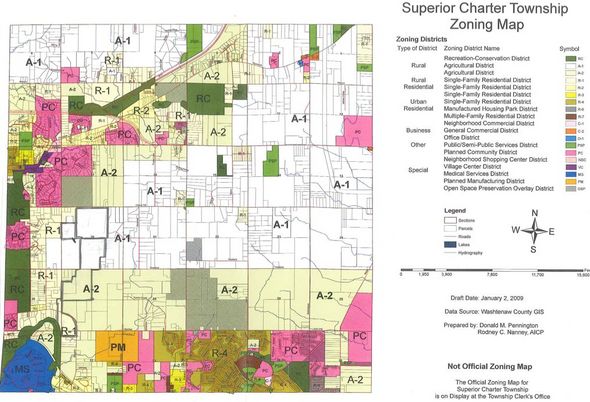
- View a pdf of the Superior Township zoning map
- View a pdf of the zoning map that notes where the proposed manufactured home park would be constructed
Tom Perkins is a freelance reporter at AnnArbor.com. Reach the news desk at 734-623-2530 or news@annarbor.com.
Comments
Wolf's Bane
Thu, Feb 24, 2011 : 5:44 p.m.
Let's hold off on this project and bury it in red tape and wait and see what can be done in a few years when the economy is (hopefully) a bit better. Mobile homes just seems like low hanging fruit?! Besides, Cash is right. We have plenty along Geddes.
abc
Tue, Feb 15, 2011 : 3:02 p.m.
520 acres is almost a square mile. My hometown is about 500 acres and has about 8,000 people. It also has a range of housing types, businesses, schools (all grades), parks, churches as well as police and fire stations. It also has commercial and industrial areas. It is a town; where you can live, work and play. The small towns and villages in this area (Milan, Dexter & Manchester) are all about 1,000 acres; Milan has the largest population at 4,700 with the other two at about 2,000. These towns also have a range of housing types businesses, and services for the people who live there. Argue all you want about affordable versus inexpensive; in the end the people who live there will have needs and desires. Where will they shop or work or play? For sure wherever it is it will require a car a bus or a taxi. Is there bus service there? Also 500 total acres divided by 2,000 units allows for a total of ¼ acre per unit HOWEVER that does not allow any land for, roads, stormwater detention, natural features, landscape buffers, or said treatment facility. If you assume that 20% to 30% will get used for those things (and that may be low) that leaves about 8,000 square feet for each mobile home. On that land will be a 1,200 to 1,600 sf trailer and surface parking for at least two cars. By comparison small inner city lots like these have houses with approximately 500 sf footprints; they are usually two stories with basements. It is bad planning to place 3,000 to 5,000 people out in a rural area with no services. We should not be in the business of slathering any one residential solution over a square mile.
Ann English
Tue, Feb 15, 2011 : 12:24 a.m.
Looks like the proposed area would cover part of Vreeland Road.
SemperFi
Mon, Feb 14, 2011 : 9:11 p.m.
I must agree with all the posters who question the need for such a development in the first place. With the glut of housing in Superior Twnsp and the region, there is no need. Since these manufactured home developments are primarily beneficial to the developer and this corporation wants to build a high-density community, then they should find some property that's zoned accordingly and invest where there is a need. The pollution of the Huron River is a real concern. I am not a Green Shirt liberal and I find it offensive that this unneeded wastewater treatment facility is being given any consideration, at all. The state law needs to be revised to cause these villages to pay their real share of community taxes on par with condos, single family permanent homes and apartment buildings.
John Q
Mon, Feb 14, 2011 : 8:18 p.m.
"I love it when elite Green Shirt liberals are opposed to real affordable housing but were on board with spending a million bucks for the City Court Police Building water fountain." There's absolutely no connection between these two issues. Why are you thread-jacking to force one?
Wolf's Bane
Thu, Feb 24, 2011 : 5:47 p.m.
This does not constitute real affordable housing, John. This is a nightmare waiting to happen for the working poor. Besides, what constitutes real affordable housing? How about along a bus line?! How about walking distance to a downtown or stores!? Huh? Seems you Republicans are not even sure what affordable housing is really about, huh?
Alan Goldsmith
Mon, Feb 14, 2011 : 7:11 p.m.
I love it when elite Green Shirt liberals are opposed to real affordable housing but were on board with spending a million bucks for the City Court Police Building water fountain. Let's keep the Huron River clear for those who deserve it (i.e those with MONEY) and if you can't afford to live in Washtenaw County, sorry dude.
MK
Mon, Feb 14, 2011 : 6:39 p.m.
I live @ Geddes and prospect there are 2 trailer parks in the area no need for more. I moved to this area for the natural aspect please don't go messing up with this cr*p
Bob Martel
Mon, Feb 14, 2011 : 6:38 p.m.
I don't think that any of the commentators here are against manufactured housing per se, but rather we are pointing out that there are plenty of affordable and inexpensive housing alternatives already available in this and nearby communities. Why add more supply pressure to a depressed market? If you add nearly 2,000 new residential units to Superior Township in the next couple of years, all existing residents of this Township and nearby communities will suffer through lower housing values. Plus municipalities will suffer through lower SEV's and thus tax collections. There has to be some mechanism to control this type of over-development since it would seem that the banks haven't learned their lessons.
dading dont delete me bro
Mon, Feb 14, 2011 : 6:15 p.m.
atticus, two points, first i never said 'affordable', i said, 'inexpensive'. second, i have no problem with manufacured communities. from the comments i'm reading, most don't either. my first post, "manufactured, mobile, single family...isn' there a large enough surplus of real estate already?" is one of the most "vote getters". the real estate market is saturated. i live in ypsilanti township, i have relatives that live in superior township. we both continue to watch our home values plummet. why build more (move in more) homes when there is a surplus of living quarters already? could you answer that for me? am i that dense and can't figure it out?
BobbyJohn
Mon, Feb 14, 2011 : 8:53 p.m.
The developer knows the process will take several years and is betting that the real estate market will be much improved by then. Mobile home communities have historically been gold mines for owners. They sell the mobile homes. they finance the homes at rates that are quite high to cover their risk (mobile homes decrease in price so foreclosing is a loser for them) and they collect high rents of hundreds a month for the lots. That is why they want to build it.
Atticus F.
Mon, Feb 14, 2011 : 6:54 p.m.
And my original point was there is little choice when it comes to AFFORDABLE housing... So do you agree with my first statement, that there is little choice when it comes to affordable housing? Or were you simply choosing your wording carefully in an attempt make it appear as if there were affordable housing in the area?
Cash
Mon, Feb 14, 2011 : 4:58 p.m.
Superior Township offers two large manufactured home communities, one about two miles east on Geddes and one another mile or so east on Ridge Road. There are for sale signs all over both parks. I am sure if asked Mr McFarland could tell you the percentage of vacancies in those parks. He quoted the number a while back and it was appalling. In the subdivisions south of Geddes there are affordable houses galore...foreclosed or other. Atticus, there are houses for sale in the section south of Geddes in the township right now that would be cheaper than a manufactured home and do not require payment of an outlandish rental fee for a lot. And in a few years there would be some equity. There are is also assistance for first time home buyers to get a reasonable interest rate. I'm all for affordable housing. And I'm all for lower income folks to have a real chance to get ahead. Look up interest rates for purchasing a manufactured home! Look up lot "rent"...a lifetime of payments "the man". I don't call that affordable. I call it a rip off.
John B.
Tue, Feb 15, 2011 : 12:38 a.m.
Atticus: Owning your own home is most definitely *not* over-rated. There are so many benefits, I can't even list them all here. People shouldn't buy more house than makes sense for them, or get in over their head debtload-wise, but buying our (modest) home was one of the best decisions we ever made. We went from a rent payment of $750/month to a mortgage payment of about $650/month on a 15-year note. We paid that off early, and today we are debt-free, and man, let me tell you, that is the place to be, despite what many so-called 'financial advisors' may tell you....
Cash
Mon, Feb 14, 2011 : 6:19 p.m.
Atticus, I understand what you are saying, especially in light of the fact this proposed mfg housing is a couple of miles from Snyder's house! However, I'd disagree about the financial side. The homeowner can deduct his property tax on both fed and state tax and deduct his mortgage interest as well. The deduction allowed for lot rent is a small percentage. There's something to be said for owning your own little piece of ground. You'll never own that tiny plot under your mfg home....Maybe that's just my age talking. But who wants to be 80 and still paying lot rent? And how long will that mfg home last? Not a long life span there.
Atticus F.
Mon, Feb 14, 2011 : 5:57 p.m.
I can't argue with either one of your points. Except that owning one's home is overated in investment terms (once interest and taxes are taken into concern). Also, my comment was directed at the fact that nobody was complaining when they were building large McMansions in that area 8-10 years ago. But when there is talk of moving middle to lower income people into the area, there becomes this great uproar about erosion of the tax base, and things of that nature. Similar to when there is a proposal to bring low-income houseing to an area.
quitoslady
Mon, Feb 14, 2011 : 5:27 p.m.
You are so right owning a mobile home is a very big rip off.
dading dont delete me bro
Mon, Feb 14, 2011 : 4:17 p.m.
i inadvertantly clicked 'vote' on this. can i take it back? atticus, there is plenty of inexpensive housing around. pick up a sunday realtor section or go for a drive.
Stefanie Murray
Mon, Feb 14, 2011 : 4:31 p.m.
@dading, no, once you vote on a comment you can't take that vote back.
Atticus F.
Mon, Feb 14, 2011 : 4:23 p.m.
Depends on what you consider affordable.
Atticus F.
Mon, Feb 14, 2011 : 3:59 p.m.
So I guess people in that area don't have a right to affordable housing.
Chase Ingersoll
Mon, Feb 14, 2011 : 3:52 p.m.
Tom Perkins: Thanks for the long detailed article. Your time investment on this one should be noted.
Chase Ingersoll
Mon, Feb 14, 2011 : 3:50 p.m.
............Superior Township voters approved a three-year, .25-mill tax in May 2006 that generated $165,000 annually to help pay for legal costs to protect the township's growth management plan. Phillips said that vote demonstrates their opposition to the Rock project....... I don't understand why the legal costs for a government entity "to just say no" are so high. I think the voters are being scared into passing millages that primarily benefit legal insiders. Money being "fungible" someone should look into how this is being spent. Also.....with so much vacant new construction housing throughout E. Washtenaw County, demand does not seem to be there, so one must ask, "IS ROCK SPENDING THEIR OWN MONEY? OR IS THIS PROJECT BACKED BY FEDERAL OR OTHER TAX PAYER SUBSIDY?" And keep in mind that the public subsidy may be in the form of insurance of the investment securities or bonds that would be issued to underwrite these types of projects. Also, we are are still 12 month away from another bulge in the foreclosure of single family homes "many of which were probably financed by ROCK". So ROCK is going to produce additional homes....and the financing terms on such to compete with the sale of properties in the same County, being liquidated by Fannie Mae, et al.? Again, something smells here, and specifically smells like ROCK is using subsidized money and not actually bearing the risk.
John B.
Tue, Feb 15, 2011 : 12:24 a.m.
There's no conspiracy, they just want to be able to take advantage of ever-more financially-squeezed consumers and charge them outrageous fees, lot rents, and high interest rates for years and years to come. Simple (for them), really. What a racket.
Bob Martel
Mon, Feb 14, 2011 : 3:46 p.m.
I'm surprised that anyone thinks there is a demand for 1,950 manufactured homes in this market when there are so many single family homes and apartments available with monthly payments that would be less than the mortgage payment on the mobile home plus the lot rent (which would be around $1,000 a month all in.) There certainly is no appreciation potential in a land-leased manufactured home community to offset the higher monthly payments.
Beth
Mon, Feb 14, 2011 : 2:27 p.m.
We live in a neighborhood built by Rock Construction - or more accurately "partially built" - the neighborhood is at least 12 years old and there are still many empty lots, which Rock does not seem to be making any effort to sell. That leaves them as the default Homeowner's Association - I believe the neighborhood is supposed to be something like 90% built and owner occupied before the residents can take over? - and I do not have good things to say about their management. I also don't have good things to say about the quality of homes they build.
John B.
Tue, Feb 15, 2011 : 12:19 a.m.
Beth: You can sue them over the intentional hijacking of the Homeowners Association (which they do intentionally to be able to keep receiving the fees). We did that in our subdivision, and won. It took a couple years, but it was well worth it. See if you can find a sympathetic lawyer that will do it pro bono (i.e. at no cost to you).
John Q
Mon, Feb 14, 2011 : 2:25 p.m.
"Is there *anything* good about this proposal?" No.
dotdash
Mon, Feb 14, 2011 : 2:17 p.m.
Why are they doing this, except that developers develop? (If all you've got is a hammer, everything looks like a nail.) This sounds like the worst possible combination: lowering the quality of the Huron River, going against the township's zoning plan, shoddy construction, low taxes for the services needed to support it. Is there *anything* good about this proposal?
timjbd
Mon, Feb 14, 2011 : 2:09 p.m.
Park? How about consolidating all the people in the half-empty cookie cutter developments which have displaced the farmland in the townships around the city and then raze the empty ones? Then once THAT'S done, take a fresh look at what's actually needed instead of rubber stamping housing developments? Should have a goal of 100% occupancy in what's already built. Maybe an ACTUAL park out there.. I wonder how much tax revenue is coming in from empty houses? Have to imagine that some percentage of that revenue will dry up soon.
DonBee
Mon, Feb 14, 2011 : 12:54 p.m.
Trailer park.... 1950 Trailers, average of 1 to 2 children each. Minimum taxes, trailers are not taxed like conventional homes. Depending on where it is, it could be in the Ann Arbor School District, but is likely in the Ypsilanti School District. The final address for the main entrance to the development will determine the school district. Figure turn over of residents every 2 to 4 years, as families either move up the economic ladder, have their kids grow up or move down the economic ladder. Which ever school district it ends up in, will have a major challenge with that many children and the buses needed to support them. But, hey it is more money for the district in question.
Bucky Dornster
Mon, Feb 14, 2011 : 12:47 p.m.
How about a map plotting out this 522-acre area at Cherry Hill & Geddes.
dading dont delete me bro
Mon, Feb 14, 2011 : 11:43 a.m.
manufactured, mobile, single family...isn' there a large enough surplus of real estate already?
AlphaAlpha
Mon, Feb 14, 2011 : 11:43 a.m.
"Manufactured home" = Trailer ?
Craig Lounsbury
Mon, Feb 14, 2011 : 1:37 p.m.
"Manufactured home" =affordable housing for lower income folks.