

Washtenaw County needs to be concerned about efforts to cut hunger-relief resources
Food Gatherers is grateful to the community for rising to the challenge and helping us meet our Rockin' for the Hungry food drive goal. While it is the season of giving across Washtenaw County, some of our nation's leaders are reconsidering support of hunger relief services in their negotiations as we approach the “fiscal cliff.”
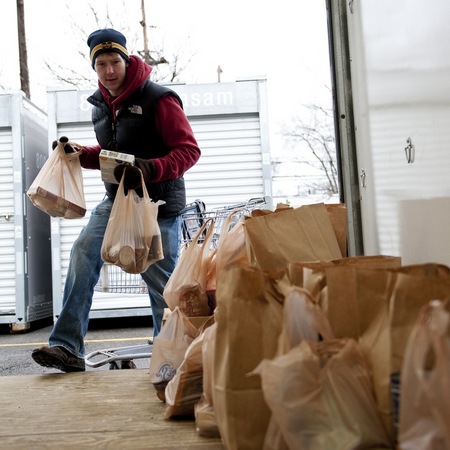
The 2012 Rockin' for the Hungry drive.
When talking about the trillions of dollars involved in the current discussions on deficit reduction, it is easy for our nations' leaders and us to forget that the tax and program funding decisions now will have a lasting impact on real people right here in Southeastern Michigan -our neighbors, our colleagues, people who are part of the fabric of our community. You only need to make a visit to Food Gatherers or any other food bank in the nation to see the "new normal.” From 2006 to 2010, the number of people accessing one of the many food pantries we partner with in Washtenaw County rose by 138%. Too many people are still unemployed, and many of those who are back at work are working for reduced wages or fewer hours. That’s why Food Gatherers is deeply concerned about proposals to cut hunger-relief resources as part of fiscal cliff and Farm Bill negotiations. There is no way food banks can fill the gap if anti-hunger programs like SNAP (formerly food stamps) are cut and the charitable tax deduction is limited.
Food Gatherers is a private, non-governmental response to a national problem. Less than 5% of our funding comes from grants; the majority of our food and funds are donated by businesses and individuals whose gifts are eligible for a tax deduction. Nearly 70% of our labor is donated by volunteers whose service is conservatively valued at more than $1.5 million. There is simply no way we can continue to leverage private donations effectively, if the charitable tax deduction is capped. Michigan food banks and shelters already suffered a blow this year with the elimination of the Michigan state tax credit. While some believe that hunger is a problem better solved by charity, the truth is charity can’t do it alone. On the front lines, we are barely able to keep up with existing need. If you have any doubt that need is real, take a look at these numbers:
- 1 in 6 children and 1 in 7 adults in Washtenaw County are food insecure.
- According to the 2011 Map the Meal Gap study by Feeding America, 44,850 individuals in our community don’t know where their next meal is coming from.
- 3 of every 4 households participating in SNAP nationally include a child, senior, or disabled person, and half of all SNAP participants are children.
- The average national SNAP benefit is less than $1.50 per person, per meal. For senior households, it is only $1.23. On average, monthly food stamp benefits last less than 2.5 weeks.
- 80 percent of food distributed by food banks like Food Gatherers comes from charitable resources.
Eileen Spring is the President/CEO of Food Gatherers, the food rescue/foodbank program serving Washtenaw County.
Comments
Vivienne Armentrout
Wed, Dec 26, 2012 : 4:17 p.m.
As stated, Michigan tax law changed this year to eliminate a credit that was available to food banks and facilities serving the homeless. Previously, it was possible to receive a credit of 50% of the contribution up to $200 each for food banks and homeless shelters. This certainly did make contributions to these organizations relatively painless. I haven't seen any statements this year about how much contributions have dropped as a result of this change (and of course the year is not quite over). But I don't agree with the main thrust of the column. Many of us do not itemize Federal taxes. The relatively generous standard deduction means that people without mortgage interest to deduct or big business-related expenses can't benefit from itemization. Therefore we have to give to our selected charities without receiving a special deduction. And we should. The charitable deduction has the effect of warping the administration of many programs. They are sometimes structured only to obtain the deduction. For example, the UM has imposed "seat licenses" on ticket buyers that are structured to be a charitable deduction. See http://annarborchronicle.com/2012/12/14/column-the-true-cost-of-football-tickets/ The seat licenses are required to buy tickets but are structured as a charitable deduction. Should other taxpayers support football seats? That is the effect of making this deductible. There are many other such examples, I'm sure. I've been writing a lot of checks to my selected charities this month, definitely including Food Gatherers. We should all support through charitable giving as we are able. But I'm not going to lobby my representatives to keep the charitable deduction.
Vivienne Armentrout
Wed, Dec 26, 2012 : 3:43 p.m.
In answer to Jay Thomas, it is not correct that food insecurity is simply a measurement of income. It is measured using a dataset derived partly through surveys. See the USDA definition: http://www.ers.usda.gov/topics/food-nutrition-assistance/food-security-in-the-us/definitions-of-food-security.aspx#ranges I participated in this survey a couple of years ago as a volunteer. I visited various Food Gatherers distribution sites and asked people if they were willing to answer questions. The form was very long and included some rather personal questions, but the recipients were willing to sit down with me for half an hour and answer them. It made me feel very humble because of the simple dignity of the recipients, who were answering the questions not because of a requirement for receiving benefits, but to help the program itself. I have been doing a series (currently interrupted but to be restarted) on the connection between local food and food security. The latest one http://localannarbor.wordpress.com/2012/11/24/local-food-and-good-eating-in-a-season-of-plenty-iii/ discusses food insecurity. The graph from the USDA shows that across the country, food insecurity is increasing. That includes up to 5% of people who say that they have to miss some meals.
arborarmy
Mon, Dec 24, 2012 : 4:11 a.m.
Ahhh, I can see the peanut gallery has discovered the true meaning of Christmas: "Are there no prisons?" asked Scrooge. "Plenty of prisons," said the gentleman, laying down the pen again. "And the workhouses?" demanded Scrooge. "Are they still in operation?" "They are. Still," returned the gentleman, "I wish I could say they were not." "The Treadmill and the Poor Law are in full vigour, then?" said Scrooge. "Both very busy, sir." "Oh! I was afraid, from what you said at first, that something had occurred to stop them in their useful course," said Scrooge. "I'm very glad to hear it." "Under the impression that they scarcely furnish Christian cheer of mind or body to the multitude," returned the gentleman, "a few of us are endeavouring to raise a fund to buy the Poor some meat and drink and means of warmth. We choose this time, because it is a time, of all others, when Want is keenly felt, and Abundance rejoices. What shall I put you down for?" "Nothing!" Scrooge replied. "You wish to be anonymous?" "I wish to be left alone," said Scrooge. "Since you ask me what I wish, gentlemen, that is my answer. I don't make merry myself at Christmas and I can't afford to make idle people merry. I help to support the establishments I have mentioned -- they cost enough; and those who are badly off must go there."
brian
Mon, Dec 24, 2012 : 2:22 a.m.
99% of people are not going hungry. If you think they are come work a day with me. You will see the abuse of the food stamp card. People buy snacks and drinks on it and then buy large amounts of alcohol and cigs with cash. The food stamp program needs to go. Contact me a Bmonosso@gmail.com and you can work with me for a day. If I am wrong You can tell all you know that I am wrong.
Milton Shift
Tue, Dec 25, 2012 : 5:14 p.m.
Some rich people use immigrants for slave labor. Therefore, all rich people use immigrants for slave labor. Seeing the flaw in your logic yet?
MDavid
Mon, Dec 24, 2012 : midnight
I've been a volunteer for Food Gatherers in the past. It is a wonderful organization and Ms. Spring is beyond compare in leading it. I'm all for supporting efforts to provide food for the hungry by NGOs. However, I've reached my saturation point of people and organizations being fed by the government trough filled by the ever increasing taxes we pay. So, preventing a charitable deduction cap is a step in the right direction, but eliminating other government support programs and seeing a reduction in my taxes will have to occur before I go back to contributing at my previous level.
arborarmy
Mon, Dec 24, 2012 : 4:13 a.m.
You, apparently, are not aware that state and federal taxes have gone down over the last four years? Apparently not.
nickcarraweigh
Sun, Dec 23, 2012 : 10:10 p.m.
You think an organization dedicated simply to feeding the less fortunate is surely on the side of the angels? Meet the peanut gallery.
Jay Thomas
Sun, Dec 23, 2012 : 9:26 p.m.
I feel the need to correct a few points. 1. "Food insecure." I have seen this figure as high as 25% as it is simply derived from income levels. The problem is that plenty of people that don't make much money manage to keep themselves fed. 2. "The average national SNAP benefit is less than $1.50 per person, per meal." This is the MISLEADING FIGURE used also in the so called food stamp challenge. It is misleading because you have to have OTHER INCOME in order to get that reduced amount. So if you have no income THEY GIVE YOU MORE THAN THAT. So in reality people are spending more than that on food (making it misleading). I know this will be attacked, but I think such groups do a disservice by trying to make the most extreme case they can. Yes, there are people who need help, but lets not try to deliberately exaggerate things. The biggest issue causing "food insecurity" is inflation (which in turn is caused by the government PRINTING MONEY to pay for its deficits and stimulus programs, because it can no longer find enough borrowers). The price of crude oil is traded in U.S. dollars causing huge price increases when Washington uses the printing press (and the cost of food on the shelf to go up because of transportation costs). We think we are getting something for nothing when the government spends money, but they are robbing us in other places. Inflation is really a form of hidden taxation that affects everyone rich or poor.
arborarmy
Tue, Dec 25, 2012 : 7:36 p.m.
My mistake. My last was in reply to Jay, not Milton.
Milton Shift
Tue, Dec 25, 2012 : 5:12 p.m.
That $1.50/meal figure is closer to the maximum SNAP benefit, actually... which is $200/month for an individual with no income whatsoever, approximately $6.50/day, or $2.20/meal (assuming three meals a day).
Jay Thomas
Tue, Dec 25, 2012 : 8:12 a.m.
@YpsiGirl4Ever: They are... but NOT EVERYONE DECLARED TO BE "FOOD INSECURE" is actually going without food. They arrive at the "food insecure" number BASED SOLELY ON INCOME and having been in that category (and knowing many more people who have been in it) I can tell you that it is inaccurate and not everyone in it is going hungry. @arborarmy: Krugman is a hack and was given his prize for the same reason Obama got his ---> Politics.
antikvetch
Mon, Dec 24, 2012 : 1:36 p.m.
Yeah, well, the Nobel ain't what it used to be -
arborarmy
Mon, Dec 24, 2012 : 4:16 a.m.
Paul Krugman has shot down your nonsense about inflation numerous times. You ought read him. But what does he know? He only had a Nobel Prize in economics.
YpsiGirl4Ever
Sun, Dec 23, 2012 : 10:01 p.m.
So if a family does not have money to buy FOOD they are not FOOD INSECURE, right Jay? This is the biggest piece of bologna (speaking of really cheap, un-nutritional based food) I've read here on A2.com, at least today~~~
Top Cat
Sun, Dec 23, 2012 : 8:17 p.m.
What is the source of her numbers regarding "Washtenaw County" and "in our community" ?
Milton Shift
Sun, Dec 23, 2012 : 5:31 p.m.
Who is really bankrupting our country? http://assets.motherjones.com/politics/2011/inequality-page25_actualdistribwithlegend.png
stevek
Sun, Dec 23, 2012 : 4:58 p.m.
Maybe if people would stop having children that they cannot afford to feed, shelter, clothe, and raise, that would take care of part of the problem.
YpsiGirl4Ever
Sun, Dec 23, 2012 : 8:50 p.m.
SteveK STOP IT. First, its' people like you that are the first to say that people who would normally seek state assistance for food stamps/bridge cards, should instead be able to get food from charities like Food Gatherers. Now that Food Gatherers are stating cuts from State/Federal and Private resources are DECREASING, thus adding to the organizations' worry about feeding the hungry.....you're complaining that people should have children. Are you a Right to Lifer also? Just wondering.
slave2work
Sun, Dec 23, 2012 : 3:40 p.m.
The cost of food keeps going up too. This was a great editorial thank-you. How sad is it that people can work a 40 hour a week job, and by time they pay for rent , elec, gas( both car and home) water there is just not enough left to buy much in groceries.
Alan Benard
Sun, Dec 23, 2012 : 3:33 p.m.
Food Gatherers is a critical and successful force for good in the region. I support it as a member of a Faith and Food congregation and encourage everyone reading this to help it as they see fit. I agree with Ms. Spring that private efforts are not enough to meet the ongoing human need in our region and state. Rather than redistributing wealth upwards through corporate welfare and tax breaks for those who can best afford to pay more taxes, we need to stabilize our nation's economy by structuring it so that those who work hard are appropriately rewarded. Starving government is not the answer -- adequately funding it, as we last did during the 1950s and 1960s, promotes general prosperity.
a2xarob
Sun, Dec 23, 2012 : 2:38 p.m.
Eloquent, informative, and inspiring. Thank you for reminding us that this challenge continues, and we can help.