

Higher education could be facing crisis without reevaluating debts, policies
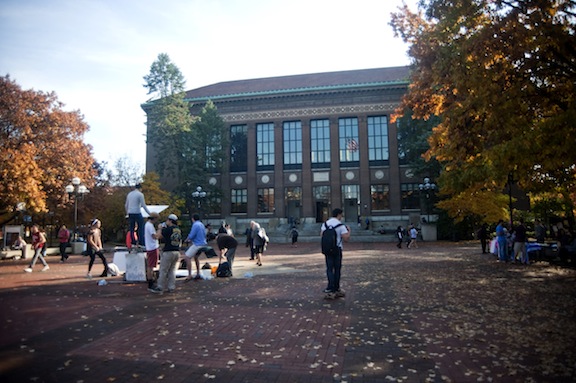
AnnArbor.com photo | Joseph Tobianski
No, it has nothing to do with the City of Detroit, but everything to do with the future of higher education in Michigan. Education DOES matter. There has been much debate swirling around our public schools and municipalities which have failed to lead, manage, and control spiraling health care and pension costs and are now engulfed by debt, layoffs, service elimination and in some cases, the appointment of emergency managers or draconian consent agreements to reign in costs and mismanagement. Why should we think some of our institutions of higher learning may not be subject to these same pressures and maladies? According to a story in The Economist, The College-Cost Calamity, many American universities are in financial trouble and have been piling on debt at alarming rates. Between university debt, changing demographics, legacy costs, competition from for-profit educational institutions, soaring student debt, state funding cut backs, philanthropy drying-up and skyrocketing tuition and fees, we may be heading for a crisis. Many universities have gone on building sprees at a time when technology, especially e-learning with its anywhere, anytime, any place, any pace learning — may make the need for dorms, huge lecture halls and other institutional edifices obsolete. There is no argument about the need for higher and better skills to thrive in the hyper-competitive, disruptive, transformational, knowledge economy where ideas and jobs can and do effortlessly move around the globe. The questions remains are our institutions of higher learning positioned to help take the citizens of Michigan where we need to go to be able to collaborate and compete on the world stage? Clearly, Michigan Future led by Lou Glazer has demonstrated the value of higher education and have been a strong advocate for additional public investment in higher education. Yet we would be wise to give pause and study the financial status of our universities, asking how to make them stronger moving forward. Are we receiving and adequate return on our investment now and how should we best invest for our collective future? Bain and Company and Sterling Partners released a report that studied the balance sheets of 1,692 universities and colleges between 2006-2010 and discovered one-third were significantly weaker than several years earlier. This should not come as a surprise, as the study covers the period of time of the worst economic meltdown since the Great Depression. Yet, it should be a canary in the coal mine reminding us of potential trouble brewing. There is no doubt that our major flagship universities, such as University of Michigan, Michigan State will weather the storm. They have solid leadership and endowments to help smooth out the rough patches they have been managing for some time. Yet, just how stable are Michigan's smaller institutions and how will they manage these pressures going forward? I can imagine the hate mail from The President Council, faculty, students and alumni from Michigan universities for daring to raise the issue. Put your hands down, don't go on auto-pilot and email me nasty notes. I am on your side and value education and know it will be our state's and indeed, the nation's salvation.
There are only three ways to balance a budget:
1) Find new revenue 2) Decrease expenditures 3) Combination of 1&2 above
The resources out colleges and universities receive from the state has been on a steady decline. Yet, the first step in problem solving is problem identification and that simply sticking our collective heads in the sand will not make problems disappear. With leadership, clear thinking and time we are capable of solving any problem. I suggest that before a calamity hits Michigan, it is wise to ask ourselves: How stable are our universities? What can we do to strengthen them to assure they remain strong to help prepare us for our increasingly global, knowledge economy? How, or should we change the investment we make in higher education? Will an increase in state funding using the funding formula”s of the past produce the results we need today or tomorrow? Do we have the right number of universities, concentrating on the appropriate academic areas to drive knowledge, innovation, creativity and job and wealth creation in the future. We do know that significant changes have impacted the private sector and K-12 school districts across the state. Have our universities kept pace with necessary change? Have our institutions of higher learning been leading change, reacting to it or ignoring the new realities? Perhaps the answers to these questions will demonstrate we are heading in the right direction — or not. How stable are our institutions of higher education? A calamity and crisis are terrible things to waste. Tom Watkins served as Michigan’s state superintendent of schools, 2001-05. He is a U.S./China business and educational consultant. He can be reached at: tdwatkins88@gmail.com.
Comments
debling
Mon, Jan 7, 2013 : 12:07 a.m.
The real question is when will Michigan residents take back their State higher education system? Costs are spiraling because the University system has no incentive to drive costs lower. The public should not fund research unless it owns all of the IP. The atheletic system has one purpose and that is to subsidies tuition, but it fail to. Professors should teach, but they are more concerned with licensing technology, starting businesses and cashing in $$$ from public funded research. Course note should be free but Professors push to sell their own textbooks. The student loses and so does all of Michigan. Let's take back this system and drive costs out.
Linda Peck
Wed, Jan 2, 2013 : 6:11 p.m.
The attitude of "money grows on trees" is prevalent in our country across the board. There is no sense of conservation of goods and money, or protection of what we have right now. The attitude is just charge it please and pay it later. Also, people at the "top" of ladders are paid so much money and yet they still feel "poor." I hear people making $100,000 say they feel "poor." What is wrong with this picture? What is wrong is that it does not work.
outdoor6709
Tue, Jan 1, 2013 : 5:34 p.m.
Business' needs to reinvent itself from time to time and reevaluate its core business. Government neveer does that. Mary Sue Coleman said once last year, U of M has cut to the bone and cannot cut more. Part of the problem is liberals always think there is more tax $'s out there for their cause. Lets look at current tax hike scheduled for next year. 2% increase in SS tax rate, depending in income level, higher tax rates on income and investments. 3.8% excise tax on medical devises, transfer tax when you sell your house, SSI tax also indexed for inflation. Wants by Michigan politicians. $1 billion for roads, many local schools want higher mileages, taxes for mass transit, higher plate fees. I am sure this is only a partial list. I think most of us could find ways to cut government budgets, but politicians are not interested in listening