

Having the University of Michigan call Ann Arbor 'home' comes with pros and cons
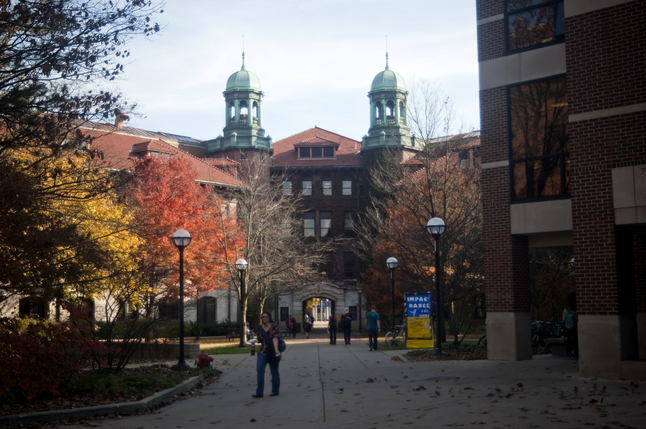
Having such a large university in a city can be both a blessing and a curse — depending on who you ask.
AnnArbor.com file photo
While it is difficult to gather all of the pros and cons of being the hometown to the U-M, I would like to make note of a few points.
Ann Arbor property values are strong: A comparison using figures from the state Department of Treasury, shows the taxable value of property in the City of Ann Arbor grew more and declined less when compared to eight other Michigan cities of comparable size in tax base and population.
The comparison shows that during the last decade’s growth period (2001-2008), Ann Arbor's tax base grew 42.9 percent while the average growth of the eight other communities was 24.6 percent. During the recent recessionary period (2008 - 2012), Ann Arbor's property values declined 4.4 percent compared to the 23 percent average decline in the eight other Michigan cities.
Had Ann Arbor experienced these average rates of growth and decline, the city would have $23 million less in tax revenue than it received this year.
Universities are good for the local tax base: If you were to look at the taxable value of property during that same time period in other Michigan cities that host state universities (East Lansing, Kalamazoo, Mount Pleasant, Marquette), you similarly would see there is both greater growth in property values and greater insulation from decline.
Universities pay taxes on leased space: The university leases more than 1 million square feet of privately owned office space in the Ann Arbor area. Through those leases U-M pays an estimated $4.5 million of property taxes every year to local authorities.
Universities pay for services: U-M pays the City of Ann Arbor directly for water and sewer services resulting in payments in excess of $9.6 million a year. When you add in the other services the university pays for - from police services on football Saturdays to parking lot leases - total payments to the city and Ann Arbor Public Schools in 2012, totaled $11.3 million.
State support for fire protection: The city also receives about $1.2 million annually from the state to partially compensate for providing fire protection to the U-M campus. The university also built and maintains, at no cost to the city, Fire Station No. 5 on the north side of town, which has an estimated value of $250,000 a year.
A plausible contribution to the economic prosperity of the Ann Arbor tax base and insulation from decline is the employment growth at the university during this past decade of more than 9,200 new jobs, a doubling of research spending from $656 million to $1.3 billion, and the creation of 83 new start-up companies since 2001 - now at a pace of one every four to five weeks.
And, though the story accurately reported that U-M has purchased 29 parcels of land in the city during the past 13 years, I would add that the university also sold 12 parcels during that time, which were returned to the city’s tax rolls or deeded to the city itself.
While the information presented here may not completely answer the oft-asked question of what Ann Arbor’s tax base would be like without the presence of the University of Michigan, it is intended to provide additional information on the university’s financial support both directly and indirectly to the city’s financial bottom line.
Jim Kosteva is the director of community relations at the University of Michigan.
Comments
Paul Wiener
Fri, Mar 1, 2013 : 4:47 p.m.
And yet with all our great property values, employment stats and tax base and revenues we still have some of the worst maintained streets in the USA, unbearable architecture, terrible city and traffic management, decades-old decaying buildings still standing, no newspaper, no bookstore, no food shopping near campus, and the U-M still does virtually nothing to see that A2's downtown and campus area is a liveable, attractive or innovative space - except for the heavenly Summerfest.
Buckybeaver
Fri, Mar 1, 2013 : 2:55 p.m.
This is a non argument. cities are what they are and taxes match the services that are needed to run the city regarless of it's size. Better to live out side the city where tasxes are lower and you still get all the benifits the city has to offer. It would be helpful thou if the UM would funnel some money back into the community and stop buying their products and services from the low, low lowest bidder regardless of their geographical location. The UM has more money then they know what to do with.
HB11
Fri, Mar 1, 2013 : 1:22 p.m.
"Through those leases U-M pays an estimated $4.5 million of property taxes every year to local authorities." Ummmmm, yeah. That's a bit of a stretch. I believe the property owners would be paying taxes regardless of who their tenant was.
A2comments
Fri, Mar 1, 2013 : 11:59 a.m.
If the city adopted a 1/2 or 1% wage tax on non-residents, any idea how much that would raise? The headline is misleading and is clearly designed to promote controversy. Good job AnnArbor.com. I'd like to see the city file suit against the state for the missing fire department reimbursement. While the value of UM is not in dispute - we moved back to the area for that reason - there needs to be a formula that increases, or decreases, a fee paid to the city by UM based on funds received (or not) and services used (or not) by UM. For example, calculate usage of police, fire, and other services over the past x years. Use 10% more next year, pay more. If a facility doubles in size, you use more services. Hence you should pay more. The North Campus Fire Station is a poor argument. When it was given to the city, what was the square footage of buildings on North Campus? What is it today? Fire vehicles don't last forever, UM should contribute to a vehicle fund. And she the city had no working aerial trucks, did UM inform students and parents of the increased risk? Or the increased risk with less fire personnel? Tuition and room and board is roughly $25k for in state and $50k for out of state. I paid $120k for my oldest to attend (1/2 out of state, 1/2 in state) and will pay $125k for ,y youngest to get a combined undergrad/grad degree. I pay UM legal fees, student govt fees, registration fee, ... Add in a fire dept fee...
Tom Whitaker
Thu, Feb 28, 2013 : 11:50 p.m.
Some states, as well as the District of Columbia, where a lot of property is government-owned, have what is known as a "possessory interest tax" that's collected from private companies leasing space in government buildings. If these businesses were leasing space in a private building, they would be paying property taxes via their landlord, either included in rent or as a pass-through. If this tax option were available to Michigan municipalities, Ann Arbor could tax the restaurants and bookstores operating inside UM buildings, as well as any other companies operating out of UM properties. This might only add up to a small percentage of the real taxable value of all the UM buildings, but since it wouldn't come directly out of UM's coffers, perhaps they wouldn't object to it?
David
Thu, Feb 28, 2013 : 9:59 p.m.
Mark Twain said there are 3 kinds of 'lies'- -lies, damned lies, and statistics. Mr. Kosteva's statistics are indeed one sided. (Ann Arbor did 'better than 8 other Michigan cities'. Wonder which 8 cities they were? Flint, Pontiac, Saginaw, Bay City, Monroe, Detroit?? What Ann Arbor needs is a serious committee to look into how other college communities work with their respective institutions to achieve a fair committment to addressing those 'cons' of having an 800 pound gorilla in their midst.
Eep
Thu, Feb 28, 2013 : 11:30 p.m.
The spreadsheet that is linked at the bottom of the article does identify the "8 other Michigan cities." They are: Dearborn, Farmington Hills, Livonia, Sterling Heights, Troy, Warren, Grand Rapids, and Lansing. Seems like a pretty fair set of comparable cities to me.
Jay Thomas
Thu, Feb 28, 2013 : 9:35 p.m.
Yes, the University effectively pays taxes already when it leases space instead of buying it. So what is the problem with paying taxes if they want to take a property off the tax rolls? All Universities should have a tax exemption for a "core area" but beyond that pay taxes so as not to leave the other property owners to make up the difference. If they want to build up they can do that without paying tax, but not if they intend to build out. The taxes they would pay are actually insignificant compared to their total operating budget.
David Cahill
Thu, Feb 28, 2013 : 7:40 p.m.
It's always nice to hear from Ambassador Kosteva of the Sovereign Nation of the U of M.
Cendra Lynn
Thu, Feb 28, 2013 : 7:07 p.m.
"...compared to the 23 percent average decline in the eight other Michigan cities." Eight? Which of our many cities are The Eight?
Dog Guy
Thu, Feb 28, 2013 : 6:36 p.m.
In their hearts, many of the University pros know that they are running cons.
louis daher
Thu, Feb 28, 2013 : 5:55 p.m.
Jim, I was glad to hear about some of the mitigation that takes place by the university in regards to the tax revenue lost. I am concerned every time that the University purchaes property. I used to live in Ypsi township and I just purchased property in Ann Arbor last year. The property value decline has not been anywhere near as dramatic. You would have to be living in denial if you couldn't recognize the valuable resources that the univeristy as provided the community, social resources like art and theatre and music and free academic events. Business development with a robust downtown supported by students, staff and visitors or other university related traffic. A vibrant public transportation system compared to other michigan metro areas with out higher eductation. I like other AA residents choose to live in the community because of those perks almost all of them are directly related to the presense of the unversity. As for the cons and the concerns While Jim pointed out that the University sold property the numbers are probably misleading, in what is important is the total value of the properties taken out of the reveneue base. The university has a tremendous purchasing power and can likely purchase enough property to have an negative impact on the city as it grows. One thing that the city could consider is a modest non resident income tax on those who work in the city but don't live here to help defray the cost of wear and tear to the infrastructure. I worked in detroit and lived in detroit and city income tax are not pleasent but they can address this inequity. The other cons I feel those are are off topic that's not the focus of the article the focus of the article has to do with taxes and revenue loss.
M-Wolverine
Fri, Mar 1, 2013 : 2:28 p.m.
Another problem is there's no link to the property tax breakdown. Which is fine for the city, but not necessarily helpful to residents. Is the lower property values mainly on commercial properties downtown around the University? Because those seem to be selling for more and more. And that benefits the city. But I have a hard time believing personal housing values have only gone down 4.4%. I know my house has been assessed at a lot less value than that. And the houses I see listed for sale are often going at under purchase price, even still. So while the city might not have taken as much of a hit because businesses around the U are a good investment, it's not really accurate to say the school has saved individual dwelling property tax payers THAT big a percentage of loss.
Kellie Woodhouse
Thu, Feb 28, 2013 : 5:38 p.m.
Readers, I just posted a link to a PDF version of a tax comparison chart Jim Kosteva created and referenced above. I think it will be helpful.
Kellie Woodhouse
Thu, Feb 28, 2013 : 5:39 p.m.
The link will appear at the bottom of the column in a few minutes.
Vivienne Armentrout
Thu, Feb 28, 2013 : 5:26 p.m.
A point about increased taxable value due to the UM's presence: This is, of course, a reflection on the higher resale value of property (including single-family residences) in the city, in proximity to the UM. Presumably that is both because of the student market and because individuals who work at the UM like to live close to it. Yes, this results in more property tax being paid to the city. But to me as an individual taxpayer, it simply means that my taxes are higher, without any corresponding increase in services. True, my property values are likely to remain stable or increase, but the only way I will obtain benefit from that is to sell my house, which I don't want to do for many years yet. The tax exclusion on UM property thus does affect me directly as a city taxpayer. It also means that residential property in the city is less affordable to ordinary middle-income families (as well as lower-income, of course), both because of taxes and because the sale price is high.
pb
Thu, Feb 28, 2013 : 6:25 p.m.
You made a good point that undermines your argument: Your property values are stable, and will likely increase, which is more than you can say for real estate in many locations. Thus, however many years it may be until you sell, you can reasonably count on a better return on your investment than you would in East Lansing or Kalamazoo - in fact, most likely an increasing return the longer you live here (yes, it's possible for it all to go down the toilet, but it's a shallower commode, with a better refill time). I would also say that residential property here is pretty comparable to quite a few other college towns, and that there are numerous affordable areas in the city. Taxes might be a different story, but, in my (admittedly limited) experience of 5 or 6 states, we don't pay an abominably high premium for living here.
CLX
Thu, Feb 28, 2013 : 6:07 p.m.
And I assume you knew this before you bought and made the calculation that it would be worth it.
JBK
Thu, Feb 28, 2013 : 4:34 p.m.
Since Jim obviously suffers from selective amnesia! I will help him point out the CONS! - My tax dollars paying for snow removal on sidewalks that ONLY students use. - Waking up to a barrage of empty beer cans, McDonald wrappers and empty pizza boxes thrown all over the place after a home football game - The constant road closures on football Saturday's that force A2 taxpayers to snake thru residential streets just to get to a grocery store or even Church - Walking down the street after a big game and seeing 3 or 4 people (both men and women) taking care of their business behind a tree or in the bushes. - The potholes that are caused by increased traffic flow from BOTH the student body and employees of UM and the Health Center. I have to PAY for it. They DON'T unless they live in A2. Remove the extra traffic and our roads last longer. I hope this helps Jim and his memory issues~ Sincerely signed, an A2 resident that pays over 5k in property taxes!
M-Wolverine
Fri, Mar 1, 2013 : 2:42 p.m.
-Yes, the added traffic does cause more damage and more cost. Fair point. But the reason for all that traffic is people coming to the area and spending money at establishments that pay taxes on all the money they're making and where they set up. It's not like it's a commuter college and the students are all driving back and forth every day just to go to class. They're spending their money to live here, people are working here, eating hear, attending games and shows. If you want a city where the roads are nice because there's not traffic because no one goes there, because there's nothing to do, then Ann Arbor was a bad choice. Like I said, there are some fair points on what the University does to hamper the city, but yours aren't really good ones.
M-Wolverine
Fri, Mar 1, 2013 : 2:42 p.m.
There are some substantial cons that could be quoted (and the headline writer probably needs to look for a different area of work), but yours aren't really good ones. -Actually the University clears all sorts of areas that are used by far more than just students. So if anything there's probably a net benefit for the town. And what sidewalks are cleared by the city? Most are down by homeowners and private businesses. I can't get the city to clear my STREET most of the time. Ann Arbor's method of clearing is called "Waiting for the sun to come out." Ann Arbor has the worth street clearing this side of Detroit. I'm not really feeling bad they don't have more responsibility in this area. -I find it hard to believe you live past Briarwood and are dealing with that much garbage or urination. I live closer to the Stadium than that, and have property and deal with none of it. I actually get more trash blown by the wind on trash day than a football Saturday. And I've walked to games from there and elsewhere around town for decades. I have never seen anyone doing their business from my house, and really only in the "student ghetto" days did I ever notice it. I really doubt it's a rampant problem. -"Constant road closures on football Saturdays" is kind of an oxymoron. Yes, they are consistently closed on those days, but 6-8 days a year is not really constant. Other than it happening every one of those 6-8 days. If you can't plan around those days, you need a better calendar. (Who goes to Church on a fall Saturday?). I never understand the mentality of people who hate football days, hate the Art Fair, hate all the events that go on in a city...but chose to live in it. If you don't like all the things a city has to offer, why not live somewhere else? People live here for those things. If it's not your cup of tea I hear Saline is very nice.
Bertha Venation
Thu, Feb 28, 2013 : 7:28 p.m.
I'm with you, JBK! Absolutely!
justcurious
Thu, Feb 28, 2013 : 6:40 p.m.
I moved out of Ann Arbor long ago and don't pay 5K in taxes or deal with those problems. Everyone has a choice in that regard.
CLX
Thu, Feb 28, 2013 : 6:05 p.m.
The U. clears its own sidewalks, and does the job quickly. It's like any other business that way. And plenty of people use those sidewalks, like the thousands employed by the U. Your tax dollars pay for lots of things you would rather not pay for - that's the deal with tax dollars. I wish I wasn't paying for corporate welfare and for multi-million dollar bailouts of rich people.
UpperDecker
Thu, Feb 28, 2013 : 5:57 p.m.
My point still stands, you chose to live near the largest stadium in the country for college athletics. You get to deal with traffic for 6-8 saturdays of the year. Stop whining.
JBK
Thu, Feb 28, 2013 : 5:16 p.m.
Upper decker - I never stated that I lived near the Stadium. In fact I live 2 miles away, but I still see the pizza boxes, empty beer cans, etc......... People leave their cars at Brairwood and shuttle to the stadium.......... The road closure I speak of is at Ann Arbor-Saline. RVs are left at Briarwood and the surrounding businesses. I ride my bike in the area and I see young adults relieving themself behind bushes and trees................. It is very dangerous when YOU assume something. You should refrain from generalizing.........
UpperDecker
Thu, Feb 28, 2013 : 4:46 p.m.
lol I propose that in order to work at any business within the city you MUST live there! (That way the roads do not get damaged by outsiders) There are plenty of places you can live in A2 that avoid the hassle of living next to the stadium. Frankly if you chose to live near it you can't complain about the extreme inconvenience you face 6-8 weeks of the year. Complaining about sidewalks being cleared? Get real brah
Mitch
Thu, Feb 28, 2013 : 3:41 p.m.
The State of Michigan should NOT offset the UofM's cost of Police and Fire. Pay your own damn bills. How about the repavement of Stadium blvd between the golf course and the stadiums?
SemperFi
Thu, Feb 28, 2013 : 3:46 p.m.
The last time I checked, that was a public roadway.
deb
Thu, Feb 28, 2013 : 3:34 p.m.
Considering he is the director of community relations at the U, why would he state there may be another side
Jay Thomas
Thu, Feb 28, 2013 : 9:46 p.m.
I'm still waiting for him to identify the "cons" he spoke about.
bereasonable
Thu, Feb 28, 2013 : 6:25 p.m.
Considering he is the director of community relations at the U, Why would you throw spears at him for performing his job?
UpperDecker
Thu, Feb 28, 2013 : 4:43 p.m.
Deb you can go ahead and move out of A2 whenever you see fit. Your contempt for the university is rather annoying and your banter has yet to provide a "con" that seems viable or accurate.
deb
Thu, Feb 28, 2013 : 3:32 p.m.
Jim, "The city also receives about $1.2 million annually from the state to partially compensate for providing fire protection to the U-M campus." As far as I know, and has been reported on this site before (and by an email from the mayor), the state has not been paying the city $1.2 million as directed too, and has not been for years. Also I have never heard that the University "maintains" fire station #5, I know that it built it, but i was under the belief that the city staffed it. I know the U has also bought a truck or two, but it still pales in comparison on the actual amount of money that it takes to service the U's property,
deb
Thu, Feb 28, 2013 : 6:03 p.m.
Whats stopping the U for making up the difference in the funding?
Jim Kosteva
Thu, Feb 28, 2013 : 4:38 p.m.
deb, You can verify either with the City of Ann Arbor itself, or with the State Department of Technology, Management and Budget that the City is in fact receiving these funds. The lament has been that the State Fire Protection Grant program has never been "fully" funded, thus communities with state facilities like Ann Arbor are only getting about 55% of what the legislated formula suggests. The city should be getting closer to $2.4 million. As to Station #5, the University charges no rent and provides all utilities and maintenance. It is of course, staffed with city personnel.
yohan
Thu, Feb 28, 2013 : 3:09 p.m.
So let me get this straight... If a man financially supports a woman then it is OK for him to use and abuse her. The municipal corollary of this kind of thinking is if a company supports a town then it is ok for the company to use and abuse and do whatever it wants to the town and it's people. It really is an issue of respect. The um has shown over and over that it has no respect for the citizens of Ann Arbor. The um's rape of Wall Street is a prime example.
Ignatz
Thu, Feb 28, 2013 : 3:29 p.m.
Yes, how dare they provide even more world class eye care and build a place for their employees to park. The swine.
ChrisW
Thu, Feb 28, 2013 : 2:37 p.m.
As L Brooks said, Ann Arbor is just Bad Axe with a college.
Evan Smith
Thu, Feb 28, 2013 : 2:21 p.m.
Thanks for this column. There is way too much misinformation on this topic, and it is very nice to see some actual numbers for once.
deb
Thu, Feb 28, 2013 : 3:35 p.m.
Yes because the spokesperson for one side will always set the facts straight. Did you realize this is the director of community relations for the U?
deb
Thu, Feb 28, 2013 : 3:29 p.m.
You mean like the actual fact that the city has not been paid the fire subsidy from the state in years...
Chase Ingersoll
Thu, Feb 28, 2013 : 1:29 p.m.
Jim: Thanks for pointing out that effect on property values is actually a net gain for the municipalities.
Top Cat
Thu, Feb 28, 2013 : 1:27 p.m.
Without the U of M, Ann Arbor would at best be Jackson. Nuf Sed-
Buckybeaver
Fri, Mar 1, 2013 : 2:56 p.m.
Jackson is a factory / prison town, no comparison is possible
deb
Thu, Feb 28, 2013 : 6:19 p.m.
....and some other place in Michigan would be Ann Arbor, with a different name and the same problems . . .
drewk
Thu, Feb 28, 2013 : 3:59 p.m.
Of course, what are they going to do? Pack up and move? NOT
Chip Reed
Thu, Feb 28, 2013 : 1:26 p.m.
It would seem that Mr. Kosteva's job is to present the "pros" and ignore the "cons", as his column is one-sided to a notable degree...
Chip Reed
Fri, Mar 1, 2013 : 2:18 a.m.
I know the editors get to write the headlines, so I was trying to gently point something out to the nice people at aa.com...
Bertha Venation
Thu, Feb 28, 2013 : 7:22 p.m.
Totally, Chip!
bereasonable
Thu, Feb 28, 2013 : 1:59 p.m.
Since this is a "guest column" and not an "article", this seems an appropriate forum for the topic. The columns title does not state that the pros and cons will be discussed, only that there are pros and cons.