

Giving a dollar or two to a panhandler isn't the right thing to do
There is a compassionate response to a panhandler who asks you for money, and it’s not to hand over a couple of bucks. Michigan State Police Trooper Duane Zook knows that all too well.
Zook has made it his personal mission to work with people who panhandle on freeway exit ramps around the Ann Arbor area. And in our view, he’s an ideal example of how to address panhandling with a clear-headed compassion that seeks to solve the problem rather than perpetuate it.
We introduced readers to Zook last week in an article that described his efforts to get panhandlers off freeway ramps and into treatment programs. Zook was moved to get involved in the issue after a man he’d seen panhandling a number of times in the summer and fall of 2007 froze to death in December of that year.
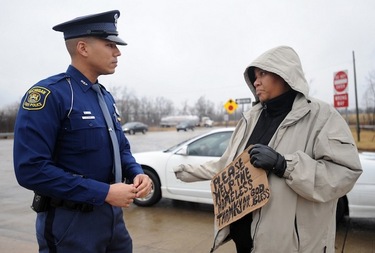
Michigan State Police Trooper Duane Zook talks recently with Linda Edwards on the Rawsonville Road ramp from Interstate 94, where Edwards had been panhandling.
Angela Cesere | AnnArbor.com
It’s illegal to panhandle on freeway exits, and Zook will give violators a warning or citation. But more importantly, his emphasis is on steering them to treatment through programs like Project Outreach.
Panhandling is an ongoing concern in Ann Arbor, particularly in the downtown area. In 2010, the city reconvened a task force to address aggressive panhandling. The problem tends to wane during the winter months, then resurge in warmer weather.
Over the years, Ann Arbor has developed a reputation for attracting panhandlers because our compassionate population has been known to be generous in giving to people who beg on the street. But giving money to a panhandler is the wrong answer. In most cases, it just feeds addiction. That money could be better spent supporting programs that help get people off the street and treat their underlying issues.
That’s what Trooper Duane Zook has dedicated himself to, and we admire his efforts.
Accessing a spike in crime
It might seem incongruous for the city of Ann Arbor to report that crime is at the lowest level in years, and at the same time warn residents to be on the alert because of a spate of break-ins. But a lower crime rate can create opportunities for criminals if it lulls people into a false sense of security.
It’s concerning that Ann Arbor has already seen 67 burglaries occur in neighborhoods across the city since the beginning of the year. Police became concerned enough that they sent an alert to neighborhood watch groups two weeks ago. That action came just two days after Police Chief Barnett Jones issues a report showing that Ann Arbor experienced fewer crimes in 2011 than in any year over the past decade.
According to police department statistics, Ann Arbor had 2,758 major crimes reported last year, which is almost 500 fewer than the previous year and nearly 1,000 fewer than in 2002. Welcome as that news may be, no one should look at that number of crimes and conclude this is such a safe city that it’s unnecessary to take precautions against becoming a victim - as the recent wave of break-ins demonstrates.
A closer look at the statistics shows that while other crimes like arson, robbery and assault dropped in 2011, the number of break-ins didn’t. And Jones points to a tough economy and the expiration of unemployment benefits for many people as possible factors in the wave of break-ins now occurring.
We recall the concern that spread across the west side of Ann Arbor in 2009 when a similar rash of break-ins occurred. It turned out, as it is often the case, that the break-ins were the work of a small number of people, and that the crime wave subsided when they were caught.
In fact, if you look at crime statistics over the course of 2009, the total number of break-ins ended up being lower than the previous year, and that type of crime fell again the following year. So such spates are not evidence that crime is out of control.
They are cause, however, for citizens to understand that crimes occur in Ann Arbor on a regular basis, and whether crime is up or down in a given year, anyone can be a victim. Keep yourself safe by taking such basic precautions as locking your doors and windows, and watching for suspicious activity in your neighborhood. That’s good advice during this wave of break-ins, or at any time for that matter.
(These editorials were published in today's newspaper and reflect the opinion of the Editorial Board at AnnArbor.com. The editorial on break-ins has been revised to correct an error of fact regarding crime statistics.)
Comments
GP
Mon, Feb 27, 2012 : 3:13 p.m.
So where is the rest of the story about how to handle a panhandler?? What about telling them where the nearest Department of Human Service office is located, or the Salvation Army or St. Vincent DePaul or telling them to call 211 for assistance resources in their area??? There is a wealth of services available to people if they want them, but they have to want them.
moveon2011
Sun, Feb 26, 2012 : 11:16 p.m.
Well Mitt Romney states there is a SAVETY NET...hmmmh where is it? The Department of Humans Servcies? The vA for the homeless vets? We need the news ,Tv and raido go go fore It. and make this a iussed thst need to be address now(Election year). With our foodstamps/Snap being cut by Gov. Snyder 3X times we need this returned to the citizens Now! No one should be homeless or helpless , this NEED has to be made GOOD Now! All citizen that sighned the Census are worth $10,000 this time around that money to be given to the citizen personal not to the STATE(big brother as he see fit)..We SEnior and vetreans are first in line ...this way we know where the money does the most good and keeps our local economy going.....It is better to give the panhandler a buck exspecialy when you/me are walking , then beiing hit on the head for a buck! yes the troopers does the right thing no walker on the expressway or on any country road, The SAVETYNET is the Department of Human Services gov. Snyder hired 500 more socailworkers in jan.. So put/test your goverment at work.
capersdaddy
Sun, Feb 26, 2012 : 10:55 p.m.
if it's illegel to panhandle on freeway exits, is it also illegal for someone to panhandle today at the front doorstep of my home? - lying that her mother just got out of the hospital and she needs gas money to get home? and when i said "no" to the white female with long dark, salt n pepper hair with a man in a dark blue truck, that speeds away when i take the license plate number (i called the police) - she gets indignant with me? really?! sorry, sweetie, you bug me in my home, then i'm callin' the police.
RunsWithScissors
Mon, Feb 27, 2012 : 3:29 a.m.
That poor woman! When she was at my door, she said that her *father* was dying and she needed money for gas to get home. To quote one of my favorite playwrights, "To lose one parent is tragic, but to lose both of them is careless."
Patricia Lesko
Sun, Feb 26, 2012 : 8:47 p.m.
Tony, You (and the editorial board?) write: "But giving money to a panhandler is the wrong answer. In most cases, it just feeds addiction. That money could be better spent supporting programs that help get people off the street and treat their underlying issues." This is the grandest demonstration of ignorance and presumption that I've read in one of your editorials in quite some time. Panhandling is an "addiction?" Malarky. How about we look at some real panhandlers in Ann Arbor: The DDA is a panhandler who is operating at a deficit, despite boatloads of public money. Roger Hewitt was recently quoted as saying the answer would be to defer care of the parking structures or raise parking rates or both. Those are some people who are seriously addicted to handouts from the public. Ann Arbor SPARK is a panhandler who gets millions from the city, county and public schools through the LDFA. What do we get in return? We get spin and unverified job creation numbers. The agencies that "help" the homeless provide a lovely living for those who run them. According to tax documents, in 2009, Ellen Schulmeister earned over $80,000 as the executive director of the Shelter Association of Washtenaw County, which runs the Delonis Center. Schulmeister told AnnArbor.com that providing the homeless with a place to stay warm for the next few winter months is just a way to "feed a lifestyle of homelessness." I would be ashamed for my sons to see me say no to someone in need who asked me for help, for spare change. Between 2007-2009, Ellen Schulmeister's organization spent about $220,000 housing themselves in warm, cozy office space. Ann Arbor's growing homeless population, meanwhile, still has no 24/7 warming shelter. I'm cutting out the middle man who is constantly begging for public money to support their own lifestyles.
moveon2011
Sun, Feb 26, 2012 : 11:24 p.m.
yes the agency taken in million everyday and people still give ,but if you on the street no TAX DEDUCTION!
tosviol8or
Sun, Feb 26, 2012 : 9:49 p.m.
They didn't say panhandling was an addiction; they said it feeds an addiction. Other than that: Brava! BRAVA!!
chucklk
Sun, Feb 26, 2012 : 7:53 p.m.
What??? Are there no prisons? And the union workhouses - are they still in operation?
Tom Joad
Sun, Feb 26, 2012 : 6:56 p.m.
Panhandlers are a problem because people keep them in business by giving them money. it's profitable for them to remain a fixture at certain locations. It's rather preposterous to give money to someone for performing no service. Do you go to work and do nothing and expect to receive a paycheck? This type of shiftless behavior is an affront to all those that actually work to earn a living. I never give change or fall for the line "got a few dollars to get something to eat?" There are public shelters and many churches provide meals. I don't see anyone starving on the street. If you want to contribute give to agencies that provide services to the needy but giving directly to a panhandler creates a problem for the rest of us who have to endure them every time we take a walk downtown and are accosted.
Jack
Mon, Feb 27, 2012 : 3:35 a.m.
moveon2011 - Regarding cutting the deductions for charities - is that why you give, if you actually give? So they were cut. It should not be a reason to not give.
moveon2011
Sun, Feb 26, 2012 : 11:30 p.m.
When was the last time you give to an agency or went to an agency to help out or at least see where your money went?
moveon2011
Sun, Feb 26, 2012 : 11:20 p.m.
P.S starting this year Gov. Snyder CUT the deduction for the charities!
moveon2011
Sun, Feb 26, 2012 : 11:18 p.m.
What agency does a panhandler belongs too? How many of the charity agency ReallY help you/me/them?
Tony Dearing
Sun, Feb 26, 2012 : 6:15 p.m.
The task force reconvened to address aggressive panhandling issued a report last March that encouraged people not to give money directly to panhandlers. For someone who would like to refer a panhandler to local services, it suggested the following: For shelter or housing: SOS Community Services Housing Crisis Line -- 484-4300 Delonis Center -- 662-2829 Project Outreach -- 222-3750 Salvation Army Staples Center -- 761-7750 Ozone House (for youths ages 10-20) -- 662-2222 For substance abuse: Dawn Farm Street Outreach -- 485-8725 Home of New Vision -- 975-1602
rusty shackelford
Sun, Feb 26, 2012 : 6:08 p.m.
It's quite arrogant to assume that 1. you know what any given individual is going to do with money they are asking for and 2. you have the right to dictate how that individual would use it. If you have no compassion for your fellow human beings, that's your problem. But don't get so laughably self-righteous, claiming that by NOT giving to someone in need, right in front of you, when you have money to spare, that you are actually being compassionate! What a cruel, disgusting joke. It's doubly insulting to encourage this type of behavior on a Sunday during Lent. Shame on Dearing and whoever else thought publishing this was a good idea.
JustMyOpinion
Sun, Feb 26, 2012 : 5:56 p.m.
The headline of the OpEd gives an opinion - too bad the article doesn't make a case for the position. "in most cases it just feeds the addiction". Hardly a stunning case for not giving to pan handlers. No alternative is given as well, which leads one to wonder if the proposed action is simply ignore them - they will go away. Sounds a lot like "let them east cake". Addicts, pan handlers, severe poverty, untreated mental illness, misfortune and want are facts. They will not go away if you ignore them. They will always move to areas where there is some chance at survival. People have a fundamental human need to survive and will do it. I appreciate that some people will wish them all away, but it will not make it so. Nor will blaming them for their plight, incarcerating them all (we do that now with no success) or simply sending them on down the road. Until someone has an answer that works, I will continue to offer a few bucks when I can. If they drink it, smoke it or eat with it, I wish them well. It either brings them one step closer to their maker or one step closer to survival. Leaving them with nothing only offers them the chance for death or committing a crime to move forward. (Save me the platitudes on enabling which is a luxury for those with families and ties alone)
Doug
Sun, Feb 26, 2012 : 5:42 p.m.
I once encountered a young man panhandling on a street in Toronto. I usually ignore panhandlers but there was something about this young that made me feel sorry for him. I offered to go across the street and buy him food from McDonalds and bring it back. I was taken aback when he replied "I don't want no ******* food, I want money". I know this is not the norm, but I have never stopped for panhandlers since.
moveon2011
Sun, Feb 26, 2012 : 11:26 p.m.
My mother always give to a panhandler , here reason You never know which is the lord jesus..it is better to give then to recieve!
EyeHeartA2
Sun, Feb 26, 2012 : 7:25 p.m.
No, this is the norm, acually.
paul wiener
Sun, Feb 26, 2012 : 5:09 p.m.
Count me among those who can't stand the panhandlers in downtown Ann Arbor. I also don't like people telling me how to handle them. Usually I ignore panhandlers. But sometimes - maybe it's a change in the weather, or my mood, or the look or pitch of a particular panhandler - I give them something. Whether I give or not, I know that there but for the grace of god....One thing I don't do is lecture them on why it's bad for them to take my money,or on how to spend it, or clothe themselves, or pick up their lives. There are enough free lectures available in A2, but I never see the panhandlers there.
Tru2Blu76
Sun, Feb 26, 2012 : 4:22 p.m.
I'm a bit disappointed, mainly because the "answer" given to panhandling seems to be that we should contact police whenever we encounter a panhandler. I agree that misguided generosity is not wise, but what IS the proper response to panhandling? State Trooper Zook is to be commended but having a one-man army to fight panhandling isn't exactly the "solution" we need. I would bet that: if the City declared an Anti-Panhandling Month and called for all citizens to rebuff panhandlers FIRMLY without confrontational attitude, that panhandlers would start moving out of Ann Arbor. As for the depressed economy being a cause of panhandling and break-ins: that's very true and we can thank our politicians for reducing regulation and failing to exercise corporate crime control. Our government stopped protecting us and the corporate crooks who PAID them to do that weren't long in taking action which brought down the world economy, not just Michigan's. But I am glad to see Tony Dearing offering a clearer perspective on crime rates versus our own knee-jerk alternating attitudes: crime EXISTS and it happens to people who DON'T expect it and make proper preparations. The best "crime suppressor" is a prepared population. At present, the NRA Home Defense Course is the best way to get started on becoming prepared.
Stephen Landes
Sun, Feb 26, 2012 : 10:17 p.m.
We could carry cards with the numbers of all the available agencies and their addresses on them. If the cards were available from the agencies for a donation we could help fund the work they do with charitable contributions and put a dent in the panhandling problem at the same time. How about a stack of twenty cards for $20 -- that's a dollar per panhandler.
Tony Dearing
Sun, Feb 26, 2012 : 4:01 p.m.
Thanks to those who have weighed in so far. One thing I should note is that we occasionally write two short editorials on two different topics, rather than one longer editorial on a single topic. Usually, this is not confusing to our readers, but it appears to be causing some confusion today. These two editorials are not intended to be related. One is about Trooper Zook and the other is about the recent wave of break-ins.
Tony Dearing
Sun, Feb 26, 2012 : 4:31 p.m.
Thanks for the suggestion. I made that change.
Borisgoodenough
Sun, Feb 26, 2012 : 4:28 p.m.
An easier way to make your point might simply be to start the headline with "EDITORIALS:" rather than "EDITORIAL:"
a2citizen
Sun, Feb 26, 2012 : 4:08 p.m.
Tony, Allow me to be the first to criticize you for this. Thank-you, a2citizen
Nathaniel Borenstein
Sun, Feb 26, 2012 : 3:25 p.m.
E. Crowe writes, "Would his detractors rather have him idling on 23 waiting to pull-over the occasional speeder?" Absolutely, I would, yes -- writing tickets to speeders reduces the danger to other motorists, produces revenue when the ticket is paid, and doesn't uselessly persecute the most downtrodden in our community. The real problems are the misguided war on drugs and the dismantling of the social safety net, but for some reason many of us keep believing that if we just punish the most miserable and pathetic among us, all will be well. Portugal has been showing us a better way: <a href="http://www.google.com/hostednews/afp/article/ALeqM5g9C6x99EnFVdFuXw_B8pvDRzLqcA" rel='nofollow'>http://www.google.com/hostednews/afp/article/ALeqM5g9C6x99EnFVdFuXw_B8pvDRzLqcA</a> <a href="http://www.scientificamerican.com/article.cfm?id=portugal-drug-decriminalization" rel='nofollow'>http://www.scientificamerican.com/article.cfm?id=portugal-drug-decriminalization</a> <a href="http://www.stgeorgeutah.com/news/archive/2012/02/17/what-we-could-learn-from-portugal-winning-the-drug-war/" rel='nofollow'>http://www.stgeorgeutah.com/news/archive/2012/02/17/what-we-could-learn-from-portugal-winning-the-drug-war/</a>
johnnya2
Sun, Feb 26, 2012 : 3:53 p.m.
"writing tickets to speeders reduces the danger to other motorists, " Actually that is the common misconception. A motorist not keeping up with the flow of traffic actually is just as dangerous as somebody who travels proportionately faster than the flow of traffic. Arbitrary speed traps do not help reduce the risk to motorists I would also submit that a person standing on a freeway exit ramp holding a sign is a danger to motorists as they are a distraction. I want people paying attention to the road, not to the sign that says "will work for food", or " I am a veteran, so give me money". "produces revenue when the ticket is paid,"- So are we doing this for safety or for revenue? If you really thought it was about safety, you would revoke their driving and not allow them to drive anymore, but instead it is a money grab. "we just punish the most miserable and pathetic among us"- I don't think getting an individual to a treatment center is punishing them. In fact, if we had single payer universal health care, those that want help with addiction would receive it. The "war on drugs" is silly and as far as I am concerned people should have the right to use or abuse any drug they want, until they start to effect other people. When you commit crimes, do not pay bills, or beg on the streets you have crossed the line as to being allowed to use them anymore.
David Briegel
Sun, Feb 26, 2012 : 3:12 p.m.
Keep yourself safe out there while our society and our govt continue to pursue the very same foolish policies that have gotten us here! The failed war on drugs. What a waste of money, time and lives. And just why do you think that we are doing virtually nothing to address the Afghan heroin supply? Cut all social services and unemployment. "Take a bath and get a (non-existent) job". And this from people who are leaders! Are we really this stupid? Oh, and don't forget to cut taxes.
Ann English
Mon, Feb 27, 2012 : 12:01 a.m.
What about the other illegal drugs, the ones that the Mexican drug cartels sell here? There's also a demand for cocaine here. If there were not, the Mexicans in the drug cartels would be doing something else.
EyeHeartA2
Sun, Feb 26, 2012 : 7:24 p.m.
"The failed war on drugs." ..and the solution is? Legalize Heroin?
jcj
Sun, Feb 26, 2012 : 6:50 p.m.
Gotta all be the fault of the Tea Party! Just give Oblabla 4 more years and he will solve all our woes! LOL
E. Crowe
Sun, Feb 26, 2012 : 2:19 p.m.
Officer Zook is doing proactive police work. He deserves to be commended. If your addiction or situation drives you to panhandling on a Freeway ramp, it is time to ask for help. He is helping people find the resources available to assist them. Would his detractors rather have him idling on 23 waiting to pull-over the occasional speeder?
BBC
Sun, Feb 26, 2012 : 7:04 p.m.
Occasional speeder, what planet do you live on?
Richard Wickboldt
Sun, Feb 26, 2012 : 2:18 p.m.
Again we hear from the city. Watch out and be careful because it's dangerous out there. Take precautions to protect yourself. Make sure you ratchet up your paranoid factor every morning with your coffee to remember all the things you need to do. Oh yes and by the way crime is down. Basic common sense; worst recession since the 1930s, high unemployment, most of the money in the hands of the 1%, and reductions in local police force. The environment is going to be unsafe. Basic law enforcement techniques such as enough presence on the streets isn't being practiced because our AAPD is not properly funded by the city council. Mr. Ranzini's comments above ring true on reasons for much crime. Desperation for an addiction or survival in tough economic times makes for people to be irrational when committing their crimes. In other words very dangerous and life threatening under the right circumstances. I was burglarized in a home invasion during the west side crime spree noted above in the middle of the night, while our family was asleep. This is serious business! So fellow Ann Arborites. Do we abandon our liberal ways and purchase dangerous weapons to protect ourselves. Or; do we stop spending money on a Green Belt, and stop spending money endlessly preserving nature against invasions, so we can have a police force to protect us from the invasion of dangerous, irrational and desperate people on our community?
just a voice
Sun, Feb 26, 2012 : 1:24 p.m.
what officer Zook is doing it stupid. It is a waste of tax payer time and sounds like a one man crusade. Did anyone ask his boss if that was how he is supposed to spend his time? the reason I think it's a waste of time is that there will be two to replace everyone he stops. Plus, the reality is that there isn't enough social services to help all the homeless, so stopping them from panhandling isn't a good solution. Also, just thought that if I need money for drugs and can't get it begging on the highway, maybe I'll just go rob a house, seems like the cops are too busy stopping roadside panhandlers to stop actual crime finally, freedom of speech issues are raised here too, but her, if your poor you don't deserve rights
Mick52
Mon, Feb 27, 2012 : 6:07 p.m.
I agree that the social problems probably cannot manage all these folks. Also even if they get straight, that does not eliminate the urge to solicit since it can be quite profitable.
Diane
Mon, Feb 27, 2012 : 1:04 a.m.
Police work isn't all about giving tickets, policing accidents, going to court cases, etc. Knock it off!
Mumbambu, Esq.
Sun, Feb 26, 2012 : 1:58 p.m.
Haha!
RunsWithScissors
Sun, Feb 26, 2012 : 1:02 p.m.
This article is a Trojan horse. The headline promises we'll read something about panhandling and the correct response(s) to a panhandler. Instead we're given an assessment of the crime stats in Ann Arbor - without a tie-in to the headline.
Brad
Sun, Feb 26, 2012 : 2:27 p.m.
Really. What a meandering load of fluff. Starts with the ramp panhandlers, segues to the downtown panhandlers, and then winds up being a crime stat report whose two conclusions seem to be "oh, crime is down", and "oh, be careful because crime seems to be up". Thanks for clearing that all up for us.
Stephen Lange Ranzini
Sun, Feb 26, 2012 : 11:39 a.m.
My father, who was a lawyer who also served a number of years as a municipal judge, used to observe that over 90% of the felonies that came through his court were at their source caused by or related to drugs. Academic research shows that over 95% of all felonies are related to people stealing to get money for drugs, or other drug related crimes, so the two topics (panhandling for money for drugs & alchohol and home invasion crimes) are intertwined. People are likely causing a home invasion crime wave because they need money for heroin, as witnessed by recent local spikes in heroin overdoses. Michigan is designated by the federal government's Office of National Drug Control Policy as a "High Intensity Drug Trafficking Area" for good reason, and if the Ann Arbor Police don't have the resources to effectively investigate and contribute to other area law enforcement efforts to combat drug distribution gangs, problems will rapidly increase because being wealthy and having a high concentration of young adults, we are a prime market target for their snares.
Mick52
Mon, Feb 27, 2012 : 6:06 p.m.
Sure Plubius, legalize drugs and prices will fall and crime will stop. You are presuming that drug addicts will work despite their addiction and pay for drugs with their pay. What if the number of drug addicts increases and they lose their jobs and then have to steal to fund their fix?
Stephen Lange Ranzini
Mon, Feb 27, 2012 : 3:53 a.m.
@Jack: I'm curious, what in my post specifically makes you think I sound like someone running for political office, as opposed to someone whose family lives downtown telling a story here to illustrate that the Ann Arbor Police are poorly funded and that this is a problem with repercussions across the entire town? My wife and neighbors and I have noticed problems that are not being effectively addressed by the police, so I am speaking up on this issue. The true source of the problems have an impact on what the solutions ought to be. FYI, I am NOT running for political office.
Jack
Mon, Feb 27, 2012 : 3:25 a.m.
No offense intended, but must you always sound like someone who's running for office?
tosviol8or
Sun, Feb 26, 2012 : 9:16 p.m.
If not for the risk premium associated with the chance of imprisonment, many drug users could get enough money for their drugs by collecting returnable cans. The crime is, as the others have noted, money-related, not drug-related, and the law-enforcement/imprisonment complex isn't going to allow an end to the war on drugs to derail their gravy train unless we make them.
Homeland Conspiracy
Sun, Feb 26, 2012 : 5:06 p.m.
There's to much $$$$$$$$$ made by the law enforcement to really fix the so called "war on drugs"
Major
Sun, Feb 26, 2012 : 3:34 p.m.
What your father has observed, underscores (with a fluorescent sharpie) the total, absolute failure of the "war on drugs". One could even conclude the WOD actually expanded the problem. I'm one who believes in "if isn't broken, don't fix it" yet with this situation there is only one common sense conclusion "if it's broken, FIX IT!" and the way we go about drugs/crime...that system is...has...will always be...broken!!
Plubius
Sun, Feb 26, 2012 : 2:47 p.m.
Legalize drugs. Prices will fall, and with it, crime.