

Ann Arbor needs to get up to speed on its speed limits along main roads
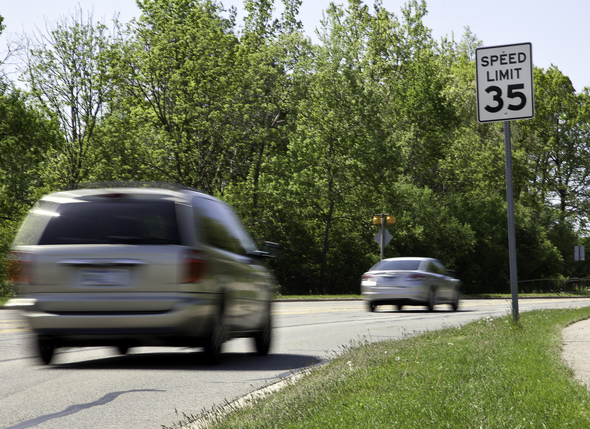
The 35 mph speed limit along Huron Parkway in Ann Arbor is artificially low and won't stand up under state law, says Ann Arbor resident James C. Walker, who is a board member of the National Motorists Association.
Steve Pepple | AnnArbor.com
The Michigan Legislature passed Public Law 85 of 2006, effective Nov. 9, 2006. This revised the Michigan Vehicle Code to add a new method for cities to post legal speed limits using a sliding scale of access points (driveways and intersections) to post realistic speed limits of 25, 35, 45 or 55 mph proportional to the level of road development.
This method was in addition to the one using an engineering and traffic investigation including speed studies to find safest 85th percentile travel speed that is authorized for cities which have adopted the State Police Uniform Traffic Code (Download PDF document ). Investigations are usually used by the State Police and the Michigan Department of Transportation (MDOT) or the county road commissions to post safe and realistic speed limits on our highways and county roads, including when they pass through cities.

James C. Walker is an Ann Arbor resident and executive director of the National Motorists Association Foundation.
The Ann Arbor City Council and Project Management Department do not follow either method under state law, nor do they use the best-accepted engineering practices, to set safe and realistic speed limits. The city posts most main road speed limits around the 30th, the 20th or even below the 10th percentile speeds of traffic, which arbitrarily defines 70 percent, 80 percent or 90 plus percent of drivers as violators when traffic is free flowing.
These ultra low posted limits do not enhance safety, but they satisfy residents who do not understand that posted limits have almost nothing to do with safety or actual travel speeds, particularly at the upper end of the travel speeds scale. City officials do not explain to residents that raising or lowering posted speed limits by up to 15 mph will change 85th percentile speeds by not more than 3 mph, and usually by 1 mph or less. The only change is the speed at which tickets can be given, and most speeding tickets go to safe drivers at normal speeds when posted limits are set too low.
As one example, the City Council strongly objected when the State Police and MDOT corrected the speed limits on two segments of Washtenaw Avenue (Business Route I-94) in April 2008, from the former 30 and 35 mph to the current 40 and 45 mph to match actual and safe 85th percentile traffic speeds. The 85th percentile travel speeds remained unchanged (plus or minus 1 mph). The only thing that changed is these segments are no longer the speed traps they were before April 2008, when the former limits arbitrarily defined about 90 percent of drivers as violators.
Another driver and I challenged speeding tickets in 2007 on Huron Parkway and Nixon Road, received against the artificially low posted speed limits which became illegal after PA85 took effect. We prevailed in 15th District Court in 2008 and our tickets were dismissed. (See: http://blog.mlive.com/annarbornews/2008/08/speeding_ticket_challenge_uphe.html) The city appealed my dismissal to Circuit Court, and the dismissal was upheld.
Yet, right up to today, the illegal posted limits on Huron Parkway and Nixon Road remain unchanged. The city continues to issue speeding tickets in these and other speed traps, secure in the knowledge that most people do not understand how to legally object in court. Most improperly ticketed drivers continue to pay fines they could have dismissed if they knew how to object legally to the arbitrarily low posted limits that do not conform to state law or proper engineering practices.
Some 5 1/2 years after the adoption of Public Law 85 of 2006, the city has done nothing to change any of its main road posted speed limits to reflect maximum safety, accepted engineering practices or to comply with state law. This total lack of action does not inspire confidence in the City Council or the Project Management Department regarding this traffic management issue.
James C. Walker is an Ann Arbor resident, a board member of the National Motorists Association and executive director of the National Motorists Association Foundation (www.motorists.org).
Comments
Peregrine
Sun, May 20, 2012 : 2:36 p.m.
@Jim Walker: How does it help pedestrians, you ask? "Pasanen estimated that about 5 percent of pedestrians would die when struck by a vehicle traveling 20 mph. The pedestrian fatality percentage would rise to about 40 percent for vehicles traveling 30 mph, about 80 percent for vehicles traveling 40 mph, and nearly 100 percent for speeds over 50 mph." [Leaf and Preusser 1999, citing Pasanen 1992 (http://trid.trb.org/view.aspx?id=365827)]. A different set of estimates to the chances of pedestrian fatality when hit by a vehicle is this: "... the UK Department of Transport Traffic Advisory Leaflet 7/93 (TAU, 1993), figures quoted are, for 20 mph impact speeds: 5 percent death, 65 percent injured, and 30 percent uninjured; for 30 mph impact speeds: 45 percent death, 50 percent injured, and 5 percent uninjured; for 40 mph impact speeds: 85 percent death and 15 percent injured." [Leaf and Preusser 1999] So traffic speeds have a huge impact on the chances that a pedestrian would die when hit.
Jim Walker
Wed, May 23, 2012 : 1:27 a.m.
For Peregrine: I fully understand the effects for pedestrians being worse if struck at higher actual speeds. That is simple physics. It is the same issue as hitting a bridge abutment at 45 mph versus 60 mph -- utterly independent of what the nearby speed limit sign said. But, that is NOT the question. The question is: HOW does painting lower numbers on the signs improve or affect safety for the pedestrians or cycles -- given that the ACTUAL travel speeds do NOT change by more than 1 mph. When the 85th percentile speed is now 41 mph and will be 40, 41 or 42 mph regardless of whether the posted limit is 25, 30, 35, 40 --- HOW does painting one of the lower numbers help the pedestrians or cyclists? The number on the sign does NOT reduce the potential impact speed. Jim Walker, NMA
Jim Walker
Mon, May 14, 2012 : 8:46 p.m.
I have a question for those that do not like 85th percentile speed limits. Suppose you have a main street like Packard, Plymouth, etc. It is currently posted at 30 mph. The 85th perventile speed is 41 mph now. If you change the posted limit to 25, 35, 40, or 45 mph, the 85th percentile speed will be between 40 and 42 mph with the new posting. The 10 mph Pace will be from 31-40 up to 33-42. WHAT is the benefit, if any, to having the posted limit be 25, 30, or 35 -- instead of the correct 40? HOW does it benefit anyone, including pedestrians and cyclists to have the posted limit be 11 mph below the 85th percentile speed which will NOT change more than 1 mph if you post it 25, 35,or 40? Jim Walker, NMA
Jim Walker
Fri, May 25, 2012 : 1:30 p.m.
For CZA2: Most completely residential streets, subdivision streets, etc. would survey for 85th percentile speeds of 25 or 30 mph, so posting them with 85th limits would make almost no difference. People basically drive to what they can see - their perception of the necessary braking distance in emergencies. You could post most subdivision streets with 55 mph limits, and it would make virtually no difference in the travel speeds because people would not find those speeds to be safe and comfortable. What the research has shown for 70+ years is that the actions of about 85% of the public will establish a more correct speed limit than any arbitrary decree based on subjective evaluations of the various factors. Here is one more example, from highway data. The 85th percentile speed on rural 2 lane Missouri highways was 62.5 mph - in 1941, 70+ years ago. The 85th percentile speeds on equivalent rural Michigan highways today varies from about 62 to 69 mph. With drastic differences in vehicles, the speeds are essentially the same, because the character of the roads and the vision distances are essentially the same. Correct posted limits that reflect actual traffic speeds of the super-majority of drivers (85%) tend to produce the smoothest and safest traffic flow, in both residential areas and on main roads and on super highways. Jim Walker, NMA
CZA2
Sun, May 20, 2012 : 7:03 p.m.
Dear Mr Walker, Since you clearly are knowledgeable and willing to respond, I have a question. Most of the discussion so far appears to be about what might be termed as 'main roads' i.e. Packard, Jackson, Dexter etc... I have concerns about the 85th percentile argument because these roads, despite being, 'main roads' with high traffic volume are also residential streets with many house driveways leading directly onto them. But I take your point that they are 'main roads' and that drivers ignore the posted speed limit. I'm not sure how you arrive at the conclusion that the 'typical' speed is the 'correct' speed unless your concern is purely mathematical. And this is where I become worried. For the same logic could, I assume, be applied to the narrower side streets that are purely residential and have no official 'trunk road' purpose. These streets are typically lined with homes with families, people who walk their dogs, ride their bikes, streets where a football or basketball sometimes goes a-wandering off the property... Should the 85th percentile speed rule apply here too? Or should mathematicians and road engineers perhaps consider other factors when setting those speed limits? Also, when these narrower, family streets are turned into the equivalent of an Indy-500 speedway by impatient drivers trying to avoid all the current road construction, should those drivers be caught and penalised without any recourse to appeals based on mathematics (i.e. that they were driving at the 85th percentile speed)? Yours sincerely, CZA2, who is perplexed.
Stuart Brown
Sat, May 12, 2012 : 10:57 p.m.
To P.J. This response is typical of the "we're different, we're Ann Arbor folks and you don't belong here" crowd when addressing Mr. Walker's arguments (so much for the much touted and over-blown reputation for tolerance.) Mr. Walker does belong here and believe it or not there is no reason why Mr. Walker cannot co-exist with people who want to ride bikes, both motorized or not. Sorry to burst your bubble, but driving is an economic necessity for most people who live and work in Ann Arbor. I'll ask you a question: have you ever driven a bike to work during rush hour and noticed that people riding bikes are certainly in the minority(and a small minority at that)? I am tempted to ask you if you think it is fair for a minority to inflict its will on a majority but this would miss the major point that speed limit signs and police enforcement of same have very little impact on how fast people choose to drive most of the time. For this reason, nothing Mr. Walker is doing or asking to be done should be viewed as a threat to pedestrians or bikers. You're specious arguments are nothing but a shoot-the-messenger defense of the status quo.
Jim Walker
Sun, May 13, 2012 : 11:20 p.m.
When the posted speed limits arbitrarily define 70% or 80% or in one case 99% of all drivers as violators, it is the posted limit that is wrong, not the drivers. The highest posted limit I have found in A2 on a main road is part of Scio Church which was at the 36th percentile, so only close to two-thirds of the drivers were defined as violators. Most other main roads are posted at or below the 20th percentile speeds which is total nonsense and degrades safety. Jim Walker, NMA
Stuart Brown
Sun, May 13, 2012 : 4:09 p.m.
P.J., Local control by local officials who systemically and habitually abuse their local residents! Wow, what a principle to die for, please draft me right away and send me off to a foreign land to defend this, "Great way of life." The local government says that it should have the right to lie to its citizens about its "right" to set the speeds on its speed limit signs in such a way as to define 70, 80 or even 95% of the people who drive on a given road as a rule breaker. The lying part comes in the form of the same local government claiming that the police enforcement of unrealistic, low speed limits serves any useful public purpose. This is the context in which critics of Mr. Walker are raising the local control mantra; as if accountability is not relevant. Local control is good except when it infringes on the basic rights of the locals, duh.
P. J. Murphy
Sun, May 13, 2012 : 3:18 p.m.
Is it really necessary for you to include a pejorative about me or my motives in every reply? Meanwhile it's true that in this case I am far less troubled by local officials exercising their discretion about guidelines issued by Lansing technocrats. Local residents, if they are sufficiently concerned about local ordinances have the means to remove the culprits who passed them. You may consider me a knee-jerk liberal, but in this matter your argument rests on the wisdom allowing centralized, big government to trump local control. Strikes me as pretty ironic. Meanwhile if advocates of your position really want to present a compelling argument here, why not cite data about the relative safety of Ann Arbor streets vs. other equivalent cities in the state?
Stuart Brown
Sun, May 13, 2012 : 5:47 a.m.
P.J., What you do not appreciate is the systemic, habitual abuse of the citizens of Ann Arbor by the city through the illegal enforcement of a traffic law that does not comply with State standards. There is also an issue of basic fairness that smacks of a blatant violation of the Fourth Amendment; when the police stop citizens in their vehicles for no valid reason, there is a clear infringement of that citizen's privacy. Thanks for letting those of us who care about these issues know you could care less.
P. J. Murphy
Sun, May 13, 2012 : 1:29 a.m.
I can't prevent you from lumping me into some type of generic "AnnArborite" category. If you need this label to dodge the substance of my remarks, take it. But I do understand the use of roads for commercial purposes. I was, for period of years, a cab driver, so I think I know something of the city's streets and byways as a means of making a livelihood. I'm also a long time resident of the city, and I've had the privilege of experiencing the roads from a variety of perspectives. My point is simply that Mr. Walker represents only one perspective. And his view is biased, limited, and frankly inadequate in addressing the real world traffic problems of the community. What I have noticed about bicycles (which I used to get to work for a few years) is that their use is increasing. Each amenity provided to this transportation option has been rewarded by a noticeable increase in individuals deciding that it's a functional alternative. Some, including me, call this progress, for each person who rides a bike is one less consumer of petroleum, road space, and precious Ann Arbor parking spots. So despite the occasional inconvenience of having to maneuver around them, I welcome this addition to the city's streets. But that's another topic. All I was trying to do in my post was to suggest that Mr. Walker's "data" is just one, limited, and rather self-serving perspective on what is a much more complex community issue. If you believe that only drivers get to make the rules on city streets, he's your man. But he doesn't represent me, nor I think many other users of our community's streets.
P. J. Murphy
Sat, May 12, 2012 : 4 p.m.
Mr. Walker's statement above that bicyclists and pedestrians are "easily visible" to drivers is a highly questionable presumption. Anyone who has operated a motorcycle, bike, or been a pedestrian knows that car and truck operators are typically poor at recognizing other types of traffic on roads. His casual dismissal of the experience and safety of alternate road users suggests a bias. The fact that he has previous citations for speeding reinforce this impression. Much of the discussion in this thread has concerned Huron Parkway, which is a very unique road, and far from typical of local streets. Additionally it's been my experience that nearly all drivers characteristically overestimate their competence behind the wheel. While driver behavior is clearly a valid component in setting speed limits, it's priority in the overall mix of factors is subject to question. Mr. Walker's op ed doesn't address this issue, and this tends, in my opinion, to weaken his overall argument. Formulas derived from computer programs and traffic engineers may be valid and essential tools for determining local traffic ordinances, but in a question as complex as safety on local roads the input of local citizens and their representatives is clearly essential as well. Roads aren't simply a utility for automobile drivers, they are elements of our community that serve a wide variety of users and residents. Mr. Walker presents an argument that is almost totally from a single perspective on the question. One wonders if he's ever tried to cross Washtenaw or Plymouth Road at rush hour on foot. Or bicycled on Huron, Platt Rd, or Washtenaw in Ann Arbor. Has he ever, with a toddler or two in hand, tried to cross Packard? I think it's possible that such experiences would provide some interesting additional data on safety and speed limits.
Jim Walker
Sun, May 13, 2012 : 11:16 p.m.
For P. J. Murphy: 1) As noted by several people, including anyone who understands the science, posted limits have virtually no effect on actual traffic speeds so painting smaller numbers on the signs changes nothing - except to spread the speed variance and give a totally false sense of security for anyone reading the signs on how fast the traffic is ACTUALLY approaching. 2) Most drivers do not overestimate their competence, as shown by the extremely low rate of crashes, injuries and fatalities today compared to previous decades. The raw number of fatalities for 2011 is the lowest since 1949, despite massive increases in the miles driven. The fatality rate per mile traveled is less than 25% of what it was in the early 1960s when I came here. Michigan's fatality rate is about 25% lower than the national average. 3) Most drivers in a city ARE local citizens, so most of the data points in calculating 85th percentile speeds are from local drivers. Jim Walker, NMA
snark12
Sun, May 13, 2012 : 12:38 a.m.
Once again, you're ignoring the fact that changing the speed limit on any of those roads will have essentially zero impact on how fast people drive on them. Raising or lowering the limit has essentially no impact on the safety of bikers or pedestrians. In fact, a properly-set speed limit can enhance biker safety because the drivers will behave in a more predictable, regular fashion. I'm a frequent driver about town and I also ride my bike about 2,000 to 3,000 miles per year around Ann Arbor, so I have a dog in this fight. I have ridden on Plymouth, Washtenaw, and Huron, even at rush hour. On a bike, I feel my safety is at risk not from speed or from drivers who don't see me, but from drivers who refuse to share the road with me (who can't bear to wait 5 seconds for an oncoming car to pass so they can get around me safely) or who actively harass me (motorcyclists sometimes like to "buzz" me, seeing how close they can get to my handlebars). Speed isn't the problem, attitude is.
Giacomo Senna
Sat, May 12, 2012 : 1:36 p.m.
I was surprised to see the number of comments on this story, until I started reading them and realized that it appears nearly half are from the author of the original op-ed.
Dan
Fri, May 11, 2012 : 11:52 p.m.
Mr. Walker, with all due respect, why do you live in Ann Arbor if your chief concern is to narrowly promote the interests of motorists? There are a lot other communities in Michigan that are more automobile-oriented than Ann Arbor. What makes Ann Arbor a special place is that we consider the needs of drivers, AND transit users, cyclists, and pedestrians.
Jim Walker
Sat, May 12, 2012 : 3:21 a.m.
For Dan: Except for one year, I have lived in Ann Arbor or nearby areas since 1962. I came to go to the U of M, fell in love with the town, and stayed. Ann Arbor has been a border-to-border speed trap for 50 years that I have personally observed. What you don't seem to understand is that the science used by the Michigan State Police to maximize safety with proper speed limits makes the roads safer for everyone, including the pedestrians, cyclists and transit users. It is NOT safer to post speed limits that arbitrarily make criminals out of 70% or 80% or 99% of the drivers. It just increases speed variance and gives pedestrians and cyclists a false sense of security that cars are coming at slower speeds than is the reality. I might note that the two State Police command officers responsible for safety statewide have received a Governor's Traffic Safety Advisory Commission award for their work to establish more speed limits at the 85th percentile level to maximize safety. They have to work hard every day to counteract the myth that painting artificially low numbers on the signs that are far below the actual and normal safe speeds of travel does NOT make things safer, they degrade safety and smooth traffic flow. Please download the booklet by the State Police "Establishing Realistic Speed Limits" at www.michigan.gov/speedlimits It is the best of several state communications on the science. Jim Walker, NMA
Dan
Fri, May 11, 2012 : 11:48 p.m.
What we ought to be focusing on is how to make transit, cycling, and walking more convenient and safe. NOT how to help lawbreakers speed more!
Ruth
Fri, May 11, 2012 : 11:17 p.m.
I agree, there are several roads or sections of roads that should be re-marked for speed limits. Now that Washtenaw was re-marked, traffic moves well, especially during the afternoon. I hope the A2 administrator (directed by the Council, if necessary) will re-evaluate roads noted above.
Jim Walker
Sat, May 12, 2012 : 3:11 a.m.
I live near the Washtenaw sections that were reposted in April 2008. They had speed traps on them very frequently before being reposted. I have not seen a single A2 police speed enforcement action there since April 2008 - it is no longer profitable or needed. As to the A2 Administrator and Council directing the Project Management group to reset the posted limits on our main roads - that is the goal, but there is tremendous opposition to posting the safest speed limits on our roads. It comes from citizens who do not understand the science of traffic safety engineering. The Council and the Project Management group are reluctant to tell the citizens the truth, so the illegal, inappropriate and less safe posted limit have stayed in place for decades. Maybe, just maybe, there is beginning to be sufficient numbers of residents who know the truth to put pressure on the Council and the Project Management group to do the right things. That would be my goal and everyone would benefit - except maybe the court treasurers who get the fines from mostly safe drivers. Jim Walker, NMA
Paul Epstein
Fri, May 11, 2012 : 7:08 p.m.
And next something must be done about Ann Arbor's horrible horrible horrible traffic signals, which make traffic stop, sit, and wait and wait and wait and wait virtually all the time. Count how many lights you have to stop at and, at night, how many vehicles go through the green (almost always zero) while you sit there.
Left is Right
Fri, May 11, 2012 : 5:43 p.m.
I'm actually OK with Ann Arbor's speed limits. I now feel comfortable driving a speed that's undoubtedly close to the 85th and know that if I'm ticketed, I'll have a great case in court--denying the city the revenue it thinks it deserves. And it's my perception that the AAPD has reduced the number of speed traps because the know that the tickets will be thrown out. Poor public policy--ticketing for revenue.
Jim Walker
Fri, May 11, 2012 : 6:59 p.m.
I would MUCH rather see proper 85th percentile speed limits to define the super-majority of safe drivers as legal, because we already know they are safe. Then traffic patrol officers could concentrate enforcement efforts on truly dangerous drivers who are reckless, careless, DUI, severely distracted, etc., AND the small group of drivers who are way above the normal safe speed ranges. These are drivers that actually damage traffic safety for all of us. These types of citations would correctly punish the small group of bad drivers and would contribute to improving overall traffic safety. This change in city policies would also help restore the respect for speed limits as being set for safety, it would help restore the respect for traffic laws in general, and it would help restore the respect for traffic officers as those sworn to protect and serve - by ending their role as predatory road tax collectors who ticket primarily safe drivers because the posted limits are set artificially low. Jim Walker, NMA
hmsp
Fri, May 11, 2012 : 5:34 p.m.
@mixmaster, re: "Raise it to 45 and people will drive 50." I disagree. Oak Valley Drive between Scio Church and Waters is an exception to the local norm — it is posted at 45, and very few people exceed that. I have actually driven 50 on it, and that feels REALLY fast. 45 is a good limit for that road, because it is obviously close to, or at, the 85th percentile. Setting Stadium Blvd @ 35, however, is wrong, at least for most stretches of it. I actually set my cruise control at 42-43, so as not to risk creeping up to where I might get a ticket. Back when the bridge was still there, I couldn't count the number of times I crested that hill to see a cruiser with radar parked by Chrysler or the Big House. I was always glad that I had set my cruise control, and never bothered to tap the brakes — nobody is ever going to get a ticket for driving less than ten over in that stretch, unless they are also doing something else!
Jim Walker
Fri, May 11, 2012 : 6:49 p.m.
Correct for Oak Valley Drive, the limit is just right. Most of Stadium would be better posted at 45. I actually saw the very common Big House speed trap being run at 8 pm on an Easter Sunday evening when traffic was VERY light, and therefore almost every car was toward the upper end of the normal safe speed range around the 85th percentile speed. There was, of course, no event or other pedestrian traffic present - just the BIG opportunity for a predatory speeding tickets versus an under posted limit. Jim Walker, NMA
HeimerBoodle
Fri, May 11, 2012 : 3:39 p.m.
Being in favor of keeping the posted speed limits means you are in favor of providing the city with illegal revenue from speeding tickets. It does not mean you are in favor of increased safety for pedestrians, cyclists, or motorists. Read the article, read the science behind it, and then if you still have an irrational love of the posted limits do your fellow citizens a favor and write a check to the city. Maybe then they won't feel the need to fine others unfairly. In the meantime, find something to do that doesn't involve straw man arguments about babies playing in the middle of Huron Parkway.
HeimerBoodle
Fri, May 11, 2012 : 7:01 p.m.
@Jim Walker I 100% agree that it's not intuitive that raising the posted limits doesn't result in higher overall speeds. I was more directing my comment to those who had a knee jerk reaction, rather than taking the time to understand what was presented in the (very fine - thank you!) column. Mostly I can't believe that folks want to willingly hand over money to the city for something that isn't actually a crime.
Jim Walker
Fri, May 11, 2012 : 5:14 p.m.
There is another element here that plays a big part. Because the city council and the project management group have not tried to educate the residents on the real science of posted speed limits versus traffic speeds, many residents believe false things and it is not all their fault for the false beliefs. Many residents believe the false equation: Lower Posted Limits = Lower Actual Traffic Speeds = Better Safety The real equation is Correct Posted Limits = Smoother Traffic Flow = Fewer Conflicts Between Vehicles = Better Safety For All Road Users It is counter intuitive and really hard to teach, but that is how it works. It has been known for 70+ years. I have a 1941 National Safety Council Report on Speed with the principles clearly spelled out. If the city council and the project management group would change their overall communication philosophy and help teach the truth, we could start to get rid of the false beliefs about speed limits many residents hold and how they affect traffic safety. Jim Walker, NMA
aareader
Fri, May 11, 2012 : 2:26 p.m.
Thanks for your information and presentation! I agree with your position. A sad state when a government entity works AGAINST the better interests of the "85th" percentile of its people. Keep bringing these issues to the larger audience. The more information people have a good resolution of the issues will happen. City council members can be voted out of office. AND ..... You have shown that challenging irrational speeding tickets may work.
Jim Walker
Fri, May 11, 2012 : 5:06 p.m.
People can contact their council representatives, the mayor and the project management group to express their agreement with posted speed limits set according to state law at the 85th percentile speeds of free flowing traffic under good conditions to maximize safety and smooth traffic flow. Are there exceptions to the rule? Sure, but the exceptions must be for the very unusual hazards that are NOT apparent to the average driver. Those hazards do NOT include obviously visible pedestrians, bikes, parked cars, sharp curves and hills that can/should have advisory speeds and warning signs, etc. All the normally visible hazards are already taken into account in the drivers choices of safe and comfortable travel speeds and arbitrarily lowering speed limits for obvious hazards counts those elements twice, which results in arbitrarily low posted limits that very few drivers will find reasonable, so they don't comply. Jim Walker, NMA
Bob
Fri, May 11, 2012 : 1:07 p.m.
Oh, boo-hoo. Obey the posted speed limit. Period.
Jim Walker
Fri, May 11, 2012 : 4:59 p.m.
When posted limits are arbitrarily set way below the safe speeds of traffic so that 70% or 80 % or in one case 99% of drivers are defined as violators, it is the posted limit that is wrong, not the drivers. Jim Walker, NMA
nuseph
Fri, May 11, 2012 : 3:29 p.m.
When the posted speed limit is a violation of state law, that should be a reason for concern.
Fender66
Fri, May 11, 2012 : 12:33 p.m.
Great article. I agree 100% with Mr. Walker. In addition, let's get rid of the crosswalks along Plymouth Rd. Cars have the right of way on the road, not pedestrians! Cross at the traffic lights people, and quit disrupting traffic flow on a very busy road!
A2comments
Fri, May 11, 2012 : 11:10 a.m.
Well written. Ann Arbor residents should be outraged and contact City Council NOW.
Jim Walker
Fri, May 11, 2012 : 4:55 p.m.
If enough people contact their council representatives, the mayor and the project management group to demand proper posted speed limits according to state law and proper engineering practices, maybe we can end the use of arbitrarily low posted speed limits used to collect revenue. Jim Walker, NMA
Stephen Lange Ranzini
Fri, May 11, 2012 : 10:35 a.m.
@Hmm wrote: "Another excellent Op-ed today with great practical information." I agree!
davecj
Fri, May 11, 2012 : 4 a.m.
Huron Pkwy was 45 mph. The city re-paved the road, added new berms, added bike lanes on both sides of the road (seperate from the actual road) and then lowered the speed limit to 35. Really!!! I nice new, smooth road, bikes not on the road. The only reason can be to generate moe money from tickets, not safety of cars, bicyclists or pedestrians!
John Q
Fri, May 11, 2012 : 1:31 a.m.
Here's Jim trumpeting the top-down directive from the state government pushing a "one size fits all" mandate for local communities. Jim only has one interest and that's driving as fast as possible. Safety for other users on the road, pedestrians and bicyclists mean nothing to him. As was noted in another comment, higher speeds result in much higher fatality rates for peds and bikers. The focus of the city should be engineering the city roads to make them slower and safer.
SMC
Sat, May 12, 2012 : 2:50 p.m.
It's funny how John Q is so dead-set against the "top-down directive" when arguing against raising a speed limit, yet when he commented in favor of narrowing Jackson Ave, he kept going on about the MDOT traffic studies that said the road should be narrowed. Hypocrisy: exposed.
Jim Walker
Fri, May 11, 2012 : 4:53 p.m.
snark12 is correct, that is the well proven science. If the city council and the project management group would tell the TRUTH to residents and explain how correct speed limits make things smoother and safer, we could make progress toward ending the improper posted speed limits problem in the city. As an aside, Chelsea corrected most of their main road speed limits to comply with PA85. It was briefly controversial, and the controversy died when people noticed there was no change in the traffic flow - except it is legal now to drive at the normal safe speeds of traffic flow. Ann Arbor wants it to remain illegal to drive at the normal safe traffic flow speeds. Jim Walker, NMA
Stuart Brown
Fri, May 11, 2012 : 5:37 a.m.
Thanks John Q for the continuation of misrepresentations concerning Jim's views. Would you characterize the Fourth Amendment as a top-down "one size fits all" mandate for local communities as well? What part of reality do you not understand? The cars on the road that you hate will continue to drive at about the same speed regardless of what the posted speed limits are likely to ever be; but why should proven facts such as this concern you? You're a man of faith and faith is all that matters, right? Why do you wish to see so many people ticketed for speed offenses when doing so has no meaningful impact on speeds? Ah, that's right, you have faith that some day the enforcement might actually make a difference, never mind how many people get burned in the interim.
snark12
Fri, May 11, 2012 : 3:46 a.m.
The point that you and others are ignoring is this: the posted speed limit has almost no impact on the speeds at which people actually drive. That may seem counter-intuitive, but it has been borne out by decades worth of research. And an artificially low speed limit can actually cause more accidents because a small number of people will drive substantially below the normal flow of traffic speed (that is, they'll try to observe the lower limit). So an artificially low speed limit is mainly there to increase ticket revenue and it can actually lower safety.
Jim Walker
Fri, May 11, 2012 : 2:28 a.m.
The Traffic Services Section of the State Police is responsible to improve safety statewide. They are the publishers of the Establishing Realistic Speed Limits at www.michigan.gov/speed limits. This is also the method in the Manual of Uniform Traffic Control Devices and in most other engineering studies. I have a real question, if you care to answer. HOW does it improve safety to set a posted speed limit at the 18th percentile speed so that 82% of all drivers under good conditions are arbitrarily defined as violators? (That is Huron Parkway.) HOW does that make things safer? Jim Walker, NMA
a2chrisp
Fri, May 11, 2012 : 12:43 a.m.
Thank god...finally someone with some sense says what everyone I know has been thinking for years. Kudos Mr. Walker. If you need support, count me in.
Jim Walker
Fri, May 11, 2012 : 2:22 a.m.
Thanks, a2crisp. Contact your city council representatives, the mayor and the project management group. Tell them you want speed limits on main roads set at the legitimate 85th percentile speeds of free flowing traffic under good conditions. That will put you in line with the folks at the state police department responsible for safety statewide. Jim Walker, NMA
1bit
Thu, May 10, 2012 : 10:42 p.m.
Mr. Walker, I too recall the days when Huron Parkway was 45mph. I wonder if you are aware of any actual accident data from that time period versus the current 35mph era. The data would need adjusting for traffic volume, but it would be nice to see if there is any meaningful difference.
Jim Walker
Fri, May 11, 2012 : 2:24 a.m.
I don't have that accident data, but you are right it would need to be adjusted for traffic volume because the era when it was correctly posted at 45 mph is a LONG time ago. Jim Walker, NMA
Halter
Fri, May 11, 2012 : 1:17 a.m.
As I recall, the speed limit was reduced from 45 to 35 when they did the original reconstruction of the retaining walls/walking paths back in the late 90's....and they just never raised to back to 45 after the construction was completed.... What is ironic is that while they were doing construction they SLOWED the traffic to 35 which was deemed safe around pylons and construction...
Halter
Thu, May 10, 2012 : 10:32 p.m.
Its also another example of hour our council really doesn't care much about any of these issues that don't effect the 8 square blocks of downtown...they see the rest of the city as a means to an end -- lets ticket people going into and out of the city center to make sure they really want to return there again. Lets ticket the parents picking up their kids on the way out of town while we have the chance. Lets ticket people on huron parkway because we know its almost physically impossible to drive 35 mph on that stretch. I once got a ticket there and my car was on CRUISE CONTROL on 35mph -- but as it went down the hill post the golf course it accelerated to 42 mph because it's physically impossible to go slower than that on that stretch without your foot on the break -- causing a safety hazard to anyone behind you. But hey, its not in the city center, so who cares... People -- think about who you elect, and who they represent, and why we have this lack of change. I was appalled when I read in a previous comment that "if people don't like the speed limit they can just drive on a different street." -- it is exactly that type of self-aggrandizing comment that shows how insular some areas of our community really are....
Halter
Thu, May 10, 2012 : 10:31 p.m.
A very well written opinion, much better than most of the spontaneous opinions we get here... And its a topic that should have been addressed 5 years ago, and not just something that Ann Arborites should be taught now -- again, another example of how in an age where real newspapers don't exist anymore in Ann Arbor, this kind of information is just hidden away, and City Council expects that these types of things will just disappear when nobody reads about them.. Everyone that gets a ticket on Huron parkway, for example, can now point to the ruling/precedent cited in this article for their own defense. For that alone, this article is better than most of the other opinions here. Not just reporting an opinion, but also giving proof of how/why it should change.
Jim Walker
Fri, May 11, 2012 : 4:45 p.m.
The specific case number on Huron Parkway where the posted 35 was ruled as not enforceable by Judge Julie Creal in 15th District Court is # 07-W137909-OI, ticketed for 45 mph in 35 zone on 6/15/07 on Huron Parkway between Washtenaw and Geddes. The TCO in force then was #2564, dated 11/2/01, completed 11/8/01 and it remains (improperly) in place. A first hearing for testimony only was held in 15th District Court by Judge Julie Creal on 11/19/07, but no final ruling was issued at that time. Judge Creal ruled in a second hearing in 15th District Court on January 4, 2008 that the posted speed limit on Huron Parkway was not set according to state laws in effect 11/9/06 and later. The case was dismissed. No appeal by the city was ever filed in this case. Jim Walker, NMA
Linda Peck
Thu, May 10, 2012 : 10 p.m.
In some cases, increased speed limits make sense, in other places where people are constantly speeding, it is very dangerous because the roads will not handle it, i.e., Jackson Road. Jackson Road is marked 35 and people drive 45 and run you down if you are driving 35. People are walking close to the cars on the sidewalks and the houses are close to the roads. It is not right for people to drive 40 or 45 on that road. It is dangerous and rude. There are people who just simply must go fast everywhere regardless of whether it is safe or promotes ease of traffic flow. Jackson Road works great at 35 and is dangerous at 45. I hope whoever is going to make these adjustments will do so taking into account the type of road and the environment surrounding it.
thinker
Fri, May 11, 2012 : 11:32 a.m.
Let's mandate house and sidewalks be moved back 30 feet to make the area safer.
Jim Walker
Thu, May 10, 2012 : 10:39 p.m.
The 85th percentile speed on Jackson Ave. midway between Maple and the Dexter split near Worden was 42 mph in 2006. I know it is counter intuitive, but the posted limit has virtually no effect on actual traffic speeds, particularly at the upper end of the range. The posted 35 is within the Pace (10 mph band with the most vehicles, what the layperson calls the normal traffic flow), but it is toward the bottom of the pace. Jim Walker, NMA
MRunner73
Thu, May 10, 2012 : 9:04 p.m.
Huron Parkway is mostly non residential. It IS a Parkway, thus, the speed limit should be 45 mph as it is on Washtenaw Ave east of the Stadium Ave split. That corridor has a high traffic volume then Huron Parkway, thus not as safe. A 45 mph limit on Huron Parkway is prudent and would love to see it come.
SMC
Sat, May 12, 2012 : 2:46 p.m.
Wrong, Dan. Studies show that the majority of people drive the speed at which they are comfortable, not a predetermined speed faster than the posted limit. This is why speed limits were traditionally set lower than the maximum safe speed on any given roadway, making it easier to generate revenue from speeding tickets.
Jim Walker
Sat, May 12, 2012 : 3:03 a.m.
For Dan: this is one of the great myths about posted limits and your view is simply incorrect. You can raise a too-low limit by up to 15 mph or lower a good one by up to 15 mph and you will change the 85th percentile speed by not more than 3 mph, but usually by 1 mph or less. When the Washtenaw limits were raised from 30 and 40 mph between Hill and Stadium, the 85th percentile speeds went up by 0 mph, they remained the same. That is the reality. The ONLY reason people consider that drivers will "drive 10 over" is because that is the most common difference between the 85th percentile speed and the posted limits -- they are set 10 under. Reset them correctly and the 85th percentile speeds remain unchanged +/- maybe 1 mph. Jim Walker, NMA
Dan
Fri, May 11, 2012 : 11:44 p.m.
If it increased to 45 mph, people will start driving 55 mph. People usually like to drive 10 mph more than what is posted. So no, 35 mph should be kept in place.
Jim Walker
Thu, May 10, 2012 : 9:50 p.m.
A very long time ago, the limit WAS 45 mph on that stretch of Huron Parkway between Washtenaw and Fuller/Geddes. Then it went down to 40, then down to 35 after the road was improved it got an even lower limit !!!!! There are 12 access points between Washtenaw and the first big curve - the major speed trap area that is periodically worked so heavily. The 35 limit is nonsense, BUT it is undoubtedly quite lucrative. MRunner73 is correct, the limit should be 45 mph, with if you want advisory speeds and curve arrow signs for the twin curves. THAT would be good engineering. The posted 35 (or even 40) is NOT good engineering. Jim Walker, NMA
Gary Biller
Thu, May 10, 2012 : 8:19 p.m.
While several have commented here about lawbreaking in the context of drivers who travel above the posted speed limit but are within the 85th percentile speed, few have taken issue with the City of Ann Arbor ignoring for five years the state law that requires speed limits to be established using 85th percentile speed data. I would think more city residents would be up in arms about the issuance of tickets using, in many cases, unlawful speed limits as the basis. For those questioning Jim Walker's motives, I can verify that he is not a professional lobbyist. In fact, the work he does as a director for the National Motorists Association Foundation is on an unpaid voluntary basis. If you want to call him a lobbyist, fine, but he does so at his own expense and his motivation is a passion for fairness in our traffic laws. Gary Biller, President National Motorists Association
SMC
Thu, May 10, 2012 : 8:50 p.m.
Welcome to Ann Arbor, where the main road through town should be narrowed, because the traffic study says so. But, the speed limits should not be raised, despite what another traffic study says, because "we know" those cars are going too fast. If you speed, you must like driving. If you like driving, there's something wrong with you, because cyclists are superior. Everyone knows this, in the People's Republic of Ann Arbor.
Peregrine
Thu, May 10, 2012 : 7:08 p.m.
CONTINUED FROM ABOVE Page 2: "On road sections in rural areas where crash risk is typically not very high, many experts recommend posting the speed limit at the 5 mph multiple closest to the 85th percentile speed (the 85th percentile speed is the speed at or below which 85 percent of motorists drive on a given road). In urban areas with high pedestrian and bicycle activity, many experts recommend selecting the 5 mph multiple closest to the 50th percentile speed (the 50th percentile speed is the speed at or below which 50 percent of motorists drive on a given road) as the speed limit." Page 5 lists other factors that may be taken into account in addition to the 85th percentile according to the Manual of Uniform Traffic Control Devices. They are: road characteristics, shoulder condition, grade alignment, and sight distance, the pace speed, roadside development and environment, parking practices and pedestrian activity, reported crash experience for at least a 12 month period.
Jim Walker
Thu, May 17, 2012 : 4:13 a.m.
For Peregrine and others who question the wisdom of using 85th percentile speed limits to maximize safety, please review these items. www.ibiblio.org/rdu/sl-irrel.html for the largest study ever done on the effects of raising or lowering posted limits. It found that the safest limits were those at or very close to the 85th percentile speeds and that changing the posted limits had almost no effect on actual travel speeds www.michigan.gov/speedlimits for the state police booklet "Establishing Realistic Speed Limits" Are there some exceptions where factors other than the 85th percentile speeds should influence the choice of posted limits? SURE there are, but only for hazards that are not obvious to most drivers. Things like road characteristics, shoulder condition, grade alignment, sight distance, roadside development, parking practices and pedestrian activity are already included in the drivers choices of travel speeds. The Pace speed (10 mph band with the most vehicles, what the layman calls the normal flow of traffic) almost always ends at the 85th percentile speed +/- one or rarely two mph. Crash data is DEFINITELY a key item to review, to find out WHY any area has an abnormally high crash rate, and to FIX the engineering errors causing those crashes. Simply painting arbitrarily lower numbers on the speed limit signs will likely make the crash rate worse, not better. Jim Walker, NMA
Peregrine
Sat, May 12, 2012 : 8:40 p.m.
First of all, thank you for responding, Mr. Walker. You may be right that certain streets in Ann Arbor have speed limits set to low. What I was arguing with was your blanket statement that: "Traffic engineers have known for 70+ years that the safest speed limit to post in most cases is the 85th percentile speed of free flowing traffic under good conditions." And I don't see where you defended it. In fact, you also acknowledge that agreement among experts could not be achieved by listing only the 85 percentile, hence you substantiated my point. As a side note, and not related to you, Mr. Walker, I can't help but smile at the down votes I got for quoting a Department of Transportation report.
Jim Walker
Thu, May 10, 2012 : 7:47 p.m.
I have talked at length with both the main authors of that expert computer system to recommend speed limits. The use of the 50th percentile limits was a compromise in order to get ANYTHING approved. I use USLIMITS2 to help analyze roads and was one of the early users of the system. BUT, when you count bicycle, pedestrian, parked vehicles as a reason to go to the 50th percentile, those elements have been counted twice and the resulting limit comes out too low. All those elements are easily visible to drivers and are already factored into their choice of travel speeds. That said, there are precious few main road speed limits in Ann Arbor that exceed even the 30th percentile speeds. Huron Parkway is posted below the 20th. Nixon Road where I was ticketed has a 16th percentile speed limit. These are all total nonsense with NO relationship to improving safety. Jim Walker, NMA
Peregrine
Thu, May 10, 2012 : 7:07 p.m.
This article misrepresents the facts. I ask James C. Walker, the author, to back up his statement: "Traffic engineers have known for 70+ years that the safest speed limit to post in most cases is the 85th percentile speed of free flowing traffic under good conditions." I assume by "traffic engineers" he means that a majority and that he won't simply find two such engineers who make that claim. As people might suspect, determining a safe driving speed is an unsettled issue and subject to research even today. Interested readers might wish to read this report of the process by which a computer expert system to help traffic engineers determine speed limits was developed (http://safety.fhwa.dot.gov/uslimits/documents/finalreport.pdf). Let me cite some statements from this report. Page H-2: "Appropriately set and enforced speed limits are essential for managing speeds and improving highway safety. In a recent study of current practice for setting speed limits, a TRB special committee concluded that setting speed limits primarily on the basis of the 85thpercentile speed may not be appropriate on roads in built-up areas with a mix of road users, high traffic volumes, and roadside activity. There are many factors bearing on reasonable and safe speed, and there is little agreement about their relative importance among residents, drivers, public officials, enforcement officers, and engineers." CONTINUED BELOW
Ron Granger
Thu, May 10, 2012 : 7:06 p.m.
Forget pedestrian and public safety - we must worship the car! Because speeding to where you want to go - even if it is just getting a buger - is the most important thing ever. More important than people's lives. Nevermind that Ann Arbor is completely bordered by highways on all sides. Nevermind that automobile use is in DECLINE.
SMC
Thu, May 10, 2012 : 8:43 p.m.
But... Traffic study.
Halter
Thu, May 10, 2012 : 7:55 p.m.
This same comment about automobile use being in decline is just wrong, yet it's posted over and over as a way to justify the 12 people in Ann Arbor who ride bikes for anything other than recreation.
SMC
Thu, May 10, 2012 : 7:04 p.m.
It's funny how city council (and their legion of lemming followers) couldn't repeat the words "traffic study" enough when trying to justify a plan that makes traffic move slower, but when it comes to increasing the speed limits according to what the state recommends, they don't seem to care. Ypsiboy brought up the author's use of anecdotes when advocating for increased speed limits, but it seems that the anti-speed side uses them just as much. People went on and on about the traffic on Jackson Ave being too fast, to justify the narrowing of the road, yet that stretch of road does not have statistically higher rate of traffic accidents than similar roads. Yet, everyone just "knows" that the traffic goes too fast there. The fact of the matter is, it is impossible for the human eye (and brain) to accurately judge speed. This has been proven countless times, which is why the police cannot issue you a speeding ticket based solely on personal observation. The officer may see you travelling faster than the other cars on the road, but unless your speed is scientifically verified by radar/laser, the ticket will not hold up in court. So, if the people who issue traffic tickets cannot accurately judge the speed of vehicles, how can a bunch of housewives and retired people? It doesn't make sense, yet, they complain to city hall loudly enough, speed limits get lowered, speed bumps are installed in the roadway, and so on. Why else is there a 30mph speed limit sign on 7th, just north of Liberty, and then a 25mph sign, 20 feet north of that? Answer, some local residents got together, complained that traffic was going "too fast" on 7th, and they were rewarded with their own little low-speed zone. Only in Ann Arbor.
a2chrisp
Fri, May 11, 2012 : 1:04 a.m.
@landingspot. If you think the speed limit where you live is too high - move somewhere else. Because obviously where you live it isn't 25mph like it is in almost every other residential street in America. No one is trying to raise the speed limits in residential areas.
SMC
Thu, May 10, 2012 : 7:27 p.m.
It's not me, it's the traffic study that says the speed limits are too low in Ann Arbor. Traffic study.
LandingSpot
Thu, May 10, 2012 : 7:08 p.m.
The way it should be. If you drive past these people's houses and you think the posted speed limit is too slow, find a different road to drive on.
David Cahill
Thu, May 10, 2012 : 6:58 p.m.
It's always amusing to hear from lobbyists for lawbreakers. 8-)
Stuart Brown
Sat, May 12, 2012 : 2:12 a.m.
David, Are you referring to yourself since you are married to one of the council people who defends the law-breaking city government?
SMC
Thu, May 10, 2012 : 9:10 p.m.
They wouldn't know whether the traffic is or isn't faster than they'd like it to be, unless they had radar/laser speed measurement devices. As I've said, it is not possible for a human being to observe a moving object and accurately determine how fast it's going. If someone "feels" the traffic is moving too fast past their house, but it's only travelling 10mph (average), should the speed limit be lowered to 5mph? I feel the train that goes past my house at 3am is far too noisy, but I've had little success in getting the tracks moved.
LandingSpot
Thu, May 10, 2012 : 9:04 p.m.
The question isn't about what speed they perceive the traffic to be at, just that it is faster then they would like.
SMC
Thu, May 10, 2012 : 8:42 p.m.
They can accept the fact that their judgement of vehicle speed when observing from the roadside is no more accurate than a palm reader telling me that I'll marry a supermodel.
LandingSpot
Thu, May 10, 2012 : 7:55 p.m.
Mr. Walker, I understand your point of view, but what can people do when they feel like traffic is driving too fast past their houses?
Jim Walker
Thu, May 10, 2012 : 7:40 p.m.
For Mr. Cahill: Please download the state police booklet "Establishing Realistic Speed Limits" at the state website www.michigan.gov/speedlimits It is written by the state police department responsible for safety statewide and please note that Michigan's fatality rate is about 25% lower than the national average. Science works the best. Community pressure for lower limits hurts safety. Jim Walker, NMA
SMC
Thu, May 10, 2012 : 7:05 p.m.
I'll bet people in Mississippi said the same thing about civil rights workers, about 50 years ago.
LandingSpot
Thu, May 10, 2012 : 6:56 p.m.
Speed limits (laws) shouldn't be changed because people break the law. The speed limits should be set by the community that has the traffic driving past their front doors. There are many laws that could be broken where the perpetrator's actions are still considered 'safe'.
hermhawk
Fri, May 11, 2012 : 11:35 a.m.
So the community should set the speed limits to placate their local environment. Sounds a lot like those statements used to support states rights back in the civil rights era and those used by the tea party in this era.
a2chrisp
Fri, May 11, 2012 : 12:56 a.m.
I'm sorry - do you live at Huron Hills golf course? because that is where the speed limit would be raised.
SMC
Thu, May 10, 2012 : 8:44 p.m.
Just because someone "feels" that cars are driving by too quickly, doesn't mean they actually are.
Jim Walker
Thu, May 10, 2012 : 7:39 p.m.
Please download the state police booklet "Establishing Realistic Speed Limits" at the state website www.michigan.gov/speedlimits It is written by the state police department responsible for safety statewide and please note that Michigan's fatality rate is about 25% lower than the national average. Science works the best. Community pressure for lower limits hurts safety. Jim Walker, NMA
brimble
Thu, May 10, 2012 : 6:41 p.m.
Why make any limit higher than 25 mph? Only the very fastest bicyclists can go that fast...
YpsiLivin
Thu, May 10, 2012 : 6:29 p.m.
If every single driver who received a ticket on these mis-posted stretches of road insisted upon fighting their citation at the District Court level, the court would soon be overwhelmed with "pointless ticket" cases that it will be forced to dismiss. It will also quickly become irritated with the city and order that the speed limit signs be corrected to reflect the recommended standards.
Jim Walker
Thu, May 10, 2012 : 9:40 p.m.
Correct. Jim Walker, NMA
genericreg
Thu, May 10, 2012 : 6:27 p.m.
National Motorists Association Foundation No mention walker, bicycle, child safety. Only speed speed speed. Less enforce of DUI, make insurance optional? No thank you. A pedestrian hit at 40 mi/h has an 85 percent chance of being killed; at 30 mi/h, the likelihood goes down to 45 percent, while at 20 mi/h, the fatality rate is only 5 percent.
Stuart Brown
Sat, May 12, 2012 : 3:09 p.m.
No insurance? In places like Detroit, people cannot afford insurance and still continue to drive. Michigan's No-Fault mandatory purchase of insurance requires drivers to buy insurance but does not require insurance companies to sell; not fair and a form of corporate welfare. If the state is going to make insurance mandatory, the state should set the price that can be charged for it and require any insurance company selling auto insurance in the state to sell it to anyone who applies.
a2chrisp
Fri, May 11, 2012 : 12:53 a.m.
If you are worried about getting hit by a car are you spending a lot of time walking in the street? Any road with a 40 mph speed limit has very little pedestrian traffic. I don't know of any children that walk around streets with 40 mph speed limits without adult supervision.
Jim Walker
Thu, May 10, 2012 : 7:37 p.m.
If lower posted limits actually reduced the 85th percentile speeds, this would be a good argument, but they don't. It is the basis of why the state police, MDOT and the Washtenaw County Road Commission support 85th percentile limits. Jim Walker NMA
JRW
Thu, May 10, 2012 : 5:58 p.m.
"Yet, right up to today, the illegal posted limits on Huron Parkway and Nixon Road remain unchanged. The city continues to issue speeding tickets in these and other speed traps, secure in the knowledge that most people do not understand how to legally object in court. Most improperly ticketed drivers continue to pay fines they could have dismissed if they knew how to object legally to the arbitrarily low posted limits that do not conform to state law or proper engineering practices." The city should be sued to raise the speed limits in these areas.
Bob
Fri, May 11, 2012 : 1:10 p.m.
So, sue them!
JRW
Thu, May 10, 2012 : 5:53 p.m.
"Some 5 1/2 years after the adoption of Public Law 85 of 2006, the city has done nothing to change any of its main road posted speed limits to reflect maximum safety, accepted engineering practices or to comply with state law. This total lack of action does not inspire confidence in the City Council or the Project Management Department regarding this traffic management issue." Artificially low speed limits are great speed traps for the city. Look at the Huron Parkway between Fuller and Washtenaw with 35 mph. What a joke. It's been left that way on purpose, to generate revenue through speeding tickets for the city. The city should be sued over it's inaction.
Jim Walker
Fri, May 11, 2012 : 4:37 p.m.
For smokeblwr: The light at the bottom of the hill is visible for a LONG distance away. There is no problem stopping for the light from any speed cars are likely to be going as they crest the hill. At 45 mph cresting the hill, you could stop, accelerate back to 45, and stop again before the light. Jim Walker, NMA
smokeblwr
Thu, May 10, 2012 : 8:15 p.m.
Perhaps the "speed trap" being a half mile south has to do with the fact they don't want drivers traveling north at 45mph blasting towards a pedestrian walkway at the bottom of a hill, light or not?
Halter
Thu, May 10, 2012 : 7:49 p.m.
JRW you are correct. It's about raising revenue through tickets, not safety and legal limits.
Jim Walker
Thu, May 10, 2012 : 7:36 p.m.
for smokeblwr There is a traffic light at the place pedestrians cross and the speed trap is about 1/2 mile south of that light. The issues are not related. Jim Walker, NMA
smokeblwr
Thu, May 10, 2012 : 6:41 p.m.
I think it is left that way because the golf course is split across Huron Parkway and there is frequent pedestrian traffic.
ypsiboy
Thu, May 10, 2012 : 5:51 p.m.
I'm against speed traps (like the one on Washtenaw that is cited in the article), but Walker is a professional lobbyist whose job is (for whatever reason) to get people to drive faster. He went through the same arguments a few weeks ago in Ypsilanti using the same VERY questionable statistics (cars drive the same speed no matter what the speed limit) and anecdotes (when people cross the street, they look at the speed limit signs to determine how fast a car is driving). The 85th percentile guideline only promotes faster and faster driving. I simply do not believe that the faster cars drive the safer it is for everyone.
aareader
Fri, May 11, 2012 : 2:51 p.m.
I believe Mr Walker's interest is in providing realistic speed limits that result in smooth traffic flow with safe operation. And his conclusions are based on information and data from credible sources.
a2chrisp
Fri, May 11, 2012 : 12:49 a.m.
This is one of those comments I wish I could vote down twice. Driving safely is important, but driving 45 on Huron Parkway happens anyway and 35 is an insanely stupid speed limit for a road that has almost no pedestrian traffic.
Jim Walker
Thu, May 10, 2012 : 7:34 p.m.
For ypsiboy and others with similar views. Please download and read the state police booklet "Establishing Realistic Speed Limits" on the state website at www.michigan.gov/speedlimits Note the booklet is more complete than the smaller pamphlet. Both the state police and I testified at a hearing in Lansing yesterday and our comments were essentially identical. Jim Walker, NMA
mixmaster
Thu, May 10, 2012 : 5:45 p.m.
Raise it to 45 and people will drive 50. Exactly how much time and/or productivity/money will raising the speed limit on Huron Pkwy save? I mean, come on, you're doing 35+ and it's only a couple of miles and stoplights at major intersections. Most drivers I see operating their vehicles on residential streets are in excess of the posted 25 mph. Just because a car can go faster than the posted limit, doesn't mean that the speed limit is too low. More than a few people exceed the limits by 2-5 mph anyway. All the time.
nuseph
Fri, May 11, 2012 : 3:28 p.m.
Mixmaster, going 5 miles over an artificially low limit is not remotely dangerous.
mixmaster
Fri, May 11, 2012 : 1:58 p.m.
That's what the brakes are for. Slowing down.
nuseph
Fri, May 11, 2012 : 2:19 a.m.
I don't mind driving 35 on Huron Pkwy. I do mind having to worry that going 40 down one of the hills will get me a speeding ticket.
mixmaster
Fri, May 11, 2012 : 12:51 a.m.
That's quite a contribution, Halter.
Halter
Thu, May 10, 2012 : 7:46 p.m.
Sadly, exactly the type of comment one would expect from people who don't get how this works.
John of Saline
Thu, May 10, 2012 : 5:51 p.m.
...except that, as the article stated, raising the limit on other roads did NOT result in raised driving speeds.
smokeblwr
Thu, May 10, 2012 : 5:26 p.m.
I don't really care. As long as the lights are timed right I don't feel any less of a man driving 35 than I would driving 40.
Paul Epstein
Fri, May 11, 2012 : 6:57 p.m.
which they're not
Jim Walker
Fri, May 11, 2012 : 4:33 p.m.
Correct, SEC Fan. Virtually none of the main road posted limits on roads controlled by the city are set according to either state law or the best engineering practices to maximize safety and smooth traffic flow. Jim Walker, NMA
SEC Fan
Fri, May 11, 2012 : 12:03 p.m.
@LandingSpot: Yes, it is about obeying the law. I believe the author's point is that the city isn't obeying it.
SMC
Thu, May 10, 2012 : 8:47 p.m.
Not if the law is an arbitrarily-set speed limit, done so for the purpose of unjustly generating revenue through speeding tickets.
LandingSpot
Thu, May 10, 2012 : 7:40 p.m.
Shouldn't it be about obeying the law?
Jim Walker
Thu, May 10, 2012 : 7:32 p.m.
The real question is should you be punished for driving safely according to the conditions. I say no and so do the state police. Jim Walker, NMA
aabikes
Thu, May 10, 2012 : 5:30 p.m.
exactly...traffic and lights are much more of a factor than 5 or 10mph that might save you 60 seconds on a few miles of road.
a2roots
Thu, May 10, 2012 : 5:20 p.m.
Another example of the powers that be in Ann Arbor thumbing their nose and avoiding making changes for the greater good which are in line with accepted and legislated practices.
John of Saline
Thu, May 10, 2012 : 5:15 p.m.
Remember about fifteen years ago when they widened Fuller between Central and North Campus, so that it's two lanes, each direction, over the Huron River? When they were all done, Ann Arbor's ides of a reasonable speed limit was 25 mph. For a divided road with sidewalks a decent distance away. Either it was an intentional plot to write speeding tickets or they were incompetent. A year or so later, they raised the limit to 35.
JRW
Thu, May 10, 2012 : 5:55 p.m.
It was a way to write speeding tickets. Even at 35 it's too slow.
aabikes
Thu, May 10, 2012 : 5:11 p.m.
Maybe this is a stupid question, but why raise the speed limit if average speeds won't increase?
Paul Epstein
Fri, May 11, 2012 : 6:59 p.m.
To answer the first phrase of your comment----so safe drivers won't get penalized for driving safely, even though people like you (and AA traffic engineers) think they should be traveling at 10 mph or less.
seldon
Thu, May 10, 2012 : 5:47 p.m.
Drivers will get places at the same speed they get there now, but it will be legal instead of being a speeding violation if they're caught.
aabikes
Thu, May 10, 2012 : 5:29 p.m.
but why drive faster if you won't actually get places sooner? Why not just drive the posted limit and relax and save gas?
Ross
Thu, May 10, 2012 : 5:20 p.m.
Because then the drivers are actually in compliance with the limit. I.E. to avoid pointless tickets that waste all of our time and money to execute.
oyxclean
Thu, May 10, 2012 : 5:08 p.m.
Perhaps the decreased speed limits in A2 have more to do with pedestrian and bicyclist safety than speeding tickets. Just a thought...
Jim Walker
Thu, May 10, 2012 : 7:31 p.m.
If lower posted limits actually reduced the 85th percentile speeds, this would be a good argument, but they don't. It is the basis of why the state police, MDOT and the Washtenaw County Road Commission support 85th percentile limits. Jim Walker NMA
JRW
Thu, May 10, 2012 : 5:56 p.m.
It's about writing tickets and collecting the cash.
Hmm
Thu, May 10, 2012 : 4:54 p.m.
Another excellent Op-ed today with great practical information. Does anyone really drive 35 on Plymouth rd? I
DBH
Fri, May 11, 2012 : 1:05 a.m.
I do.
MjC
Thu, May 10, 2012 : 7:57 p.m.
We drive 35 on Plymouth Road now that we have to stop every 20 feet for pedestrians...