

Ann Arbor lacks adequate policing levels to keep the city safe
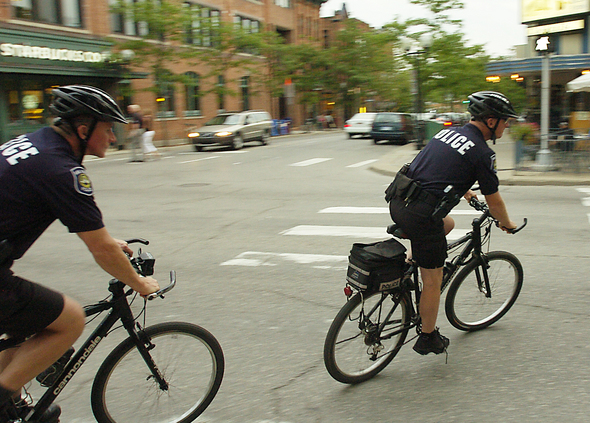
The city of Ann Arbor needs to bring back regular foot and bicycle police patrols to downtown to help make it safer.
File photo | AnnArbor.com
Most people outside of the law enforcement community do not realize that Washtenaw County and parts of Southeast Michigan are designated by the Federal Government as “High Intensity Drug Trafficking Areas” and that organized crime is present.
Solving this problem requires additional dedicated law enforcement resources. I believe that having just five officers on patrol each shift in a city of 114,000 across 27 square miles is insufficient.
The police are saying they don't have enough officers to catch the bad guys and investigate the crimes. We should listen.
Washtenaw County Sheriff Jerry Clayton has stated, “We need more proactive policing and you need more local police officers to do things to prevent crimes from happening.”
The police are saying they don't have enough officers to catch the bad guys and investigate the crimes. We should listen.
I've talked at length to a number of police officers and they all share the point of view that current staffing levels leave them spread way too thin covering way too large a geographic area of the city during their shifts.
My own observation as a downtown resident is that the perception of safety downtown has declined and we need foot patrols and bicycle beat cops downtown again daily, as well as more than five patrol cars per shift to serve the rest of the city and be able to respond to calls timely.
Drug trafficking
Washtenaw County is designated a High Intensity Drug Trafficking Area (HIDTA) by the Office of National Drug Control Policy. The Office of National Drug Control Reauthorization Act of 2006 (P.L. 109-469) established the following for determination of designation as a HIDTA:
• The area is a significant center of illegal drug production, manufacturing, importation, or distribution;
• State, local, and tribal law enforcement agencies have committed resources to respond to the drug trafficking problem in the area, thereby indicating a determination to respond aggressively to the problem;
• Drug-related activities in the area are having a significant harmful impact in the area and in other areas of the country; and
• A significant increase in allocation of federal resources is necessary to respond adequately to drug related activities in the area.
I went to City Council just before last year’s cutbacks when they fired more police (and eliminated more firefighters) and pleaded for them not to do it, noting my concerns. I am safe because I am a 6-foot tall man capable of taking care of myself, although the thought is always in the back of my mind about the safety of my wife and young children because there are 10 level-4 sex offenders registered as living at the homeless shelter downtown, across from the YMCA.
Since 2002, part 1 crimes have gone down from 3,770 to 2,758. That is 73 percent of the 2002 level. While local officials proudly note that crime has been trending down, this is part of a well known movement nationwide and the size of the drop locally has lagged behind drops in crime in the rest of Michigan.
Also of note, the decrease in crimes in our county was solely due to a decrease in vehicle thefts (part of a nationwide trend due to improved car anti-theft technology. Rapes had a significant increase (160 vs. 128) and most other categories except burglaries (2,446 vs. 2,005) had a small decrease.
More recent reports indicate a reversal of the trend toward lower rates of crime, confirmed to me by interim Police Chief John Seto. I believe that this is based on a wave of increased illegal drug usage, including increased heroin usage driven by inexpensive exports flooding in from Afghanistan, which supplies most of the world’s heroin. Most crime is driven by an urgent desire for money to buy illegal hard drugs. The wave of heroin usage locally is severe.
Check out some of the comments on this article about local use of heroin:
• “I've heard anecdotally that many young people in this area are using/abusing heroin and addiction is a growing problem. I would like AnnArbor.com to report on that because Ann Arbor doesn't seem like the kind of place where young heroin addicts live.”
• “Livingston County has also seen an extremely dramatic increase in heroin use and deaths. It has gotten to the point now that if someone in Pinckney under the age of 40 dies, it is almost assumed to be a heroin overdose.”
• “Many towns in the area have a problem with heroin but keep it quiet. Parents don't know because the deaths are not reported as news and obits don't say Heroin OD. [I saw a] heartbreaking poem online in memory of a dead Saline girl (OD), possession arrests in our local paper and two young locals dead from Heroin OD in recent months… the kids drove to Detroit to get the drugs.”
Heroin use jumps
Heroin usage has jumped locally due to several factors. Speaking to the mom of a local student who died recently of heroin overdose, I learned the following:
1. The influx of cheap heroin from Afghanistan has made it incredibly cheap. Heroin can be purchased for about the price of a pack of cigarettes. Its popularity has risen as its cost has dropped.
2. Heroin is becoming the drug of choice for those seeking to avoid drug testing programs because it is undetectable 24 hours after being taken. Drug offenders sentenced to drug monitoring can use heroin to avoid detection.
3. Once you take heroin once, you are addicted for life. Heroin addicts act irrationally, their mental processes are clouded.
With serious crimes at 73 percent of the 2002 level, if we had 73 percent of the police officers we had in the early 2000s before the cutting started, taking into account the 19 employees outsourced in the merger of the 911 call center with the county, we'd have 139 police officers. The new 2013 budget pays for 7 more than that. Of course with the crime spree at the start of 2012, the 2011 level of crime may be a low that we may not see in 2012 and more staff may be required.
Is it enough? The key to making the correct decision is to know if police are responding timely, which is no, and if the department is solving an average level of serious crimes compared to similar cities, but Interim Chief Seto told me that he is still assembling that data.
Ann Arbor needs more than 5 cars on patrol at any one time, and we need to reinstate daily downtown foot patrol beat cops. The city's new budget for 2013 leaves us with 146 police employees, below what appears to be required.
Before he quit, former Police Chief Barnett Jones was pressured in recent city budget cycles to make deep cuts to the police department, cuts he didn't want to have to make.
"We can't afford to lose a police officer," he told council members in February 2010. "Since 2000, we've gone [down] from 216-plus police officers… As a police chief, I cannot stand here and say I can afford to lose any more police officers."
Both the police department and the fire department, which Jones oversaw as public safety administrator, have gone through two rounds of cuts since he made that comment.
Stephen Ranzini is a resident of downtown Ann Arbor and president of Ann Arbor-based University Bank. He is a former community member of the AnnArbor.com editorial board. You may contact him at ranzini@university-bank.com.
Comments
Chase Ingersoll
Mon, Jul 9, 2012 : 12:41 p.m.
De-criminalize, so that people can have honest and open discussions about what they are doing, how it affects them and what they might want to do differently in regard to their substance use and their life in general. Recovery begins when this discussion is shared between two people.
Stephen Lange Ranzini
Wed, Jun 13, 2012 : 4:46 p.m.
@ADH: A really great point you've made above.
ADH
Sun, Jun 10, 2012 : 7:35 p.m.
How can a city with one of the top University's in the Country not consider more police officers to make common sense. Ask yourself the question would you want to send your child to college in a unsafe town? It's always a bad idea to cut police officers and firefighters. Ann Arbor once was a prized city to live in. Please let's not lose that. HIRE MORE POLICE and keep this great city safe.
Genboy
Fri, Jun 1, 2012 : 3:03 p.m.
It's all the holy conservative trickle down effect. Fewer police and services because we keep falling for their "smaller government" crap, we keep pumping money into the pockets of the wealthy, and we spent trillions on wars that bankrupted the nation, and the states, and the cities, and the townships. You asked for...you got it.
Ming Bucibei
Fri, Jun 1, 2012 : 5:38 a.m.
Where would the funding for more police come from?? The city is broke and broken, the people are over taxed aready!! City hall spends money like it is water!!--it is an over spending problen not an under taxing problem!! Ming Bucibei
lefty48197
Fri, Jun 1, 2012 : 1:15 a.m.
Is this article a joke? Has crime exploded around us recently? I don't think so. Sure graffiti has appeared in lots of places. I don't think that's causing heroin overdoses in Pinckney though. Is the writer saying that the AAPD is understaffed or the Washtenaw County Sheriff's Dept.? Both? We've had "near riots" on South U. Ave for nearly half a century. I don't think Ann Arbor has been "under policed" for that half century. Since we have 10 level 4 sex offenders living at the homeless shelter, should we have more police patrols in the homeless shelter? Should they patrol State st. in case the homeless sex offenders wander over there? Should they patrol Detroit to keep Pinckney children from going there to buy heroin? Times must really be bad for OC if the mafia is stealing I Phones in AA in order to raise cash.
snapshot
Thu, May 31, 2012 : 10:14 p.m.
I saw 5 police cars and a half a dozen officers stop ONE guy in a Mustang yesterday downtown Ann Arbor.....No violence, no altercations, just half dozen cops standing around for an hour talking to the guy. Safety is one thing, wating time and manpower is another. I'm sure there's a "reason" though......nothing related to better management or performance, I'm sure......
Stephen Lange Ranzini
Thu, May 31, 2012 : 10:24 p.m.
@Snapshot: Fascinating post, thanks!
Stephen Lange Ranzini
Wed, May 30, 2012 : 4:40 p.m.
@Rusty Shackelford: No where in my column do I advocate for the "War on Drugs". Objectively, if you measure success as making progress (of any type), the War on Drugs and the endless wars in Afghanistan, Iraq & etc. are abject failures. What to do? I don't have the solution. Maybe the strategy should change, but in the meantime the crime doesn't stop and we must have enough police (but not too many) to effectively serve and protect the citizens from crime. I do believe that Ann Arbor Police don't have the resources to effectively investigate and contribute to other area law enforcement efforts to combat drug distribution gangs, and over time, problems will increase because being wealthy and having a high concentration of young adults, we are a prime market target for the snares of these drug gangs. Because drug users addicted to hard illegal drugs cause most crime to meet their urgent need for cash to buy them, the hard illegal drugs cause a wider problem for society at large, and the ethical issue is not just limited to the personal choice to ruin one's own life.
rusty shackelford
Wed, May 30, 2012 : 6:49 p.m.
Fair enough, you didn't refer to the "war on drugs" by name, and it's true that a lot of crime is driven by addicts. But I think by conflating a rise in crime with the notion that Washtenaw County is supposedly infested with heroin-dealing gangs, you're arguing, if not intentionally, for its continuation. As you know, I-94 passes through Ann Arbor. It connects every major city in the Midwest, and, with its functional equivalent in Canada, Toronto and Montreal as well. The fact that a lot of drugs are trafficked "through" the county is thus unsurprising. I haven't seen any evidence, including in this piece, that organized crime has any significant presence in Ann Arbor or that heroin use is worse here than elsewhere.
Stephen Lange Ranzini
Wed, May 30, 2012 : 4:17 p.m.
@Joan Lowenstein: In the column, I wrote that there are currently 139 police on staff down from 210. I then wrote "The new 2013 budget pays for 7 more than that."
Basic Bob
Wed, May 30, 2012 : 3:52 p.m.
This county as well as most of the other most populous counties is designated as a HIDTA county in order to attract federal funding. That's a reasonable move since the feds seem intent on identifying a problem we need to fix, at least we should take their money. That doesn't mean that Ann Arbor is more dangerous than East Lansing. The "near-riot" on St. Patrick's Day was not caused by the federally identified problems of marijuana and heroin, but by alcohol. Look at all the random beatings that break out after home football games and you will also see that alcohol is a contributing factor. Heroin is scary. And we should be diligent to prevent people from getting hooked on it. But the disinformation presented from the heroin mom is as biased as asking the union rep if they need more members. I don't believe there are too many kids out there saying, "Hey, I'm bored, let's shoot some dope". They are shooting heroin because they can't get their Oxycontin, Vicodin, etc., anymore, and it's a cheap but dangerous substitute. Throw out your unused pain meds, or better yet, don't take them.
Soft Paw
Wed, May 30, 2012 : 3:32 p.m.
Once you take heroin once, you are addicted for life.>> I quit reading right there. next time get an informed opinion on the subject, instead of sensationalizing it.
lisasimpson
Mon, Jul 9, 2012 : 1:14 p.m.
Ditto.
Joan Lowenstein
Wed, May 30, 2012 : 2:49 p.m.
Since 1980, the number of people in prison for drug offenses has increased 13-fold http://www.sentencingproject.org/template/page.cfm?id=128. Does anyone think arresting more people for drug-related crimes is really the answer? Is that why we want to take hundreds of thousands of dollars away from other services to hire more police? Actually, the city has hired more police and Mr. Ranzini does not even mention that fact.
Avery
Wed, May 30, 2012 : 2:32 p.m.
If "most crime is driven by an urgent desire for money to buy illegal hard drugs", then why not have a reasoned discussion about why hard drugs are illegal. There are so many human and financial costs because we label these drugs as illegal, as opposed to simply the use of those drugs. For example, if we designated these drugs as legal, to be dispensed only by physicians, and then put all of the incredibly large drug-war expenditures into detox and drug education programs, what would be the result? Would the Taliban in Afghanistan have enough money to fight if they didn't have the income from poppy-growers? These questions should be asked -- not pushed aside because we don't like these drugs.
annarboral
Wed, May 30, 2012 : 2:31 p.m.
Crime rates are decreasing? Seems to me that if you have fewer police then there will be fewer crimes reported. Most people already realize that reporting minor crimes is a waste of time. Police must to be able to "PREVENT" crime not just fill out useless paperwork about crimes that will never be solved.
GoNavy
Wed, May 30, 2012 : 2:18 p.m.
I have no problem with taking the police out of their cruisers and putting them on bicycles and beat walks.
zigziggityzoo
Wed, May 30, 2012 : 2:15 p.m.
We should be petitioning our legislators to make it easier for volunteer police to be utilized by municipalities. We already have reserve/auxiliary police academies, but there is no reserve/aux police MCOLES certification. Most states will make their reserve officers fully sworn police. We need to have a reserve certification, and allow the community to supplement their paid police force with sworn reserve officers.
ChrisW
Wed, May 30, 2012 : 2:07 p.m.
I wonder how much of the crime reduction is just people not bothering to file reports. We waited more than an hour for a police car after a traffic accident a few weeks ago.
Ron Granger
Wed, May 30, 2012 : 1:52 p.m.
Having more cops kicking down doors at 4AM to combat this alleged "drug problem" doesn't seem like an improvement to my community.
Ron Granger
Wed, May 30, 2012 : 1:49 p.m.
Hiring more cops won't stem the FEAR that seems to drive this. When police levels were at their peak, the serial rapist went on for years. They couldn't solve it, even by DNA testing dozens of black men. A cab driver finally spotted the guy's white gloves, which were described by a victim. The point is, more police doesn't necessarily make us safer.
racerx
Wed, May 30, 2012 : 1:32 p.m.
Hey, but we got rid of the Michael Jackson dancer in the ally on Liberty! I feel much safer crossing the street and enjoying the beggars in front of what was formerly Borders!
sigdiamond
Wed, May 30, 2012 : 1:32 p.m.
There is so much misinformation and so many completely unsubstantiated claims in this article it's hard to even know where to begin. I realize this is an opinion piece but, my God, is this a joke?
a2roots
Wed, May 30, 2012 : 1:23 p.m.
Sorry a postscript to my prior post...if memory serves me correctly the reason for two police departments is primarily because the University got tired of being ripped off by the city. They were being charged for police services that they were able to bring on board and manage at less cost than what they were paying the city. Sure would be interesting to see a comparison of departmental costs. I would bet the university force is run more efficiently at less cost.
a2roots
Wed, May 30, 2012 : 12:58 p.m.
When did the University's police force start? Isn't it the primary reason why the Ann Arbor force was reduced? Prior to the University's force coming to be, wasn't the City's police force charged with covering the entire city? You never hear much about how the two forces interact and work together. What is the relationship? Seems to me that one force for the City would make more sense. Less upper echelon command, better ability to plan, easier communication with one force and no issues regarding turf. There is only one fire department in town so why are there two police departments?
YpsiVeteran
Thu, May 31, 2012 : 2:03 a.m.
a2roots, I don't think so. UofM PD is the highest paid in the entire state, with the highest-paying chief's position in the state. A2 pays its people less than the U. Everyone pays their people less than the U.
a2roots
Wed, May 30, 2012 : 1:19 p.m.
@Craig...if memory serves me correctly it is primarily because the University got tired of being ripped off by the city. They were being charged for police services that they were able to bring on board and manage at less cost than what they were paying the city. Sure would be interesting to see a comparison of departmental costs. I would bet the university force is run more efficiently at less cost.
Craig Lounsbury
Wed, May 30, 2012 : 1:12 p.m.
"why are there two police departments?" I would suggest the University wants a police department for the same reason a third world dictator wants a "royal guard". They want a law enforcement format they can control with an iron hand.
Craig Lounsbury
Wed, May 30, 2012 : 12:46 p.m.
I'm all in favor of more police. I don't think we can afford the luxury of so many police we can put some on bicycles or on foot. A foot cop or bicycle cop has a very limited effective response range and still needs a car to get a suspect to jail. We need enough cops in cars before we can remotely entertain the idea of cops on foot or peddling a bike.
Craig Lounsbury
Wed, May 30, 2012 : 4:24 p.m.
Ann Arbor and Iraq are not the same thing. The military and local police are not the same thing.
GoNavy
Wed, May 30, 2012 : 2:49 p.m.
Craig- Suffice to say, I disagree. History and military experience demonstrates that boots on the ground, as opposed to mechanized infantry patrolling in armored vehicles, is far more effective at policing a populace and maintaining order. Our experience in Iraq bears this point out. Regarding Predator and Reaper drones, I get the feeling you haven't been paying attention to recent efforts by major law enforcement divisions to acquire drone technology for the purpose of policing and surveillance. Furthermore, Israel seems to feel that dealing with problems through the application of air-to-ground rockets is an acceptable solution to their own problems, so the concept clearly isn't beyond comprehension.
Craig Lounsbury
Wed, May 30, 2012 : 2:40 p.m.
"I don't follow the logic behind "A foot cop or bicycle cop has a very limited effective response range." Does he not have a radio? " The logic is that in some sort of extreme emergency, like say, a bank hold up with gun fire and hostages at Washtenaw and Huron Parkway do we really want cops walking or riding bicycles downtown? Can we afford cops who effectively are assigned only to downtown no matter what because they can't get across town in a timely fashion? An officer in a cruiser can actually stop his car and get out as needed. He can wander a block or so but be in a car in an emergency. Thats how I see it. I won't bother to respond to your "Predator and Reaper drones" comment as I will assume its hyperbole.
GoNavy
Wed, May 30, 2012 : 2:22 p.m.
I don't follow the logic behind "A foot cop or bicycle cop has a very limited effective response range." Does he not have a radio? An officer on foot brings a presence to an area that a cruiser driving by at 25mph simply cannot. I mean, if we want "coverage" and the ability to respond instantaneously, why not blanket the city of Ann Arbor with Predator and Reaper drones? That way, we can all be monitored 24-7 and any instances of theft, vandalism, etc. can be effectively dealt with via the application of an air-to-ground missile.
theodynus
Wed, May 30, 2012 : 12:26 p.m.
So, basically: Crime is down, but I feel scared, so we should pay a bunch of people to stand around and make me feel better. Awesome logic. As for rapes specifically, I suspect the reporting rates have increased significantly in the last decade.
Mike
Wed, May 30, 2012 : 12:20 p.m.
The former head of the patrol officers' union, Aimee Metzer, said in July 2011: "Ten years ago, we used to catch people......... "The police are saying they don't have enough officers to catch the bad guys and investigate the crimes. We should listen." I guess they didn't read the other headline in today's Ann Arbor.com about arresting a suspect in the Broadway party store robbery.............. "Since 2002, part 1 crimes have gone down from 3,770 to 2,758. That is 73 percent of the 2002 level. " So what exactly is this article about again?
Major
Wed, May 30, 2012 : 4:56 p.m.
Do you not realize this "bust" was after the owners daughter, rightfully outraged by multiple robberies, had to stand before the city and plead for help? Then after being reported here, it took what..two days to get their man?
rusty shackelford
Wed, May 30, 2012 : 12:02 p.m.
You framing this, at least in part, as a need to increase our local contribution to the drug war definitely turned me off to your entire essay. Anybody remember police in black masks on Main Street breaking into licensed medical shops and trying to destroy their businesses? That certainly didn't feel like America to me.
Cathy
Sun, Jun 3, 2012 : 4:48 p.m.
Good thing we still have a Drug War. Now no one can get drugs.
rusty shackelford
Wed, May 30, 2012 : 3:11 p.m.
The uninformed and boorish comments in response to mine only demonstrate further why stronger legal protections for medical marijuana users are needed. Part of the spirit of American democracy from the beginning has been the protection of unpopular groups from the unintelligent and vaguely (not always so vaguely) aggressive horde.
pbehjatnia
Wed, May 30, 2012 : 2:59 p.m.
Oh, you mean pot dispensaries? Yeah. I am real concerned about that... NOT.
Billy
Wed, May 30, 2012 : 11:43 a.m.
"… only one stolen cell phone that is currently in a pawn shop has come from Washtenaw County and a shared inventory database means police are alerted when a stolen cell phone comes in to a store." This is an indication of organized crime since the stolen phones are being sold out of the area. Sigh.....no...that is NOT an indication that the phones are being sold outside the area. Only the stupidest of criminals sell stolen goods at pawnshops. I mean the absolute dumbest. ALL pawnshops require you to have valid photo ID. Not doing so leaves them open to a whole slew of criminal charges. This is yet another thing that makes the Sheriff department look less than sincere in their claims.
snoopdog
Wed, May 30, 2012 : 11:29 a.m.
"I went to City Council just before last year's cutbacks when they fired more police (and eliminated more firefighters) and pleaded for them not to do it, noting my concerns." The police and firefighters have in my opinion fired themselves. Rather than take reasonable cuts to save their brothers jobs, they would rather see the least senior of their members fired. And don't come here and try and tell us that they have given up much, they have not. Good Day
djm12652
Wed, May 30, 2012 : 2:57 p.m.
Anyone willing to put their own life in harm's way to save mine....earn every penny they get!
sh1
Wed, May 30, 2012 : 11:32 a.m.
This link shows the concessions they took: http://www.annarbor.com/news/ann-arbor-police-officers-union-accepts-concessions-in-new-labor-contract/ Can you share the link that shows where you got your information?
Billy
Wed, May 30, 2012 : 11:11 a.m.
Is there ACTUALLY a large drug problem in Washtenaw county.....or is LAWNET still attempting to maintain that there is a "large drug problem" in Washtenaw county? Also.....where is the evidence of this "heroin" epidemic in Washtenaw again? At least a year ago LAWNET was trumping up this supposed "heroin" problem by talking about all the "heroin busts" they made over the weekend....and then in the run down there was one single heroin bust, and over half a dozen marijuana busts. Those "facts" you list on the side of this article...are "facts" you learned from that mother....someone who just isn't even remotely a certified expert. I'm sorry but just because our area is "designated" something by the federal government doesn't make their assessment any more accurate. Sorry, but this whole article smacks of alarmist rhetoric.
djm12652
Wed, May 30, 2012 : 3:17 p.m.
@zigziggityzoo....then I guess that means children are safe...@sh1 as of today, yes 2 were listed at Delonis, but if you go 2 to 3 blocks up Huron...that number jumps to 4 times that...
pbehjatnia
Wed, May 30, 2012 : 2:55 p.m.
There is a HUGE drug problem in Washtenaw County. Heroin has been steadily on the rebound for ca. 4 years here among teens and twens especially. It's not a fabrication. It's sadly real.
rusty shackelford
Wed, May 30, 2012 : 12:05 p.m.
Seems that whether or not kids in Pinkney are doing heroin (and that seems unlikely) has virtually nothing to do with AAPD staffing levels.
Goober
Wed, May 30, 2012 : 11:33 a.m.
If Pinkney truly has this type of problem, what are the parents doing about it?
Goober
Wed, May 30, 2012 : 11:03 a.m.
I see this as a society problem - not one that will be solved by more police. Rather than writing tickets for those that did not stop for an intention to cross a street or set up a speed trap, efforts should be placed into eliminating the drug dealers, thieves, robbers and rapists. Graffiti is owned by us. Evidentially, we raised our kids to not care at all about property owned by others. Why are we allowing our kids to roam the streets at night causing this damage to property owned by others? Why are parents tolerating street gangs? Children should be at home studying and getting ready for their next phase in life. A policeperson on every corner is not going to stop what we, the citizens of the community created. This process is totally backwards. Stop it at the source and then let law enforcement control the bad element that comes to our community to break laws.
djm12652
Wed, May 30, 2012 : 2:55 p.m.
I did not raise my child that way! As a downtown resident like the author, I believe that a police presence is extremely pertinent to reducing the threat of criminal activity....but I hope you can tell me..so how do we go about stopping the criminal opportunists coming from out of town from robbing us, our homes, our cars...?
joe.blow
Wed, May 30, 2012 : 10:52 a.m.
I stopped reading the story when a Union member was interviewed. How is that a non-biased source of information?
Enso
Wed, May 30, 2012 : 7:44 p.m.
I think we'd all rather you go back to the Fox News forums anyway.
Brad
Wed, May 30, 2012 : 1:21 p.m.
So get yourself something from Livingston County to read. You'll probably like that better.
Boo Radley
Wed, May 30, 2012 : 11:32 a.m.
How would you ever find a "non-biased" source to interview? No matter who was interviewed, they would be biased in one way or another. Your anti-union bias should not get in the way of a union's professional opinion being offered.
sh1
Wed, May 30, 2012 : 11:02 a.m.
Does that mean you will never read articles with two points of view?
Carole
Wed, May 30, 2012 : 10:52 a.m.
Talking to the city fathers won't help. Citizens have been expressing their concerns regarding the safety and welfare of the city for over a year or more and they have not listened. The "bad guys" know this. Come on, get with it and bring our Police Force back to a safe level for all as well as the fire department.
A2James
Wed, May 30, 2012 : 10:39 a.m.
If stolen iPhones aren't being sold at pawn shops, it doesn't necessarily point to organized crime. Most likely, much like the drugs, the phones are being sold to acquaintances on the street, or on Craigslist. There is a fairly big drug problem in the area, though.
pbehjatnia
Wed, May 30, 2012 : 2:53 p.m.
Keep dreamin' your Deuce fantasy until you get hit personally.......