

How U-M helped free imprisoned man falsely convicted of killing his family
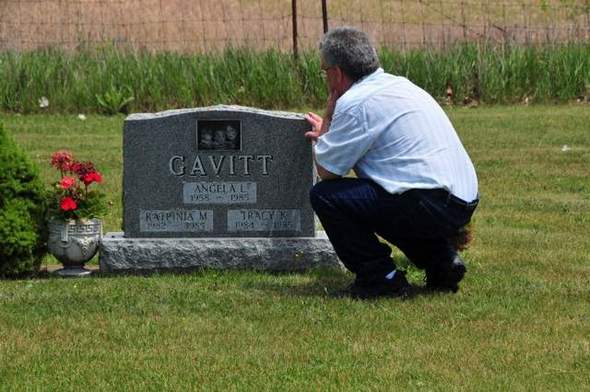
David Lee Gavitt of Ionia is shown visiting the graves where his wife and daughters are buried. Gavitt was released from prison earlier this month after being exconerated of starting a 1985 fire that killed his family.
John Masson | University of Michigan Law School
After 26 years in prison, the 54-year-old was exonerated and freed earlier this month, thanks to the University of Michigan Law School’s Innocence Clinic.
Clinic co-director David Moran estimates that 3 percent of all prisoners are innocent of the crimes for which they are convicted. That would represent about a thousand prisoners in Michigan.
In an interview on 1290 WLBY, Moran said the first place that Gavitt asked to go after his release was to the cemetery where his family is buried.
Lucy Ann: What was that moment like?

David Moran is the co-director of the University of Michigan Law School’s Innocence Clinic.
Lucy Ann: What happened on the day of the fire?
Moran: In the late 1980s, 25 percent of all house fires in the United States were called arson and today that number is about 6 percent. Thousands of fires that were called arson back in the 1980s would no longer be called arson today because we have a much better understanding of the fire science. On March 9, 1985, David Gavitt was at home with his wife, Angela, and his two young daughters, ages 3 and less than a year. After they put the girls to bed, David and Angela were watching TV. They were smoking, they had candles lit, and then they went to the bedroom. They heard the dog scratching the door and David opened the door and there was an inferno going on in the house. He ran across the hall and broke a window to create an escape route, which in retrospect probably made things worse, it created a draft. Angela ran down the hall toward the nursery where the girls were. Then David ran to the nursery after he had broken the window to create an escape route…and he couldn’t make it to the nursery. He got out the window he broke, wearing only jeans, no underwear, no socks, no shoes, no shirt, in the snow outside, badly lacerated from the window and had second degree burns over much of his body. He went around the house, leaving a blood trail, and the neighbors arrived and were physically holding him down as he was trying to fight his way back into the burning house. He was so badly burned and lacerated that he spent weeks in the hospital.
The arson investigation showed burn patterns inside the house appeared to indicate arson, but modern fire science now disproves that. A fire science expert told the clinic it was caused by a flashover, which occurs when toxic gases burst into flames in a closed room. It also has been determined that a Michigan State lab technician botched a test that he said showed there was gasoline on the carpeting.
Moran: The fire examiners at the time concluded that this fire had been intentionally set in the living room, even though there were obvious sources of ignition in the living room - the candles lit, cigarettes burning in the ashtray and a large dog to knock them over. No motive in this case. This was a happily married couple. No life insurance. But just based on this forensic evidence at the time, he was convicted and sentenced to three counts of first degree murder to life in prison without parole.
Lucy Ann: Technology has changed and you were able to determine what actually happened.
Moran: Our students, especially Max Kosman, Imran Syed and Caitlin Plummer, developed this case and we sent it out to the experts to say, with all of these photographs of the scene, would you call this arson today? The answer was no, this was more likely to be an accidental fire. Remember those gas chromatographs that supposedly show gasoline on the carpet? We got those original gas chromatograph charts from the Michigan State Police and we sent them to the top gas chromatograph people in the country. They told us that there was absolutely no gasoline in any of these seventeen charts. We presented all of this information to Ionia County prosecutor Ron Schafer last summer 2011 and said here’s everything we have, we want you to take a look at it, and to his great credit he was willing to do that.
Lucy Ann: How did his case get the attention of your students?
Moran: Like thousands of others, he sent us a questionnaire. We have a nineteen-page questionnaire on our website where we ask all sorts of questions. We were on the lookout for arson cases because we knew based on the change in fire science that there would be people in prison who had been convicted of arson and arson murders from before the science changed, and who were wrongly convicted.
Lucy Ann: If Michigan had a death penalty, is it likely that someone like Gavitt could have been put to death before this technology had changed?
Moran: Entirely possible. It’s the kind of case that would tug at the heartstrings. You have two little girls dead, and a woman dead, so it is entirely possible that this could have been a death penalty case. There was a death penalty case very similar to this in Texas, Cameron Todd Willingham. The house burned very fast, his children died, and the same bad arson science was applied. He was sentenced to death and was executed about eight years ago, even though new reports had been done showing that there was actually no evidence of arson. (Governor) Rick Perry, who ran for president last year, was heavily criticized for his refusal to stop the execution despite the new evidence. There’s a Texas forensic science commission which has been looking into the case.
Lucy Ann: What is David Gavitt’s life going to be like now?
Moran: He’s working to put it together. While we were at that cemetery, 20 members of his extended family showed up - his two sisters, one of whom lives here in Ann Arbor, his aunt, his stepmother, cousins, nephews, nieces - so he has a strong and supportive family. He also now has a girlfriend and he’s staying with her. He has a job offer as a landscaper and is going to start working soon.
Lucy Ann: He’s rebuilding his life.
Moran: He is rebuilding his life and there’s a network of exonerees who are going to help him. There are literally hundreds of exonerees around the country who are there for each other. When a new exoneree gets out, they try to help them through the experience.
Since it began three years ago, the Michigan Innocence Clinic has exonerated six people, who among them served a total of 84 years in prison. For more information, visit www.law.umich.edu/innocenceclinic. Listen to the complete interview with David Moran at www.lucyannlance.com.
Comments
talker
Sat, Jun 23, 2012 : 10:42 p.m.
The failure rate is horrible. I fear it would be even worse if prisons was privatized. A crooked judge (perhaps with a gambling or other expensive habit) might be bribed to send more people to (privatized) prison and for longer periods of time. This seems impossible, but such behavior has been brought to light when sentences that shouldn't have occurred sent teens to youth facilities and for longer periods of time.
David Frye
Sat, Jun 23, 2012 : 5:33 p.m.
A "failure rate" of 3% is absolutely criminal when you compound it by the fact that the US has the highest incarceration rate of any country on earth (and possibly of any country in history). It means that we are falsely imprisoning around 23 people per 100,000. This compares very badly with the 73 per 100,000 TOTAL incarceration rates for countries like Denmark and Norway. (And doesn't even take into account the 400 or so per 100,000 that we keep locked up for nonviolent drug "crimes.") Our entire criminal justice system, from grandstanding prosecutors, to elected judges who pander to the "lock em up and throw away the key" mentality, to grotesquely underfunded public defender programs, to mention the growing threat of politically connected, for-profit prisons, is in drastic need of overhaul.
bedrog
Sun, Jun 24, 2012 : 3:49 p.m.
David,...there is no shortage of grandstanding and 'rope- a- doping' via narrow legalisms ( to the detriment of truth) by the defense side of the aisle--be it the o.j. simpson case or , more locally, the original case for obstruction of justice against a physician at a UM event a few years ago ( involving her and a few other notorious antisemite accomplices ) in which she was wrongly acquitted, although more recently having her counterclaims of police brutality rejected...happily..
Peter
Sat, Jun 23, 2012 : 3:27 p.m.
Remember this story when people advocate for capital punishment. And remember this one, which was very similar but had a very different outcome: http://en.wikipedia.org/wiki/Cameron_Todd_Willingham
Michigan Reader
Sat, Jun 23, 2012 : 12:51 p.m.
Good work, Innocence Clinic.
xmo
Sat, Jun 23, 2012 : 12:46 p.m.
It seems that most people have a low opinion of our criminal justice system? The 3% that are innocent and behind bars is pretty good failure rate. Most country's would like to have a record like that. Yes, there is room for improvement but I would rather be charged in the US than any other country!
Craig Lounsbury
Sat, Jun 23, 2012 : 3:26 p.m.
The notion that its only 3% is unknowable. Wherever that number came from would be the minimum. Its at least 3%. There are certainly innocent people who will never get out because no one will advocate for them.
Ed Kimball
Sat, Jun 23, 2012 : 2:37 p.m.
It's only a good failure rate if you're not one of the 3%.
Brad
Sat, Jun 23, 2012 : 1:12 p.m.
That's a terrible failure rate in the supposedly most free country on the planet. You are talking about depriving people of their liberty. What worse thing could a free country do to someone? And of course the other thing is that those 3% will be predominantly minority and poor because that's how it works. And in many of the cases there is also prosecutorial misconduct to go along with in. Also it's common for people to continue to be imprisoned even when they know they're innocent because it's "embarrassing" to let them go. Criminally ridiculous. If this interests you I invite you to check out and/or contribute to the Innocence Project which is the "grandaddy" of these efforts. http://www.innocenceproject.org/
pseudo
Sat, Jun 23, 2012 : 11:07 a.m.
I wish Mr. Gavitt all the luck and support in the world. Starting your life after such a long time in prison is a huge challenge. Doing so in the face of this tragedy, makes that even harder.
Craig Lounsbury
Sat, Jun 23, 2012 : 10:52 a.m.
In my opinion, at times, overzealous prosecutors care more about their "won-loss" record than anything else. Certainly more than whether the defendant was actually guilty.
SW40
Sun, Jun 24, 2012 : 11:04 a.m.
While that may be true in some places you are fortunate enough to live in a county where the prosecutors don't care about convicting anyone as long as their docket stays light and they have enough time to goof off in the hallways around the courthouse. plea deal plea deal plea deal, dismissal. Washtenaw county style baby. ask any cop in town our prosecutors lack of fortitude makes a hobo seem down right enthusiastic
trespass
Sat, Jun 23, 2012 : 10:33 a.m.
If there was no gasoline evident in any of the gas chromatographs, how is that "botched" and not perjury? It also cannot be blamed on the technician because all forensic laboratories have a Director who must review and approve any results. Unless the technician falsifies the lab results then the Director is responsible for the interpretation. Does the statute of limitation prevent him from suing the laboratory and its Director? Is the laboratory protected by legal immunity? Why didn't his lawyer get a second opinion on the lab results before his trial?
Michigan Reader
Sat, Jun 23, 2012 : 12:57 p.m.
I don't think it was perjury, because there was no intent to knowingly decieve the court, and the director of the MSP lab, if I'm not mistaken, has absolute immunity if he/she was acting within the scope of his/her employment duties.
aquileyendo
Sat, Jun 23, 2012 : 12:23 p.m.
Were all the same standards and protocols used 26 years ago as they are today?