

Officials: Prescription drug abusers in Washtenaw County younger than ever
Courtesy of Washtenaw County Public Health
About 150 professionals met at Washtenaw Community College Thursday for a prescription drug abuse symposium to learn the scope of a nationwide problem that officials say is happening here.
There were 461,893 prescriptions filled for opiates in 2010 in Washtenaw County - which is more than one prescription for each resident, according to the Michigan Automated Prescription System, which tracks all controlled drugs in the state.
In 2010, poisoning by drugs was the second leading cause of death in the county.
“Because this is a community problem, you have to tackle this problem as a community,” said Marci Scalera, director of the Livingston Washtenaw Substance Abuse Coordinating Agency.
Adreanne Waller
“This is an epidemic of national proportions,” said Dr. John Hopper, a prescription drug abuse specialist who directs the internal medicine residency program at St. Joseph Mercy Hospital, Ann Arbor. “There are solutions at the pen of the subscribers, but also in the community itself.”
Only 18 percent of prescription drug abusers have a single doctor from whom they get their medication, Hopper said during his presentation Thursday on the state of prescription drug abuse nationwide.
“This is a disease, and it requires lifelong treatment,” Hopper said.
John Hopper
With prescription drugs a common sight in many medicine cabinets, young adults have access to powerful medications that have been known to lead to heroin use.
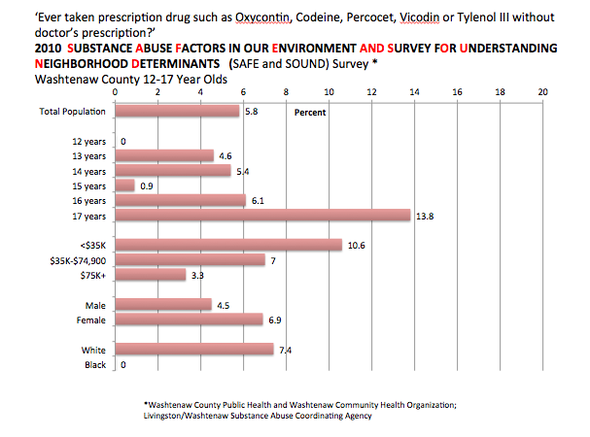
About 13.8 percent of 17-year-olds in the county admitted to taking a prescription drug like Oxycontin, Codeine, Percocet, Vicodin or Tylenol III without a doctor’s prescription, according to a 2010 survey.
Teenagers in Washtenaw County who admitted to taking prescription drugs without a prescription also mostly come from low-income households, Waller said.
Low-income individuals on Medicaid are more likely to be prescribed prescription painkillers because they can’t afford alternative treatments to manage chronic pain in other ways, Hopper said.
Courtesy of Washtenaw County Public Health
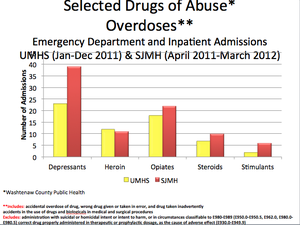
Officials link an increase in prescription drug abuse to a rise in the use of heroin as well, as many individuals addicted to drugs like Oxycontin are known to turn to heroin for a cheaper way to get their fix. Single doses of heroin are more potent and less expensive than the pills whose effects they mimic.
The average age of individuals who overdose on heroin at Washtenaw County hospitals is 20 years younger than the average age of those who overdose on depressants, opiates and hormones.
There were 80 percent more heroin arrests in 2010 than in 2007, according to the most recent data from the Michigan State Police.
MSP also reports that heroin sales and manufacturing offenses have increased by 375 percent in that same time frame, Waller said.
The grade of heroin on the street today is about 90 percent pure and has a low threshold for overdose, Waller said — citing data from the county medical examiner’s office.
In the 1960s-80s the grade of heroin was much lower, about 10 percent pure.
Washtenaw County Public Health infectious disease epidemiologist Laura Bauman said young adults comprise a growing proportion of the population with the disease Hepatitis C in the county.
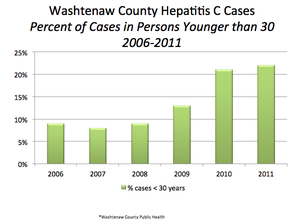
Courtesy of Washtenaw County Public Health
Hepatitis C and heroin activity both correlate with prescription drug addiction, Waller said. Many individuals at the symposium Thursday suggested during the presentation that prescription painkillers need to be more carefully administered.
Hopper said patients especially at risk for addiction to prescription drugs include individuals with:
- Smoking addiction
- A history of substance abuse
- Family history of alcohol or drug abuse, especially with sleep aids
- Mental health problems
- History of sexual abuse
- Prior incarceration
Hopper noted addiction to painkillers often begins subconsciously and eventually affects the development of the brain so the body becomes emotionally and physically dependent on the drug.
Prescribers need to move past the “pill for every ill” mindset to the mentality that “every pill can kill,” Hopper said.
Because of a 1990s mandate by the Joint Commission on Accreditation of Healthcare Organizations, prescribers are required to treat pain as a vital sign — and thus an ailment which has to be treated.
Better risk assessments and observations are needed for patients when pain medication is prescribed, Hopper said.
The first step in confronting the problem in the county is assessing the scope of the problem, Scalera said, noting educational strategies on behalf of the health department will move forward from there.
Amy Biolchini covers Washtenaw County, health and environmental issues for AnnArbor.com. Reach her at (734) 623-2552, amybiolchini@annarbor.com or on Twitter.
Comments
Jeremy Engdahl-Johnson
Sat, Jun 2, 2012 : 3:59 p.m.
Tough road ahead in treatment of Hepatitis C, a lurking epidemic that already infects millions. http://www.healthcaretownhall.com/?p=2891
Stephen Lange Ranzini
Sat, Jun 2, 2012 : 1:40 p.m.
"There were 80 percent more heroin arrests in 2010 than in 2007, according to the most recent data from the Michigan State Police. MSP also reports that heroin sales and manufacturing offenses have increased by 375 percent in that same time frame, Waller said. The grade of heroin on the street today is about 90 percent pure and has a low threshold for overdose, Waller said — citing data from the county medical examiner's office." Heroin is flooding into Michigan from Afghanistan. The war in Afghanistan is an abject failure for many reasons and extremely costly at over $1 trillion and we should stop it immediately. We killed Bin Laden, so what is the point of continuing?
Basic Bob
Sat, Jun 2, 2012 : 4:09 p.m.
People continue to be afraid of the power that the Taliban might wield in Afghanistan once we leave. One thing they did well was suppress heroin production.
Cory
Fri, Jun 1, 2012 : 5:19 p.m.
So they simply asked kids if they had taken prescription drugs without a prescription? Seems to me that there may be parents out there who give their kids medicine, but not in a drug abusive way. I know that I had access to several prescription drugs as a kid, things like 800mil ibuprofen. Was I an abuser? Hell no. I was sick. It just seems like that's a loaded question, leading to erroneous survey results. I mean they're questionable enough with a 5% drop in JUST 15-year-olds. Also, apparently this is race-related as well. It's obviously not a Black problem, at ZERO percent? I'm calling shenanigans on this survey. According to the survey, the group to target is Poor, White, Females.
Rork Kuick
Fri, Jun 1, 2012 : 4:39 p.m.
Maybe our young folks haven't seen or heard of enough of the damage, or don't realize oxy is playing with fire. Recently there's been increased cocaine abuse in Australia, and one theory is the people there just didn't experience the horrors we did in the U.S. (abuse decreases with time - cause they die) so they lack fear. So thanks for covering this.
chubbybunny
Fri, Jun 1, 2012 : 3:40 p.m.
This story leads with a graphic of survey data. However, the data collection method is not explained and a link to the original study is not provided. The data looks odd. Do you have a link to the original study?
Rork Kuick
Fri, Jun 1, 2012 : 4:29 p.m.
Second that. Washtenaw County Public Health web site is pretty labyrinth. Good reporting would have given us some idea of the sample sizes in charts 1 and 3. We can't tell if HepC is rising in young folks, or falling in older ones, for example.
mixmaster
Fri, Jun 1, 2012 : 2:58 p.m.
Where is Bill Scheutte on this issue? He's on his witch hunt for medial marijuana patients.
Billy
Fri, Jun 1, 2012 : 2:19 p.m.
"Prescribers need to move past the "pill for every ill" mindset to the mentality that "every pill can kill," Hopper said." Maybe they should be talking to big pharma then...since they're the ones pushing to prescribe a "pill for every ill" after all... Follow the money....whoever is making the biggest profit is ALWAYS the culprit.
justcurious
Fri, Jun 1, 2012 : 2:10 p.m.
One more thing, their is a lot of profit in treating drug abuse. You can trace just about everything back to the almighty dollar.
justcurious
Fri, Jun 1, 2012 : 2:08 p.m.
Kids want to emulate parents. They see their parents popping pills and figure it must be good and alright. The horse (no pun intended) is out of the barn. I don't see how you'll get it back in ever. People today have an overly relaxed attitude about just about everything our young people get involved in. Now the immature are raising the immature and it goes on and on. Glad I didn't live any later.
Homeland Conspiracy
Fri, Jun 1, 2012 : 1:55 p.m.
And yet "they" are still busting ppl for medical marijuana. But I forget that if a person in a white lab coat gives the drug to you it's OK... but if the drug come from a green leaf & God gives it to you it's BAD! Stop the Reefer Madness.
xmo
Fri, Jun 1, 2012 : 1:38 p.m.
Why not just give the prescription drug abusers a pill for their problems?