

Consumers advised to check cantaloupes after salmonella outbreak sickens 6 in Michigan
Consumers are advised to check their cantaloupes after six cases of illness due to salmonella in Michigan have been linked to a nationwide salmonella outbreak.
Since July 7, 141 cases of Salmonella Typhimurium have been reported in 20 states, including two deaths in Kentucky. The U.S. Food and Drug Administration and the Centers for Disease Control and Prevention are investigating the outbreak, and have linked the source to cantaloupes grown on a farm in southwestern Indiana.
It was the second time in two years cantaloupes have been the source of deadly food-poisoning outbreaks. Last year, 30 people in 28 states died from eating cantaloupes contaminated with listeria.
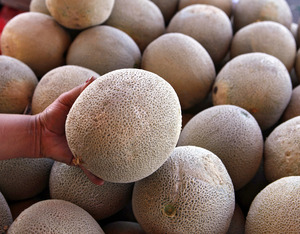
Cantaloupes grown at a farm in southwest Indiana are linked to a nationwide outbreak of salmonella, including six cases in Michigan.
Ed Andrieski | The Associated Press
Three children and three adults in Michigan reported salmonella poisoning in mid to late July after eating cantaloupe. One of the children was hospitalized. All have since recovered.
Branch and Kalamazoo counties each had one case of salmonella poisoning, while Calhoun and Wayne counties each had two cases, according to the Michigan Department of Community Health.
Salmonellosis is an infection from the salmonella bacteria and causes diarrhea, fever and abdominal cramps about 12 to 72 hours after infection.
The illness usually lasts four to seven days. Most people are able to recover without treatment. Infants, the elderly and those with weakened immune systems are the most likely to have severe illness from salmonellosis.
The Michigan Department of Agriculture and Rural Development is working to determine which stores in Michigan sold the cantaloupes from the farm in southwestern Indiana.
Health experts advise consumers to check cantaloupes at grocery stores to see where they were grown. If there is no sticker on the fruit, consumers should ask.
“Many cantaloupes have the growing area identified with a sticker on the fruit, but if no sticker is present, consumers should ask the grocer where the melons were purchased to identify the source,” said Kevin Besey, director of MDARD’s Food and Dairy Division. “The best advice to follow is, ‘When in doubt, throw it out,’ especially if you cannot determine where the melons were grown.”
Corky Anderson, produce category manager for Busch’s markets, said the company buys its cantaloupes from California. A spokeswoman for Whole Foods said that the company's produce is not affected by the salmonella outbreak.
Kroger staff members also reported Wednesday that their cantaloupes are not from southwestern Indiana.
Attempts by AnnArbor.com to reach Meijer and Walmart representatives were unsuccessful Wednesday.
The FDA has advised that cantaloupes may be contaminated on both the inside and outside of the fruit.
Cutting, slicing and dicing the fruit could also transfer the bacteria from the surface to the inside. If there is any doubt that a cantaloupe is unsafe to eat or was grown in southwestern Indiana, the FDA has advised consumers to throw cantaloupes away.
Jennifer Holton, communications manager for MDARD, offered the following safety tips for cleaning fresh produce:
- Rinse raw produce thoroughly under running water — even items that will be peeled
- Scrub firm produce, like melons or cucumbers, with a clean produce brush
- Dry with a clean cloth after washing
- When buying pre-cut and packaged produce, make sure it is refrigerated or surrounded by ice
People with questions about food safety can call the FDA's information line at 1-888-SAFEFOOD or click here to read more.
Amy Biolchini covers Washtenaw County, health and environmental issues for AnnArbor.com. Reach her at (734) 623-2552, amybiolchini@annarbor.com or on Twitter.
Comments
Tru2Blu76
Thu, Aug 23, 2012 : 6:59 a.m.
Obama's Dept. of Agriculture is suspect, the FDA is a joke... comments like these are sure signs that this is an election year and some people can't help but make their favorite political fantasies known - even in response to an article about infected cantaloupes. Lets move on. We live within 30 miles of one of the nation's most productive cantaloupe growing areas - which melons so far have not been shown to have any bacterial contamination. Here's one for the "buy locally" faction.
justcurious
Thu, Aug 23, 2012 : 2:32 a.m.
This would actually be under The Department of Agriculture. Check out who Obama appointed to be his secretary of Agriculture. The fox guarding the henhouse. http://en.wikipedia.org/wiki/Tom_Vilsack
Tom Todd
Wed, Aug 22, 2012 : 9:41 p.m.
FDA is a joke!