

Occupy Ann Arbor leaders on a mission to open new 24-hour warming center before winter hits
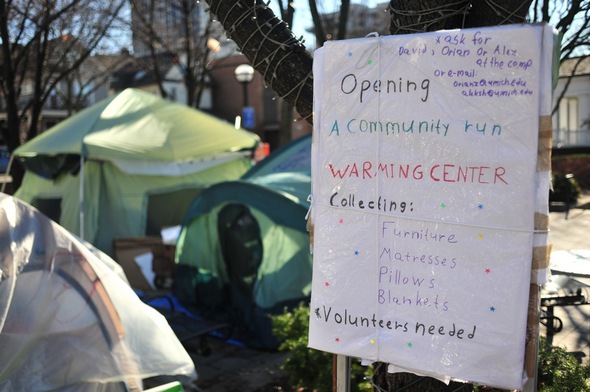
The Occupy Ann Arbor movement, based here at a tent-filled Liberty Plaza in downtown Ann Arbor, is shifting its attention to opening a new 24-hour warming center.
Ryan J. Stanton | AnnArbor.com
Their goal: to open a new 24-hour warming center for the homeless by December. They're out collecting petition signatures, holding fundraisers and lobbying the city for support.
But city officials and leaders in the nonprofit community don't sound so sure it's an idea that will work, arguing a warming center requires professional staffing and budgets are tight.
Representatives of Occupy Ann Arbor appealed to the City Council this week for city support for locating and potentially funding a space that could be leased or donated.
They say recent foreclosures, layoffs and pension cuts mean more people will be looking for shelter this winter, but the Delonis Center is cutting back on the number of spaces available. And there currently is no walk-in daytime warming center in Ann Arbor.
"Our vision is a 24-hour warming center democratically run by homed and homeless volunteers," said Orian Zakai, a graduate student at the University of Michigan. "This will be a place of community-building where homeless and homed individuals combine their skills, explore their creativity, and support and empower each other."
Zakai said 25 volunteers already are committed to working at the warming center this winter and more and more people are constantly asking to get involved.

The scene at Liberty Plaza, home of the Occupy Ann Arbor movement, on Wednesday.
Ryan J. Stanton | AnnArbor.com
"I've spent years working on issues with folks at the shelter, and I think their concern would be that this type of facility needs professional management," Hieftje said. "There's all sorts of problems that can come up along the way."
Ellen Schulmeister, executive director of the Shelter Association of Washtenaw County, which runs the Delonis Center, agreed with the mayor.
Schulmeister said she'd caution the Occupy group that it's incredibly difficult to run a shelter without professional staffing, given the complexity of issues facing the population being served. Many are struggling with substance abuse problems, and simply providing a warm place for them to go could "feed a lifestyle of homelessness," she said.
"Every place has to be working toward sobriety and ending homelessness," she said. "It has to have that intent, otherwise you are just housing people and there's no end to it."
But absent a daytime warming center, Occupiers argue deadly low temperatures this winter will force hundreds of people in Washtenaw County without shelter to seek warmth inside places like public libraries, university buildings and local businesses.
At Monday's council meeting, members of the Occupy movement presented a petition signed by more than 500 members of the community in favor of a 24-hour warming center. They said they're still searching for a site that would be ready and available by December.
In previous winters, Occupiers say, dozens of people in Washtenaw County could be found sleeping under bridges, on sidewalks and on footsteps of churches — even when there were more shelter spaces available. They believe the needs are even greater this winter.
"As the county funding of social services is drastically diminishing, the city of Ann Arbor needs to adapt to the new economic situation and continue to care for all of its inhabitants," Zakai said. "We cannot maintain an image of prosperity while leaving people out in the cold."
Hieftje said most cities the size of Ann Arbor don't have a daytime warming center. He argued Ann Arbor still remains more generous in caring for the homeless than other cities.

One of the Occupy Ann Arbor signs at Liberty Plaza.
Ryan J. Stanton | AnnArbor.com
But county officials approved a new budget for 2012 that reduces the county's human services funding, and the county's general fund earmark for the Delonis Center is being cut from $160,000 to $51,230, in addition to other cuts to the coordinated funding for human services.
Fearing the shelter's overnight warming center might not stay open this winter, the Ann Arbor City Council agreed in October to up its commitment to the Delonis Center by $25,000.
The warming center accommodated more than 60 people on some nights last year, but with limited staff, that proved to be overwhelming and police had to be called on a number of occasions, Shelter Association officials said. It's now limited to 25 spaces this winter.
Schulmeister said 25 is the actual fire code capacity for the overnight program and it was never intended to reach above that level.
"We are not going to go over capacity this year because it's dangerous for us to do so," she said. "It's way too many people in one space."
The overnight warming shelter program runs in addition to the Delonis Center's year-round residential program, which accommodates about 75 people, and a program rotating among several area churches that shelters another 25 people during the winter.
That allows 100 individuals to receive shelter both day and night, Schulmeister said, but she acknowledged there still are other people in need.
"There's always been more need than there are spaces available," she said. "There's never enough money or resources to cover the need — hasn't been for the 13 years that I've been here. Which is not to say we shouldn't be working to fill the need."
Schulmeister said the Delonis Center strictly enforces a sobriety policy at its warming center, and those admitted must have a blood alcohol level of less than 0.1.
She said the shelter doesn't test for drugs for the overnight warming center program and there was a heroin overdose in the bathroom last winter.
The Shelter Association for many years ran a daytime walk-in warming center called Ashley Place, located kitty-corner from the Delonis Center, but it was torn down in 2003. Schulmeister said the place was out of control and police were called many times.
Having been in the business of caring for the homeless for many years, Schulmeister said she has a hard time believing volunteers could run a facility like that.
Schulmeister noted that the Delonis Center opens its doors during extreme weather events, such as blizzards, to allow additional people inside.
Ryan J. Stanton covers government and politics for AnnArbor.com. Reach him at ryanstanton@annarbor.com or 734-623-2529. You also can follow him on Twitter or subscribe to AnnArbor.com's e-mail newsletters.
Comments
Alan Goldsmith
Sun, Dec 4, 2011 : 11:54 a.m.
"But city officials and leaders in the nonprofit community don't sound so sure it's an idea that will work, arguing a warming center requires professional staffing and budgets are tight." But plenty of dollars for a full time 'arts' project manager. Merry Christmas.
Don Bisdorf
Thu, Dec 1, 2011 : 11:54 p.m.
I'm truly disheartened to learn how many of my fellow Ann Arborites (based on the comments here) would gladly let me starve on the street if I had a personal disaster and wound up homeless and unemployed. Remember, folks, sometimes it's only one really bad day that separates you from the unfortunate folks you are showing such contempt for.
Kagmi
Fri, Nov 25, 2011 : 10:47 p.m.
It's days like this that make me question my faith in humanity. Are the majority of readers of this site really more concerned about chastising the "lazy" protesters who are choosing to stand out in the cold and collect signatures to create a warming shelter for the homeless than they are about housing the homeless? I'm also kind of shocked at the degree of misunderstanding here--the warming shelter they're collecting signatures for is not FOR Occupy Ann Arbor. It is for the local homeless. That would be why they're citing the shortage of beds at the Delonis Center. It would be kind of pointless for them to protest the government out of a government-run shelter, wouldn't it? They're not seeking government support for themselves. They're trying to get a warming shelter up for people who have nowhere else to go.
paul yaskanin
Fri, Nov 25, 2011 : 6:29 p.m.
Here's an Idea. Quit giving benefits to illegal aliens and send them back to where they came from. Then there will be jobs for everyone. (If they want them)
Basic Bob
Fri, Nov 25, 2011 : 10:11 p.m.
Rob, obviously you haven't been in Alabama. A large number of Mexican, Japanese, and Korean tradesmen are building a new engine plant (I don't know how they got work visas, but I suspect they are completely legal). If they tried to hire Americans, they couldn't find any because they are busy elsewhere. Anyone with ANY skill is working. Engineers are relocating to Alabama from Michigan to work in the thriving industry there. If the crops are going untended, it is because they are too busy working! It's got to be impossible to keep people working in the fields, unskilled factory work, at Walmart, or at McDonalds with the better opportunities that open up every day. Just imagine if unemployed people in Michigan were willing to move down there for a job. But they're not. They'd rather make rude comments about the ignorant South.
Sparty
Fri, Nov 25, 2011 : 9:24 p.m.
Yes, there are so many illegal aliens in Ann Arbor taking away jobs from people - that's the answer. Have you read anything about what's happening in Alabama? The so people here illegally have left the farms and other jobs, and now no Americans will work those jobs. Crops are going to ruin. Plants are running at a fraction of capacity or are closing. The economies of some towns are cratering, because the taxes these people paid and the businesses they supported have lost their income. Schools are losing education funding support because large numbers of students have left. There's your answer. Do some research.
Diagenes
Fri, Nov 25, 2011 : 4:13 p.m.
Although the article sited here is about the Occupy event, it offers a broader question as to what type of society we want in Ann Arbor in particluar and the nation as a whole. No one wants to see people freezing to death on our city streets. But is it the resposiblility of government to provide food and shelter to EVERYONE who asks for it regardless of their circumstance. So where do we, as a society, draw the line between those who have the ABILITY to support themselves and those who are truely disabled and need assistance? Many will say how can they support themselves when... It all comes back to personal responsibility. If you are an able bodied adult, you have the obligation to support yourself. Millions of us do everyday. We have a choice; do we keep moving down the path to greater government control of our lives which is what I believe the Occupy people want, or do we move the pendulum back toward the middle with a more balanced approach to personal responsibility and care for the truely needy.
Billy Bob Schwartz
Fri, Nov 25, 2011 : 7:46 p.m.
So far as I can see, the governments of the US and of the states are controlled by the one percent (or maybe up to 7 percen or so) who have most of the money and are free to buy a government that will do their will. I would rather leave the protection of the needy at least partly to government, if we had one run by people chosen by the multitude rather than by the moneymoneymoney minority. I doubt that the Occupy movement wants to have the rich do this. They would prefer to have the People in control. So when you say that we are heading to more government control, let's face it: this means more control by the rich and giant corporations and such. Let's "invite" the government to control the amount of money the rich can pay to buy a government, and let's return the goveernment to the People. I believe that this is what the Occupy movement is about, and I totally support it. The situation in America has become detestable in terms of who really makes the dicisions. It's time finally to get our country back from the robber barons and their ilk. This way, the people with the bucks could start paying their share to support the government(s) in the US, and we could perhaps get enough money being spent by real people to create the demand needed to get people working. Until then,..well, good luck America.
bhall
Fri, Nov 25, 2011 : 6:27 p.m.
Okay, explain how caring for the homeless and providing food for the hungry results in "greater government control of our lives." Sorry, why don't you just say you don't want to pay taxes that go to social service programs. At least that's an argument. This, not so much.
Steve Pepple
Fri, Nov 25, 2011 : 12:30 p.m.
Several comments posted overnight that contained personal attacks against other commenters have been removed. It is OK to be passionate and disagree, but don't personally attack others in the process.
all for the people
Fri, Nov 25, 2011 : 6:24 a.m.
Romans 15 Bearing Others' Burdens 1 We then who are strong ought to bear with the scruples of the weak, and not to please ourselves. 2 Let each of us please his neighbor for his good, leading to edification. 3 For even Christ did not please Himself; but as it is written, "The reproaches of those who reproached You fell on Me." The majority of comments make me wonder how things could have went so very, very wrong with the thinking about those less fortunate. This coming from Ann Arbor, I am saddened, by so many who only care for themselves and can not look through the eyes of others, who are hurting!!
Rob T
Fri, Nov 25, 2011 : 6:24 a.m.
Let's take this discussion to Outkube! <a href="http://www.theonion.com/articles/new-decoy-website-launched-to-lure-away-all-moroni,26393/" rel='nofollow'>http://www.theonion.com/articles/new-decoy-website-launched-to-lure-away-all-moroni,26393/</a>
coley
Fri, Nov 25, 2011 : 5:53 a.m.
This is Ann Arbor! Odds are, if you're commenting on this website, you've got plenty of money. So why don't we all stop pretending to be compassionate and start acting like we care about fellow human beings? There are people who will be freezing all winter, and there are far too many people who would let that happen because heaven forbid your taxes go up 1%. And I find it obscenely amusing that people are criticizing the Occupy movement for doing this--who else will?
Roadman
Fri, Nov 25, 2011 : 5:50 a.m.
Go through some areas of Detroit and you see homeless people on steam grates seeking warmth during the winter. There are veterans in wheelchairs trying to beg for cash to buy food. Some try to get in hallways of public buildings for warmth or all-night restaurants to sleep. Some search through trash bins for discarded food to eat. Some enterprising homeless get themselves arrested on purpose by the Detroit Police so they can receive food and shelter in a holding cell or the county jail. It is disgusting Americans can bail out multi-billion dollar banks from failure, but cannot lift a finger to provide food and shelter for the millions of hungry and homeless. But then again who has the more powerful lobby?
David Briegel
Fri, Nov 25, 2011 : 3:25 p.m.
Great post Roadman! Thank You! Vets can't find work. Vets can't even get their old jobs back. Many Vets are homeless. Vets benefits are about to be cut along with every other civilized program aiding human beings. And the naysayers in the AnnArbor.com Curmudgeon Club all have yellow ribbons on their SUV's! American Exceptionalism?
gamebuster
Fri, Nov 25, 2011 : 5:36 a.m.
People writing negative comments here, I hope that their life are all smooth till the end and never end up on the streets. The level of civilization of a place sees how much we care for the vulnerable. Even vampire bats help each other to survive by sharing blood. Talk about wasting AA resources?! Ann Arbor has better facilities and supporting services for the vulnerable. Being a bigger city if compared with others in Washtenaw County, we dare to say "get the OAA to feed and house...."???!!!! really hope that those people said some mean things here never end up on the streets. Washtenaw County cut Human Service Fund, the County Fund goes "Coordinated Funding" Another big share of the fund got sucked up as overhead in United Way after money drawn up as admin cost in government agent. There are some problems in the system, something wrong in people's hearts. Just do a little kindness to each other, we will surely have a better place to live. We need the positive thoughts and energy. If everyone is so selfish, we definitely put ourselves to the wrong path.
Bear
Fri, Nov 25, 2011 : 3:31 a.m.
I see a lot of vitriolic, uninformed & just plain dumb comments on this board. First off, what is up with the idea that there is a job for everyone? If there were no unemployment, the price of labor would skyrocket, or do any of you know anything about this 'free market' you tout? Second, there are a lot of people involved in Occupy Ann Arbor that DO have jobs! Thirdly, What do you think the Occupy Movement is all about anyways? The jobs are being destroyed, the quality of life is being attacked, the middle class is disappearing! The wealth is being concentrated at the top and more & more people are being left out in the cold! Get it through your head; the jobs are disappearing. Was a day when the head of the household of a middle class family could go out and make a good living and support his family. Then both parents had to go out and work to support the family, now even that is getting more difficult! And we are told to tighten our belts while the wealthiest still eat their caviar & filet mignon. You who gripe don't seem to have a clue. Or are you just heartless souls who would let a man die on the sidewalk without taking notice because it's not your problem? Well, guess what? This is everybody's problem and it isn't going to get better. Just think of that when, down the line, you lose YOUR job, lose YOUR home and have nowhere to go. You folks are a sorry example of our society, in my opinion. No one is an island. No one should be set adrift in our society. That's why we are supposed to have the rule of law, not the rule of the jungle, to paraphrase George H.W. Bush in his 1991 state of the union address. I'm angry about your callous reaction to something that you are totally ignorant of, but stand so ready to judge and wag your tongues and shake your fingers at. Educate yourselves, because what I see is a pretty sorry picture.
jcj
Fri, Nov 25, 2011 : 7:26 p.m.
"I'm angry about your callous reaction to something that you are totally ignorant of, but stand so ready to judge and wag your tongues and shake your fingers at." You've been angry before. You'll be angry again. And I could give a rip!
Diagenes
Fri, Nov 25, 2011 : 4:25 p.m.
There was a time in this country when a Man and a woman got married and the woman stayed home and the man supported the family on one income. Society changed. Birth control pills, abortion, the Great Society programs of the 60's, Veitnam, over indulgent parents, gay rights, 1970's inflation, energy crisis, professional politicians ect, ect, ect As the old philosopher the Temptations say... Its a ball of confusion,thats what the world is today
Denise Heberle
Fri, Nov 25, 2011 : 4:40 a.m.
Oh Bear. Are we really just arguing with our cats? Actually, my cats are much more generous than most of these folks! But as a friend put it, there's no sense in becoming pen pals with trolls, so I'm giving it a rest for now. You are a good man.
mohomed
Fri, Nov 25, 2011 : 3:01 a.m.
This warming center would be for these people to get high all day then have a nice cozy spot to sleep at night from the tax payers. I bet not ONE liberal in this blog is willing to have these people stay with them at their homes during a cold night, including Mr. good night and good luck. Jesus is talking about the able bodied poor who have legit problems not lazy people who refuse to work and get high all day. Get in context with your Bible and Jesus Christ before spitting quotes out of context.
Billy Bob Schwartz
Fri, Nov 25, 2011 : 5:51 p.m.
Mohomed.... Please cite the book and verses of this in the New Testament. I have a feeling I read it once. Doesn't Jesus say, "You are crippled, and that guy is blind, and this other fellow just has no will to work. You guys can go to, well, you know. The rest of you I feel for. I will help you by giving you advice. GO OUT AND GET A JOB! Lazy bums get nothing from me! Loser jerks!" I rember it well. I always thought he had it right. And I especially like the part where he says to "store up your riches in your barns, so that you can have lots more stuff than anyone else. Then you can follow me as I try to get really, really rich, just like all the big bankers and those guys."
Orian
Thu, Nov 24, 2011 : 11:33 p.m.
How quick people are to latch onto misinformation just to protect themselves against the possibility of change. The center to be will be maintained by a team of professional and non-professional volunteers, with an elected, and rotating, executive committee coordinating the shifts, programs etc.. During the daytime, it will serve as community center, with workshops, art space, library etc... We are carefully looking at successful models to learn how to do this effectively, and are, of course, in contact with the planing and zoning department at city hall about issues of location and safety. Although many of us have jobs, we are ready to devote our time and energy to work toward a better community.
Arborcomment
Fri, Nov 25, 2011 : 4:58 a.m.
Denise, very noble. I understand. I think many people have correctly, or incorrectly, view this as a plan for a OAA HQ warm shelter for the winter, funded in part by the taxpayers. That's why I asked the questions of Orian.
Denise Heberle
Fri, Nov 25, 2011 : 4:36 a.m.
If the people snarling and spitting and trying to protect their own little piece of the American pie here could take a minute and think, they would see the goodness and the wisdom of this project. OAA is full of all kinds of people - working people, students, working poor people, professionals, business people -- hardly slackers. We want a better world and a better city and we are willing to work for it even as we raise our families, do our jobs and make good on our other commitments.
Arborcomment
Fri, Nov 25, 2011 : 2:58 a.m.
Orian, will it also serve as the de-facto HQ for the OAA during the cold winter months? Will the " elected" executive committee be made up from OAA ranks? Just curious.
pbehjatnia
Thu, Nov 24, 2011 : 10:41 p.m.
have a center? sure. if you are paying for it yourself. i am already fed up with paying for your extended camping trip down your hippiesque memory lane. get a life. if you are not retired get a job. if you are willing to do honest work - there is work out there. whatever you do - get your campground out of our public property. i don't want to pay for you.
Billy Bob Schwartz
Fri, Nov 25, 2011 : 5:42 p.m.
@braggslaw....some people are just plain lazy. True enough. And some people are just plain lazy-brained. By that I mean they like simple (and simple-minded) solutions to all problems, no matter how complicated others may see them, and are convinced that their knee-jerk mental response to an issue must be, and IS, totally correct and indisputable. They don't look into things with an open mind. They just blink a "thought" and follow it up forever. Sound like anyone you might kinow?
Sparty
Fri, Nov 25, 2011 : 2:15 p.m.
And where are the jobs? Millions of unemployed would love to hear the specifics please!
braggslaw
Fri, Nov 25, 2011 : 1:15 p.m.
nothing unfair about the system.... some people are just plain lazy.
Bear
Fri, Nov 25, 2011 : 4:07 a.m.
If you think trying to change an unfair system or trying to make a difference in the world isn't 'getting a life' than you just might be clueless. I've seen a lot of the work that these folks have been doing firsthand. Let me tell you, it's stressful, time consuming and takes a level of dedication that, frankly, I don't think you, yourself possess. So, you just sit back in your comfortable chair, sip on your hot chocolate or coffee and cast aspersions upon people who have come out to make a difference in the world, while you sit at home and complain. I think it's YOU who need to get a life, They've got one and it includes more than just themselves and a stinginess worthy of Scrooge. I pay taxes. I support what Occupy Ann Arbor is trying to do. I believe in an inclusive society. Even including the likes of you, neighbor.
ypsiarborchica
Thu, Nov 24, 2011 : 9:56 p.m.
The point that Mayor Heiftje and Ellen Schulmeister were trying to make is getting lost in the article and comments. They are saying that in order to make a 24-hour warming center a safe place for a community to gather, there would have to be professional staff willing and able to handle a variety of difficult situations, such as people withdrawing or actively using illegal substances, medical emergencies, and monitoring a mix of people including those with severe mental illness. The staff would also have to be accountable to show up or find coverage for their shift, which is almost impossible to achieve with an entirely volunteer staff and no coordinator. This is the exact same argument that got made against the pavilion being put up at the First Baptist Church for people to stay at overnight; the church thought they could handle the problems and spent $15,000 to put it up against the advice of those who work with the population every day. Well, guess what--there were too many problems and the pavilion is gone (<a href="http://annarbor.com/news/churchs-effort-to-help-homeless-fails-ann-arbor-first-baptist-removing-shelter/)">http://annarbor.com/news/churchs-effort-to-help-homeless-fails-ann-arbor-first-baptist-removing-shelter/)</a>. A 24-hour warming center is not a bad idea, but to ignore the lessons of the past and opinion of professionals seems foolish. If you're going to do this, do it right and make sure that it can truly be a safe place for those who need it rather than something we can look back on a few years from now to remind us what NOT to do.
Bear
Fri, Nov 25, 2011 : 3:34 a.m.
excellent point.
braggslaw
Thu, Nov 24, 2011 : 9:46 p.m.
Occupy this, occupy that blah blah blah If you want to make a change get a job and fund whatever you like
braggslaw
Fri, Nov 25, 2011 : 9:47 p.m.
3-6 million jobs open and no qualified people Learn to program Linux Balance an account Nursing Logistics Don b$&$&
Sparty
Fri, Nov 25, 2011 : 9:17 p.m.
And where are the millions of jobs for all of the millions of unemployed that are seeking them? I'm sure they are all looking for specifics. Please advise.
braggslaw
Fri, Nov 25, 2011 : 1:14 p.m.
I think it is silly an utterly ridiculous that aUM grad student is spending time in a park when that person could make let's say.... 80,000 a year and then contribute a tax deductible 30,000 a year to fund a private warming center. Get five or six people together like that "voila" the task is done. Occupy is a complete waste of time and it has ended up as a pot party for people who don't like working.
Bear
Fri, Nov 25, 2011 : 3:32 a.m.
do you even know what you are talking about? Do you even know how silly utterly ridiculous that sounds in the face of the very REASON the occupy movement started in the first place?
Denise Heberle
Thu, Nov 24, 2011 : 8:34 p.m.
As human beings, we can't let people freeze to death while we wait for professionals to figure out how to cure addiction and mental illness. Perhaps it is a band-aid, but it is necessary to stop the bleeding. Moreover, Occupy proposes a different "governance" of the center. The hatefulness in the most popular comments here is the only true obstacle I see to making this a reality. Shame on you for being willing to treat fellow humans as just so much trash. There but for fortune...
Basic Bob
Fri, Nov 25, 2011 : 2:43 p.m.
A few uncomfortable nights in the cold convinces many addicts to seek help for their drug problems. A warm cot and a hot meal does not have the same effect.
Bear
Fri, Nov 25, 2011 : 4:18 a.m.
Hope is what drives this whole thing. If it were hopeless, then why not just throw a monkey wrench in the system any way you can till it kills you? If it's hopeless, then how you live ain't so important as how you choose to die. Tea party members publicly applauded & supported the idea that people who don't have health insurance should be left to die. Only so far you can back a person into a corner. But there's hope. And so we all work hard at what we believe in, in order to help our fellow citizens, our neighborhoods, our state, our country, our world. And all this in the face of those who ridicule and complain. While they're complaining; others are making a difference. Hope is a mighty concept.
Bear
Fri, Nov 25, 2011 : 4:13 a.m.
Both parties are responsible for what is happening. Both have been bought by the same masters. What a lot of these complainers & naysayers are thinking is that they are warm & happy and make enough to live on. It hasn't happened to them, therefore it is the individuals fault. I suppose they'd be happier if people on the street bought into their ideas of greed and self interest and took over their jobs and put them out of work. Then they might change their mind. When Greed = Good then something is really, integrally wrong.
David Paris
Fri, Nov 25, 2011 : 2:21 a.m.
"The hatefulness in the most popular comments here is the only true obstacle I see to making this a reality. Shame on you for being willing to treat fellow humans as just so much trash. " But Denise, you have to understand one thing. Many of the people of which you speak are Fox News targets, and in a recent poll it was found that Fox News viewers are less informed than those who watch NO News at all. Imagine that! I know it sounds ridiculous, but, you may as well just argue with your cat as to try to prove a point to the "usual suspects" (ERMG's term, not mine). Back during the Debt Ceiling argument over the summer someone commented in a national publication that "the Republicans have absolutely No Credibility", and I can find countless examples all across the internet that demonstrate that that statement still rings true. The good news is that many are starting to realize that Last November was a mistake, those are the people in the middle, who get their news from more reliable sources- I suppose. Maybe there is Hope. <a href="http://thinkprogress.org/media/2011/11/22/374174/poll-fox-news-leaves-viewers-less-informed-than-those-who-dont-watch-any-news/" rel='nofollow'>http://thinkprogress.org/media/2011/11/22/374174/poll-fox-news-leaves-viewers-less-informed-than-those-who-dont-watch-any-news/</a>
alex
Thu, Nov 24, 2011 : 8:28 p.m.
I think this is an example of the benefits of the decentralization of the occupy movement. Its energy and urgency is harnessed towards many projects. Homelessness is not a side issue; I recommend reading Barbara Ehrenreich's article: <a href="http://www.huffingtonpost.com/barbara-ehrenreich/throw-them-out-with-the-t_b_1028715.html" rel='nofollow'>http://www.huffingtonpost.com/barbara-ehrenreich/throw-them-out-with-the-t_b_1028715.html</a>. And to all those saying "get a job": many in the occupy movement and its supporters are lucky enough to have jobs. This is a critical time and we need to come together and figure out solutions to the economic and social situation we are in. This is not the time to tell people to "fend for themselves"; we are all in this together. We need to be alert and active. No more excuses.
Bear
Fri, Nov 25, 2011 : 4:20 a.m.
Well said.
Edward R Murrow's Ghost
Thu, Nov 24, 2011 : 7:55 p.m.
Never mind. I found it: "At this festive season of the year, Mr. Scrooge," said the gentleman, taking up a pen, "it is more than usually desirable that we should make some slight provision for the Poor and Destitute, who suffer greatly at the present time. Many thousands are in want of common necessaries; hundreds of thousands are in want of common comforts, sir." "Are there no prisons?" asked Scrooge. "Plenty of prisons," said the gentleman, laying down the pen again. "And the Union workhouses?" demanded Scrooge. "Are they still in operation?" "They are. Still," returned the gentleman, "I wish I could say they were not." "The Treadmill and the Poor Law are in full vigour, then?" said Scrooge. "Both very busy, sir." "Oh! I was afraid, from what you said at first, that something had occurred to stop them in their useful course," said Scrooge. "I'm very glad to hear it." "Under the impression that they scarcely furnish Christian cheer of mind or body to the multitude," returned the gentleman, "a few of us are endeavouring to raise a fund to buy the Poor some meat and drink and means of warmth. What shall I put you down for?" "Nothing!" Scrooge replied. "You wish to be anonymous?" "I wish to be left alone," said Scrooge. "I help to support the establishments I have mentioned -- they cost enough; and those who are badly off must go there." "Many can't go there; and many would rather die." "If they would rather die," said Scrooge, "they had better do it, and decrease the surplus population." Good Night and Good Luck
Bear
Fri, Nov 25, 2011 : 4:29 a.m.
I think that ERMG isn't one who fears looking in the mirror in a hard, honest way, sbbuilder. The very fact that there is an Occupy Movement should tell you something, if you but had ears to see. And it's funny, because one of those trumpeting their 'knowledge' of Jesus' intentions down the line a little in these posts I called a Scrooge. And if you need to hear of contributions, well, apparently you're ignoring what many good people are doing in this town. From on high to the lowest part of our citizenry. Good deeds go on all the time. Just because they escape your notice doesn't mean they don't exist. Perhaps you would do to take a closer look around you. AH! But that would take EFFORT! That which you are unwilling to give as you putter about in your daily tasks of such important things to do. Which is worse, ignorance; or willful ignorance?
Edward R Murrow's Ghost
Thu, Nov 24, 2011 : 9:13 p.m.
As I said above, others appear to feel the need to trumpet their alleged contributions to their community. From that I can only conclude that they have reason to feel that need. I do not. But I will point out the hypocrisy of "Christians" whose words are incredibly unchristian. But feel free to trumpet your "contributions" if you feel the need. It might salve your conscience. GN&GL
sbbuilder
Thu, Nov 24, 2011 : 9:01 p.m.
Time for you to demonstrate your personal convictions, and enlighten the rest of us as to your contributions to society. Point the finger, point the finger, point the finger. Time to look in the mirror, my friend.
Edward R Murrow's Ghost
Thu, Nov 24, 2011 : 7:18 p.m.
And Jesus said unto the masses "My children, do not care for thy neighbor. Do not provide for thy neighbor in need. It is thy neighbor's responsibility to pull himself up by his own bootstraps and, if thy neighbor fails, then be gone with him." I wonder if any of the usual suspects might help me find that Bible verse. I know it's there somewhere. Chapter and verse, please? Good Night and Good Luck
Real Life
Thu, Nov 24, 2011 : 7:10 p.m.
Hilarious - the "Occupiers" want a warming center. From the City no less. Why don't they get their shelter from their masters at SEIU? It's time for these refugees from the sixties to go back home. Go read up on Hayek and Schumpeter and realize that capitalism isn't the problem, but the solution. What's holding the economy back is the Occupier-in-Chief and his statist cronies in government and on Wall Street (Solundra, Immelt, Golman Sachs, Bank of America, etc.) January 20, 2013 can't come soon enough.
Bear
Fri, Nov 25, 2011 : 4:46 a.m.
Once again, I must state that your comment is ludicrous. These aren't 'refugees from the 60's.' A lot of these kids weren't even born until the 80's or 90's. It is this type of screwed up world they are inheriting from US! They are working to make a difference. And it isn't about either party, but BOTH parties that have been bought out and co-opted by some of the very villains you mention. Your statement is hilarious on the face of it. You complain loud & long about something you haven't the slightest idea about. Wonderful. Let's hope you approach your job with more diligence than you do this subject. Hey, are you in the mortgage business? A banker perhaps? If so, I could understand your lack of diligence as being an apparent extension of what already has been proven to be a lack of vision, oversight & competence. Oh, and Hayek offers scant support for a free market system and laissez-faire capitalism. And another problem with your contention is that the government doesn't control the monetary system, the FED does. And that's just scratching the surface. The way things are supposed to work and the way they DO (or in this case, don't) work can be entirely opposite. But pat yourself on the back all you want, Scrooge. I don't see much worth noting in your empty statement. Oh wait! I'll bet your an economist... kind of like being the weatherman isn't it? You get paid even when you're wrong.
Halter
Thu, Nov 24, 2011 : 6:30 p.m.
Just another indiction that the entire Occupy movement has no focus and no direction for the future. Its pretty clear that the entire movement is falling apart across the country because frankly, they don't represent anyone but themselves. Nobody is "catching on" and following them. They speak of the 1% vs the 99%....but their numbers are in the .013 percent, and I don't see any of the .987 other percent of the country coming to their support. Even the "hippy movement" so mentioned in the comments here ended up having followers and grew in size -- for at least a year....Occupy is gaining no supporters and in fact, doesn't even have a core philosophy nationwide now only a few months in. Give them another month with the snows blowing in a few weeks from now, and this entire movement will pretty much disappear...
Bear
Fri, Nov 25, 2011 : 5:16 a.m.
I guess you've overlooked the number of regular people who are behind them. I remember hearing about the 'silent majority'. Remember that? They didn't have to show any real numbers for that did they? But let me remind you that there are a lot of people who support this movement, not just the one's on the front line, but the one's behind the line, providing support, networking and thanking them for what they are doing and doing whatever each can to keep the movement going. You can have an army, 500,000 strong, but without a supply line of support they wouldn't last a week. An army or a movement is only as strong as those who stand behind it. I'm afraid there are more people standing behind the occupy movement than you can imagine. Happy Thanksgiving! I support the first Amendment, prohibiting the making of ANY law interfering with the right to peaceably assemble or prohibiting the petitioning for a governmental redress of grievances. If the Occupy movement violates some ordinances in exercising their First Amendment rights, then I guess you have to figure out which is more important, ordinances or the constitution? And the destruction of the middle class and increasing of poverty in this country, turning it into a banana republic IS a focus of the movement. Providing for homeless, many of them created recently through the greed & incompetence of others in our society is a part of that. Do not think 'nobody is catching on' simply because you lack the imagination to 'get it'. Core philosophy? Apparently you don't keep up with current events too well. <a href="http://www.breakingcopy.com/wp-content/uploads/2011/10/occupied_wall_street_journal_2_demands.jpg" rel='nofollow'>http://www.breakingcopy.com/wp-content/uploads/2011/10/occupied_wall_street_journal_2_demands.jpg</a>
tim
Thu, Nov 24, 2011 : 10:23 p.m.
I believe that a majority of Americans support " parts " of OWS but wanting to control corporate greed and the resurrection of the old Soviet Union are two different things. Not a Republican -- not a communist is where most people are at.
Denise Heberle
Thu, Nov 24, 2011 : 8:40 p.m.
Don't get too complacent. We are still here. We still do not forget. We still do not forgive. Look over your shoulder. There we are. Think some, read some, and join us.
Tru2Blu76
Thu, Nov 24, 2011 : 8:33 p.m.
The complacency and detachment of the 99% is also responsible for the very existence of both the 1% and the: FOURTEEN PERCENT who have nothing. All the Occupy Movement is trying to do is to bring attention to these disparities. I'd venture that the percentage of people employed in advertising agencies and lobbying offices isn't much better than 0.013 percent either: do you mean THAT demographic has no legitimacy either? I do agree: this movement is poorly conceived in terms of what makes movements successful. But I suspect that the membership has more interesting in just raising awareness - and outrage - at the criminal conduct by too many corporate "leaders."
Jim Osborn
Thu, Nov 24, 2011 : 5:56 p.m.
Some government worker will sit in their back generator air conditioned office in the Delonis Center next summer, but this winter, someone will freeze
bhall
Thu, Nov 24, 2011 : 7:43 p.m.
@Hot Sam, If you have a problem with the tax code, take it up with Washington DC. But you can't just make up your own labels.
bhall
Thu, Nov 24, 2011 : 7:30 p.m.
@Jim You're confusing two things: The residential program at the Delonis Shelter has 75 beds. In the winter, a warming center is opened that has chairs and has taken 60 people each night. Now it will have 25. This is information in the story and on the center's website.
golfer
Thu, Nov 24, 2011 : 7:24 p.m.
hey jim you are WRONG!. 99% of those who work have air conditoning. so just like all you want to pin it on the government. keep you thoughts real. not just say what you want to. even if is not true.
Hot Sam
Thu, Nov 24, 2011 : 7:18 p.m.
Delonis gets WAY too much public money to be called "private".
Jim Osborn
Thu, Nov 24, 2011 : 7:04 p.m.
THe article said, "The warming center accommodated more than 60 people on some nights last year, but with limited staff, that proved to be overwhelming and police had to be called on a number of occasions, Shelter Association officials said. It's now limited to 25 spaces this winter" 25
Jim Osborn
Thu, Nov 24, 2011 : 7:01 p.m.
If it is a "private non-profit" why does it get close to a quarter million for a back up generator, software, and other expenditures drom the DDA? Taxpayers also pay the bond that built it. It gets plenty from public money sources.
bhall
Thu, Nov 24, 2011 : 6:40 p.m.
And just to add, your either being ignorant or deliberately misstating facts? Which is it? Clearly you want to make a point that has no basis on reality.
bhall
Thu, Nov 24, 2011 : 6:39 p.m.
Hey Jim, Name ONE government worker at the Delonis Center. It is a private non-profit. That means it is NOT government run.
Jim Osborn
Thu, Nov 24, 2011 : 5:55 p.m.
Have we "done our share"? Just because we spent a fortune on the Deloinis Center, was it well spent? It sleeps only 25? I say e were hoodwinded. Private charities, spending much less than half of this amount could have served more than twice as many. This is the folly of government. Government can be good, and do great things, but not this poor example.
Denise Heberle
Thu, Nov 24, 2011 : 8:42 p.m.
a FORTUNE? god i'm tired of folks just pulling "facts" out of their - well you know.
bhall
Thu, Nov 24, 2011 : 6:38 p.m.
@Jim, Again, if you're going to be critical, at least read correctly. The Delonis center sleeps 75. It is clearly in the story and on the center's website. Your ignorance of basic facts clearly raises suspicions about your argument.
charles mancherian
Thu, Nov 24, 2011 : 5:40 p.m.
Do these homeless people know that businesses are looking for Christmas help? Do they know that janitorial jobs are being advertised? And why don't they seek shelter in the townships-Pittsfield, Scio, Ann Arbor, Ypsilanti Townships? Why is it always the City's taxpayers'responsibility to help these people? We City taxpayers have funded the $8 miilion Delonis shelter and so have done our share. I guess they're not satisfied with their take-over of Liberty Plaza.
Billy Bob Schwartz
Fri, Nov 25, 2011 : 5:14 p.m.
Let's see. I don't have a home. Thus, I have no place to go to clean up for a job interview. Even if I could get cleaned up, what would I wear? Even if I could get cleaned up and had something nice to wear, how would I get there. Even if I could beat all of the above, the first thing (after my name) that they would ask would be, "And what is your address." Try getting a job without having an address. Go ahead, try it.
Bear
Fri, Nov 25, 2011 : 5:25 a.m.
Maybe if you checked it out and got informed you might know that a lot of the people staying at the homeless shelter have jobs and are working hard at bettering themselves. What do you say to people when the opportunities start drying up? Maybe people should start leaving the city, county, state? How do you think Flint got the way it is? Or Detroit, just to name two places. If you want a thriving economy, you have to have opportunity to thrive and incentive to stay. Think about what you are talking about. The homeless staying at the shelters have historically worked for a number of companies in the Ann Arbor & Dexter area. You just don't get it, do you?
bhall
Thu, Nov 24, 2011 : 6:37 p.m.
@Charles, Homeless does not mean jobless. Many of the people who stay at the Delonis Center bag your groceries, clean the floors at your stores, and perform other jobs that you might take for granted.
motorcycleminer
Thu, Nov 24, 2011 : 5:30 p.m.
How about all the locals that believe in this balderdash just adopt one of these slackers for the winter ..problem solved...
Bear
Fri, Nov 25, 2011 : 5:29 a.m.
I don't see any slackers in this Occupy movement. I see a cadre of strong, dedicated people who are putting a lot of effort into making a difference rather than going out to the bar, theater, concert or some other distraction from what is going on in our society right now. What are YOU doing to make a difference? Just askin'.... You don't have to reply. I just want to know what you are doing besides complaining?
Edward R Murrow's Ghost
Thu, Nov 24, 2011 : 6:02 p.m.
Yes, I recall that Bible verse: "And Jesus said to the masses "My children, do not care for your fellow man. It is thy neighbor's responsibility to care for him." I KNOW he said that, I just can't find the verse. Might you help? GN&GL
Bob Carlin
Thu, Nov 24, 2011 : 5:12 p.m.
Why should it be so difficult to people to support the homeless? Everything is complex-- the mayor doesn't like any other organization trying to help. Our society has a difficult time because so many layers of it have to profit. If you need an aspirin in the hospital, it costs a lot. Why can't we help each other without all these competing forces?
David Briegel
Thu, Nov 24, 2011 : 4:35 p.m.
As a veteran myself, I get angry when I hear silly comments like joe's that said Iraq and Afghanistan Vets can find a job. That is an outright lie. There are 16 million unemployed in joe's America and those noble, saintly job creator's created less than 200,000 jobs last month. But facts don't seem to fit into that right wing rhetoric very well. Many Vets can't even get their old jobs back. You might wish to examine the truth just a tiny little bit!
Tru2Blu76
Thu, Nov 24, 2011 : 8:22 p.m.
EXCELLENT: TELLING OF THE TRUTH AND FACTS. Thank you!
cinnabar7071
Thu, Nov 24, 2011 : 6:12 p.m.
I want! I want! Give it to me now! Stomping his feet,. Lol
bunnyabbot
Thu, Nov 24, 2011 : 4:34 p.m.
so, Occupy, which was started as a political statement against wall street is really just about homeless in Ann Arbor. So take the tents down at Liberty Plaza. As they have just made it about something it wasn't. They can pitch their tents at camp take notice.
paul wiener
Thu, Nov 24, 2011 : 4:28 p.m.
There is a huge, excellent warming center available right now for all A2 homeless. It's called Florida (sometimes it's also called Texas, South Carolina, Alabama, New Mexico or Arizona). When the City tends to its legitimate business of fixing its horrendous roads, hiring police, instituting sane traffic control, downsizing its public educational establishment, cutting subsidies for UM sports overflow, plowing its streets and attracting business, it can then turn to providing robes and slippers for those who choose to live on the streets.
rosy12
Thu, Nov 24, 2011 : 4:27 p.m.
Well, you can pity the homeless and believe they are all hungry and hopeless. Wake up people. Example: my sister drove thru Tim Hortons, got off the expressway, felt bad for the person panhandling at the exit. She offered up her untouched hot soup and sandwich she just purchased. They told her they "prefer cash". They are using the money you give them to buy beer, cigarettes and illegal drugs. The fact that the city has has allowed OAA to take over the area with their tent community is unbelievable!!!! Clean it up, get them out of there.
Bear
Fri, Nov 25, 2011 : 5:52 a.m.
Uhm, panhandlers at the freeway exits are professionals, preying on those who are prone to guilt-tripping. In NO WAY does that even hold up as a solid example of what's going on in this country. One collegiate assistant coach raped little boys. So, do ALL college coaches rape little boys? Do you see the fault in your logic? I commend our city for supporting the first amendment of the constitution. You might do well to actually READ that document and work to understand that it is NOT conditional.
Edward R Murrow's Ghost
Thu, Nov 24, 2011 : 9:28 p.m.
Yes, one data point explains all. Good Night and Good Luck
TFR
Thu, Nov 24, 2011 : 7:37 p.m.
AMEN Sister!!! I totally agree.
Edward R Murrow's Ghost
Thu, Nov 24, 2011 : 4:25 p.m.
I see that the spirit of Thanksgiving is alive and well among the usual suspects commenting on this site. Yes, Jesus said we ought teach men to fish. So how many of the usual suspects are doing any teaching? And in the meantime I'm certain he intended that the poor be shunned and ignored, right? Matthew 25:34-36: "Then the king will say to those at his right hand, 'Come, you that are blessed by my Father, inherit the kingdom prepared for you from the foundation of the world; for I was hungry and you gave me food, I was thirsty and you gave me something to drink, I was a stranger and you welcomed me, I was naked and you gave me clothing, I was sick and you took care of me, I was in prison and you visited me'". Mark 10:21-22: "Jesus, looking at him, loved him and said, 'You lack one thing; go, sell what you own, and give the money to the poor, and you will have treasure in heaven; then come, follow me.' When he heard this, he was shocked and went away grieving, for he had many possessions." Luke 14:12-14: "He said also to the one who had invited him, 'When you give a luncheon or a dinner, do not invite your friends or your brothers or your relatives or rich neighbors, in case they may invite you in return, and you would be repaid. But when you give a banquet, invite the poor, the crippled, the lame, and the blind. And you will be blessed, because they cannot repay you, for you will be repaid at the resurrection of the righteous.'" And there are many, many others. So, yes, teach a man to fish. In the meantime, WWJD? I guarantee His answer to that question would be nothing like those of the usual suspects here. Happy Thanksgiving! And be certain to be thankful that you are in a position to be so judgmental. Good Night and Good Luck
Arborcomment
Fri, Nov 25, 2011 : 11:28 p.m.
Yup, Maryland, I picked a nice solid democratic state to illustrate a nationwide trend. Wouldn't want you to claim a red state bias. In addition, if you'll compare the two wikis (Ypsi and Crownsville) which one looks better researched. And speaking of your namesake. Do you have permission to use his likeness, name, and signature quote from either Charles Casey Murrow (conservator of ERM estate) or the ERM Center for Public Dimplomacy, Flethcher School, Tufts University (granted administrative responsibilities)? Using his name carries great responsibility.
Roadman
Fri, Nov 25, 2011 : 11:23 p.m.
This is likely an annarbor.com record for most replies to a post.
Edward R Murrow's Ghost
Fri, Nov 25, 2011 : 11:09 p.m.
". . . . for the State of Maryland." LOLOLOLOL Whatever might be true about my namesake, of this you can be assured: in a discussion about the causes of MICHIGAN'S homeless problem, he would not pull out an example from the state of MARYLAND to prove his point. And with this, I surrender the field to those who twist and contort facts and logic to the point that neither are recognizable. GN&GL
Arborcomment
Fri, Nov 25, 2011 : 10:09 p.m.
ghost, fudge and twist? Silly Sal, if you're even interested. Ghost's namesake, professional that he was would have probably answered: Closure of State mental institutions was part of a nationwide trend due to the recognition of the rights of the mentally ill to determine (if not in harm to others) their own lives with aggressive assistance from patient rights organizations. In combination with a dwindling patient base, advances in drug treatment, therapy, and group home settings, then Michigan Gov. Engler closed all but one of the states' mental institutions in 1991. See the wiki on deinstitutionalisation. For an example in other states, try this one:<a href="http://en.wikipedia.org/wiki/Crownsville_Hospital_Center" rel='nofollow'>http://en.wikipedia.org/wiki/Crownsville_Hospital_Center</a> (last four paragraphs) for the State of Maryland.
Edward R Murrow's Ghost
Fri, Nov 25, 2011 : 9:32 p.m.
Fudge the facts any way you want: Engler closed the state hospital system, save KSH, in 1991, thereby releasing thousands of people who required institutionalization, thereby creating much of the state's homeless problem. De-institutionalizing people who did not require institutionalization did not cause the state's homeless problem. Once again, a con-servative twisting facts to match their fairy tale world view. GN&GL
Arborcomment
Fri, Nov 25, 2011 : 8:49 p.m.
Why thank you Ghost. You've now managed to acknowledge one more of the six factors of deinstitutionalisation. In another 15 entries or so, you may make it above 50%. And yes I read my link, thanks for highlighting my point: "people were in all these cases...were being institutionalized who could care for themselves". Exactly. As society determined that more could live on their own, and a legal system backed that up, a large state system was not needed, hence the drawdown and closure of facilities nationwide. Keep cycling.
Pixie Belle
Fri, Nov 25, 2011 : 5:29 p.m.
Dear Ghost, Thank you.
Edward R Murrow's Ghost
Fri, Nov 25, 2011 : 5:16 p.m.
"ghost, civil rights and the ACLU had much to do with the nationwide closure of facilities. Previously, people could be committed via a legal process more akin to a criminal case" VERY GOOD!! And, if you bothered to read your link, you'd find that, in all of those cases, there were serious questions about whether or not institutionalization was the best option. The answer was "no"--that people were being institutionalized who could care for themselves and who could be productive members of society if they received proper care outside of an institutional setting. But, in 1991, our Dear Leader closed the hospitals being used by those folks about whom there was no doubt they needed institutionalization. And hence, created a homeless problem that will not go away because they are not capable of being productive members of society and therefore need an institutional setting. So thanks for that trip. Takes us right back to where we started. Engler closed state hospitals and thereby created much of the state's homeless problem. GN&GL
Billy Bob Schwartz
Fri, Nov 25, 2011 : 4:54 p.m.
@TFR So you are saying that the best way for a schizophrenic homeless person is to buy an American-named car, and all will be well? Or is this the solution so that we don't all have to chip in and help these people hang on to life? I really think it would help if we all bought a Chevy with parts made in Chinga.
Arborcomment
Fri, Nov 25, 2011 : 3:53 p.m.
ghost, civil rights and the ACLU had much to do with the nationwide closure of facilities. Previously, people could be committed via a legal process more akin to a criminal case. When recognition of the civil rights of the mentally ill became common, commitment rates dropped. Only if an ill person was a threat to themselves (suicidal) or others can a remaindering take place. Many of the mentally ill choose not to become wards of the state and remain in society. Keep riding that Engler unicycle.
Edward R Murrow's Ghost
Fri, Nov 25, 2011 : 5:34 a.m.
Yeah. Engler was doing what JFK (had been dead for 30 years), the Civil Rights movement, and the ACLU wanted done. Keep believing that one if that works for you. Like I said, what might have been generally true in a nation with 50 states and 260 million people over a period of 40 years is not necessarily true in any specific case. For example, if someone attends a conservative political rally and wears a swastika, it doesn't necessarily mean that everyone at that rally is a Nazi, does it? GN&GL GN&GL
Arborcomment
Fri, Nov 25, 2011 : 3:27 a.m.
Sorry, and the " spectral rungs" refers to your 9:09 post which was deleted by the moderator.
Arborcomment
Fri, Nov 25, 2011 : 3:22 a.m.
Engler closed the state hospitals as part of a nationwide trend by both republican and democratic governors. Cost, "to save money" as you put it was one of the factors. Your namesake would have provided the full context and reasons why beyond the Engler jab.
Edward R Murrow's Ghost
Fri, Nov 25, 2011 : 2:40 a.m.
Reaching for spectral rungs? Not hardly. In a discussion about the homeless problem in A2 I thought it appropriate to discuss the causes of homelessness in . . . . wait for it . . . . Ann Arbor!!! You, apparently, think that what happened in Vermont 50 years ago is appropriate to this discussion. Engler closed the state hospitals. Doing so put thousands of mentally ill on the streets and the lack of adequate care for the mentally ill continues to result in thousands of homeless on our streets. That is what I wrote, and nothing you have posted or cited refutes this. Indeed, I suggest you look at the sixth factor--describes exactly what Engler did (somehow I don't think Engler was motivated by JFK's policies or by the Civil rights movement, which the article cites as factors in the major changes.) But I do understand why you would want to obfuscate the facts of what happened in the State of Michigan. GN&GL
Arborcomment
Fri, Nov 25, 2011 : 2:25 a.m.
Reaching for spectral rungs there ghost. Never said Engler didn't close them, never said cost was not a factor. I provided silly sal full context of what was happening in Michigan and nationwide - beyond your 1/6th of the truth. Your namesake did better.
Arborcomment
Fri, Nov 25, 2011 : 1:56 a.m.
"The wiki lists six factors that broadly address the entire nation." Thank you. Last time I checked, Michigan was in the union - thus the full reasons why, beyond your Engler boogieman, are a topic of THIS discussion.
Edward R Murrow's Ghost
Fri, Nov 25, 2011 : 1:32 a.m.
The wiki lists six factors that broadly address the entire nation. Nowhere does it say what happened in the State of Michigan which is, last time I checked, the subject of THIS discussion. Which then means your wiki says absolutely nothing to dispute my point about Engler's role in shutting down the state's mental hospital system (Kalamazoo is the only one that remained open). Typical usual suspect: lacking specific facts they draw broad conclusions based on no evidence whatsoever. But if you think Governor Engler DID NOT close numerous state mental institutions, please feel free to present evidence that he did not. GN&GL
Arborcomment
Fri, Nov 25, 2011 : 1:23 a.m.
Typical Ghost. wiki lists six factors that lead to a nationwide deinstitutionalisation process, not just Michigan. Was I incorrect in pointing out that you glommed onto one and your usual villain? I worked at UM hospital in the early eighties and we routinely treated patients who had hurt themselves or others at Ypsi state. Rightly or wrongly, state facilities were closed nationwide in the face of aggressive lawsuits in the name of deinstitutionalisation. As society recognized these patients had rights above prisoners, and more importantly the lawyers realized there was either money or social justice notoriety to be made for themselves, state after state got out of housing the mentally ill.
Edward R Murrow's Ghost
Fri, Nov 25, 2011 : 1 a.m.
But, since arborcomment likes Wikipedia so much: <a href="http://en.wikipedia.org/wiki/Ypsilanti_State_Hospital" rel='nofollow'>http://en.wikipedia.org/wiki/Ypsilanti_State_Hospital</a> The key passage from which is: "In 1991, Governor John Engler cut all funding for state hospitals. The Ypsilanti State Hospital was the first to be shut down." Why is it that the usual suspects never--NEVER--have any facts? GN&GL
Edward R Murrow's Ghost
Fri, Nov 25, 2011 : 12:48 a.m.
@arborcomment: The wikipedia article says nothing--NOTHING--about the state of Michigan. The link below--a GLOWING review of Engler's tenure as governor, makes clear what he did to the state's mental health system: <a href="http://www.governing.com/poy/John-Engler.html" rel='nofollow'>http://www.governing.com/poy/John-Engler.html</a> The key passage: "Early in his tenure, he eliminated general welfare assistance for able-bodied adults and pushed to close state mental hospitals, winning him the eternal enmity of social service activists. " And, again, let's note: this is a glowing review of Engler's first term. Indeed, this is the write-up for awarding him 2001's public official of the year. So, as usual, the usual suspects cannot finds the facts to support their fairy tales. GN&GL
Arborcomment
Fri, Nov 25, 2011 : 12:35 a.m.
Silly Sal, Following the "gospel" of Ed tonight, I suggest you wiki "deinstitutionalisation". You will find the ghost is roughly 1/6th correct and blaming the conservatives as usual.
EyeHeartA2
Thu, Nov 24, 2011 : 11:34 p.m.
<a href="http://en.wikipedia.org/wiki/Slacktivism" rel='nofollow'>http://en.wikipedia.org/wiki/Slacktivism</a>
Edward R Murrow's Ghost
Thu, Nov 24, 2011 : 9:27 p.m.
@tru: I have followed a similar path. And, apparently, talking about that path leads one to get censored. So I'll leave it at that. GN&GL
Edward R Murrow's Ghost
Thu, Nov 24, 2011 : 9:05 p.m.
Unlike others in this discussion, I have no need to self-promote and claim to have done things. The judgment of my actions (or lack thereof) will be left to a god other than those self-appointed judges who appear in A2.com discussions. And anyone who feels the need to promote their alleged service to community likely has reason to feel they need to promote themselves. Sound familiar? GN&GL
sbbuilder
Thu, Nov 24, 2011 : 8:58 p.m.
I notice all the things that you would have others do, but not one single thing that you would actually do yourself. IE would you PERSONALLY clothe the naked, feed the poor, comfort the sick, visit the imprisoned? It's one thing to pontificate from on high, and another to get in the trenches and do the hard work yourself. And, by the way, I seriously take umbrage with your judgement that others on this board are not Christian like. That, in of itself, is throwing the first stone. Someone once had to say something about that.
Tru2Blu76
Thu, Nov 24, 2011 : 8:20 p.m.
Ghost: I find it delightful that you present the real picture in place of the political delusion which so many embrace now days. To me, it's most interesting and most alarming that: both political parties actively seek to replace such humanitarian teachings as those of Jesus with their own venal, arrogant and self-promoting "principles." How "educational" of them, eh? I also grant: the political Right (to which I once belonged) is far and away "better" at this moral and ethical betrayal than the Left. I was there at the beginning when, after reading the fictional works of Ayn Rand: a bunch of righties cried: Hey, she must mean US! Thus today we see the One Percent who hold 90% of the wealth crying: She still means US! To those who object to having "their tax money" spent to literally save lives and prevent cold weather injuries: I say - You're living under the lightest tax burden of any generation in over 45 years: GET OVER IT. Tax payers are not abused, but they constantly betray their ignorance of this fact and of their greed and selfishness. WWII was very expensive: everyone was EXPECTED to pay "more than normal" and the result (post war) was the greatest economy the world had ever seen!
TFR
Thu, Nov 24, 2011 : 6:35 p.m.
Buy AMERICAN CARS engineered and marketed and in some cases assembled in DETROIT and most of these problems will GO AWAY!!!
David Briegel
Thu, Nov 24, 2011 : 5:59 p.m.
Sally, Ghost is right about Engler. I can understand a difference of opinion but one needn't lie about an easily verifiable fact!
Edward R Murrow's Ghost
Thu, Nov 24, 2011 : 5:54 p.m.
@Michigan Man: Do you disagree with my interpretation of Jesus's teachings? If so, please feel free to offer an alternative interpretation. No, I do not have formal divinity training. I do know my Bible lessons taught to me from childhood to adulthood. And from those lessons I am quite certain that the usual suspects do not reflect Jesus' teachings. And I also KNOW religious history. And from that knowledge I KNOW that the largest Protestant Churches in the United States, the Methodist and the Baptist churches, were born in the First Great Awakening which happened in the colonies in the 1740s and 1750s. What set those two religions apart from their counterparts (Congregationalists, Anglicans, and Presbyterians) was that they rejected the hierarchical nature of the older churches, and they especially rejected the idea that someone needed special training in order to understand the word of God or the teachings of Jesus Christ. And this belief remains strong today among modern American evangelicals. But is you disagree with my understanding of Jesus's teachings regarding the obligation we owe to our fellow man, please feel free to say so and to justify it from the New Testament (gotta love "Christians" who appear not to understand that Christ's teaching tell us to jettison most of what is in the Old Testament, esp. in books like Leviticus). @Silly: You cite myth about the State Hospitals. Engler closed them as a way to save money so he could cut taxes and, in so doing, put thousands of people on the street who could not take care of themselves. That event was the start of a significant homeless problem around the state, not just in urban areas with unemployment problems (e.g., Flint and Detroit). GN&GL
Silly Sally
Thu, Nov 24, 2011 : 5:31 p.m.
Actually, I agree with much of what yu said, but. The mental hospitals were closed after liberal types prevented the forced stays, allowing most to leave. THis emptied most, and turned our jails into the new treatment centers for the mentally ill. A very sad state of affairs, indeed. What I object to is spend more and more tax payer money foolishly on things such as back up generators and health care software, while ignoring the healthcare issues caused by turing away most when it is freezing outside. That is not compassion, but empire building or something else, but not compassion. And it is wasting my money.
paul wiener
Thu, Nov 24, 2011 : 5:03 p.m.
Jesus who?
Edward R Murrow's Ghost
Thu, Nov 24, 2011 : 4:54 p.m.
There is a very simple answer to that question. The Delonis center is a tiny band-aid that addresses symptoms. We need to address causes. Ghost would create serious job training programs and provide child care and housing for those who are in those programs. Ghost would also re-open the state hospitals closed by Engler. Many many of these homeless have serious mental issues that prevent them from performing as productive members of society. Ghost would raise taxes to pay for all of this. But the "good Christians" on the radical right oppose all of this, especially the latter. They complain about the cost of the Delonis center but are entirely unwilling to undertake the substantial effort required to actually solve the problem. Hence, they are "Christian" in name only. Good Night and Good Luck
Silly Sally
Thu, Nov 24, 2011 : 4:47 p.m.
I agree with all of what your just said, but what would Ghost Do? Toss tons of good taxpayer money for solar panels and back up generators and 6 million for the 25 bed Delonis center, or spend the taxpayer dollars wisely? So far, we have collected the needed money, then squandered most of it.
David Briegel
Thu, Nov 24, 2011 : 4:24 p.m.
In keeping with the finest Holiday Tradions, The Ann Arbor.com Curmudgeon Club come out of their holes, see no shadow, and bring their very own ray of sunshine by pronouncing their "warmest blessings" for their less fortunate fellow man. I feel all warm and fuzzy now.
Bear
Fri, Nov 25, 2011 : 5:55 a.m.
MM, how do you know he hasn't already or is still? Heck of a statement buddy. You know what they say about assuming?
Michigan Man
Thu, Nov 24, 2011 : 5:10 p.m.
Briegel - Why don't you be the first to donate to the OAA crowd if you are feeling so benevolent on Thanksgiving?
toothless wonder
Thu, Nov 24, 2011 : 4:12 p.m.
Ellen Schulmeister and Mayor Hefty both agree that : Running a shelter isn't about sheltering people from the elements, you must also follow a slew of rules down the line, and so this makes it UNFEASIBLE to HAVE said warming shelter, because of the complexities require professional staff. Also, the homeless need to act more professional or get coaching so as to present the proper image to the world, right? Kidding. People should have a place to go, period. Also You know its going to move a lot of bodies off the streets,who may be considered by some as basically bothering people, they can be around the warming shelter instead of hanging around merchants and stores etc.
Bear
Fri, Nov 25, 2011 : 6:06 a.m.
yeah, that and the occasional frozen body found on the streets. If you think I'm being facetious than you really don't know this town. There have been at least two bodies found frozen in the snow come daylight in the past several years. Check it out. <a href="http://blog.mlive.com/annarbornews/2007/12/frozen_body_believed_to_be_tha.html" rel='nofollow'>http://blog.mlive.com/annarbornews/2007/12/frozen_body_believed_to_be_tha.html</a> In fact several years back they found a homeless man in Liberty Plaza, fallen in the snow, dead from hypothermia. But many of the people here think that's ok. Let 'em die. They're useless. Wonder what they'll think when they get old and people start using that logic on THEM!
Lets Get Real
Thu, Nov 24, 2011 : 4:11 p.m.
"Our vision is a 24-hour warming center democratically run by homed and homeless volunteers. This will be a place of community-building where homeless and homed individuals combine their skills, explore their creativity, and support and empower each other." What a bunch of rhetoric. Utopia doesn't exist. If all were reasonable, thinking people with congruent goals and compliant behavior . . . . . . Give me a break Occupy can't agree on common goals. They don't even know who they are mad at - they are just mad. They take on the "victim" role and beg for handouts and entitlements because they have "been wronged" by the system. The best solution is to cut funds - as the county and the city did - forcing the remaining funds to be focused on helping those truly in need with disability challenges: physical, mental, emotional, educational, or overcoming substance dependency. This will force the able bodied among them to stop leaching and go to work. There are plenty of plain old jobs out there that can ultimately lead to "positions" or "careers", but in the mean time, WORK doing whatever. I agree with the Newt Gingrich model: "take a bath and get a job." Set priorities, Clean up; dress up; show up; do what is asked; don't let temptations to "escape" siphon your money; and MOST OF ALL don't expect entitlements and handouts - earn your keep. Then work witin the system to make change. Hard work is noble and builds character. Successful entrepreneurs know that the best businesses do for people what they can't, won't, or don't want to do themselves. There are lots of those jobs out there. I'll capitalize a start-up by donating a rake and a snow shovel and be the first customer, since those are tasks I can't do myself at my age. Enough of the handouts. Go back to your warm apartment & your scholarship, "Ms. Orian Zakai, graduate student at the University of Michigan". Stop stirrin
Bear
Fri, Nov 25, 2011 : 6:09 a.m.
And since when did trying not to freeze to death become an 'entitlement'?
Lets Get Real
Thu, Nov 24, 2011 : 4:13 p.m.
Stop stirring up trouble by giving credibility to chaos. How disingenuous. (AnnArbor,com your word count is not accurate)
outdoor6709
Thu, Nov 24, 2011 : 4:05 p.m.
It is a misplaced priority to feel sorry for the OAA protesters. The are cold because they choose to be out in the cold. Wether you agree with the tea party or not, The tea party protested excessive government spending. The OAA crowd wants more freebies. With a $15 trillion debt, about $50,000 each woman, man child in US, Which goal is more sustainable?
Bear
Fri, Nov 25, 2011 : 6:14 a.m.
Feel Sorry? My, my, my... When did ANYONE ask ANYONE to feel 'sorry' for OAA? The OAA crowd is taking care of themselves. They are a much larger movement than just the people you see on the streets. You are so far off with your accusations that I must actually point out that you are shooting in the diametrically opposite direction of the target. Get involved, talk to people, find out what is actually going on instead of throwing inaccurate accusations about like confetti. It's the least you can do, if you are really serious about 'priorities' and actually wish to have something intelligent to say upon the subject.
toothless wonder
Thu, Nov 24, 2011 : 3:59 p.m.
It is fashionable to "crucify" those miniscule groups who ACTUALLY try to do something to better things in 'Merika You can always tell who's been watching Faux News on here!
Bear
Fri, Nov 25, 2011 : 6:23 a.m.
sbbuilder, i haven't owned a television in 20 years. I read from multiple sources and not all of them 'mainstream'. I have friends who are conservative, friends who are liberal, and a lot of friends who are right in between, like me. I don't just listen, but follow up on what those i disagree with proffer as evidence. The fact is that a lot of people on this thread are talking trash about a subject that they have little to no knowledge of. they certainly haven't been paying any attention to what is happening and I, personally think many of them could care less about anyone but themselves and that's a crying shame and a pitiful statement about our culture as a whole. I think instead of carping and blaming and complaining, maybe some of these folks would do better to get off their duff and become involved. If then, they find that it irks them, fine. At least they will have some solid ground upon which to base their decision other than assumption, accusation, innuendo and prejudice. I work hard to do that before i engage myself in debate, conversation or casting any accusations.
sbbuilder
Thu, Nov 24, 2011 : 4:58 p.m.
'Gummin' it: Some of us haven't had a TV for well over a decade. I know, go figure. We actually read books, talk to myriads of people, even listen at length to those with whom we disagree. Try painting with a brush a little less wide. Not all of us fit into the Fox News, Rush box.
Usual Suspect
Thu, Nov 24, 2011 : 3:58 p.m.
The thing the occupy group has going for it is that we've told them that our inept city government has taught them they don't have to work within the law - overnight camping in parks, etc. They know they will be able to open up any kind of place they want, regardless of building codes or other laws. Anybody think after allowing them to play around Liberty Plaza outside the law that Ann Arbor is going to step in now and tell them they have to have an inspection and a COO for their warming center? No way.
RTFM
Thu, Nov 24, 2011 : 3:43 p.m.
So am I to think that city hall does not have heat? Impromptu flash mobs in city hall by OAA loafers should be a heat source.
Silly Sally
Thu, Nov 24, 2011 : 5:34 p.m.
the hot air coming from the mayor should be enough heat
Diane
Thu, Nov 24, 2011 : 3:35 p.m.
You've got to be kidding !!!! More of our TAX dollars @ work !!!!!
Bear
Fri, Nov 25, 2011 : 6:26 a.m.
I pay taxes also. You don't represent me or my views.
Sparty
Thu, Nov 24, 2011 : 3:29 p.m.
The US and even little Ann Arbor like to consider themselves Christian, moral, and compassionate people. I guess most are living in a state of delusion. Clearly the majority of the posts here are not compassionate and do not reflect traditional Christian values of caring for others, caring for your community, etc. They seem rabid, filled with disdain, hate, and designed to incite splits within the community, similar to the far right-wing republican party tactics of late.
Bear
Fri, Nov 25, 2011 : 6:37 a.m.
And since when is it a prerequisite to know everything about what needs to be done in order to do the right thing? Where do you people come up with this stuff? And since when is helping your neighbor considered 'sponging'? And once again, MM you show how much you assume when you smugly figure that you know who has and hasn't contributed to OAA or even how or what shape that support has formed itself. Dang, is that all you people have to offer this town? What a paltry offering. Hope you do better tithing to your church... or do you consider THEM sponges also?
Sparty
Fri, Nov 25, 2011 : 3:54 a.m.
Good point, the malice and hateful comments clearly couldn't come fom true Christians :)
jcj
Thu, Nov 24, 2011 : 11:27 p.m.
Please indicate how many have professed to be Christians.
tim
Thu, Nov 24, 2011 : 9:59 p.m.
That's because Christians made a deal with the devil when they threw their support behind the Republican party. The deal went something like this--- We'll support on a couple moral issues if you vote for us, but in the process Christians faith was diluted with Republican fiscal policy. The end result is a cross breed Christianity that has lost its compassion for the poor and has turned to mammon worship.
Sparty
Thu, Nov 24, 2011 : 8:36 p.m.
Christians don't judge others, or pass their values onto others, or pick and choose who among their neighbors are worthy of assistance, or make assumptions about what their neighbors are supporting or doing but rather focus on whether they themselves are doing "right", so the comments don't seem to fit into the definition of christianity that they seem to indicate that they adhere to. But it sounds good, doesn't it? LoL.
bhall
Thu, Nov 24, 2011 : 4:27 p.m.
Welcome to the comments on annarbor.com!
Michigan Man
Thu, Nov 24, 2011 : 4:27 p.m.
Rob - Why don't the millions of OWS and/or OAA supporters open up their wallets and/or run to their banks for a quick withdrawal and help out the OAA crowd. Hey, even better, we don't you offer up the 1st donation!
jcj
Thu, Nov 24, 2011 : 3:57 p.m.
Wake up Rob! Clearly those from OAA and yourself don't have a clue what is involved when you start providing a place for people to gather. Especially those with various problems that can lead to violence and behavioral issues. Would you be willing to put up your home as collateral to cover the cost of the inevitable lawsuits? I thought not!
InsideTheHall
Thu, Nov 24, 2011 : 3:39 p.m.
Come on Rob, take a ride on the Reading! What Christian value says it is morally correct to spoinge off others? I greatly anticipate your reply.
TFR
Thu, Nov 24, 2011 : 3:15 p.m.
I think Orien's sign is hilarious! "Opening a Community Run Warming Center. Collecting: Furniture, Matresses, Pillows, and Blankets..." Where should we deliver our junk, Orien??? Should I bring my old crappy furniture and matresses to your "CAMP" in downtown Ann Arbor? Just because you have a "great" idea doesn't mean the rest of us have to pay for it! Please - pack up your tents and clean up your messes and go home! Happy Thanksgiving.
Sparty
Fri, Nov 25, 2011 : 3:51 a.m.
If you've not been to the Occupy site, how do you know the protesters need a bath? It's a snide, hateful, arrogant, uninformed comment that alot of scared 1% tea drinkers use rather than becoming informed about the goals oaf the Movement.
Denise Heberle
Thu, Nov 24, 2011 : 11:58 p.m.
If you have never met or spoken with Orian, you are missing a lot. I'm not sure why I bother, but the ignorance and malice on this page is so stunning to me I have to imagine you are all alone with your faux news ... sad.
joe.blow
Thu, Nov 24, 2011 : 3:32 p.m.
...and take a bath!
15crown00
Thu, Nov 24, 2011 : 3 p.m.
You have to be kidding me.just who exactly is suppose to pay 4 this thing?maybe the Occupiers.
Bear
Fri, Nov 25, 2011 : 6:40 a.m.
It isn't Democrat, or Republican or anything else other than a lot of people who are fed up with the selfishness and greed and it's effect in destroying our country and our world and impoverishing the majority of the people who live within it's boundaries. Get a reality check, Diane.
Diane
Thu, Nov 24, 2011 : 3:38 p.m.
Must be a democratic idea. Pay, pay, pay.
joe.blow
Thu, Nov 24, 2011 : 2:55 p.m.
Given that some homeless shelters are handing out premium organic food ONLY, I doubt they need the help of us regular joes who eat normal food. Also, I find it odd, how this movement still doesn't have a point. What do they want? The flavor of the moment is a warming shelter, what are they doing?
Pixie Belle
Fri, Nov 25, 2011 : 5:25 p.m.
You have got to be kidding me. I have volunteered for Food Gatherers at the Delonis Center The residents and walk in clients are feed rescued food. This means that whatever has been donated is what the volunteer staff at food gatherers have to work with. Very little food is purchased and what they do buy is USDA surplus and some produce. The food served is as healthy as possible but not always the best tasting. I invite you Joe to have lunch with us. You won't be checked for income level or identity. Please sample our "Premium organic food".
Bear
Fri, Nov 25, 2011 : 6:42 a.m.
Joe Blow, you don't know what you are talking about. Most of the food that the Delonis center recieves is DONATED. A lot of it by local restaurants & businesses. and THESE PEOPLE are doing a lot more than YOU are. All I hear from you is complaints.
Arborcomment
Thu, Nov 24, 2011 : 6:44 p.m.
"taxes on the top 1% (those that have benefited most from our country) to return to where they were back in the 80's and 90's." Interesting choice of decades. Do you mean the Reagan tax consolidation that removed many deductions (income averaging, interest on credit cards to name a couple), reduced rates for all and had the 1% at about 28% tax rate? It did get us out of the Carter "malaise" recession after all. Or do you mean the Bush I and Clinton tax hikes that raised the top rate to about 33%? That too was followed by a boom - you could go either way I suppose. Of course the latter will leave you with the 1% having a 200% "income inequality" rating as evidenced by the CBO study. What is the tipping point for those that covet? Is it 201 percent? 250? 276?
joe.blow
Thu, Nov 24, 2011 : 3:45 p.m.
Interesting clownfish, many of those items are what the TEA party wants. Except, the TEA party focuses on legeslators who have ruined our country, not Target - who employees hundreds of thousands, offers good benefits to established employees, pays BIG taxes, and has a good product. Let's go through your list. 1. Taxes on top 1%. The top 1% already pays 70% of all taxes, you want more? How much more? Why not go after GE who paid $0 in taxes after $Billion + in porfits? 2. Federal regulators to enforce banking regulations. Which ones don't they enforce? Maybe it was Clinton's home program that forced banks to not discriminate when handing out loans. Thus giving to people who couldn't pay for their $400K home. 3. TARP, wasn't that an OBAMA flop? Why were the OWS people for the TARP program, it bailed out failed corporations! When these corporations fail, it leaves room for the little guy to expand and for new little guys to pop up. Obama killed the little guy. 4. Trickle down works, do your homework. Yes, there are people in poverty, but they are new people. There is only a small fraction of those in poverty from last decade still in poverty. Thus, most people make it out. Obama demographics hide it. 5. Iraq/Afghan veterans should have no problem finding a job. They work hard, they'll do fine. This isn't a OWS issue, it's a TEA/GOP issue, glad you joined our side. 6. You want wealth, get a job, take risks, work 100+hrs a week, get a good education in something that matters (sorry, library science isn't a good degree). Don't go after people who worked hard, took the risks and became successful, people tend to hate you when you do. Just like few in poverty stay there, few in wealth are able to maintain it in their family, the future generations usually end up liberal and loose all their money. 7. Life may not be fair, but once again, how much tax should a rich person pay? Remember, if they move, they won't pay any. 8.Florida is nice.
clownfish
Thu, Nov 24, 2011 : 3:17 p.m.
From my talks with OWS, they want: Taxes on the top 1% (those that have benefited most from our country) to return to where they were back in the 80's and 90's. Federal regulators to enforce banking regulations People that took TARP funds to not use that money to pay out multi-million dollar bonuses They want to see "Trickle down economics" actually work. They want Iraq/Afghanistan war veterans to be able to find jobs after they serve their country. They want a more equitable distribution of wealth, as societies with inequitable distribution always fail, look it up, it's true. They want those that say "life is not fair" to expalin why they want a "fair tax", if life is not fair. They want homeless people to not freeze to death while Donny Trump bathes in a gold wrapped marble bath.
Stephen Landes
Thu, Nov 24, 2011 : 2:41 p.m.
We have already built a facility that can be used as a warming center; it's the new city hall extension. Open that building after working hours so that people don't have to be on the street. Use the same criteria as the Delonis Center for alcohol and drugs. People can only stay if they obey the rules and clean up after them selves. As for the OAA folks I suggest they do what some of our smarter street people do in the winter and OAZ.
joe.blow
Thu, Nov 24, 2011 : 2:57 p.m.
The City council blasts corporate waste and greed, yet spent millions on art for city property, that they individually walk by each day and enjoy. They spend out money building a palace, blasting us for living in anything beyond a shack. Liberals and "public servants."
Silly Sally
Thu, Nov 24, 2011 : 2:43 p.m.
Have the mayor and city council clean up after them each morning, after all, it was they who wasted our tax dollars, leading to this./
tim
Thu, Nov 24, 2011 : 2:34 p.m.
Go home re-group - plan, and go back in the spring.
Denise Heberle
Thu, Nov 24, 2011 : 9:52 p.m.
fear not - we will not disappear! marching keeps you warm.
Halter
Thu, Nov 24, 2011 : 6:37 p.m.
This is correct -- OAA has no focus. It's what happens when kids in a college town jump on the bandwagon without understanding what it is that they are now getting on the bandwagon for....oh, wait....that's because there is no national goal for any of the Occupy groups....
clownfish
Thu, Nov 24, 2011 : 2:34 p.m.
I am overwhelmed at the compassion shown for fellow human beings on this site.
Denise Heberle
Thu, Nov 24, 2011 : 9:50 p.m.
I know. It is bad enough that I fear going out. So much hate - so little knowledge - so much denial. Do they realize how close some of them are to being the people they despise?
Hot Sam
Thu, Nov 24, 2011 : 5:47 p.m.
The most compassionate thing you can do is make those who can help themselves do so... Enabling dependency with no sense of shame is the worst...
cinnabar7071
Thu, Nov 24, 2011 : 5:47 p.m.
Clown you failed to give out your adress, whats up with that? And I would take Joe's advice about the dope smoking area outside or make sure your insurance is payed up.
joe.blow
Thu, Nov 24, 2011 : 3:47 p.m.
Clownfish. Teach a man to fish, don't just hand him government cheese. I give a lot of money to charity, non of it goes to cold shelters. That's just not a smart place for it, I prefer not to help them stay cold by giving them just enough not to change.
TFR
Thu, Nov 24, 2011 : 3:26 p.m.
And where does it end? At some point you have to say "NO - enough is enough." As much as you are overwhelmed at the compassion I am underwhelmed at the reasoning to cater to OAA and homeless people. The more our city caters to them (and I mean both groups), the more those groups will naturally expand.
clownfish
Thu, Nov 24, 2011 : 3:11 p.m.
Joe, I think you just channeled The Christ! I feel the warmth and the Holy Spirit emanating from you, you epitomize our alleged "Christian Nation", sir!
joe.blow
Thu, Nov 24, 2011 : 2:58 p.m.
Then give out your address so that they can warm themselves with your family. I recommend fencing off a weed smoking area in your yard so they don't burn the house down.
Carole
Thu, Nov 24, 2011 : 2:26 p.m.
Before the new Delonis Center was built, there was a day-center on Ashley Street that was open to all. I know because I used to donate food to the center. As to the folks in Occupy Whatever, I say there are some jobs out there, they just maybe don't pay what you think you should earn. I remember working three small jobs in order to keep my home. And, I survived.
Sparty
Fri, Nov 25, 2011 : 3:45 a.m.
So the millions of unemployed are just lazy then, Carole ? Where are all of these available jobs at ? Details please, I'm sure they'd be appreciated!a
InsideTheHall
Thu, Nov 24, 2011 : 2:07 p.m.
Clear it out! This is a violation of zoning regulations. If a legit business tried this every son and daughter of the 60's would be ranting @ City Council. What if the Tea Party wanted to OCCUPY a park?????? But. OH NO, this a "noble" cause. Poppycock. Get the bull dozers, clear the park and return it to the families of Ann Arbor NOT the lemmings of the LEFT.
Bear
Fri, Nov 25, 2011 : 6:48 a.m.
Since when do zoning regulations trump the first amendment? "The First Amendment (Amendment I) to the United States Constitution is part of the Bill of Rights. The amendment prohibits the making of any law...interfering with the right to peaceably assemble or prohibiting the petitioning for a governmental redress of grievances." That includes local government.
Sparty
Fri, Nov 25, 2011 : 3:43 a.m.
Well, the tea party represents the 1% so it's not likely that they'd need a warming center now is it?
EyeHeartA2
Thu, Nov 24, 2011 : 1:54 p.m.
It is nice and warm in Florida. Don't feed the pigeons.
Diane
Thu, Nov 24, 2011 : 3:40 p.m.
There are people that have been on the FREE list for years. We MUST stop this trend.
Silly Sally
Thu, Nov 24, 2011 : 1:42 p.m.
Last Summer they spent •New washers and dryers, including maintenance — $30,000 •Lockers and chairs — $8,000 •Emergency generator — $60,000 •Water conservation/lighting/HVAC energy conservation measures — $84,050 mostlySolar panels •Medical equipment and software — $36,000 BUT THEY TURN PEOPLE AWAY ON COLD DAYS
ypsiarborchica
Thu, Nov 24, 2011 : 9:32 p.m.
@sbbuilder: the Shelter Association is a non-profit that gets support from the government, it is not "the government" @Silly Sally: 1) The washers and dryers are essential to the functioning of the shelter. Each night that the warming center operates, there is at least one blanket that needs to be washed for each person who has stayed, and no more than 2 blankets could fit at a time. Also, clients who are staying there or outside and looking for employment need to be able to have the ability to clean their clothes or they will never be presentable for interviews. Having washers and dryers that were breaking down on a daily basis was not a workable situation. 2) I don't know about the chairs, but the lockers were part of expanding their program from 50 to 75 beds by converting the 2nd floor service center into a residential floor at night. 3) The residents of the shelter literally have no where else to go if the building loses power; a generator sounds like a good investment to me. 4) An investment now to allow lower water and energy bills in the future. 5) Many people do not know this, but the Shelter Association Clinic is the primary care clinic for many people experiencing homelessness, including some on the Washtenaw Health Plan. Running a clinic means having up-to-date equipment, and I'd guess that if you compared their expenditures to similar low-fee clinics you'd find the spending conservative rather than outrageous.
sbbuilder
Thu, Nov 24, 2011 : 3:55 p.m.
Exactly. Dead on. Let's see, $218050/25=8722, and that doesn't even touch their operational budget. Prime example of government not having a clue on how to spend wisely.
zax
Thu, Nov 24, 2011 : 1:31 p.m.
No one is forcing these folks to stay here and freeze. Are they aware that the temperatures are much warmer in the south? $25,000. would buy a lot of bus tickets. I know, people don't want to leave their family and friends, but if their family and friends are willing to let them live out in the cold all night, would their family and friends really be opposed to their homeless friends heading south to stay warm? Or can't they warm up at family and friends houses?
Bear
Fri, Nov 25, 2011 : 6:49 a.m.
why don't you lead the way?
xmo
Thu, Nov 24, 2011 : 1:15 p.m.
Why does the "OCCUPY CROWD" go out an earn money for a "WARMING CENTER" instead of making us pay for it? Or, is it beneath them to work?
Denise Heberle
Fri, Nov 25, 2011 : 4:14 a.m.
We have already conducted a fundraiser to increase awareness and to bring people together. People - many of you are a paycheck or an unforeseen accident or illness away from being one of the homeless people you sneer at and would discard. Count your blessings this Thanksgiving Day and hope that if you should fall into dire straits, people will not treat you with the attitudes expressed here.
Sparty
Fri, Nov 25, 2011 : 3:41 a.m.
And where are the jobs that the millions unemployed should go to?
golfer
Thu, Nov 24, 2011 : 3:05 p.m.
silly sally blame the city of ann arbor for this. blame the state of michigan, blame the us government for cutting mental health. blame medicare for cutting out rx for them. we seem to blame the city for all our problems but yet we vote them in. you say mental health. i say what percent of the homeless falls in this group. i have seen them beg on exits for money with signs. then i have seen not all but one. leave the exit go to his car and drive away. i have seen two go into a store and buy beer and chips. mental health you say i say smart get money and do not pay taxs on them. sure some fall in the mental health group. how many come from other citys to ann arbor? we are not the state of michigan. we should not take care of the state of michigan.
Silly Sally
Thu, Nov 24, 2011 : 2:33 p.m.
We have already paid for it, seferal times over. And this city government has squandered the money. Many of these people are unhireable. Would YOU hire them? THey are mentally ill. Should we have dead on the streets like Mexico? SPEND OUR TAX MONEY WISELY NEXT TIME
mohomed
Thu, Nov 24, 2011 : 2:14 p.m.
It is beneath them to work!
Robbo
Thu, Nov 24, 2011 : 1:09 p.m.
No public funds for an eyesore that should be removed.
lynel
Thu, Nov 24, 2011 : 1:54 p.m.
Is this about the fountain in front of City Hall?
golfer
Thu, Nov 24, 2011 : 12:36 p.m.
they reduced the art budget by 50%. you had some members vote keep it at 100%. if and only if it happens money comes out of the art budget. take it down more. we are hurting for funds. i am sorry for the homeless. really am. but i do not think the Occupy has any business in this. they started out against walls street. now expanding to other stuff. they should run for office and see what they can do. we then get a vote in who gets elected.
golfer
Fri, Nov 25, 2011 : 12:42 p.m.
here is another fact. taken from the news. Even at 1 percent, more than $2.2 million in city capital dollars have been channeled toward public art in the last four years, much of it remaining unspent, city records show. lots of money for warming ?
golfer
Fri, Nov 25, 2011 : 12:38 p.m.
bear wow lets see 1/2 reduced when 8-2 or 8-3 voted to reduce it. pretty good chance. take 1% half of that is 1/2% (.5%) or what i would say math wise is 50%. gee it sounds like also they are against every thing. good luck. why has all the papers except ann arbor say wall street. sounds like they should run for office.
Bear
Fri, Nov 25, 2011 : 6:56 a.m.
Hey Mort, pssssst.... got news for you... The art budget last year was %1 of the city budget! Now they want to cut it to %.5... What's your beef? They aren't just against Wall St. they are against all of the sorrow, homelessness, unemployment, degradation of infrastructure, and obscene profits given to the boneheads who've created this economic mess in the first place. And more... It isn't an expansion... it's an inclusion... get your facts straight, then question honestly. BTW, I don't think they've reduced the art budget yet. They are discussing it. Unless it happened very recently while I was too busy to notice. But thanks for your input, Mort, it was fascinating.
Billy Bob Schwartz
Fri, Nov 25, 2011 : 3:17 a.m.
If the Occupy folks don't consider the homeless their business, I suppose the 1percenters will hop in and save the day???? It's up to those who care to do what they can. The bottomliners will look after the bottom line. The rest of us may need to help each other survive.
outdoor6709
Thu, Nov 24, 2011 : 12:14 p.m.
Sorry OAA should be required fend for themselves and not use AA resources. Since many in AA are 70 hippies, maybe they will invite OAA to their homes on a rotating basis. Sorry, this is Michigan. It gets cold in the winter.
Silly Sally
Thu, Nov 24, 2011 : 1:47 p.m.
We already spend public money, much too much, in fact. The problem is that is is being spend foolishly, and homeless people are still out in the freezing cold. Leaving them to the elements only makes them desperate, and harms all of us, from being bothered on the streets, while we are in stores, thefts, and worse. But we have a model showcase that city leaders can show off to others, all on our dime, or should I say dollar. We need a system that helps them while showing them that being self sufficient is more pleasant for them as well. Not supporting them forever.
Jim Osborn
Thu, Nov 24, 2011 : 12:02 p.m.
Find some old building similar to Ashley Place, heat it, work with volunteer groups (churches and students) to help staff it, and open it up during the cold winter. People will quickly learn that those who misbehave will have another warm home on Hogback Road. Our church used to prepare a meal for the Ashley Place every few weeks on a rotating basis. The City tore it down.
Jim Osborn
Thu, Nov 24, 2011 : 11:50 a.m.
Far too much was spent on the Delonis building, making it a showpiece, losing track of the mission to serve the homeless. It only has beds for 25 people? Then, to make maters worse, they tore down the old warming place, Ashley Place. It was destroyed since it "was out of control and police were called many times." This didn't solve the problem; it just spread it to our libraries, businesses, churches, and sidewalks. These protesters do have a good point, and I'm no bleeding heart liberal
bhall
Thu, Nov 24, 2011 : 4:24 p.m.
@Jim, as the story says, the Delonis Center has beds for 75 people in the residential program.
McGiver
Thu, Nov 24, 2011 : 11:48 a.m.
Sounds like job security for the. occupiers. These folks may be smarter than I thought.
cook1888
Thu, Nov 24, 2011 : 11:40 a.m.
This situation with the Delonis Center was easily predictable. Many people in AA were of the opinion that way too much money was being invested in the structure and it was in the wrong location. Instead of a Quonset hut with space and capacity farther from downtown, the powers that be insisted on a Hilton on a prime piece of real estate. The same could be said for the Humane Society. People (or animals) need a decent meal and a roof. AA chose to invest in style over substance.
Jim Osborn
Thu, Nov 24, 2011 : 12:19 p.m.
Very well said, "AA chose to invest in style over substance", the best qoute on this topic. The Delonis Center is wonderful, if you happen to be a chosen one. Terrible if you are a frozen one, on the outside, looking in, with longing.