

New University of Michigan course lets students peek behind the scenes of the college budget
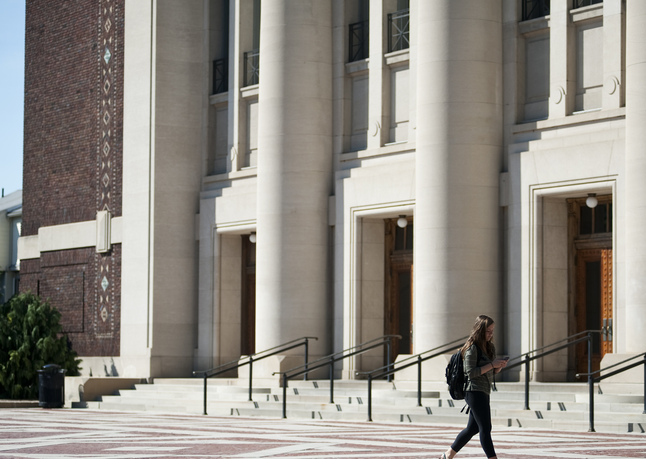
A new class examines how the University of Michigan budget gets made.
Daniel Brenner | AnnArbor.com
And when it's her money — in the form of tuition dollars — she's especially interested.
"I am a business major, so I'm always interested people use their resources. ... I am interested in how they operate behind the scenes," Harvey says.
Harvey is one of roughly 50 students taking a one-credit mini-course examining university finances. The Tuesday-evening course is the first of its kind offered at U-M.

Phil Hanlon
Resident tuition at U-M is nearly $13,000 a year —a 63 percent increase from rates a decade ago,— while out-of-state tuition tops $39,000 a year, one of the highest non-resident rates of any public university in the country.
According to the Project on Student Debt, the average graduate of a Michigan college left with more than $25,600 in loans in 2010, the 11th highest student debt load in all 50 states.
Meanwhile, the school's general fund budget has grown by $300 million since fiscal 2008, despite cost containment measures by the university.
Hanlon says the class is a way for students to wrap their heads around the changes.
"The cost of higher education is a really important national issue. ... We know it's of great interest to our students. We're very concerned about it. It's very complex," said Hanlon. "We never want to tell our students how they should think, but as Michigan students we expect that before they make up their mind about a complex topic, they're going to learn about it.
"We hope that before they make up their mind ... about whether a tuition increase is a good idea or is a bad idea, we'd hope they understand what are the implications," Hanlon said.
The class outlines the university budget and lifts the veil on some of the particulars of the business of higher education, explaining in detail things like faculty compensation and retention, the impact of college rankings, measures U-M takes to condense operations and save money, and the mix of funds that keep the school running day-to-day.
Since Harvey first came to U-M, she's seen her tuition increase. Upper-level business majors experienced a 6.2 percent tuition increase this year, more than double the 2.8 percent hike most undergraduates experienced. During that same time, she's also seen her scholarships increase.
Three years ago, when Harvey was a freshman, centrally-awarded financial aid levels were at $126 million. Now, they're nearly at $145 million.
"[The class] makes [university finances] more transparent," said Harvey. "A lot of students have no idea what's going on behind the scenes. ... This makes me feel a little more comfortable about where my money is going or at least with what they're trying to do with my money."
Added political science major Rebecca Charen:
"It's a great opportunity to let us look at exactly what's happening at the university we're going to, especially when there's so much talk of financing and all the stuff going on with tution increases."
Kellie Woodhouse covers higher education for AnnArbor.com. Reach her at kelliewoodhouse@annarbor.com or 734-623-4602 and follow her on twitter.
Comments
harry
Thu, Sep 20, 2012 : 4:57 p.m.
This is obscene. Ora Pescovitz — executive VP for medical affairs — $739,025 Douglas Strong — CEO of U-M hospitals and health centers — $612,000 David Brandon — athletic director — $600,454 Mary Sue Coleman — president — $585,783 Erik Lundberg — chief investment officer — $575,000 Timothy P. Slottow — executive VP and chief financial officer— $551,668 Alison Davis-Blake - Stephen M. Ross School of Business dean-Â $550,000 James Woolliscroft - Medical School dean - $524,509 Philip Hanlon — provost and executive VP of academic affairs — $485,040 David Munson - College of Engineering dean - $470,195
Scott
Thu, Sep 20, 2012 : 3:09 p.m.
This class will be killed off if the truth gets out. Are the administrators salaries shown? How about Dr. Ora Pescovitz making $1,000,000 in salary and bonuses per year?
Billy Bob Schwartz
Thu, Sep 20, 2012 : 2:22 p.m.
I like the idea, but why have it taught by U of M, uh, well, non-teachers? Reading the quotations, I get the feeling that the putpose of the class is to convince students that the money is well-spent and that higher tuition all the time makes good sense. Better yet, if you have two teachers, why not a university spokesperson and a critic of the budget share the teaching responsibilities?
Scott
Thu, Sep 20, 2012 : 3:11 p.m.
You know that will be the spin- to justify the unjustifiable.
Billy Bob Schwartz
Thu, Sep 20, 2012 : 2:13 p.m.
A comment before I read the article. (This is a first for me. Some posters do it regularly. LOL) Is that a picture of Hill Auditorium? You are talking about a class at U of M. Hill is rarely a classroom. (I took a psych course that held a lecture series there once.) Is the class being taught in Hill? If you want to present a story about the Business School, why not there? If you just want a generic U of M photo with columns, the facade of Angell Hall is a true classic (well, I guess it's neoclassical), recognized by all. I keep seeing Hill and wondering why it is chosen.
GoNavy
Thu, Sep 20, 2012 : 2:07 p.m.
FYI, the budget is published online and is free of charge to anybody. Combine that with Microsoft Excel and a bit of curiosity-driven analysis and you've saved yourself quite a chunk of change vs. this "course".
Hmm
Thu, Sep 20, 2012 : 12:59 p.m.
The background on the home page is GARISH!
harry
Thu, Sep 20, 2012 : 4:51 p.m.
Why is it garish. Its beautiful.
andys
Thu, Sep 20, 2012 : 12:31 p.m.
I hope that it includes a history of the metric that allowed college tuition increases to escalate much faster that inflation and household income. I hope that they teach the unintended out comes of govt programs like subsidized and guaranteed student loan which allowed tuition to go from something that could be paid for by a student earning minimum wage over the summer to something that must be financed by tens or thousands of dollars of loans that are paid back from future earnings over a decade plus., But I doubt it will.
Evan Smith
Fri, Sep 21, 2012 : 12:40 a.m.
Over the last 10 years, state allocations for the University of Michigan, in inflation adjusted dollars per student, has DECREASED BY MORE THAN 45%. If you don't call that clear cut, I don't know what is.
GoNavy
Thu, Sep 20, 2012 : 2:48 p.m.
Billy Bob Schwartz- As opposed to anecdotal evidence regarding "drastic reductions," I suggest reading this report by the Michigan House Fiscal Agency Governing committee. Your claim is anything but obvious and clear-cut: http://www.pcsum.org/Portals/0/docs/HFAppropsReport11-06.pdf
Billy Bob Schwartz
Thu, Sep 20, 2012 : 2:15 p.m.
Don't forget the part that has been played by the State of Michigan drastically reducing its aid to the universities in this state over the past few decades. It is pathetic. A great university system is key to a great state. Pathetic.
A2comments
Thu, Sep 20, 2012 : 10:58 a.m.
Nice that this is offered.