

New U-M study finds smoking ban has not killed the bottom line of bars, restaurants
More than two years after it went into effect, Michigan’s indoor smoking ban at businesses has had no significant negative impact on bars and restaurants, concludes a state-commissioned study conducted by University of Michigan researchers and released Monday.
Sales tax collections from Michigan retail eating and drinking establishments, as well as Club Keno sales, from 2006 to 2011 were collated by the Michigan Department of Treasury and analyzed by a team from U-M’s Institute for Social Research.
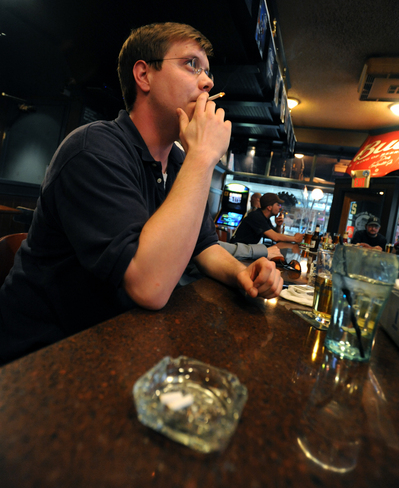
A study conducted by researchers at the University of Michigan has shown bars and restaurants have not suffered an overall negative impact from Michigan's statewide indoor smoking ban that went into effect May 1, 2010.
Lon Horwedel | AnnArbor.com
Helen Levy, Ph.D., led the study, which found that overall the ban did not have a statistically significant negative impact on businesses.
The report detailed that there were both winners and losers in terms of economic consequences: Some restaurants did see increases in business and others saw less traffic.
“It is important to note that while some establishments saw sales fluctuations after the passage of the Dr. Ron Davis Smoke-Free Air Law, bars and restaurants as a whole were not adversely affected,” James K. Haveman, director of the Michigan Department of Community Health said in a statement. “We commend Michigan bars and restaurants for their support in transitioning to a smoke-free environment as this law has also drastically improved the air quality in these establishments.”
Amy Biolchini covers Washtenaw County, health and environmental issues for AnnArbor.com. Reach her at (734) 623-2552, amybiolchini@annarbor.com or on Twitter.
Comments
Michael McFadden
Mon, Sep 17, 2012 : 7:02 p.m.
Click to the "Economic Impact Report" linked to in the article. Then look at Figure 7 to see the ENORMOUSLY clear drop in Keno sales. Then read the statement in the Report about that drop: "In????fact????this????change????is????not???? statistically????significant,????since????none????of????the????coefficients????in????either????the????basic????or????the????extended????model???? is????significant????(Table????2,????columns????9????and????10)." Look at that graph and then think about whether the words of the researchers are truly representing the picture of the findings. Then extend that to question how many of their other words and chosen numbers and formulae might be juggled in the same way. Check out their research grant proposal (if you're able to get hold of it) and see if they promised to deliver results showing the ban did no harm in order to get a the money. See the sort of games played in a VERY similar study a couple of years ago by Klein et al in Minnesota and analyzed in my several postings under Jacob Grier's article at: http://www.jacobgrier.com/blog/archives/2210.html Finally, aside from games about economic impacts, note this statement at the end of the article: "this law has also drastically improved the air quality in these establishments." If you look up the studies that this claim is based on you'll find that they almost all simply measure the amount of SMOKE in the air of places before and after the bans. And guess what? There's less smoke in the air when no one is smoking. Of course the researchers that discover this amazing fact usually charge the taxpayers $50,000 or so for their efforts, but hey, it's easy money, right? The trick they use to cover up the scam is simple: they don't say they're measuring "smoke" : they say they're measuring "Particulate Matter," specifically PM 2.5 -- which is, fundamentally, smoke. Don't be fooled by their word and statistical games. Read, print out, and share the free "Lies Behind The Smoking Bans" at
jcj
Mon, Sep 17, 2012 : 6:37 p.m.
Anyone really think someone with a smoking habit would give up their alcohol fix?
Ghost of Tom Joad
Mon, Sep 17, 2012 : 5:32 p.m.
I suggest the commenters who are crying about their "FREEDOMS" should actually read something by John Stuart Mill. To paraphrase On Liberty, "your freedom to swing your first ends at my nose." In the case of smoking, your freedom to smoke ends when it effects the freedom of those around you to not be forced to breath smoke. Essentially, be polite and just step outside. There is no need to act like a self-entitled jerk and cry about your freedoms without the slightest thought to the freedoms of others.
tdw
Mon, Sep 17, 2012 : 6:31 p.m.
Tom....You tell me who forced you to go somewhere that allowed smoking and I'll have a talk with them.As for your freedom quote how about you swinging at my nose because of my freedom to smoke ? let me guess " well that's different "
Renee S.
Mon, Sep 17, 2012 : 6:12 p.m.
Businesses are private property. I think that's the sticking point. It's really less about the freedom of smoking and non-smoking patrons and more about the business owners- which is exactly why this particular study was done.
treetowncartel
Mon, Sep 17, 2012 : 5:28 p.m.
Wouldn't the free market system be the best way to address, you know, good old supply and demand?
JimB
Mon, Sep 17, 2012 : 5:13 p.m.
Let's use some common sense here. The ban doesn't hurt businesses since it covers ALL business equally. Smokers are not driving to the bordering state to eat, drink and smoke there. Businesses suffered when some LOCAL municipalities created ordinances that would ban smoking. Customers could drive to the next town over, maybe located across the same street, to eat, drink and smoke. As long as the entire state plays by the same rules, there are no problems. The real trend setters were the businesses that went entirely non-smoking before any laws dictated to do so. They saw a loss in business, initially, then saw a rise in business from non-smokers who enjoyed the smoke-free environment.
John Davidson
Mon, Sep 17, 2012 : 4:55 p.m.
Just as I thought the data was manipulated in one way or another and it appears in there prepared staements above even this couldnt get rid of the harm done to businesses! 3C.Additional data. In some analyses, dollar amounts(restaurant and bar sales tax collections and ClubKeno sales)are inflated to real December 2011 levels using the U.S. Bureau of Labor Statistics (BLS)current price index for all urban consumers(CPIU;BLSseriesCUUR0000SA0). All tables and figures include notation indicating whether dollar amounts are real or nominal. http://www.annarbor.com/091712_SMOKING-BAN-IMPACT.pdf
John Davidson
Mon, Sep 17, 2012 : 4:59 p.m.
If anyone has been watching how well the government manipulates the unemployment numbers over the last 6 years we can see the manipulation of data in this junk economics study of the same magnitude! No doubt using the same statistical magic pen.
tdw
Mon, Sep 17, 2012 : 4:39 p.m.
Could someone answer a few questions for me ?.Who forced you to go to places that allowed smoking ? and could you name someone who was forced to work at a place that allowed smoking ?
tdw
Mon, Sep 17, 2012 : 6:26 p.m.
Peter....No one forced me to smoke it was my decision just as no one forced you to go to a place that allowed smoking it was your decision. Ross...there were plenty of places that did not allow smoking.And if someone wanted that type of job there were places that did not allow smoking , again it's a choice
Ross
Mon, Sep 17, 2012 : 5:38 p.m.
tdw, your logic is awful shallow. Since just about every restaurant allowed smoking, i was forced to visit one if I wanted to eat out. And maybe not in Ann Arbor, but in most small towns, available jobs are scarce. So if you can find a job at a restaurant or bar that allows smoking, the bills of your everyday life are going to FORCE you to keep working there.
John Davidson
Mon, Sep 17, 2012 : 5:04 p.m.
Free choise,the same freedom that can keep non-smokers out of smoking businesses!
Peter Baker
Mon, Sep 17, 2012 : 5:01 p.m.
Who forced you to smoke?
Tru2Blu76
Mon, Sep 17, 2012 : 4:28 p.m.
"... this law has also drastically improved the air quality in these establishments." -- Drastically improved? By what criteria? Oh, that's right - the opinion of the majority is the true criteria. Opinion is influential and that's a good thing - but never is it considered that opinions are often unsupported and often go unquestioned by the same majority which holds any given belief. Lets see how a ban on alcoholic beverages goes over - the consumption of alcohol is certainly proven to pose hazards to health and safety. I see an effort on the part of AnnArbor.com to support the smoking ban. Well, go ahead and join the Ban-O-Mania crowd, you're in "good company" with the likes of Mary Sue Ban It Coleman, et all. Want to stop the smoking habit altogether? Then eliminate the producers of cigarettes and tobacco crops. Oh, can't do that? Why? This worked just fine on reducing marijuana use outside of homes. No, it's far easier to give the appearance of "controlling" something than it is to actually control it. It's more effective to eliminate the demand (market) for something - but finding effective means of eliminating (while helping) addicts of anything is soooo haard. Nobody talks about how those addicted to alcohol or opiates are subject to jail time but - the number of alcoholics and drug abusers seems to remain almost unaffected. So the "market" continues to exist - the demand creates crime waves and a whole class of criminals (drug rings, drug cartels, moonshiners, street gangs) continues to make the big bucks from this market demand. 1000s of restaurant workers & patrons would never have faced smoke-filled air if tobacco smokers had been effectively treated in the first place. Or - - if tobacco producers hadn't been allowed to run their businesses while deceiving the public with falsified "studies." But nooo, people are in love with the "Ban-daid."
Billy
Mon, Sep 17, 2012 : 4:24 p.m.
"......the ban did not have a statistically significant negative impact on businesses." Translation: There were negative impacts....but we considered them statistically insignificant.... No really....anyone else looking at the ACTUAL data in this report????? They have hardly ANY post-ban data.....it's almost ENTIRELY comprised of pre-ban data....... Know what it ACTUALLY shows? The number of smokers is dropping rapidly....and has been for half a decade. I have a feeling THAT is far more responsible for the ban not having much of an effect than anything else.
John Davidson
Mon, Sep 17, 2012 : 5:01 p.m.
Here's my all-time favorite "scientific" study of the the anti-smoking campaign: "Lies, Damned Lies, & 400,000 Smoking-Related Deaths," Robert A. Levy and Rosalind B. Marimont, Journal of Regulation, Vol. 21 (4), 1998. You can access the article for free on the Cato Institute's wesbite, Cato.org. This article neither defends nor promotes smoking. Rather it condemns the abuse of statistics to misinform and scare the public. Levy, by the way taught Statistics for Lawyers at Georgetown University Law School. There is also a popular law school class called How to Lie With Statistics. You might also find this study of interest. It examines carcinogens in cigarette smoke and finds them insufficient to be a cause of cancer. Last sentence is the key one: there is little reason to be confident that total removal of the currently measured human lung carcinogens would reduce the incidence of lung cancer among smokers by any noticeable amount. http://cebp.aacrjournals.org/content/16/3/584.abstract
Rimshot
Mon, Sep 17, 2012 : 4:31 p.m.
You don't understand the concept of "statistical significance", do you?
Bcar
Mon, Sep 17, 2012 : 4:02 p.m.
what? shouldnt this be in the weather section? the sky didnt fall... good law, love it!
SemperFi
Mon, Sep 17, 2012 : 4:01 p.m.
This scenario has played out everywhere smoking bans have been put in place. There are more people that don't smoke that are willing to go to bars and restaurants that aren't smoke-filled. It more than makes up for the loss of a few disgruntled smokers. Sorry XMO, my freedom to breath clean air in a public place trumps your freedom to pollute everyone's air within the range of your smoke cloud. And every worker has the right to work in an environment that's free of carcinogens.
Dcam
Mon, Sep 17, 2012 : 5:31 p.m.
"There are more people that don't smoke that are willing to go to bars...that aren't smoke-filled. It more than makes up for the loss of a few disgruntled smokers." Great, now instead of concern over stale smoke, we've got many more drunks driving home from the bars.
SemperFi
Mon, Sep 17, 2012 : 4:48 p.m.
A bar or restaurant is still a public place because the public is invited to come in. The smoking ban is no more fascist than a speed limit. And it's funny that you used the term "sickens me", because that's how I feel about people who smoke near me or my children. If you think it's okay to blow smoke at me, then it'd be all right if I spit in your beer, right? You conveniently forgot to comment about a worker's rights.
M
Mon, Sep 17, 2012 : 4:26 p.m.
They didn't ban smoking in public places, they banned it in private businesses. And here in American, private businesses can make their own decisions. The smoking ban is by definition fascist, and it sickens me the support my fellow "Americans" give to it. I can still stand on the street corner and blow smoke at you. That didn't, and shouldn't, change.
smokeblwr
Mon, Sep 17, 2012 : 3:55 p.m.
The fact I am not allowed to smoke in the presence of those who don't want to breathe my carcinogenic output drives me nuts.
xmo
Mon, Sep 17, 2012 : 3:53 p.m.
Maybe the economy sucks so much it skews the results? Why not lift the ban for two years and see if the businesses grow? "Helen Levy, Ph.D., led the study, which found that overall the ban did not have a statistically significant negative impact on businesses." Their is also a Freedom issue but one comment at a time!
GoNavy
Mon, Sep 17, 2012 : 5:38 p.m.
Did you read the report? It's long, and it's full of things for literate folks, but in the executive summary area they cover a lot of this. PS You are "free" to do pretty much whatever you like to yourself. However, you are not "free" to share it with others.
Ross
Mon, Sep 17, 2012 : 3:42 p.m.
Always nice to see common sense prevail. Having thousands of restaurant and bar employees that can work in clean air is a great thing.