

New protocols have Ann Arbor firefighters responding to fewer emergency medical calls, and union isn't happy
Ann Arbor firefighters play a crucial role in responding to not only fires, but also to emergency situations ranging from heart attacks to car accidents.
As trained emergency medical technicians, they often work alongside paramedics from Huron Valley Ambulance. And many times, though not always, they're the first on the scene.
But under new protocols put in place this month, Ann Arbor firefighters now respond only to the most serious emergency medical calls — those classified as "Category 3."
The reduced workload comes as city officials consider a plan to trim 12 firefighter positions from the budget over the next two years, and the firefighters union isn't happy about it.
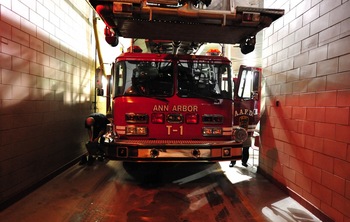
The Ann Arbor Fire Department is now responding to fewer emergency medical calls and leaving it up to Huron Valley Ambulance to handle the less serious incidents.
Ryan J. Stanton | AnnArbor.com
"We do have a pretty sophisticated dispatch system that can tell very quickly what the severity of the injury is and whether or not you need the fire department in addition to HVA," Hieftje said.
The fire department responded to 3,290 emergency medical calls in 2009, the last year for which complete data is available. The department also handled 280 fires, 224 auto accidents, 695 false alarms, and 1,191 other incidents varying in nature that year.
"Category 3 is for major medical emergencies only," said Assistant Fire Chief Chuck Hubbard, explaining that can include respiratory arrest, unconsciousness, chest and neck injuries, serious accidents or suffocation.
Ann Arbor firefighters are continuing to respond to those types of calls, Hubbard said. But they no longer are leaving the station for a wide range of other incidents of lesser seriousness that are classified as either Category 1 or Category 2, he said.
Previously, fire trucks responded no matter what the call was, Hubbard said, even if it was a cut finger, a bloody nose, or a trip-and-fall accident.
"So we've gotten away from all those calls and gotten back to just the real serious calls," he said. "In other words, we don't go on unknown calls anymore. If the call comes in as an unknown-type medical — possible intoxication, or possible this or possible that — we don't go."
Hubbard said the changes are being driven by a desire to reduce wear and tear on city fire trucks and make sure they're more readily available to fight fires.
Hieftje acknowledged he was incorrect when he stated earlier this week that union contracts had prevented the city from implementing the new protocols.
But the firefighters union has opposed the idea.

Matt Schroeder
Schroeder pointed to a situation earlier this week where Ann Arbor firefighters were first on the scene to assist a person who suffered from an apparent heart attack. He said the fire department's first responders arrived several minutes before HVA and were able to make a significant difference in the patient's outcome as a result.
"It happens a significant amount of times," he said of the frequency of similar situations occurring. "We have an ability to make an impact on people's potentially life-altering medical circumstances. That's why we first-respond on those calls."
Hubbard, who has been with the fire department for 25 years, said he couldn't say for sure what the full impact of the new protocols will be. He acknowledged the city will be relying on HVA to determine whether a call is serious enough for the fire department to be dispatched.
"We just started this so it would be unfair for me to say I'm uncomfortable or comfortable with it because I don't know," he said. "We need some time to see just exactly how this is all going to play out. The data is going to speak for itself. We just started April 1, so we don't know what the savings will be, what the effects will be."
Ryan J. Stanton covers government and politics for AnnArbor.com. Reach him at ryanstanton@annarbor.com or 734-623-2529. You also can follow him on Twitter or subscribe to AnnArbor.com's e-mail newsletters.
Comments
CincoDeMayo
Sat, Apr 30, 2011 : 6:35 a.m.
"New protocols have Ann Arbor firefighters responding to fewer emergency medical calls, and union isn't happy" - AnnArbor.Com Lastly, I just want to say that this headline could've read: "Mayor retracts statement regarding who determines what medical calls get run" or "Mayor's inaccurate statement leads to discussion on medical response by fire department" or "New protocols have Ann Arbor Firefighters responding to fewer emergency medical calls, and mayor is happy" or "Administration and Union Disagree on Response to Medical Calls"
CincoDeMayo
Sat, Apr 30, 2011 : 6:20 a.m.
I just received an email from Chris Taylor that says cutting 20 positions in police and fire would save the city 1.8 million. Am I doing the math right when I divide this number by the population of Ann Arbor - about 64,000 not including students and get about $28. per person? I see a LOT of money in Ann Arbor. I can't even afford a working TV or cable, but I would pay $28. for the year to keep the services that I am getting now from police and fire. That is an incredible deal.
LogicIsTheAnswer
Fri, Apr 29, 2011 : 2:47 p.m.
Wow! In response to "TheTruth" - I think he/she missed that the fire department union just took a 4% cut in salary to help the city? No other city union, city council member, city worker, or city administrator has taken a 4% cut in salary that the Mayor himself wanted mandated to all employees!! Give the fire department a break - it is obvious that the the Mayor and Administrator has it out for the department and my guess would be because they endorsed a candidate to run against the Mayor. The fire department has given back to the city in these hard economic times. How about asking other workers to give back as well?
CincoDeMayo
Sat, Apr 30, 2011 : 6:07 a.m.
I think it started earlier than that. I think it started when Berlin (then the city manager) et al developed a plan that would allow him to leave with tons of money (sorry it happened so long ago I can't give specifics easily), but also made it so that fire department personnel could retire very comfortably. Maybe not like Berlin, but very comfortably. The union let the city know that if that system proceeded, union rules would require that the positions left open by retiring fire personnel would have to be filled. And they were, at which point the next firefighter would retire. Comfortably. The administration (city council?) was so myopic that they didn't listen to the cautionary outcry of the union. (I know that sounds surprising...) They proceeded with the plan that would enable Berlin to leave with lots of money. And then the firefighters started retiring with their lesser bit of money. What an embarrassment to the city administration! So, the fault became the firefighters. The greedy, greedy firefighters who were presented with this option of retiring comfortably, or continue working. That was when the city administration began vilifying the fire department in the media. The firefighters have been the bad guys ever since. Again, this is how I remember those events and feel free to correct me if I am wrong. But even now you see the city manager (Fraser) leave very comfortably and make a snotty (and surprise ---- untruthful) remark about the fire department as he does it.
Eyeswideopen
Fri, Apr 29, 2011 : 4:59 a.m.
It's a shame with all the name calling and mud slinging that happens on these comments pages that people dont stop, think and see ALL the problems that lead to these situations. As we all know HVA provides ambulance services to the entire county. Their paramedics come when we call and take us to the hospital and when all is said and done we get our bills from them, charging us several hundred dollars for the bandage for our cut and the 3 mile ride to to the hospital for stitches. This system is the norm and we have all grown to accept it, but HVA managment wanted more. Recently many ambulance services began to impliment something called "treatment without transport". TWT is basicly this.....say your involved in a minor car accident. HVA shows up and tells you they just want to "check you out" to insure your uninjured. This action can be billed to you even though they never really treated you or take you to the hospital. If you investigate online you will find that you can be charged up to $150 for this non-service. Now then how does this apply to Ann Arbor? Fire Departments historicly respond as first responders and provide treatment until an ambulance arrives. In instances where a patient merely fell and needed help getting up or a car crash has no people injured the fire department would cancel the ambulance. There is where the problem lies. How can HVA tap this source of income if the fire department beats their ambulances to the calls. To combat this problem HVA management instituted the "catagory" system. HVA sells the system to various cities and municipalities as a "cost saving" measure. Dont send fire departments to certain routine calls and you save money, when in actuality they dont want the fire department on these calls and a new venue of income is in their control. This system will fail at some point and somebody that needed help will not get it fast enough and they wil die. But we wont read about th
CincoDeMayo
Sat, Apr 30, 2011 : 5:37 a.m.
I would argue that you are paying for HVA through your insurance and medical costs and through any taxes you pay that go to help subsidize care for others, for health care of our public employees (!), and toward charities. It may be different, but it is getting paid for somewhat by you even when you don't use it. (Not complaining, just saying.)
Craig Lounsbury
Fri, Apr 29, 2011 : 12:46 p.m.
I will add that in my 27 years in Ann Arbor I have not needed the services of either HVA or the fire department. Its distinctly possible I could die without ever needing either service. I do however pay for the fire department to be there. Not so for HVA. Again, as above, I am NOT NOT NOT complaining about paying for a fire department.
Craig Lounsbury
Fri, Apr 29, 2011 : 12:35 p.m.
We get billed from HVA for services rendered. If we don't need them we don't pay them. For many of us our health care or automobile insurance will cover at least some of the cost if we do need them. With the Fire Department a home owner pays for them in their property taxes year after year whether they need them or not. Please note I am NOT NOT NOT complaining about that, just pointing out they aren't "free". Further more, from their website..." Huron Valley Ambulance is a private, 501(c)(3) nonprofit organization. The organization is governed by a volunteer Board of Trustees made up of community leaders. HVA is considered a "community-ownership" ambulance model". So to portray them as a bogeyman or the enemy is unfair.
CincoDeMayo
Fri, Apr 29, 2011 : 3:51 a.m.
Well, I think you've done a good job trying. There is a lot to understand. To really create a new model takes a lot of work. To continue to provide the excellent service that us Ann Arborites have become accustomed to, and still be fiscally responsible is tough. I know that the fire department has worked hard, and been adaptable to changing systems. Because of their dedication they have not only taken pay cuts, but really worked to develop ways to cut costs further. Some of this willingness to compromise and to look out for your brothers has hurt you in the long term. You saved a handful of jobs for 6 months, but took the pay and benefit cut that would affect you for the rest of your career. For some of you, it seriously affected your entire retirement. You all are great for doing that. You were made to feel guilty for: getting a fair wage, having health care coverage and a benefit plan (in lieu of receiving social security). You were also made to feel guilty for: retiring with the benefits that the city agreed to give to you (in order that Neil Berlin could get his huge pay-out). That was the beginning of this administration vilifying you in the media, even when you all forewarned the administration of the consequences of the contract. And now, for not retiring. It's pretty crazy when you think about it. Don't get too angry at Craig, and some of the others, because they are doing you a favor. They are letting you know honestly what they think. They don't have to take the time to let you know that. And, knowing the problems can only help you work to address them. Even if the problem is simply one of perception. (And I'm not saying there is only that problem.) It is far easier to pick you all apart than to really effect change in our administrators and superintendents, or their salaries, benefits and perks. There is nothing those in power like more than having those who are not in power fighting one another.
Ricebrnr
Fri, Apr 29, 2011 : 2:33 a.m.
Further "experimentation". Less an experiment than a bet with YOUR lives as collateral. The city and the Mayor are playing games of chance. You feeling lucky? Well do ya?
BornNRaised
Thu, Apr 28, 2011 : 10:48 p.m.
It's become increasingly clear from the posts here, that no matter what the FD tries to do to help the residents, there's such a strong 'conspiracy theorist' complex from some of the commenters that we can do no right. I don't understand why it is when we try to do something to help the residents, we are condemed by some of you. And those that are doing it have never stepped foot into a station to see what it's really about. Look, the city already knows what they want to do and are going to do it. There's no stopping that. They're going to tell you that they report they paid for verified everything they've said. And then, you believe them because 'it's in the report.' Funny thing is, if we paid for the report and told you it justified everything we've been saying... instead of support the blogs would light up with "they paid for the report, of course they'll get the results they want." I'm done trying people. You win. Years of trying to help people and show them the true colors of city hall and here's where we are. I'm done.
Geez-O-Petes
Fri, Apr 29, 2011 : 1:53 a.m.
"The solution of letting FD go ALS was to increase revenue for the city while offering a faster service to you as a resident at a discounted rate. But somehow we're just trying to save our own jobs." Increase revenue by charging the citizens for a service they already pay for?? Do you charge them for fire protection?? Why then would you charge them for the ambulance should they require transport? HVA doesnt charge the average citizen unless the citizen uses the service.. This is why im having a hard time supporting your issue. It seems your pulling straws to justify your employment as Craig pointed out. I too do not want you to lose your job nor do I want to see the paramedics at HVA lose theirs either should AAFD ever begin transporting. HVA is not in the business of firefighting, why should you be in the ambulance service?? Only way I see it, it is a means to justify your fire job. Sorry not a good argument to me.
Craig Lounsbury
Fri, Apr 29, 2011 : 12:53 a.m.
If what you say about the FD running ambulances is true I'd go to bat for you with my councilmen. But I'm not an idiot. I can't go to my councilmen and tell him I think the fire department should run ambulances because some annonomus guy on the Internet SAYS they did a report showing their efficiency's but he can't or won't show me the report but he assures me the mayor and the city manager squashed it. Is that what I'm supposed to do?
Craig Lounsbury
Fri, Apr 29, 2011 : 12:47 a.m.
"And your example of 3 min vs 3 min isn't anything close to what we're discussing." Its all I've ever brought up. "I'm arming you with information." you aren't arming me with information. When I asked you for information you told me to call the mayor or the city manager and see how eager they would be to give me the report. Thats NOT arming me with information.
BornNRaised
Fri, Apr 29, 2011 : 12:25 a.m.
Never once did I state that. I'm telling you how things really work. But I'm getting blamed somehow. Ok. Take it how you like. And your example of 3 min vs 3 min isn't anything close to what we're discussing. It's that FD beats HVA a majority of the time. But that's pointless to argue. The city made the change it wanted. So you're all set. The solution of letting FD go ALS was to increase revenue for the city while offering a faster service to you as a resident at a discounted rate. But somehow we're just trying to save our own jobs. We can only help those that want to be helped. You've twisted everything I've said instead of looking at the facts. Ask anyone who's ever been in an ambulance to get a detailed bill and investigate for yourself. I'm arming you with information. How you choose to use it, or twist it, is up to you.
Craig Lounsbury
Fri, Apr 29, 2011 : 12:05 a.m.
I'll add that its hard to be on your side when thats your attitude
Craig Lounsbury
Fri, Apr 29, 2011 : 12:03 a.m.
Its not my perception you want to help the residents. You want to protect your job. I understand that I would do the same. I don't want you to lose your job. I don't want you to take a pay cut either. Nor any of your fellow fire fighters. But when I suggest an ambulance at my house in 3 minutes is a better bet than a fire truck in 3 minutes your response is essentially that the ambulance people are crooks and that you could do their job cheaper.
Geez-O-Petes
Fri, Apr 29, 2011 : midnight
Don't be sad Born N Raised.. AAFD needs to understand the end doesn't justify the means anymore.. I have no problem letting you do the fire puttin out but unfortunately times are tough and frankly your call volume (minus medical) doesn't warrant the amount of personnel your IAFF union wants the city to maintain.. I think your verbal accusations against HVA are unwarranted without proof to back up your claims.. I notice there are no HVA personnel on here battering the AAFD.. I find with due time everything will work out.. Best bet is to let the Police police, FD put out fires and HVA handle medicals.. I'd rather have the paramedic who works with patients day in and day out work on me than a fire-putter outer who only does it some of time.. Again, best of luck to you and your department..
BornNRaised
Thu, Apr 28, 2011 : 8:43 p.m.
The thing I love about everyone that says, "Let's go volunteers!" don't realize something. This city has a long standing history of sticking it to city workers. Anyone that's been around for awhile can give numerous examples. Keep that in mind when I say this... PA312 (the thing those that don't understand it are complaining about) prevents professional firefighters from going on strike. Now, volunteers work, basically, when they want. So, if they're at work and can't leave, they don't. If they're home with the wife and kids and are busy, they don't go. If family is over for the holiday's they can stay home. Add to that, when (not if) the city tries to spit in their faces too, they can simply stop working and say they're sick of this. Your FD now will show up regardless of how many lies Hieftje continues to tell. it's bad enough the city has turned calling 911 into a guessing game. Now add to that the hopes that SOMEONE shows up. Before anyone goes off on a tangent of POC vs. Professional departments, stop. That's not what this is about. Just food for thought.
Craig Lounsbury
Fri, Apr 29, 2011 : 12:11 a.m.
You say "Volley's are VERY dedicated" but then you say "Under a POC system, you never know. Sometimes you got 20 people show up on a fire. Sometimes we got 5. On a CPR I've been alone MANY times under that type of system." Maybe we have a different idea of dedication. I'll leave it at that.
snoopdog
Thu, Apr 28, 2011 : 11:20 p.m.
"This city has a long standing history of sticking it to city workers. Anyone that's been around for awhile can give numerous examples. " You cannot be serious , I've read the contracts you guys have for pay--pension--benefits and healthcare. I would say the city has bent over backwards to give you guys more than you deserve. Your "package of benefits" is very very generous and far better than anything in the private sector. Quit trying to make yourselves look like martyr's, it is not working. Good Day
BornNRaised
Thu, Apr 28, 2011 : 10:41 p.m.
I came from a volley department. Volley's are VERY dedicated. What I'm saying is that they have the CHOICE whether or not to come help you. If they have a family matter, they can opt not to come to you. If they're hosting xmas dinner, they get to stay home. I'm not saying 100% of the time they will. That's you twisting around what I wrote. What I'm saying is that now when the FD is at dinner, we leave everything behind and you know we're coming. Under a POC system, you never know. Sometimes you got 20 people show up on a fire. Sometimes we got 5. On a CPR I've been alone MANY times under that type of system. Also research any POC. The number 1 problem is burn out. People just get tired from the huge time sacrafice. I'm talking trainings, nothing to do with calls. Now factor in how many more calls AA runs that other surrounding departments where POC work for them. Multiply the burnout factor by 10. "Before anyone goes off on a tangent of POC vs. Professional departments, stop. That's not what this is about." Thanks for seeing the big picture of the comment.
Craig Lounsbury
Thu, Apr 28, 2011 : 10:26 p.m.
"Now, volunteers work, basically, when they want. So, if they're at work and can't leave, they don't. If they're home with the wife and kids and are busy, they don't go. If family is over for the holiday's they can stay home. " "I'm not saying POC and combination departments are bad." They just lack any sense of dedication to community? Is that what your saying?
Geez-O-Petes
Thu, Apr 28, 2011 : 9:22 p.m.
Oh hell make like Plymouth and become PSO!! I give up, best of luck to y'all and the AAFD...
BornNRaised
Thu, Apr 28, 2011 : 9:07 p.m.
BTW, when HVA took over dispatching for Ann Arbor City, the call volume for the city alone was higher than all the departments "completely surrounded by FT/POC". Compare apples to apples. 1 department has a combined run count higher than that of around 10 communities around them. And before you start, that's still with the new 'model'. I'm not saying POC and combination departments are bad. What I'm saying is that you need the right tool for the right job. Forcing something in just because you want so bad for it to work doesn't mean it works. No matter how hard you try. At some point you have to step back and look at the bigger picture. Get the picture?
Geez-O-Petes
Thu, Apr 28, 2011 : 9:06 p.m.
You mention four departments out of how many in Washtenaw County??
BornNRaised
Thu, Apr 28, 2011 : 8:59 p.m.
Glad you asked. Actually most have gone to full paid/professional. Those that started POC and shifted, Ypsi City, Pittsfield, Ypsi Township. They all had a POC model and moved to Full Time. Guess they all thought the sky was falling too eh?
Geez-O-Petes
Thu, Apr 28, 2011 : 8:55 p.m.
Isn't Ann Arbor almost completely surrounded by FT/POC departments?? Is the sky falling in those communities??
gotigers2007
Thu, Apr 28, 2011 : 8:29 p.m.
A volunteer fire department model is only practical in a small town or rural environment. There is no way it would work for the CITY of Ann Arbor. We need people ready at a moments notice --- not someone AT HOME that gets woken up at 3AM who has to drive to the fire station to pickup a fire truck and then drive to the emergency location. How does one put a finite number on how many people we need on an emergency run? Do you want two 80lb paramedics scooping you off of your basement floor and dragging you up the stairs? Who's gonna help them? HVA is a fantastic and professional medical emergency service provider but they can't do everything on their own. Also, with my example above, seconds do count in a fire. If you have a frat house packed with 100 people going up in flames -- do you want the full-timer firemen responding within seconds or do you want the part-timer who has his family and fulltime regular job as a higher-priority coming from his house to the station and then to the fire? What if he doesn't want to respond because HE ISN'T COMPELLED TO DO SO?
CincoDeMayo
Fri, Apr 29, 2011 : 2:44 a.m.
POC is something I am familiar with and I can tell you for sure, as good as they are, they are not the answer for A2. Will there be a residency requirement? If they are not VERY close, they will not be able to provide the kind of service that I am looking for. Without another job they will not be able to afford to live even in my modest neighborhood. With another job, their ability to respond is compromised. And, more POC firefighters are then needed to take up that slack, There is a continuous need to give basic training and the costs associated with that. I like the conversation, though, because it is good to think about what would really work best and be financially competitive.
Geez-O-Petes
Thu, Apr 28, 2011 : 9:01 p.m.
FT supplemented with POC.. Works fine in losts of communities and helps keep down the operating costs.. I'd be all for a minimal FT with POC for AAFD.
Mick52
Thu, Apr 28, 2011 : 6:40 p.m.
I am with Schroeder on this one. When I saw the headline, I figured the reason would be cutting use of fuel. But saving wear and tear on vehicles? Sounds fishy. If the fire fighters are not on a call, then they should go with the fire rescue truck, not the larger trucks. I know from my 30 years in LE that the AAFD is a gem for medical emergencies. They almost always get on scene well before HVA and that is what saves lives. To think this is happening when the city wastes so much money, like on fountains (and yes I know fountain money can only be used for art, but in fiscal crisis time, the city charted should allow transfer of funds) is a sad state of affairs.
BornNRaised
Thu, Apr 28, 2011 : 6:23 p.m.
Craig, thanks for bringing up that link. Here's more info for you... the FD, many times, has approached the city and offered that we do the ambulance work. City has a 'bucket' fund for trucks that can only be spent on trucks. Use it to purchase a couple ambulances. AAFD and MANY already trained Medics on duty. HVA charges a fee-for-service. They charge YOU. So you're paying taxes, AND HVA. We showed how we could deliver better, faster, and LESS EXPENSIVE services to the residents because the knowledge and most of the equipment is already on hand. HVA is VERY VERY political. They have thier teeth deep into this city. The exact words from Fraser were, "The council decided they didn't want to get into a competitive situation with a private service." That 'competitive situation' is one to reduce your costs while INCREASING your services. Google how far Station 4 is from your house. Would you rather pay HVA to come from god knows where, charging your for FULL services regardless of what they do (and yes, that's what they do). Or have the rig a few blocks away be at your doorstep faster and for less money to you?
CincoDeMayo
Fri, Apr 29, 2011 : 2:28 a.m.
"I dont know how or what HVA charges but im sure its reasonable to cover the cost of service. Last I checked, ambulances are not glorified free taxis. If you truly need an ambulance, im sure the cost of that service is well justified. " This was surprising to read. I constantly have to go over the medical bills I receive because I have discovered how frequently I am incorrectly billed for things. Anyway.... Thanks for trying to explain how the fire department has been working on exactly what the mayor says is needed: a new model. Working out a new model that is effective, accountable and financially competitive actually is more difficult than just moving over to another pre-existing model that you are not responsible for, and that may not be in the best interests of your community.
Craig Lounsbury
Thu, Apr 28, 2011 : 11:54 p.m.
"Your trusted leaders should be more than willing to help you, right?" I don't trust them...never have Now your telling me not to trust HVA either. You say the lie they fudge their books and they are in bed with city officials. Why should i trust you? You come in here with a made up name and insult peoples intelligence all the time. And your not willing to provide me the information you claim exists.
BornNRaised
Thu, Apr 28, 2011 : 10:33 p.m.
Craig, I'll tell you what... I'll answer your questions real quick. Since I'm skeptical that you'll believe anything I have to tell you, how about this... you call Hiefte or Fraser and ask for the couple of studies that the FD has provided them over the years. See how willing they are to show you the facts. Accountability: Because now it's billing residents. Must report all of those bills and reports to the city. You would also have access to those on request. Extrication: Yes, there's actually a box they check of what activities THEY did on scene. You get a bill for each item they've checked. That's what they're instructed to do by their management. You know, the 'non-profit' company. You will also get charged for the trip, as well as ALS services, regardless of what they do (ie. just give you a ride vs. full cardiac support). Also, the FD is the group that 'packages' you as soon as you get out of the vehicle. Backboard, c-spine, etc. They bill for that. Like I said, ask for the report. See how many hoops they make you jump through if they'll even give it up. Your trusted leaders should be more than willing to help you, right?
Craig Lounsbury
Thu, Apr 28, 2011 : 10:18 p.m.
"Not only would you (your insurance company) not have to pay anywhere close to what HVA charges..." based on what numbers? give me a study to read. "the FD would be more accountable to justify and prove why they're billing." based on what do you make that claim? "Take the extrication for example. HVA charges you. That's a fact. They do nothing in an extrication." are they charging for the "extrication" or for their presence and subsequent trip to the emergency room?
Geez-O-Petes
Thu, Apr 28, 2011 : 8:36 p.m.
So basically what your saying is the citizens of Ann Arbor will pay your salaries and for fire engines and ambulances and then you still bill them on top of that?? Isn't that what we called double-dipping?? I see HVA units sitting all around the Ann Arbor area and do you know how much its costs the citizens of Ann Arbor for them sitting around waiting to help?? Nothing.. When your at the fire station waiting for a call how much does that cost each and every taxpayer in Ann Arbor. Thats right, whats your salary again?? So you want to eliminate a pay as needed service (HVA) and start a fire based service which will not only increase the overall operating budget but will cost the citizen a bill for which they have already paid for through taxes. That makes alot of sense!! I dont know how or what HVA charges but im sure its reasonable to cover the cost of service. Last I checked, ambulances are not glorified free taxis. If you truly need an ambulance, im sure the cost of that service is well justified. Lastly, I dont know why im arguing about this because by 2012 AAFD will be short quite a few more fire-put'er outers.. The fire-put'er outers who post on here are not making a strong case for themselves.. Your pulling at whatever straws you can to justify your means..
BornNRaised
Thu, Apr 28, 2011 : 6:53 p.m.
Are you going to give me the chance to answer? 1st, yes, just like any private ambulance service, you would have to choice of hospitals depending on how serious you were. Serious emergencies go to the nearest equiped hospital. HVA doesn't even give you a choice there. It's a county protocol. 2nd, Just like now, your insurance would be charged. But if you needed a ride to the hospital for basic life support (BLS) services, you'd be charged accordingly. Right now, if HVA even looks at your heart, you're charged for full advanced life support (ALS). Also, did you know that when the FD extricates someone from a vehicle, we don't charge, but HVA DOES charge. They stand around watching and bill you. 3rd, there would be a charge, but it was shown that for residents, it could be a signifcantly reduced rate. Thank you for being professional enough to allow me to respond to your question. :)
Geez-O-Petes
Thu, Apr 28, 2011 : 6:45 p.m.
So your saying the AAFD wouldn't charge for ambulance service?? They would transport you to St Joes or Oakwood if the patient request?? Stop it already, I can't stand reading your posts.. Where there is smoke, its coming from Born N Raised..
joe.blow
Thu, Apr 28, 2011 : 6:08 p.m.
Why are firefighters even responding to medical emergencies? What are they going to do? I don't feel like paying for three engines and 12 men to run to every paper cut. Even serious medical issues, what are they going to do? For "heart attacks," besides pulseless arrest, the only thing that prolongs survival is Aspirin - and guess what CPR really isn't going to save someone with a heart attack! EMS will arrive when they can, the firetruck shouldn't be sent just because it may be a touch faster, that's a waste of money.
Ricebrnr
Fri, Apr 29, 2011 : 4:16 p.m.
Where do you see anything about increasing Fire Stations?!?!? All the talk is about keeping those we have manned and active...
joe.blow
Fri, Apr 29, 2011 : 1:25 a.m.
I didn't see mention of AED in the article. So, we should increase the number of fire stations so that they can get to medical calls faster? It's ridiculous. It would be cheaper to throw AED's in all cop cars!
Craig Lounsbury
Thu, Apr 28, 2011 : 5:13 p.m.
The cost/funding issue for HVA has been a bit of a sidebar to the discussion Here is a link to the HVA FAQ page that may ansewer some questions. It has given me some knowledge i didn't have this morning when I woke up. <a href="http://www.hva.org/Government/GovernmentQ&A.htm" rel='nofollow'>http://www.hva.org/Government/GovernmentQ&A.htm</a>
CincoDeMayo
Fri, Apr 29, 2011 : 2:09 a.m.
Yes, thanks for the link. I read that "Governmental units generally contract with us for services. Contracts provide minimum service levels for the municipality." So the fire department must be filling in the gaps of that minimum service. "If a city or township would request some specialized coverage above and beyond what we provide to other municipalities, a subsidy would be required. Please call us for additional details." I would like to think that someone has made that call and asked what the cost would be to replicate the service that the fire department has been providing. I would still have concerns about an organization that gets paid based on what it runs on, although they seem confident that they will be paid through insurance companies or charity programs. This makes me think about the cost of health care coverage for our fire fighters and police officers...... One of those times you think, "Hhhhmmmm...."
Geez-O-Petes
Thu, Apr 28, 2011 : 5:38 p.m.
Thanks for the link!
Craig Lounsbury
Thu, Apr 28, 2011 : 5:22 p.m.
Here is a second link to their current board of trustees. <a href="http://www.hva.org/Info/Governance.htm" rel='nofollow'>http://www.hva.org/Info/Governance.htm</a>
Sandman
Thu, Apr 28, 2011 : 5:05 p.m.
HVA is merely an emergency response team, contracted to respond to our medical catastrophes and they do a great job, thank you HVA. Why do we not have city owned emergency medical response teams and our own fleet of ambulances? Is there a requirement that we use HVA and we are prohibited to create our own team of ambulances? What do we pay for HVA services; I'm sure there's an idea in this somewhere…
Geez-O-Petes
Thu, Apr 28, 2011 : 5:37 p.m.
What do we pay for HVA services; I'm sure there's an idea in this somewhere… As far as I know the city of Ann Arbor does not pay to have HVA as its EMS provider nor are there any taxes collected from Ann Arbor citizens for this service. HVA only charges those who utilize the service and collect payment via insurance or private pay. As for how much it costs?? I would guess a typical 911 call would cost probably $600-800. I, for one, have never had to utilize the service but its a nice option to have then utizling a fire based service which I pay for through taxes and then would be charged for the service again on top of it. Thats what happens with most Fire Department EMS services.
javajolt1
Thu, Apr 28, 2011 : 4:56 p.m.
I gew up here. Many moons ago, a Superior or Fontana-Taylor Ambulance service ambulance was the only thing dispatched until the fire department got into the medical emergency business with their "Rescue 1" truck. It has always seemed odd to me that over most of my years in Ann Arbor, the Fire Department rolls out a GIANT snorkle ladder truck for any sort of medical issue - which includes intoxicated person on the street, issues where the person refuses medical attention and walks away, etc. Most of the time I've witnessed this, the truck rolls up well after the police car and ambulance. There is no doubt there have probably been instances where they have gotten there first and perhaps stabilized someone until the ambulance arrives. ....But a UNION isn't qualified o make this determination when they have a titanic financial conflict of interest in the outcome of the decision. You can save a little gas money and send an ambulance for me and keep the hoook and ladder truck in the garage.
CincoDeMayo
Fri, Apr 29, 2011 : 1:49 a.m.
Responding to these statements: "there is no doubt there have probably been instances where they have gotten there first and perhaps stabilized someone until the ambulance arrives. ....But a UNION isn't qualified o make this determination when they have a titanic financial conflict of interest in the outcome of the decision" It is interesting that you mention the financial conflict of interest in the outcome of the decision, because that is exactly how I feel regarding the ambulance determining what they run on. They actually do have a stake in the cost that they incur, the more cost, the less money they can make. And, just a little thing, but the firefighters can not only stabilize, but actually save a person's life or quality of life, by being there within 6 minutes.
Ricebrnr
Thu, Apr 28, 2011 : 7:20 p.m.
1) So you want to know why a Fire Department that is fighting personnel cut backs isn't spending more money on additional equipment like vehicles? - Better you should ask the Mayor 2) Good question, in NYC every seat on every truck was filled with an Firefighter. You're question would be better posed as "Why ONLY 3 people" 3) To my knowledge that is correct, see # 2 4) I would imagine that once HVA was on site they would go to that call if they were needed and closest. Otherwise the call would go to the next closest unit. I'll check next chance I get to be sure I'm accurate.
javajolt1
Thu, Apr 28, 2011 : 6:07 p.m.
Thanks....more questions: 1. Why doesn't the fire department purchase and roll a smaller vehicle as they used to. You know...less gas, maintenance, man power? 2. Why three people? 3. If the fire department is rolling to an actual fire call - are only three people on that huge snorkel truck? 4. If not, what happens if they get an actual fire call when they're assisting the inebriated 'man down'?
Craig Lounsbury
Thu, Apr 28, 2011 : 6:01 p.m.
which speaks nicely to the whole problem. Not enough ambulances. Our first choice as citizens should always be an ambulance on the scene first....in a reasonable time frame. Instead we are settling for second choice...a fire truck designed to fight fires
Ricebrnr
Thu, Apr 28, 2011 : 5:53 p.m.
The Hook & Ladder will roll for several reasons. 1) That's the mode of transportation to get the emergency personnel to the scene 2) There are ONLY 3 people per vehicle. Using your inebriated person call as an example. IF the inebriated person fell. Who's stabilizing the neck, who's performing the examination and/or treatment, and who's left to get equipment, hold an iv bag, etc etc etc. 3) If there is a call for the hook and ladder and the personnel for that truck are at a scene by some other transportation, you'd rather that the FF have to go back to the station for it? Better hope that's not your office that needs that truck... 4) see my previous comment including response times to address your last bit.
bunnyabbot
Thu, Apr 28, 2011 : 4:48 p.m.
well I would say that this would work if HVA responders didn't take longer than the FD or in the case of a relative, HVA responded, it was two petite woman who had to call the FD anyway to help lift my relative because the woman together were weaklings. you can skip calling 911 and call an abulence service directly.
Geez-O-Petes
Thu, Apr 28, 2011 : 5:41 p.m.
Im sure it was less about being weaklings than ensuring a safe lift for both the patient and the crew. Your relative pays taxes for the FD so im sure it was well within reason to call them for assistance.
Pete Warburton
Thu, Apr 28, 2011 : 4:09 p.m.
I moved to Ann Arbor in 1977 and the management of this fine City has always been poor and self serving . The workers for the city { union and not } have always been its saving grace . They have always showed interest in any problems I have had and worked with me towards solutions. Our Police Officers and Firefighters are professionals and have our best interest at heart. The present administration seems to feel they are enemy and painting that way in the media will serve some greater good. I would rather trust the people doing the work what is necessary to mantain services and keep me safe. Not a city manager leaving for greener pastures and the parrot mayor.
seldon
Thu, Apr 28, 2011 : 3:56 p.m.
I'm confused. The Fire Fighters' Union is saying "please send us out on more calls, we want to keep responding instead of sitting in the firehouse relaxing," and commenters are saying "figures the Union would say that"? Wait, what? What kind of world is this where the Union wants its members to work harder, and the anti-Union folks are angry about that? What am I missing here?
BornNRaised
Thu, Apr 28, 2011 : 8:07 p.m.
What are you missing? Probably just forgot that this was Ann Arbor.
Listen
Thu, Apr 28, 2011 : 3:48 p.m.
Seems like continued speculation by some regarding whether taxpayers are getting a fair return on what we pay for from AAFD. It's your taxes....go spend a shift or two at your local firehouse and see. And don't just spend a couple hours on dayshift downtown for a tour and explanation, but a couple 24-hour shifts as a tag-a-long. Go see, report back.
Paul
Thu, Apr 28, 2011 : 3:06 p.m.
I was a volunteer fire fighter in a city several miles south of Ann Arbor a couple years ago, and love it. However, you talk about 24 hr shifts? Are you kidding me, i know what goes on in the firehouse, sleeping, watching sports, and making dinner, doesn't sound like hard labor. Am I discounting the life risks you take? No, but some, including myself, make that sacrifice without being financially rewarded for it. So its a little hard for me to listen to public workers cry about cut backs. I pay 50% of my health care at my day job and pay a decent amount of state tax. Why should my tax dollars go to someone that gets better benefits than me and get a full salary and retire for 30 years for something I do for free. Sorry, but that bite is a little hard for me to swallow.
CityFF
Thu, Apr 28, 2011 : 4:51 p.m.
I have done Roofing and construction myself Craig. I would never claim that its not hard work. Its very tough and there are lots of jobs out there that are.
CincoDeMayo
Thu, Apr 28, 2011 : 4:05 p.m.
Two hard working people fighting one another..... Somebody should have gone into banking.
Craig Lounsbury
Thu, Apr 28, 2011 : 3:46 p.m.
"I am guessing that you havent spent 5 hours in 10 degree weather on a fire cause if you had you would say it was the hardest labor you have ever done. I have." Can't say I have done that . But I have spent 8-10 hours on a roof tearing off 3 layers of shingles in 95 degree weather.... and repeated it for 5 straight days. I've also done it in 15 degree weather with steady winds that generated a 25 below zero wind chill. So you don't have a corner on hard work.
CityFF
Thu, Apr 28, 2011 : 3:34 p.m.
I would like to know where "you do it for free." As far as I know all of the FDs anywhere near Ann Arbor are paid. If we work 24, 12 or 8 hour shifts there is still going to be some downtime. Its the nature of the buisness. Just like police, we are somewhat reactive and have to wait for something to happen. I am guessing that you havent spent 5 hours in 10 degree weather on a fire cause if you had you would say it was the hardest labor you have ever done. I have.
AACity12
Thu, Apr 28, 2011 : 2:40 p.m.
I think Schroeders point was in a specific time when someone was literally dying there was no HVA ambulance in sight. They have not amped up their coverage as the AAFD has decreased theirs. The most serious of all medical emergencies and AAFD is first to get there to help, where was HVA? When you call 911 you want someone there as soon as possible, Right? Thats not what you are getting right now. You are getting a big decrease in service and still paying the same premiums. You have highly trained people a few blocks away ready and willng to help. Instead you wait for an ambulance from where? The other side of town? St Joes? Ypsi? Chelsea? We want to be there for you in your time of need. The AAFD is there to help. We want to help. Thats what we signed up for.
CincoDeMayo
Thu, Apr 28, 2011 : 3:01 p.m.
You say that so much better than me. And, thank you, by the way, for being so willing to help. I know that is it your job, but I still respect and appreciate what you all do.
CincoDeMayo
Thu, Apr 28, 2011 : 2:08 p.m.
Just learning - Assuming HVA increased its services and response time - presumably with more ambulances deployed within the city of Ann Arbor, how will that get paid for? Is the city going to pay for this increase, or the consumer? If the consumer, how will this affect health costs, including those covered by taxpayers? Right now we know what the taxpayer is paying for in regards to the fire department. For the firefighters to respond with emergency medical treatment costs nothing extra - other than costs associated with the truck. The firefighter is already on the job and ready for deployment. ALso, how will the profit margin of the ambulance company factor into the number of ambulances available, response times, and care given to certain incidents and locations?
CincoDeMayo
Thu, Apr 28, 2011 : 3:42 p.m.
Okay - thanks for giving it a try! So, some taxpayer money will go to covering calls via the patient's respective health care coverage. There is no "profit" so to speak, but incoming funds (versus outgoing costs) affects what people in the organization will be paid. The gaps that I am talking about being covered by the fire department are: The emergency medical treatment given by the fire department before HVA's arrival ---particularly for those life threatening emergencies that may have been mis-categorized, and, driver service by the fire department when emergencies necessitate HVA personnel be in the back of the ambulance providing medical care in order to get a person to the hospital alive. Either these gaps will be left open, or, if they are covered by HVA, HVA will have to incur additional costs which will affect their break even point, thus the salary and wages of their workers will be affected. The consequences of that are worrisome to me.
Craig Lounsbury
Thu, Apr 28, 2011 : 3:06 p.m.
I'm no expert so I can't supply you expert answers...just opinion. "So, there are no salaries being paid because it is nonprofit?" Of course there are salary's in this nonprofit, just not a profit margin. It's nonprofit not volunteer. "Who actually pays for the call? If a patient is on Medicaid, or some other tax payer subsidized program, wouldn't I be helping to pay for it? " the calls are paid for by those receiving the service often through some sort of insurance.. So yes to some degree we all chip in for medicare and medicaid. We also chip in for non-government funded health care as its built in to the cost of goods and services. "will... the service... remain the same, and those gaps that the fire department is now covering will be left open?" I'm not sure I follow your question. Are there situations where the fire department shows up and HVR does not? Or are we talking about who gets there first?
CincoDeMayo
Thu, Apr 28, 2011 : 2:45 p.m.
Okay. I am not sure how that works. Who actually pays for the call? If a patient is on Medicaid, or some other tax payer subsidized program, wouldn't I be helping to pay for it? So, there are no salaries being paid because it is nonprofit? Or, are those who are receiving salaries and wages going to take pay cuts? Or, will there be no earnings decrease because the service will remain the same, and those gaps that the fire department is now covering will be left open?
Craig Lounsbury
Thu, Apr 28, 2011 : 2:18 p.m.
according to the HVA website they don't cost the tax payer anything. I believe HVA is a nonprofit so they have no "profit margin", they have a break even point.
the major
Thu, Apr 28, 2011 : 2:01 p.m.
I don't understand the point Shroeder is trying to illustrate. He said that firefighters were first on the scene for an apparent heart attack, but wouldn't a heart attack fall under a category 3 emergency under the new rules or am I missing something?
onlytruth
Thu, Apr 28, 2011 : 1:35 p.m.
Fire Fighters not happy huh. What a suprise. I am a born Union man. I support Unions. I am in a Union. I support my Union. I will tell you one thing, I don't support the Ann Arbor Fire Fighters Union and I'll tell you why. Plain and simple, all they do is wine and cry about almost everything. City of Detroit Fire Fighters go out on more than 10 times the calls the A2 Fire Fighters do and they get paid less money. The A2 Fire Fighters could help the City with the budget issues in so many ways that it's just plain stupid. I ask the A2 residents to read their contract sometime. They have a food allowance for Gods sake. Visit a fire station sometime. Pool tables, cable TV, work out equipment, and many more. The A2 Fire Fighters need a reality check and they need it now. If I were the Fire Chief and I wanted to get a message across I would turn off the cable and have the pool table burned in a empty field for them to practice actually fighting a fire. I don't understand how a group of people who make the money they do, have the freedom they do, work the hours they do, and actually have a job in Michigan in these hard economic times can complain and cry so much. Look my Union has stepped up to the plate to help my Employer and so should yours. Its almost like none of them can read to see what shape our State is in. I don't mean to be so negative, but enough is enough. Live in the now. If they really cared about the residents of Ann Arbor, like they always say, then they would step up to the plate and help out so the City was not forced to lay people off. The numbers are falling because of their greed. The A2 Fire Fighters Union is the kind of Union that gives hard working Union members a bad name.
CincoDeMayo
Thu, Apr 28, 2011 : 10:31 p.m.
That's kind of what I'm wondering too.
Ash
Thu, Apr 28, 2011 : 9:44 p.m.
What union?
BornNRaised
Thu, Apr 28, 2011 : 6:12 p.m.
A lot to say for someone that doesn't know anything about us! Let's see... Pool tables? Out of 5 stations, there is only one. Hasn't been a pool table for over a decade. It's a work table not with wood ontop of it. Cable? od forbib we have basic cable in our HOME that we live in for 24 hours. We could do more to help the city? We were the one and only department to give concessions... more than they asked, and the only to get lay offs. Work out equipment? Seriously? I don't even need to justify that one. What 'freedom' do we have? Please explain. You're true union man huh? Gathering all your facts before making statments? I doubt it.
Ricebrnr
Thu, Apr 28, 2011 : 5:06 p.m.
So after they've washed the trucks, maintained all the equipment done their mandatory continuing ed training and in between calls, they should sit on their butts and twiddle their thumbs?.... I must've missed the pool table in the Downtown and Briarwood stations when I was there. I'll have to look harder. How can you complain about work out equipment? And it was pretty much only free weights and a bench downtown. You want out of shape wimpy firefighters? Betcha not if you broke your legs and are in the middle of a fire on the second story of your office or house... Seriously you people are complaining about people who want to work?!?!? Little reminder here. Look at HVA's service map: <a href="http://www.hva.org/Patients/ServiceMap.htm" rel='nofollow'>http://www.hva.org/Patients/ServiceMap.htm</a> They service a wide area, entire counties not just our city. Therefore calculated into their coverage and response times is how many and where to place the number of ambulances available. "HVA has a benchmark of providing a response to lifethreatening emergencies within 10 minutes (urban) and 15 minutes (rural), 90% of the time." Response times : <a href="http://www.hva.org/Info/Dashboard-Responsiveness.htm" rel='nofollow'>http://www.hva.org/Info/Dashboard-Responsiveness.htm</a> They benchmark 10 minutes as a reasonable response time. Per this AAFD report (for Fire vs. Medical) 72.76% of the population was getting a response between 2-6 minutes. With a Mean of about 4 minutes. <a href="http://www.iaff-local693.org/docs/Spatial_Analysis_of_the_Ann_Arbor_Emergency_Response.pdf" rel='nofollow'>http://www.iaff-local693.org/docs/Spatial_Analysis_of_the_Ann_Arbor_Emergency_Response.pdf</a> I've said it before and I'll say it again. When it's YOUR critical incident, when it's YOU having to fight for YOUR life, 2-6 minutes response difference will be an eternity. Better hope when you're having a stroke, whoever calls 911 doesn't think you're just inebriated, dehydrated or have alzheimers. Cuz you know 2-6 minutes won't mean too much to your brain...
CincoDeMayo
Thu, Apr 28, 2011 : 2:34 p.m.
Hey I don't even know why I am on here so much lately! I agree it sounds like a lot of crying. Unfortunately the firefighters have been put in a position of having to defend their jobs in the media and they don't do the best job at it. And neither do I, but.... Since you're a Union Man you know how much the union can be credited for creating a decent living wage and safer workplaces. Has it gone overboard at times? Yes. Particularly in the area of protecting bad workers. However, it is similar to letting one guilty man free in order that the innocent are not imprisoned. As far as wages go, though, I think they are reasonable and in line with the cost of living. I am not sure what union you work for, but most abhor their employees taking a pay cut because it brings compensation down for everybody. Including for those who work in the private sector. However, this fire department did take a 3% or 4% pay cut. This fire department did present several options for decreasing costs, yet saving jobs (the loss of which creates different financial burdens to the city). The city manager could not answer a council person's question regarding what kind of cuts were necessary to still be able to retain the jobs that are on the chopping block. So, at a gut level I would agree with you. But, when really looking at the factors involved, I think what is lacking is not the firefighters lack of "stepping up to the plate", but a lack of respect and honest communication from the administration in order that reasonable concessions and negotiations can take place.
CincoDeMayo
Thu, Apr 28, 2011 : 1:09 p.m.
@Gary Hann Are you for real?
deb
Thu, Apr 28, 2011 : 1:09 p.m.
"Hubbard said the changes are being driven by a desire to reduce wear and tear on city fire trucks and make sure they're more readily available to fight fires." I get the "readily available to fight fires" but wear and tear on fire trucks is the first reason he gives? Couldn't the aafd just respond in one of their pick ups? Seems like just a bad reason if you are only going to give two. How about just saying to cut cost. Or to reduce the number of calls the fd goes on so. . . .
AA
Thu, Apr 28, 2011 : 1:07 p.m.
"Union isn't Happy?" Good God.
BornNRaised
Thu, Apr 28, 2011 : 6:04 p.m.
Union isn't happy that the Mayor is lying to you as a resident. But you should probably condem us for bringing your attention to the truth. Shame on us.
David Cahill
Thu, Apr 28, 2011 : 12:52 p.m.
This is a great follow-up article! Thanks, AnnArbor.com.
Carole
Thu, Apr 28, 2011 : 12:47 p.m.
How does one decide whether an injury/illness/concern is a category 3? Agree, most folks don't just call 911 for a minor injury. AAFD for as many years as I've been affiliated with them (which is a long, long time) most often arrive first on the scene with totally trained personnel. This is not to say the HVA does not do an excellent job. They do, but have a huge area to cover and their response time can be determined as to where they might be located at any specific time. As with the individual who stated that AAFD only went on a few number of house fires, if one of those fires was his house, he would want the best there. The same goes to the mayor -- if he dialed 911 -- would he wish to wait until it was determined if the call was a category 1, 2 or 3 before the emergency squad took off. At my recent CPR class, our instructor spoke often providing care as quickly as possible especially with heart attacks or folks found unconscious. And, he spoke about response time being of the utmost importance -- AAFD has always proven themselves to be outstanding in their work ethnics, response times and in their contributions to the community. I will continue to support them and commend them for the work that they do. Dissolve the DDA which in my opinion is doing the work city hall should be doing, and think about how the "buckets" might once again be filled with revenues that belong to the city not to an organization doing whatever.
bob
Thu, Apr 28, 2011 : 1:48 p.m.
DDA is doing the work city hall should HAVE been doing. Years ago, before the DDA, the city put all the parking revenue into the general fund "buckets" and spent it and everything but MAINTAINING the parking structures. Parking monies should be spent on maintaining a vibrant downtown so people will want to come into the city and spend their money. Parking monies should NOT be spent on city council's pet projects, such as the green belt.
CincoDeMayo
Thu, Apr 28, 2011 : 12:37 p.m.
"We do have a pretty sophisticated dispatch system that can tell very quickly what the severity of the injury is and whether or not you need the fire department in addition to HVA," Hieftje said. Okay, it is not just because Hieftje said it, I just really want to know. What is the "pretty sophisticated" system? Some serious injuries are definitely apparent. In my experience, many others are not - or by the time you know that they are, it's too late to call in for that immediate help that could have prevented that death or severe damage. I am not trying to fear monger, I think that my experience just leaves me more concerned.
BornNRaised
Thu, Apr 28, 2011 : 6:02 p.m.
Hieftje doesn't even know how the FD works, but WE have a dispatch system? Nice try big guy... maybe you should check your facts on that one too. You took away dispatch from the FD. THEY have the system, not us. But hey, why check facts.
bluemax79
Thu, Apr 28, 2011 : 12:31 p.m.
so the union is pissed because someone did something smart to save taxpayer money>? pissed because they will not be needlessly dispatched? why am I not surprised.
BornNRaised
Thu, Apr 28, 2011 : 6:01 p.m.
The union is pissed because the Mayor told a bold face lie by stating we dictate what medicals we run on when he full well knows that Fraser tell HVA what we run on. Thanks for understanding the article.
nowayjose
Thu, Apr 28, 2011 : 2:37 p.m.
Then I guess you'll be happy with the money you save, if you get in a some sort of medical emergency, and the person who calls 911 reports it as less serious than it is.
jcj
Thu, Apr 28, 2011 : 12:26 p.m.
I agree this makes sense, if HVA can provide prompt service. It all looks good on paper. But wait until someones loved one dies because HVA did not get there on time and the were fireman within a quarter mile preparing lunch monitoring the call on the radio!
jcj
Thu, Apr 28, 2011 : 12:42 p.m.
Very good point Craig! No easy answers. The fire department responded to 3,290 emergency medical calls in 2009, the last year for which complete data is available. The department also handled 280 fires, 224 auto accidents, 695 false alarms, and 1,191 other incidents varying in nature that year.
CincoDeMayo
Thu, Apr 28, 2011 : 12:41 p.m.
If there are not enough firefighters to respond. So, you are right - if there are not enough firefighters, the decision does have to made: do they potentially save the lives of car accident victims, or potentially save the lives of people in a house fire. Whose life is more important?
Craig Lounsbury
Thu, Apr 28, 2011 : 12:35 p.m.
"But wait until someones loved one dies because HVA did not get there on time and the were fireman within a quarter mile preparing lunch monitoring the call on the radio!" A valid concern. But so is the hypothetical that someone dies in a house fire while the fire truck is at a fender bender in the opposite direction.
pseudo
Thu, Apr 28, 2011 : 12:13 p.m.
wow - numbers, who'd of thunk Ryan might come up with relevant numbers? First, can anyone explain why a city department is 2 years behind in proper reporting? So, less than 10% of the 'fire' runs are actually about fires. Seems to me that the numbers shed light and these new protocols are a good idea. My only concern here is HVA - a private company that will be providing a public service....hhhmmm
bob
Thu, Apr 28, 2011 : 2 p.m.
HVA is a community owned non-profit that was originally created by the local hospitals.
Craig Lounsbury
Thu, Apr 28, 2011 : 12:09 p.m.
In my opinion it would be in the best interest of the public if we had enough HVA ambulances to always be the first responder to medical emergency's. As citizens that is what we should strive for. When HVA shows up they are in a vehicle that can transport us to a hospital if needed. God bless the fire department, but they show up in a vehicle designed to fight fires.
Craig Lounsbury
Fri, Apr 29, 2011 : 4:43 p.m.
"Do you honestly see that coming in the near future?" I don't know. Has anyone asked them? They bill themselves as a "community run model" or something to that effect. They have a volunteer board from multiple communities, all of whom likely face similar cash flow problems like Ann Arbor does. If those communities would like them to improve their current 6 minute 24 second average urban response could they pull it off?
Ricebrnr
Fri, Apr 29, 2011 : 4:13 p.m.
Meaning I don't anticipate HVA investing the time and material enough to bring ambulances/personnel response times down to the current AAFD levels. Do you honestly see that coming in the near future?
Ricebrnr
Fri, Apr 29, 2011 : 4:09 p.m.
AH but the real disconnect is you're lobbying for how things should be. I'm lobbying for how things are. :)
Craig Lounsbury
Fri, Apr 29, 2011 : 12:10 p.m.
My point is, if assuming response time were equal, (please note I realize they aren't) the ambulance is a better bet we should be striving for better ambulance response. That is the preferred scenario. So while I am lobbying for preference #1 your lobbying for preference #2 and doing so in the name of safety.
Ricebrnr
Fri, Apr 29, 2011 : 2:13 a.m.
Craig, All things being equal, I will allow that fiscally speaking if both can arrive at the same time, it might as well be the ambulance in case you need transport. You failed to acknowledge the comment I posted earlier and below with the cites to HVA and AAFD's stats on response times. One shoots for 10 minutes as a reasonable response time. The AAFD is generally under 5. HVA spreads it's ambulances across entire counties. AAFD is only responsible for Ann Arbor (plus mutual aid agreements). Is it surprising that often AAFD arrives first? You keep bringing up 3 mins with both arriving at the same time. We keep trying to correct you that in reality, there's 2-6 minutes difference with AAFD arriving first. Take AAFD out of the picture and you only have 6-10 min response time. Your transport to the hospital? Might just as well be a hearse possibly. FYI I have no affiliation with AAFD. Professional or otherwise. I'm less interested in saving jobs than lives. Possibly my own and my loved ones.
Craig Lounsbury
Fri, Apr 29, 2011 : 12:23 a.m.
Ricebrnr, your points are duly noted and valid. However all I was trying to say in my initial post is that an ambulance in 3 minutes is better than a fire truck in 3 minutes. Simply because they are ready to run me to the hospital if needed when they show up. The fact that you and BnR don't accept that suggests you might be more worried about job security than public safety. Tell me why I shouldn't wonder that given my first comment and your response?
Ricebrnr
Thu, Apr 28, 2011 : 10:32 p.m.
Right you are a 3 ... Unless the highly probable untrained person that called 911 describes you as a 2...or a 1 ah he fell and he looks ok but he should probably be looked at... Hope you didnt fall because you're having a stroke... Hope you didn't bang your head. Your swolling brain it can wait a few extra minutes right? Hope on a hot day your caller can tell the difference between a little dehydration, heatstroke and the onset of a diabetic episode. All the difference between a 3 and a 2 and all depending on a bystander and another person on the line to decide whether you need help 2-6 minutes sooner. Hold your breath for 4 let me know if that is fast...
Craig Lounsbury
Thu, Apr 28, 2011 : 9:48 p.m.
Can't breath? I'm a #3 Heart attack? I'm a #3 Stroke? I'm a#3 Bleeding out? I'm a #3 Hopefully you aren't at the deli counter at the Kroger in Pittsfield Township when someone is a #3.
Ricebrnr
Thu, Apr 28, 2011 : 7:33 p.m.
OK so while you're waiting for the ambulance to get there to transport you, wouldn't it be nice to have trained personnel there to stabilize you? hmm... Can't breath? Just wait 2-6 minutes, the ambulance will be here to transport you... Heart attack? Just wait 2-6 minutes, the ambulance will be here to transport you... Stroke? Just wait 2-6 minutes, the ambulance will be here to transport you... Bleeding out? Just wait 2-6 minutes, the ambulance will be here to transport you... Let's not get hung up on HOW help arrives and concentrate on the fact that it does.
Craig Lounsbury
Thu, Apr 28, 2011 : 6:21 p.m.
BnR I know your smart enough to get my point. If I need to go to the hospital in a hurry your not going to get me there in your fire truck. Thats why the HVA getting there first is my first choice. You getting there first is my second choice. Don't take it personally. If I need an ambulance ride to the hospital I'm probably a #3 anyway. In that case you MAY very well beat the ambulance. Or you could be at a fender bender at Carpenter and Packard or a fire at.... while the Ambulance is driving up Platt two blocks from my house. There are no guarantees from any emergency responder.
BornNRaised
Thu, Apr 28, 2011 : 6 p.m.
Craig, you see all those doors full of equipment on the fire trucks? An entire compartment is dedicated to medical equipment. I know you're smart enough to realize we don't run into a medical call fully dressed for a fire and carrying hoses. We take the life saving equipment. Maybe you're good with us sitting down the street from you while you wait for the ambulance to come to your home knowing we have all the equipment and training.
CincoDeMayo
Thu, Apr 28, 2011 : 12:09 p.m.
So, I guess that is what I would like to see as an Ann Arbor tax payer: a plan from HVA in how they are going to respond to medicals and the speed at which they will get there. Before removing the fire department response.
CincoDeMayo
Thu, Apr 28, 2011 : 2:54 p.m.
HVA does already respond to all medicals - just not always with as much speed. In your case HVA responded at the same time. Good. However, that is not always the case, especially since they are categorizing their calls. The fire department fills in the gaps, which at times can be life saving. It is not a perfect system and improvements can probably be made. I just want to know what they are and make sure that they are in place. I feel like the way this is being done, and the time at which it is being done, is more for the administration's convenience than for good of the community.
bob
Thu, Apr 28, 2011 : 1:53 p.m.
It is my understanding HVA ALREADY responds to all the medicals. We had a 911 call to our downdown business and HVA got there at the same time as the fire dept and HVA did all the patient care. And the fire dept can not transport to the hospital. Sending the fire dept and HVA is just duplicating services.
Craig Lounsbury
Thu, Apr 28, 2011 : 12:22 p.m.
again I agree.
aataxpayer
Thu, Apr 28, 2011 : 12:05 p.m.
"In other words, we don't go on unknown calls anymore. If the call comes in as an unknown-type medical — possible intoxication, or possible this or possible that — we don't go." What if the unknown-type medical is chest pain? What if your grandmother falls down the stairs and you think she's broken something but her injuries are "unknown." Is that category 3? A category 3 only policy doesn't sound good. Remember that someone felt each situation was serious enough to call 911. People generally don't do that for paper cuts. Also note that falls can cause major injuries, especially for the elderly. It is comforting to have the highly trained FD at the scene to help stabilize the person for transport by HVA.
areyoukiddingme
Thu, Apr 28, 2011 : 12:33 p.m.
"In other words, we don't go on unknown calls anymore. If the call comes in as an unknown-type medical — possible intoxication, or possible this or possible that — we don't go." What if the unknown-type medical is chest pain? What if your grandmother falls down the stairs and you think she's broken something but her injuries are "unknown." Is that category 3? If they knew what the problem was, then it wouldn't be an unknown call would it? The Fire Department doesn't take calls and Dispatch them. That is now HVA's responsibility. You can't fault the Fire Department for the information given to them by HVA.
CincoDeMayo
Thu, Apr 28, 2011 : 11:58 a.m.
And when I say "I can accept it if they can respond with as much speed and effectiveness as the fire department." I mean the ambulance company, not police!
CincoDeMayo
Thu, Apr 28, 2011 : 11:57 a.m.
I can accept it if they can respond with as much speed and effectiveness as the fire department. I think that response should be in place first, before just removing what we have now. It would be appropriate to have HVA show how they will handle it, then consider it as an alternative. It is not appropriate to just remove this response and then see how things will fall.
Craig Lounsbury
Thu, Apr 28, 2011 : 12:21 p.m.
I agree
ToddGack
Thu, Apr 28, 2011 : 11:54 a.m.
Would a city resident rather have the fire department to respond to medical calls or a police officer? The fire department is trained in those incidents while the police department is trained in emergency first aid only. If it was me, I would rather have the fire department respond as they know how to give medical care. Maybe Mayor Hiefte should also stop sending the police on these minor medical issues and only let HVA handle them.
Craig Lounsbury
Thu, Apr 28, 2011 : 12:20 p.m.
I'd rather have HVA respond than the police or fire department...unless the fire department responds in an ambulance.
Awakened
Thu, Apr 28, 2011 : 11:28 a.m.
I actually agree with the new protocols..... assuming HVA steps up to the plate to provide consitent and equivalent service. The assumption that they will instantly be able to assume the load does not seem to have been backed by any studies. Or at least they haven't been cited by the proponents. Cynically, Mayor Hieftje's level of comfort does not reassure me. I hope someone will track if (or how many times) they do not have a rig rotated into position for a medical run. Implementing any new protocol is bound to create some transition difficulties. HVA is being tasked for a larger part of the workload. do they have to raise prices to cover, or is the patient simply going to have to wait longer? Interesting.
countrycat
Thu, Apr 28, 2011 : 11:14 a.m.
I believe the new protocols are a good idea - why send a huge fire truck and a team of FIREmen out for a minor medical problem!
Alan Goldsmith
Thu, Apr 28, 2011 : 10:16 a.m.
So the Mayor, a failed real estate agent, is now an expert on medical emergencies? "Hieftje acknowledged he was incorrect when he stated earlier this week that union contracts had prevented the city from implementing the new protocols." And thanks for burying this little fact in the middle of this article like it's not a big deal. If you go down the list of statements AnnArbor.com has reported over the past nearly two years, there are endless examples of the Mayor's 'incorrect' skills in making statements. This admission, if that's what it is, is step one. I would call 'incorrect when he stated' something else.
DDOT1962
Thu, Apr 28, 2011 : 11:54 a.m.
I think you should run for mayor in the next election, Alan. That way, the Emerald City of your visions could be our happy reality.
Awakened
Thu, Apr 28, 2011 : 11:21 a.m.
Yes. It could have been the headline since the entire article revolves around correcting his assertion.